Afroman, the spokesman for free speech, became an internet sensation by mocking the police, was invited to showcase at the Bitcoin conference, and announced his run for the 2028 presidential election.
Written by: Jessica Klein, Wired Magazine
Translated by: Saoirse, Foresight News
Joseph Edgar Foreman, better known by his stage name Afroman, is currently puffing on a joint in the backstage lounge of the Venetian Hotel in Las Vegas, which is temporarily divided by curtains. The joint in his hand was rolled by a camera woman who was wearing a tight evening mini dress and transparent high heels. Thousands of audience members are waiting outside, but the 51-year-old rapper is completely unfazed. This spacious and luxurious venue stands in stark contrast to the cheap bars where he performed over the last twenty years.
Foreman is wearing the American flag-themed suit he donned in court, a look he has adopted everywhere he goes. In 2022, when police suspected he was involved in drugs and kidnapping, they raided his home in Winchester, Ohio. Aside from a can of "green herbal plants," THC concentrate wax, smoking devices, and over $5,000 in cash, police found no evidence to convict him. After the raid, Foreman released several songs mocking the involved officers, filled with jibes about their receding hairlines, jokes about their wives, and various ways to humiliate one another. Seven police officers subsequently sued him for defamation and invasion of privacy, seeking $4 million in damages. Ultimately, Foreman won the trial, and clips from the court proceedings went viral online, with the internet rallying behind him.
After all, generating buzz has always been Foreman's forte. He claims that his 2000 hit song "Because I Got High," which became a staple at college parties, originally conveyed this concept of carefree expression - though this is open to debate, he indeed has a natural talent for capturing public attention. During the trial over the police case, Foreman’s calm demeanor, along with his continuous advocacy for the importance of free speech, drew millions of listeners to his music page. Footage from his home security cameras showing officers breaching his residence was edited into his music video, further amplifying its popularity. The most talked-about song, "Lemon Pound Cake," specifically mocks an officer who could not take his eyes off a cake on the kitchen counter during the raid. The video has nearly 10 million views on YouTube, and the officer, referred to by netizens as the "Cake Cop," stated that he received hundreds of lemon pound cakes afterward, all of which turned into props for harassing him.
This rapper's victory transformed him into the "freedom fighter" that the public speaks of, which is why he made the trip to Las Vegas to perform for a group of cryptocurrency enthusiasts advocating for moderate freedom ideals. Craig Deutsch, the program director for the Bitcoin conference, stated that Foreman "won his lawsuit for the right to write songs and criticize the police for illegally entering his home, which perfectly aligns with the core pursuit of Bitcoin." Participants in the annual Bitcoin conference are diverse: industry practitioners, ordinary American couples who bought Bitcoin at low prices years ago, and QAnon followers who distrust all government-related systems. In recent years, this has also become an important speaking venue for politicians to court voters. During the 2024 presidential election, Trump took the stage as a keynote speaker; the following year, JD Vance also delivered a speech there. Now in its second year in Las Vegas, despite the price of Bitcoin dropping by about $33,000 compared to last year, the event's popularity has only increased.
Show host Gregg Davis enters the smoke-filled temporary lounge to find Foreman surrounded by a small group of entourage: Bishop Don "Magic" Juan, a former pimp; an assistant in a grandmother green suit; several men passing around marijuana joints; and two young women wearing tight, shiny dresses.
"How do you want me to introduce you on stage?" Davis asks.
"Speak your true thoughts," Foreman replies, "and don’t forget to mention that struggling and fighting American Dream—if you remember that term, just lead into Afroman at the end."
The host jokes and thanks Foreman for "filling the whole room with such a fragrant aroma." Not long after, the manager strides in and gently informs him that the hotel staff has smelled the marijuana and threatened to call the police.
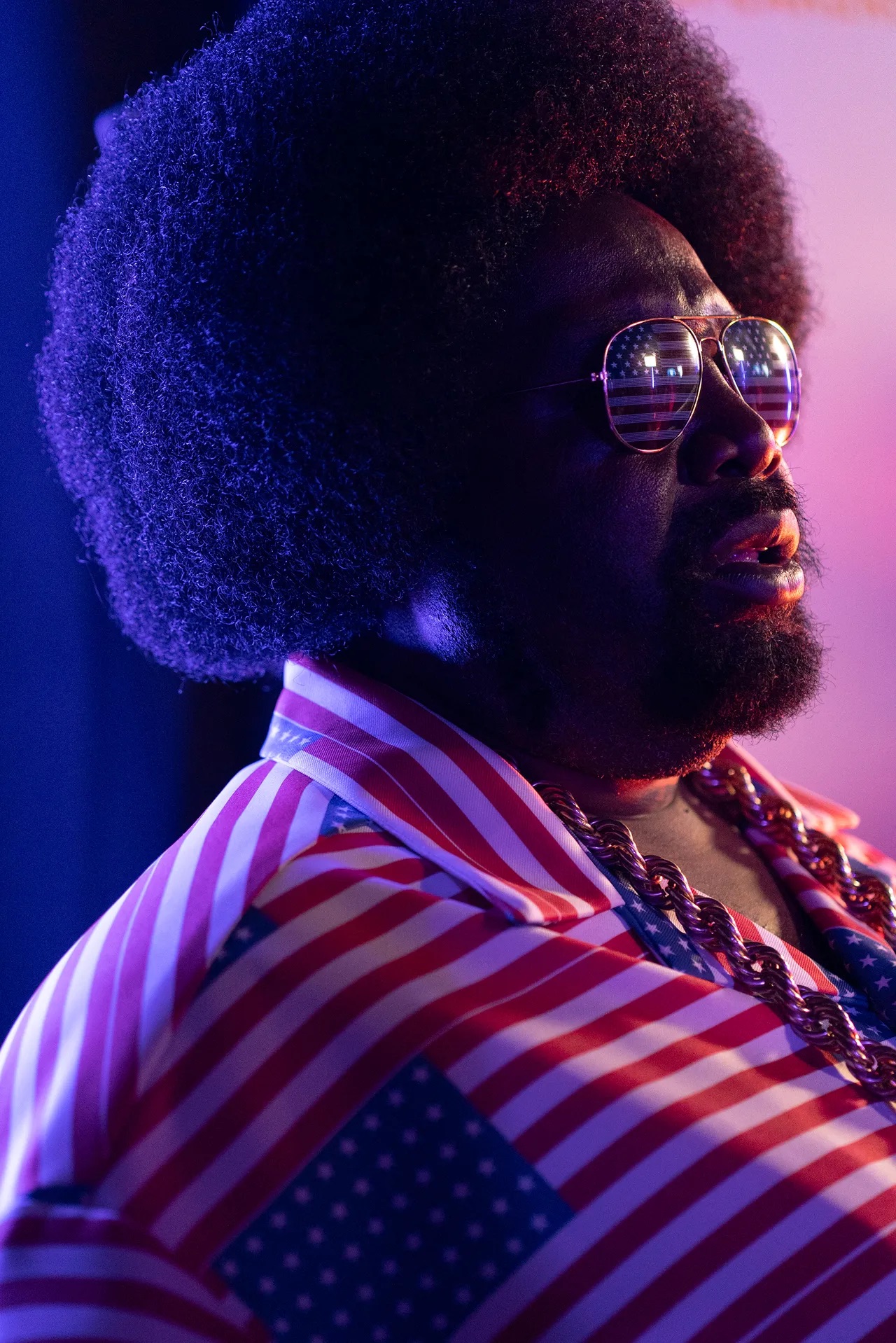
Joseph Edgar Foreman, popularly known as the rapper Afroman, became famous for "Because I Got High," a comedic theme song about the consequences of smoking marijuana. The song was nominated for a Grammy in 2002. Photo: Gabriella Angotti-Jones
"Alright, okay, I got it," Foreman acknowledges, turning to those around him, saying, "They want us to put out the smoke, so everyone take a few more puffs and enjoy."
Only 20 minutes remain until Foreman takes the stage at the "Satoshi Nakamoto Main Stage" named after the anonymous founder of Bitcoin. The rapper admits he knows nothing about cryptocurrency, does not own a single Bitcoin, and cannot talk about its logic. He pauses briefly, trying to think of a few lines to resonate with this group of cryptocurrency enthusiasts, then lets it go. "I'm 51," he says, "it'll be natural when I get on stage, everything will take care of itself."
Foreman learned to sing in church as a child, and started writing rap at age 12. He recalls that his first song specifically mocked a girl he encountered after transferring schools who bullied him, describing her as having excessive facial hair around her lips, with lyrics saying: "Hairy Carrie ruins herself, so her lip hair is impenetrable." After adulthood, he moved back to Mississippi and, shortly after quitting his job at a chicken processing plant, recorded "Because I Got High," distributing 500 copies of the single at a carnival party in New Orleans. Young people took the song home and uploaded it to Napster, and within a few days, Foreman says, it spread globally. In 2001, Universal Music sent people to New York specifically to sign him; the following year, the song earned a Grammy nomination.
However, Foreman's peak was short-lived, and he never released another song that surpassed this one about smoking marijuana and wasting life. He severed ties with Universal Music and began independently releasing music online in 2004. Over the past twenty years, he has continued to rely on this hit to earn money, performing at college parties around the world to maintain his income. He never considered social activism, but various freedom issues gradually incorporated themselves into his work. In a past interview with Time magazine, he stated, "I don't want to incite anyone; I just feel that since we are all marijuana enthusiasts, why not write some songs for self-entertainment?" In 2014, he collaborated with the marijuana legalization advocacy group NORML to release a reworked version of his song, with lyrics discussing the medicinal benefits of marijuana for conditions like glaucoma.
However, these choices were more about commercial opportunities than firm beliefs. Foreman spends the entire year touring, willing to take on any gig as long as the pay is right. During the 2018 Puff Puff Pass tour, he opened for Snoop Dogg; he also once accepted $2,500 to perform at a private party in Pennsylvania State University, where he was forced to stop after singing just three songs due to police dispersing the crowd. He has also been involved in numerous legal disputes himself: in 2015, when a woman rushed the stage to approach him, he slapped her, resulting in a $65,000 payout and mandatory attendance in emotional management courses. After the Ohio police searched his home, and before the court clips went viral, he also signed up for the 2024 presidential election.
At the beginning of this year, millennials expressed surprise to see a veteran artist from their party playlist returning to the public eye. Nobody anticipated he would stand up to defend the First Amendment. During the trial, when the judge asked if the police's invasion of his home gave him the right to write songs mocking the officers, Foreman responded, "They kicked down my door at gunpoint and rummaged through my home; under such circumstances, of course, I have free speech. I can totally entertain myself in the backyard and use my expression to turn a bad experience into an interesting creation." He stated it was the officers who intruded and appeared in his home security footage, so it was entirely legal for him to include them in the music video. The jury took only six hours to reach a verdict in his favor. Foreman revealed he plans to write 50 to 100 songs specifically about the officers who invaded his home back then.
Overall, in his own words, his most distinctive label is "a cannabis cultural icon," with an added political advocacy layer that particularly resonates with the Bitcoin community. Rap music itself is a form of protest music, and Bitcoin is referred to by insiders as "currency against the traditional system." Foreman also indirectly continues the lineage of past conference speakers, like former NSA whistleblower Edward Snowden and Silk Road founder Ross Ulbricht—who, after spending 11 years in prison for operating the illegal Dark Web, will be pardoned by Trump in 2025.
Conference organizer Deutsch remarked: "Whether Afroman is truly engaged in the cryptocurrency industry or not, in my eyes, he is one of us in the Bitcoin camp."
On the morning before taking the stage, Foreman goes to Top Golf, a golf leisure center on the Las Vegas Strip. Accompanying him are Christopher McDonald, who plays Shooter McGavin in the movie "Happy Gilmore"; a 19-year-old Amish boy on a confirmation holiday (who had just collaborated with Foreman to cover Weird Al Yankovic's "Amish Paradise" the night before); two gentlemen from California; and Don Juan. All these activities are part of the paid collaboration provided by the Bitcoin conference. As a professional artist, he complies with all arrangements: helping the Amish boy practice rap, interacting with cryptocurrency enthusiasts, even though he has only just started to understand their enthusiasm for digital currency.
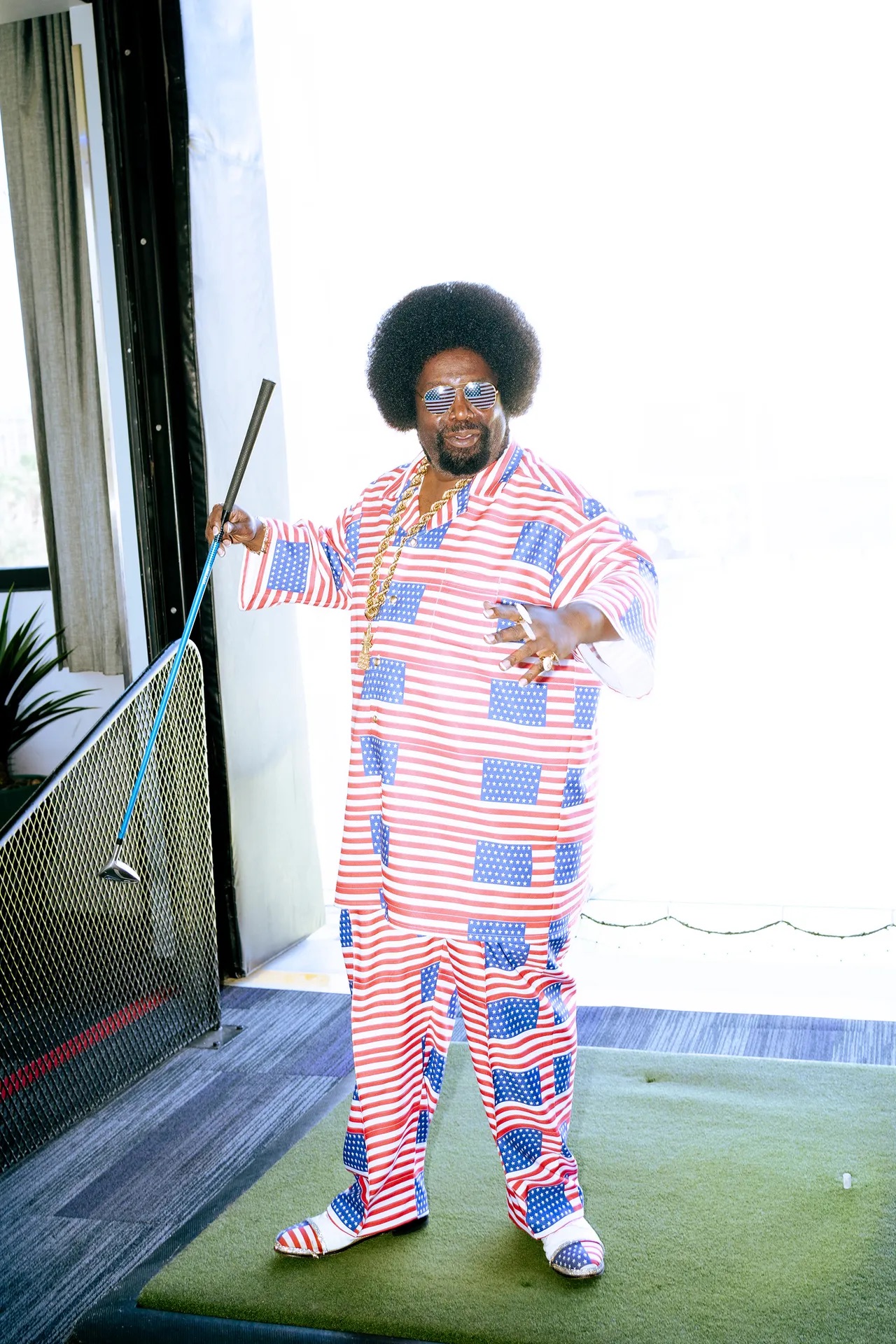
As one of the events at the Bitcoin conference, Foreman spent a morning at Top Golf, an entertainment complex combining a large golf practice field and a bar. Photo: Gabriella Angotti-Jones

29-year-old Laken Schafer is Foreman's dedicated camerawoman. The two met at a marijuana-themed wedding where she was filming, and Foreman hosted the ceremony. Foreman hired her simply because he "didn't want a male cameraman covered in sweat." Photo: Gabriella Angotti-Jones
Don Juan accompanies and takes care of Foreman throughout. They met about 15 years ago through a mutual friend and meet every year at the annual pimp gathering "Players’ Ball," which Don Juan started in 1974 for his birthday. He refers to Foreman as "the gentle giant," sitting next to him while the young female camerawoman practices golf in her high heels. A custom water cup bearing Don Juan's emblem sits on the table, adorned with a diamond-studded female silhouette.
Don Juan educates Foreman: "The value of Bitcoin keeps rising, but most ordinary people don’t understand it." He had previously bought cryptocurrency but lost the private key and could no longer access the account. He believes having public figures like Afroman promoting it can open a window for ordinary people who have had no contact with the cryptocurrency world to understand.
Upon learning that a single Bitcoin is currently worth about $77,000, and hearing that someone exchanged 10,000 Bitcoins for two pizzas back in 2010 (at the time worth only $41), Foreman reflected, "It’s almost impossible for ordinary people to save up for a single Bitcoin."
He suddenly realized, "So, it's similar to stock investments? Buy in and hold long-term to wait for appreciation."
The Bitcoin community initially consisted of a small group of cypherpunk tech enthusiasts aiming to create a financial trading channel free from government control. However, it has now thoroughly transformed, filled with various speculative politicians—many of whom urge the U.S. government to hoard cryptocurrency to inflate prices. In recent years, the conference has frequently invited cryptocurrency-friendly Republican politicians to speak, with MAGA merchandise sold everywhere, but the overall political stance is not singular. This perfectly aligns with Afroman: he is not tied to any political party, concerned only about issues that directly affect his life. He advocates for jury systems in family courts (he himself is divorced), nationwide federal legalization of marijuana, creating public positions to employ ordinary citizens to oversee law enforcement officers (which he has a deep personal connection as an African American); while opposing war, foreign aid, supporting the legalization of sex work, and calling for reparations for the descendants of enslaved people.
Even though Trump attended this conference, Foreman does not agree with his ideologies. "I can't accept the idea that officers are completely exempt from liability"; in addition, he does not agree with glorifying Nazis or preserving statues of Confederate generals, stating, "As a Black person, those policies hit my bottom line."
Foreman does have his own staunch beliefs, but he will only raise his voice when issues connect to his personal interests. During the 2024 presidential campaign, his two core platforms will be full legalization of recreational marijuana and requiring all on-duty police officers to wear body cameras.
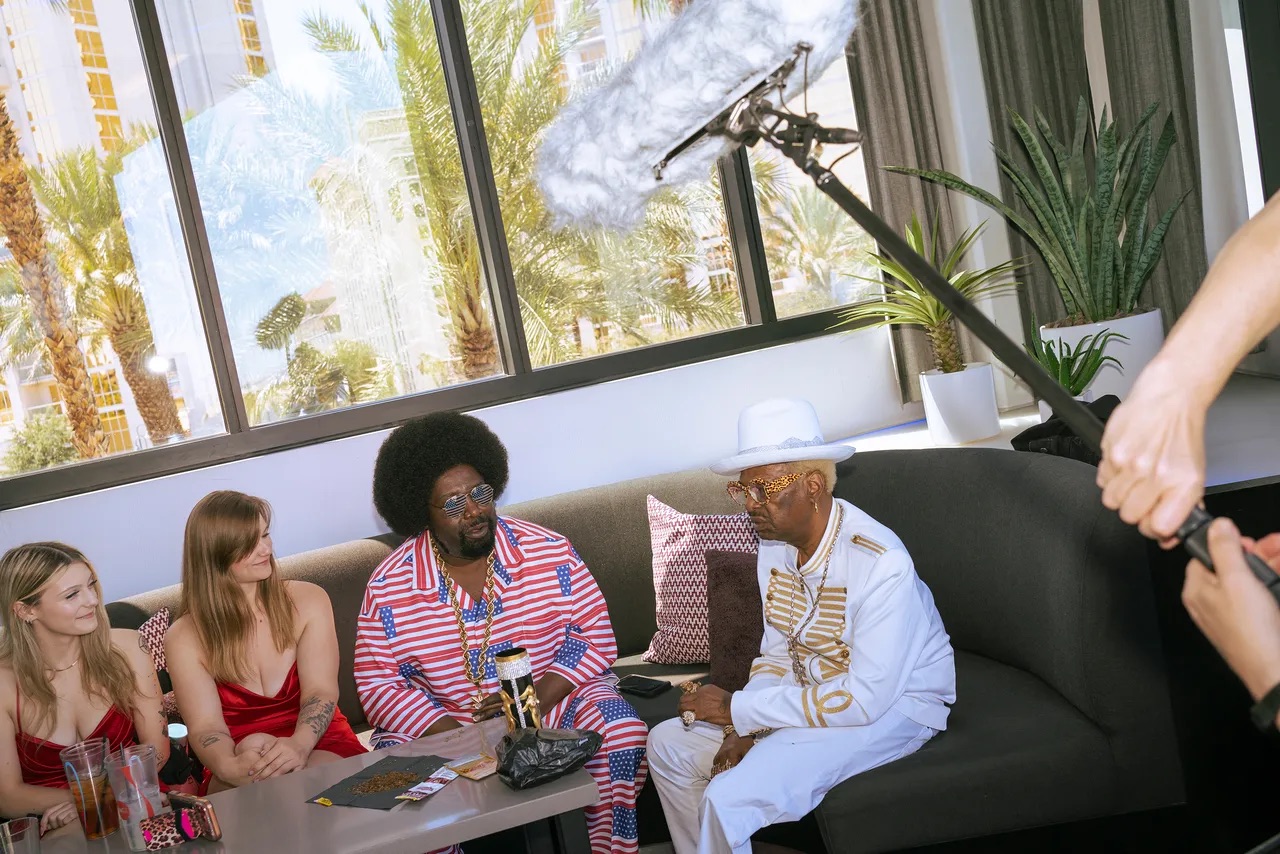
Afroman (from left to right) with his assistant Lilly Music, Laken Schafer, and Don Juan. Photo: Gabriella Angotti-Jones
Don Juan continuously praises Foreman: "He carries immense charisma now; the public yearns for a fresh choice. He’s not just a rapper; his personal strength makes Afroman running for president not a far-fetched idea."
Foreman confidently states: "I assure you, if I am elected president, all problems will be resolved."
The three-day conference hall is filled with Bitcoin mining service provider booths. Professionals in suits converse with enthusiasts wearing sailor hats and masks emblazoned with the Bitcoin logo. In one corner of the hall stands a mannequin sporting Afroman's iconic afro hairstyle, next to a glass display cabinet showcasing items for auction: Afroman's signed rolling papers, an ashtray he used, and commemorative notes featuring his portrait.
All these collectibles are listed for auction by Scarce City, a crypto auction house specializing in crypto-related memorabilia, such as old issues of Bitcoin Magazine and a harmonica set played by John McAfee, a crypto promoter and antivirus pioneer. Last year, when Ross Ulbricht spoke at the event, Scarce City auctioned three of his prison identification documents and sneakers, with one of the documents going for 5.5 Bitcoins after multiple bids, equivalent to around $371,000.
Scarce City’s general manager, Sam Kimbrow, followed Foreman's trial closely, and reached out to him in January, hoping to auction his personal items to help subsidize his legal expenses, including the iconic American flag suit he wore in court. The 40-year-old worker stated that collecting this set is "the wish of all millennials," and she hopes the younger generation can see that artists will also stand up to defend civil rights.
"The core of what we auction is freedom and personal sovereignty," she said, "Afroman is a living embodiment of a modern freedom fighter."
After the auction ended, the flag suit sold for about $4,000 in Bitcoin, the ashtray fetched about $230 in Bitcoin, while the signed rolling papers received no bids.
The auction results did not bring Foreman much actual profit. He revealed that the organizers paid a fixed fee (the specific amount was not disclosed) for him to participate in various activities over three days in Las Vegas. But he candidly expressed his primary reason for attending the conference: "The organizers only said one thing: Afroman, there’s money to be made!"
On the last day of the conference, one hour before Foreman takes the main stage, he first engages in a stage interview with elite attendees who paid high prices for the "Whale Pass," costing $12,999, an event that was restricted and inaccessible to most media reporters. The interview moderator is Tracy Hoyos-Lopez, the strategic project head at the cryptocurrency exchange Kraken, known for pushing Trump to enter the Bitcoin space. The sixty seats available quickly fill up.
When asked about his mindset during the police raid, Foreman replied, "I'm already used to being treated as a criminal right off the bat by the police. I'll be patient and wait for them to realize their judgment was wrong."
"With free speech, we can openly expose systemic corruption; only by understanding the problems can we make targeted changes; if the issues are acknowledged, there’s a chance they can be thoroughly resolved," Foreman continued, "I even hope this raid can bring me enough income so that in the end, I might be glad the police broke into my house."
According to Billboard, after winning the lawsuit, Foreman's music streaming across all platforms surged over 500%, and this income helped him cover the $20,000 in damages caused by the police raid on his home.
The audience fully empathized with his points. The ceiling was adorned with colorful planet decorations, and although the audience was partially unfamiliar with the lyrics, they chanted along to a few lines of "Because I Got High." When Foreman mentioned that the music video featured real footage of the officers who had harmed him, the crowd cheered. As the interview wound down, Hoyos-Lopez summarized: "The most precious asset of America and the U.S. Constitution is free speech, and Afroman perfectly embodies that right."
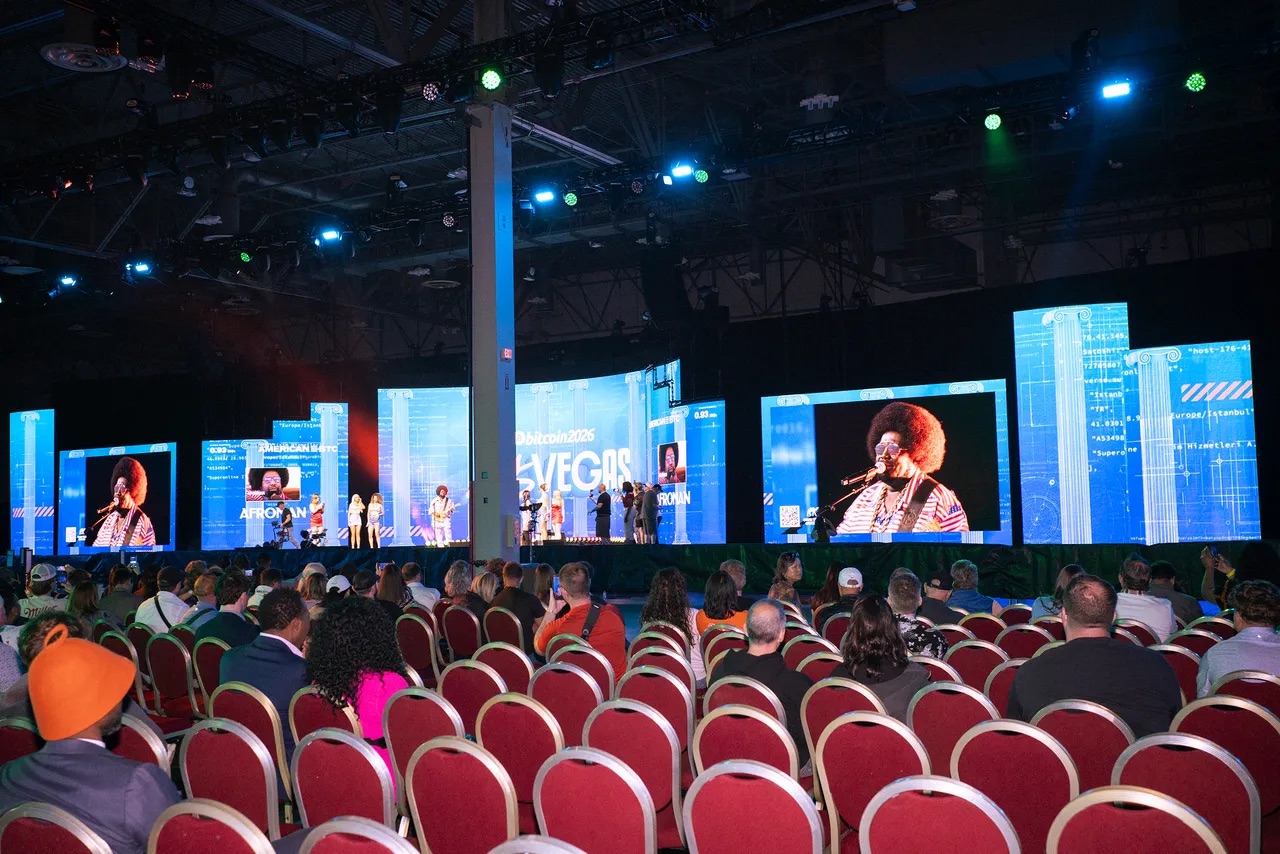
On the final night of the Bitcoin conference, Foreman took the stage at the Satoshi Nakamoto main stage, performed his most famous songs, and issued a significant statement. Photo: Gabriella Angotti-Jones
On the closing night of the Bitcoin conference, Foreman took the stage named after Satoshi Nakamoto, performed his representative songs, and announced a major message.
As the three-day activities wound down, most of the audience had left, leaving only a sparse crowd in the Venetian Hotel venue. However, the remaining audience nearly filled all eight thousand seats, having come specifically to see Afroman perform. As the only artist to perform at the conference who has personally faced struggles for rights, the atmosphere was not particularly lively, but a middle-aged white woman in the front row stood up to dance along to the tune.
Before starting to sing, Foreman nearly forgot his important announcement. "Oh no, I got high and almost forgot to tell you all, I’m going to run for the U.S. presidential election in 2028."
The crowd erupted in cheers, with someone shouting loudly from the audience: "Vote for Afroman as president!"
He then strummed the B-shaped guitar that the organizers lent him, launching into the timeless hit that made him famous.
免责声明:本文章仅代表作者个人观点,不代表本平台的立场和观点。本文章仅供信息分享,不构成对任何人的任何投资建议。用户与作者之间的任何争议,与本平台无关。如网页中刊载的文章或图片涉及侵权,请提供相关的权利证明和身份证明发送邮件到support@aicoin.com,本平台相关工作人员将会进行核查。


