Elon Musk publicly revealed the design plans for the "AI1" satellite for the first time on the eve of SpaceX's IPO.
By: Ye Zhen
Source: Wall Street Journal
On the eve of SpaceX's IPO, Musk detailed the orbital AI data center plan for the first time, positioning it as a core growth engine for the company. He aims to break the limitations of Earth's power supply on the development of the AI industry by transferring vast computing power to low Earth orbit.
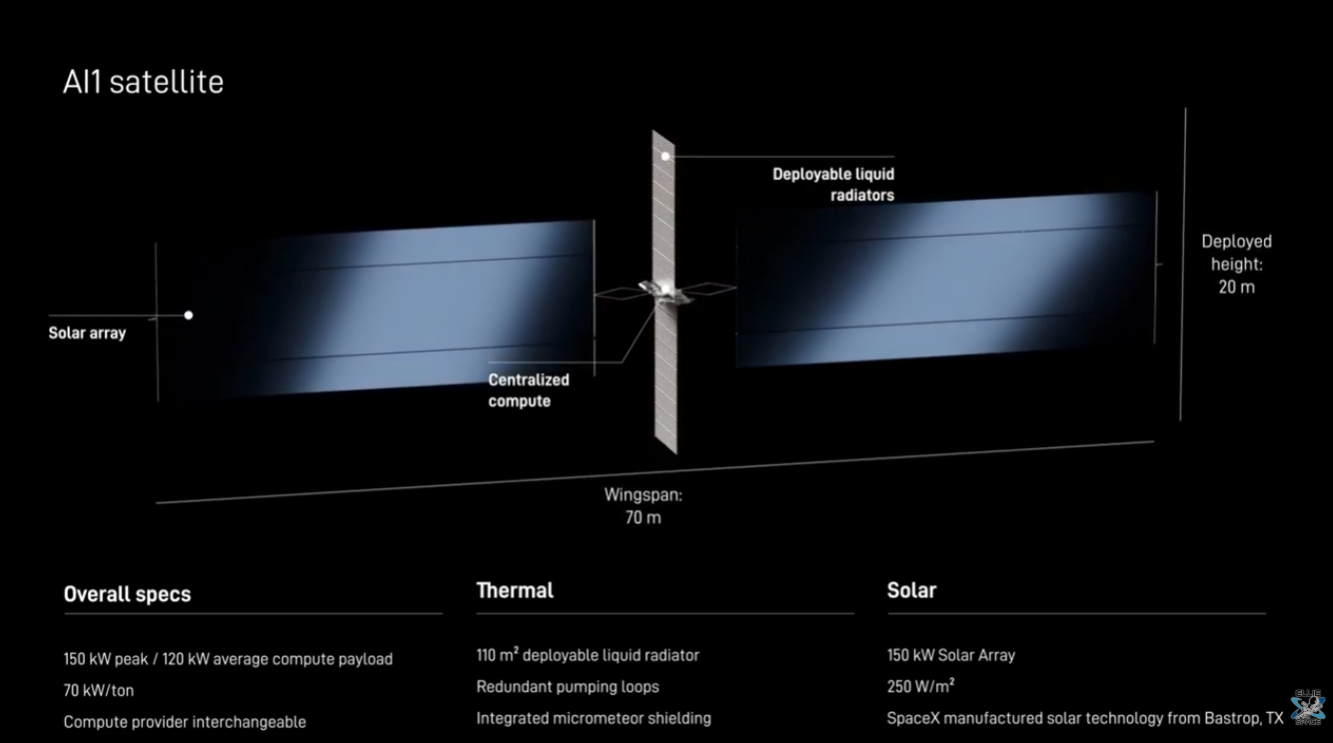
In a video released on Monday, Musk publicly unveiled the design sketches and core technical parameters of the first-generation AI satellite "AI1."
Musk clearly stated that establishing data centers in space does not require un-invented "magic" and that the technical challenges it faces are even lower than those of the existing Starlink business, which is not a particularly difficult engineering problem for SpaceX. The company is striving to achieve an annual deployment rate of 1 gigawatt (GW) of space AI computing power by the end of 2027.
This latest statement sends a clear signal to the capital markets, indicating that SpaceX is attempting to convert its absolute scale advantage in satellite production and launch into a competitive moat for next-generation AI computing infrastructure.
Although industry competitors are cautious about the economic viability of space computing, SpaceX has applied to the Federal Communications Commission (FCC) to launch as many as 1 million AI satellites. To address the high barriers of computing and launch costs, SpaceX is working with partners such as Tesla and Intel to advance its own chip manufacturing, and plans to use the Starship heavy rocket to disrupt existing launch economics, directly widening the strategic deployment gap with competitors.
Aiming at Computing Power Bottlenecks and Huge Potential Markets
In the submitted IPO application documents, SpaceX pointed out that the total potential market for AI, estimated at up to $26.5 trillion, will be severely constrained by "Earth's inability to quickly expand power generation capacity." Therefore, solar-powered orbital AI data centers are viewed by Musk and aerospace executives as the key technology to meet the growing energy demands of AI companies.
Regarding the construction timeline, Musk provided an ambitious forecast. He stated that SpaceX will strive to achieve an annual deployment rate of 1 gigawatt (GW) of space AI computing power by the end of 2027 and seeks to expand at an order of magnitude each year, ultimately reaching a scale of 1 terawatt (TW) of computing power.
However, he also advised investors to "take a reserved attitude" towards this aggressive timeline, while the official expectations given in the IPO documents are more conservative, gradually advancing commercialization starting in 2028.
Revealing the AI1 Satellite: The NVIDIA Cabinet in Orbit
In response to the misconception that space data centers "are just ground data centers launched into space," SpaceX clarified the true hardware form. The core challenge of the engineering is not the migration of physical buildings but obtaining electric power in a vacuum environment and efficiently radiating the waste heat generated by high power computing.
The video showcased the quantitative metrics of the AI1 computing satellite for the first time. The satellite has a peak power consumption of 150 kilowatts, with an average continuous computing power consumption of 120 kilowatts.
Musk indicated that this metric precisely matches the operational power envelope of the NVIDIA GB300 computing cabinet (which includes 72 GPUs) used in ground data centers, equivalent to directly sending an entire NVIDIA AI computing module into space.
To meet the extremely high energy consumption and heat dissipation requirements, the AI1 satellite has a pair of giant wings with a wingspan of 70 meters, and the solar array power generation density is set at 250W/m², with dual-sided radiators having a heat dissipation density of 1400 W/m², positioned in a "blade" orientation towards the sun to maximize heat dissipation.
Simplified Architecture and Technology Reuse, Building a Manufacturing Moat
In terms of hardware structure, the engineering design of the AI1 satellite is even more streamlined than the traditional Starlink satellites.
Existing Starlink satellites require extremely complex giant phased array antennas and parabolic antennas, whereas AI satellites are essentially more like a pure large hardware setup: they mainly consist of massive solar arrays, super large radiators, and basic laser link systems, eliminating the need for complex ground communication antennas.
Musk and the engineering team emphasize that the majority of the manufacturing of AI satellites directly reuses the Starlink V3 satellite platform technology that SpaceX has already developed and validated.
This means that SpaceX can directly apply its existing satellite mass production, launch, and operational experience without the need for breakthroughs at the basic science level. As the IPO approaches, this extremely high rate of technology reuse and capability of engineering scale constitutes a unique competitive advantage that the company showcases to investors.
Ecological Collaboration to Address Cost and Delay Challenges
In response to concerns about network delays caused by space data centers, SpaceX provided a clear solution.
The AI satellites will be deployed in low Earth orbit (LEO) at an altitude of 600 to 800 kilometers, with a one-way network delay of only about 3 milliseconds. The satellites will integrate inter-satellite laser links with bandwidths of up to 1 terabit (Tbps), and will use the existing KA and KU band antenna networks from Starlink, or directly transmit data at high speeds through space-ground laser links.
However, there are still disagreements within the industry regarding commercial viability.
Blue Origin and Amazon founder Jeff Bezos, along with researcher Andrew McCalip, point out that the expensive AI chips and high launch costs pose barriers to the current industry, and that the current economic model is not reasonable.
To this end, SpaceX is attempting to build a vertically integrated supply chain to break cost barriers: on one hand, relying on the Starship heavy rocket to significantly reduce launch costs, and on the other hand, developing its own AI chips through a factory called Terafab in collaboration with partners Tesla and Intel. By controlling both launch and foundational computing hardware, SpaceX is accelerating the commercial realization of its space computing.
免责声明:本文章仅代表作者个人观点,不代表本平台的立场和观点。本文章仅供信息分享,不构成对任何人的任何投资建议。用户与作者之间的任何争议,与本平台无关。如网页中刊载的文章或图片涉及侵权,请提供相关的权利证明和身份证明发送邮件到support@aicoin.com,本平台相关工作人员将会进行核查。


