
Watershed.
Author/Liu Bo
Reported by/Investment Circle PEdaily
A milestone scene in commercial aerospace has arrived.
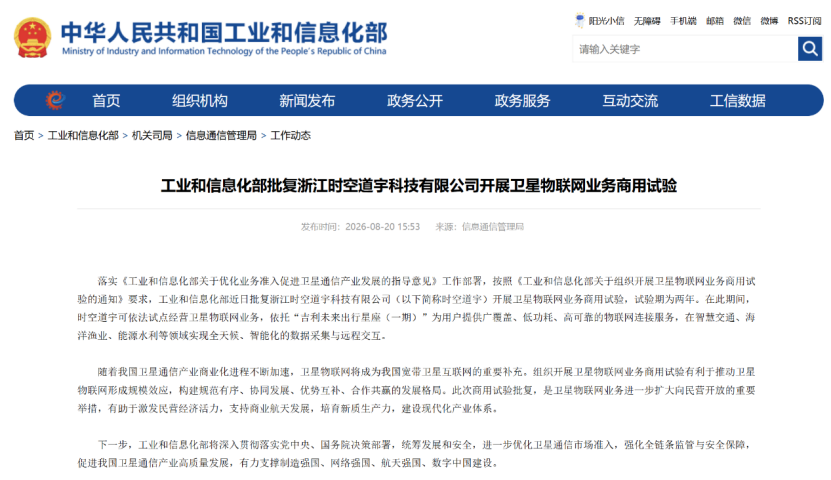
The Investment Circle has learned that recently, Shikong Daoyu officially obtained the commercial trial approval for satellite Internet of Things (IoT) business from the Ministry of Industry and Information Technology, with a trial period of two years. Thus, a private enterprise has successfully obtained the "entry ticket" to operate satellite IoT services, marking China's formal entry into a new phase of providing satellite IoT services through low Earth orbit constellations.
At this moment, a representative sample of the rise of private commercial aerospace emerges. Behind Shikong Daoyu is CEO Wang Yang, a post-80s PhD who started his career at Huawei and previously worked at the Chinese Academy of Sciences’ small satellite engineering center, gradually turning his innate space dream into reality.
This scene also confirms the prediction made by SpaceX founder Musk years ago—“The endgame is all in China.” From rocket recovery to low Earth orbit satellite IoT, his concerns are gradually becoming reality. This is not just a moment of glory for a single company; it is a microcosm of China's commercial aerospace transition from "catching up" to "leading," from "technology validation" to "value realization."
Team Led by a PhD from the 80s
Opening Up a Breakthrough Path in Commercial Aerospace

As we push the timeline forward, this moment has long been traceable.
In August 2025, the Ministry of Industry and Information Technology issued "Guiding Opinions on Optimizing Business Access to Promote the Development of the Satellite Communication Industry," proposing 19 specific measures. It explicitly mentioned, "Organize the commercial trial of satellite IoT, supporting qualified enterprises to provide wide-area IoT connection services for regions that ground networks cannot cover, such as the sky, oceans, and remote areas, relying on low Earth orbit satellite IoT constellations."
Following that, the Ministry of Industry and Information Technology issued the "Notice on Organizing Commercial Trials of Satellite IoT Business" in November of the same year, culminating in the approval for Shikong Daoyu’s satellite IoT commercial trial license.
The significance behind this is self-evident; a series of policy dividends are clearly moving down from top-level design to execution on the ground. Further, this marks that China's satellite IoT industry has officially transitioned from "experimental fields" to "commercial ventures," also indicating that the "commercial closed loop" for private commercial aerospace enterprises has been officially opened.
Before this, commercial aerospace was often regarded as synonymous with "burning money," lacking clear monetization pathways. This approval has opened a new breakthrough for the industry to explore sustainable business models, serving as an authoritative recognition by the state of Shikong Daoyu's core technology and comprehensive strength in low Earth orbit satellite IoT, holding significant benchmark meaning for the industry.
Without a doubt, as an important infrastructure and core application scenario for the 6G integrated air-ground network, satellite IoT is a key support for achieving global seamless coverage and universal interconnection and intelligence.
Meanwhile, Shikong Daoyu is continuously perfecting its industrial ecological layout. At the 2026 Shanghai World Mobile Communication Conference (MWC Shanghai), Shikong Daoyu officially launched the world's first full-stack open-source ecology for low Earth orbit communication constellations, relying on a five-level layered open system covering terminal hardware, standardized communication modules, self-developed satellite communication chips, satellite communication protocols, and satellite system resources, establishing a full-chain open capability from space infrastructure to terrestrial industry terminals. This aims to provide a layered open technological foundation for operators, chip manufacturers, industry system integrators, and other partners across the entire industrial chain through technological sharing and collaborative innovation, accelerating the popularization of satellite communication applications and promoting the large-scale landing of low Earth orbit satellite IoT industries.
As a result, a phenomenal sample stands out.
Looking back, Wang Yang, the helm of Shikong Daoyu, has silently worked in the industry for decades. His career began at Huawei, where he witnessed profound changes in the communications industry from 2G to 3G; later, he joined the Chinese Academy of Sciences' small satellite engineering center, working from satellite systems in the space segment to testing systems in the ground segment, and onto satellite AIT phases, covering almost every position.
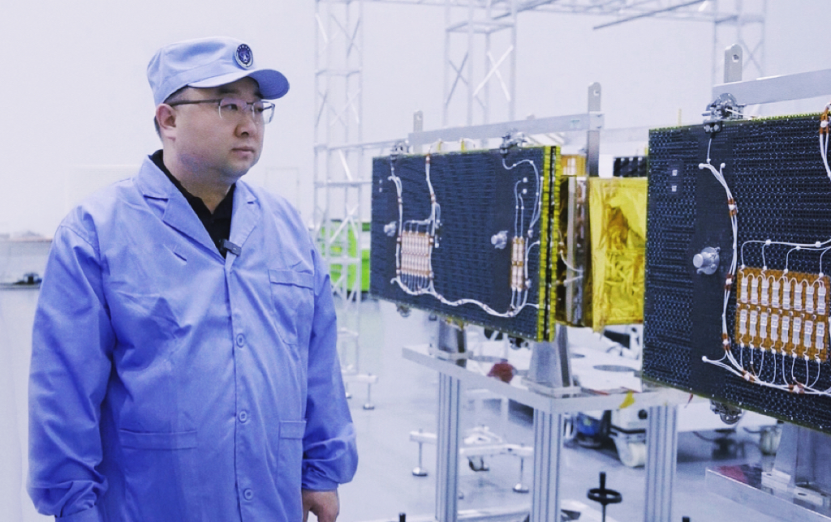
The turning point appeared in 2014, when the state first explicitly encouraged private capital to enter the aerospace sector, officially opening the doors to commercial aerospace. Wang Yang did not hesitate to dive into this entrepreneurial wave, beginning to layout in the satellite communication field, founding one of China's early commercial aerospace companies—OKMicro Aerospace. He led his team to spend four years to successfully launch "Jia Ding No. 1," the self-developed communication satellite that became China’s first IoT communication satellite independently developed by a private enterprise.
Until 2018, when most people were still watching to see “whether commercial aerospace is feasible,” Wang Yang decided to lead his team to enter the satellite IoT track, giving birth to Shikong Daoyu.
The underpinning of this choice is Wang Yang’s deep insight into the "blind spots of ground network coverage": globally, 80% of land area and 95% of ocean area remain uncovered by terrestrial communication networks, and these areas are precisely the "battlegrounds" for industries such as energy exploration, ocean shipping, and cross-border logistics. With its broad coverage, low power consumption, and high reliability, low Earth orbit satellite IoT has become an irreplaceable solution to fill the "last mile" of universal interconnectivity.
Based on this “one step ahead” strategy, Shikong Daoyu launched its own low Earth orbit satellite IoT constellation construction plan in its second year after establishment. Since 2022, the constellation has undergone six launches, with a “100% success rate,” completing the first phase of network deployment. Currently, Shikong Daoyu has a total of 64 satellites in orbit, achieving global communication coverage excluding the polar regions.

Thus, China’s private aerospace sector has achieved a leap from "trial networking" to "global coverage" in low Earth orbit IoT. Looking at the entire industry, Shikong Daoyu's achievement clearly showcases a leading posture.
Investors followed suit. In September last year, Shikong Daoyu secured a 2 billion yuan investment from the Zhejiang New Energy Vehicle Industry Fund. As a state-owned institution in Zhejiang, such a substantial move is highly indicative. Today, Shikong Daoyu has become a choice that investors cannot overlook, and its value lies in not following the trend of developing low Earth broadband communication satellites, but instead choosing the technically feasible and commercially certain track of "low Earth orbit satellite IoT" based on the current industrial development status.
It is worth noting that following the release of the full-stack open-source ecology of Shikong Daoyu's constellation, market feedback has rapidly manifested. During the first two days of the MWC Shanghai exhibition, Shikong Daoyu accumulated over 200 cooperation intentions with ecological partners, and on-site signed orders surpassed the 100 million yuan mark, with its business landscape covering the ten core tracks of the real economy, including smart connectivity, marine fisheries, construction machinery, energy industry, low-altitude economy, and smart agriculture.
This marks that Shikong Daoyu is transitioning from a "builder of infrastructure" to a "global satellite communication service provider" and "industrial ecological enabler," fully entering the fast lane of large-scale commercialization.
With this approval, Shikong Daoyu is entitled to legally pilot the operation of satellite IoT businesses, leveraging its fully self-developed low Earth orbit satellite IoT constellation to provide global users with broad coverage, low power consumption, and high reliability IoT connectivity services, realizing all-weather, intelligent satellite IoT services in multiple high-value fields. Meanwhile, it will conduct IoT NTN technology trials, continuously accelerating the research and commercialization process of 6G satellite communication technology.
Currently, the name that is closest to "value realization" in the Chinese commercial aerospace track has begun to emerge.
Why Shikong Daoyu?

Undoubtedly, the current global commercial aerospace sector is in a brutal elimination phase. For commercial aerospace companies, having a satellite is not difficult; the challenge lies in how to generate commercial value from that satellite. This requires companies to not only understand aerospace but also to be well-versed in ecosystems, markets, applications, and cost control.
This means that in the commercial aerospace track, "technological leadership" is just a foundation; "irreplaceability" is the key to survival. Following this line of thought, how can we understand the unique value of Shikong Daoyu? The answer may be hidden at the intersection of technological routes and business logic.
Technological autonomy is the foundation for a commercial aerospace firm’s survival. It is for this reason that Shikong Daoyu has constructed a technical moat with its fully self-developed technologies. This team has broken free from external technological reliance, achieving autonomous design and manufacturing of core satellite components, safeguarding the stability and adaptability of satellite performance from the source. At the same time, leveraging its own satellite factory, it conducts satellite mass production AIT (assembly, integration, testing) work, strictly controlling the production quality of every satellite through standardized and regulated production processes, resulting in a 100% reliability rate for satellites in its constellation.
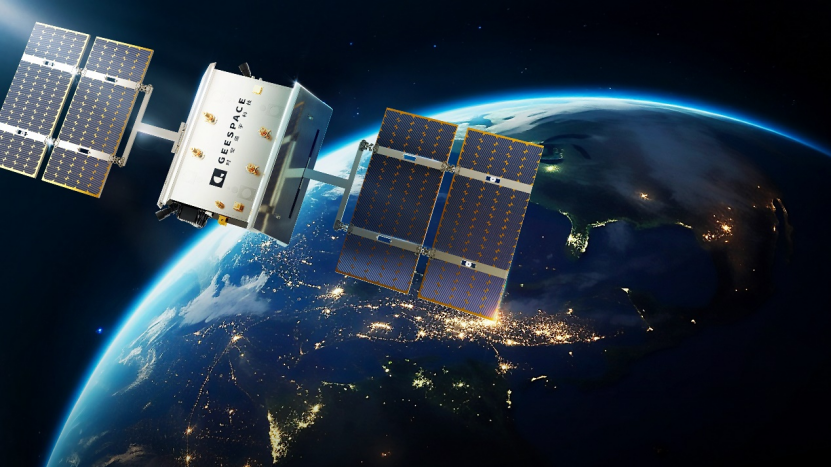
At the constellation measurement and control level, Shikong Daoyu has established a "three-ground, three-center" disaster recovery backup system, capable of achieving 24/7 automatic measurement and control, satellite management, trajectory avoidance, and maintenance, aimed at ensuring the long-term stable operation of the constellation. In terms of constellation products and services, a complete product matrix has been developed covering "chips-modules-terminals-services," providing customized solutions based on the needs of different industry scenarios.
Therefore, Shikong Daoyu has completed full-chain independent research and development from constellation system design, satellite development, satellite mass production AIT, constellation measurement and control, to the development, mass production, and scenario application of core chips, modules, and terminals, achieving full-process autonomy and control, thereby laying a solid foundation for the stable operation and commercialization of the constellation.
The communication system and private protocols firmly establish Shikong Daoyu's "security" foundation. Specifically, in technical design, the user link employs a direct sequence spread spectrum system, providing inherent concealment and anti-interference capabilities; through the adoption of a combination of spatial division (SDMA) and code division (CDMA) for multi-user access, it ensures stable access for a large number of users; concurrently, the user link payload carries an adaptive frequency domain anti-interference algorithm with a 50dB anti-interference capability. Furthermore, the terminals utilize burst access methods to avoid long-term occupation of channel resources, further balancing system capacity with communication concealment.
"Our communication system forms a synergistic advantage across four dimensions—'high security, high capacity, high anti-interference, and high concealment'—providing solid communication guarantees for critical mission scenarios in complex environments, making it irreplaceable in the market," Wang Yang concluded.
Moreover, Shikong Daoyu's choice of differentiated frequency bands has also left a lasting impression on the outside world. While most companies attempt to benchmark Starlink with "higher speeds," Shikong Daoyu chose another path—UHF/VHF frequency bands. This band possesses the industry's strongest diffraction characteristics, with low link loss, along with strong penetration and rain fade resistance features, allowing stable signal connections even in extremely adverse weather, which is a core prerequisite for supporting emergency communication and remote coverage in key tasks.
As Wang Yang emphasized, in many critical scenarios, "continuous connectivity" is more important than "high speed"; what Shikong Daoyu provides is not a "faster network," but a network "that won't drop connections."
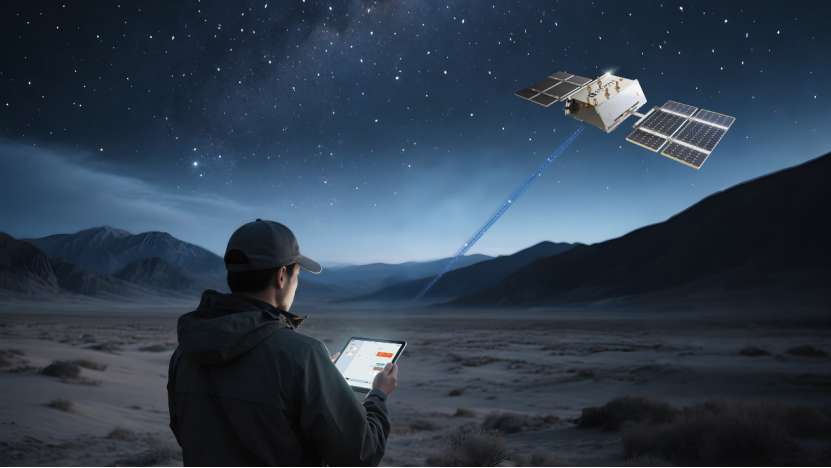
More critically, Shikong Daoyu is precisely positioned on the "backup network" demand. In key industries such as maritime, aviation, and energy, safety supervision and business continuity require the configuration of redundant systems independent of the main communication network. With its high reliability and global reach, Shikong Daoyu naturally becomes the "ultimate backup link"—its value lies not in the frequency of everyday use, but in the "must-be-available" capability under extreme conditions.
Furthermore, the low-power miniaturized design of terminals addresses the "last mile" challenge for large-scale applications from a product perspective. In wide-area IoT scenarios, terminals are distributed in remote, hard-to-maintain regions, making them especially sensitive to power consumption and size. Shikong Daoyu's low-power satellite connection capabilities have become one of the few feasible or even the only feasible solutions for such scenarios, corresponding to a high-stickiness, sustainable payment business model.
With this, the combination of five major advantages constructs a competitive barrier that is difficult to replicate. The deeper value behind this is that Shikong Daoyu has completely broken out of the old logic of commercial aerospace, which emphasizes "technology" while neglecting "profitability," charting a new path where technology has barriers, scenes have essential needs, and profitability is certain. These five advantages point towards a central goal—to lay a solid foundation for sustainable commercialization and reconstruct the valuation logic of commercial aerospace.
Soul Questioning of Chinese Commercial Aerospace
Can it make money?

The golden age of commercial aerospace is arriving at a visible pace.
According to the satellite consultancy Euroconsult, it is predicted that by 2030, the global satellite IoT connection count will surpass 300 million, with the market size expected to reach the level of hundreds of billions of dollars, exceeding 700 billion yuan. This also means that satellite IoT may activate a trillion-level industrial development space in the future.
Meanwhile, driven by technological revolution and economies of scale, deployment costs such as satellite manufacturing and rocket launches will further decrease, deeply changing the service scale, application scenarios, and business models of satellite IoT. However, the entire industry needs to be vigilant: although the number of global low Earth orbit satellite launches has surged, very few companies can achieve large-scale commercial profitability; many enterprises have fallen into a deadlock of "advanced technology but no application, high costs but unable to monetize."
Amidst this, a more essential shift is taking place: the valuation logic of commercial aerospace is transitioning from "technical breakthroughs" to "order fulfillment." The focus of the market on enterprises is no longer solely on "how large the constellation scale is," but is beginning to ask a more practical question—how to make money, and when to make money?
Essentially, commercial aerospace remains an infrastructure-driven industry, which must go through three stages: capacity building, scale construction, and value realization. Purely technical breakthroughs or successful launches are merely tickets for entry; the true watershed lies in whether there is sustained and stable service capability and revenue-generating capability after the constellation is networked.
Shikong Daoyu clearly recognizes that fulfilling industrial value is the only standard for testing the long-term viability of an enterprise. All along, Wang Yang has believed that the underlying tone of technological innovation is a sense of mission. "When doing commercial aerospace, we cannot just talk about technology; we must also discuss value."
If differentiated technical routes determine what Shikong Daoyu "can do," then the results of commercialization answer the question of "how much can it earn." Now, Shikong Daoyu has provided an answer with solid data and cases.
Leveraging the existing satellites in orbit, the constellation system can process approximately 340 million communication requests daily, serving 20 million global users.
For future network integration, Shikong Daoyu will continue launching satellites this year, completing the deployment of the first phase consisting of 72 satellites; with the networking of these 72 satellites, the constellation system will have the capability to handle 450 million communications daily.

In terms of terminal application scenarios, Shikong Daoyu's commercial landscape has also begun to clearly emerge. In the smart connectivity field, as early as 2023, Shikong Daoyu collaborated with Zeekr to achieve large-scale deployment of satellite communication capabilities in passenger vehicles, enabling cars to have bidirectional communication capabilities even in areas without ground network coverage.
Turning to the Robotaxi sector, Shikong Daoyu has also made early layouts, conducting nearly 100,000 kilometers of testing with Caocao Travel since the end of 2025. By integrating low Earth orbit satellite communication links, vehicles can maintain connectivity with the operating platform in weak or even no network environments, achieving fleet dispatching, status feedback, and emergency communication. This represents a critical step for autonomous driving from "locally available" to "universally available."
Of particular interest is Shikong Daoyu's globalization pace. Wang Yang believes that globalization is not an optional topic, but a mandatory question in commercial aerospace—only by expanding networks in more places can economies of scale truly materialize.
Currently, Shikong Daoyu's cumulative order amount in the global market has exceeded 100 million yuan, with key layouts in Asia (Middle East, Southeast Asia, Central Asia, South Asia), Africa, and Latin America, establishing cooperation with more than 20 telecom operators from various countries. Additionally, in overseas markets, Shikong Daoyu has successfully obtained intention orders from several markets in the Middle East and South America, accelerating the implementation of these orders for large-scale applications this year.

Furthermore, based on the initial phase of constellation networking and launching large-scale services, Shikong Daoyu is simultaneously accelerating advancements in cutting-edge 6G satellite communication technologies, having completed ground tests based on the 3GPP IoT NTN satellite IoT standards, with related R&D work steadily advancing to continuously accumulate technical capabilities for the evolution of next-generation integrated air-ground networks.
Ultimately, the indicators reflected by these metrics no longer present a "technical narrative," but a tangible "service capability." With this, low Earth orbit satellite IoT has truly achieved a qualitative leap from "usable" to "user-friendly."
As Wang Yang stated, “In the long term, we hope to build not just a communication network, but an infrastructure system oriented towards the future.” When an enterprise can generate stable service revenue from each satellite, it signifies that a proven "money-making model" has come to light—this is precisely the core turning point in the valuation logic of commercial aerospace.
Upon careful review, the granting of a commercial trial license for the satellite IoT business, the release of the full-stack open-source ecology of the constellation, the achievement of over 200 cooperation intentions with ecological partners in just two days during the MWC Shanghai event, and the signing of orders exceeding 100 million yuan on-site... This series of results has successively materialized, verifying that Shikong Daoyu is gradually completing the critical leap from technology validation and industrial collaboration to large-scale commercial operation.
For commercial aerospace, this not only signifies the continuous release of a single enterprise's commercialization capabilities, but also indicates that China's low Earth orbit satellite IoT industry is entering a new stage of value realization. Looking out at the vast starry sea, China’s commercial aerospace fleet embarks on a new journey.
免责声明:本文章仅代表作者个人观点,不代表本平台的立场和观点。本文章仅供信息分享,不构成对任何人的任何投资建议。用户与作者之间的任何争议,与本平台无关。如网页中刊载的文章或图片涉及侵权,请提供相关的权利证明和身份证明发送邮件到support@aicoin.com,本平台相关工作人员将会进行核查。


