Author: Geo Chen (Fidenza Macro)
Translation: Shen Chao TechFlow
Shen Chao's Introduction: Geo Chen from Fidenza Macro liquidated all AI semiconductor and infrastructure holdings in June this year, and now he provides a complete bearish rationale. His analytical framework spans the collapse of Korean leveraged ETFs, the impact of China's model on standards for closed-source AI, the shift of computing power supply from shortage to surplus, and the risks of the Federal Reserve losing credibility under stagflation pressure—this article is worth a serious read for any investor holding AI-related assets.
March 2000. March 2008. January 2020. December 2022. Certain months stand out clearly in my memory; they were turning points before severe market turmoil. I believe when we look back on this month in the future, we will feel the same way.
In June this year, I liquidated all my AI semiconductor and infrastructure holdings and moved into cash. After that, I took a break and enjoyed a summer away from the market, initially expecting a bland sideways summer with few opportunities.
The outcome was completely unexpected.
Everything that has happened over the past month has increasingly convinced me: the bull market in the stock market has peaked. I am usually an optimist, so this conclusion is not one I come to lightly. But unfortunately, the developments in the AI field, the war in Iran, and Federal Reserve policies are collectively creating stagflation conditions, with more turbulence ahead. In this article, I will dissect my bearish logic point by point.
Why the AI Bull Market Has Ended
AI has been the leader of this bull market and the main driver of GDP growth. Without AI, the bull market lacks support. The robust earnings of mega-cloud vendors and semiconductor companies have propped up this rally, leading some to say: as long as earnings grow and the fundamentals are solid, the bull market can continue. But the reality is that stock prices correspond to capital flows and market narratives; earnings are just one of many driving forces. Most bull markets peak before earnings decline, and sometimes even before analysts start to lower their expectations.
Many bull markets go through an overshooting phase: low-quality capital pushes the market to new highs, often with a parabolic trajectory. Low-quality capital refers to investors who are asymmetrically informed, price insensitive, and whose buying power is unsustainable. The overshooting phase is often only clear in hindsight, but if one can identify that low-quality buyers are driving the last segment of the rise, there is an opportunity to spot the overshoot in real-time. This was the framework I used when I exited the crypto market in August 2025—at that time, I judged that MicroStrategy and cryptocurrency treasury companies were providing exit liquidity for the top of the cycle.
In this round of AI market movements, low-quality capital mainly comes from South Korean retail investors, who have massively bought 2x or 3x leveraged ETFs tied to SK Hynix, the Korean Composite Index (KOSPI), and other memory-related assets. This influx of capital has spread outward, driving up the valuations of companies throughout the AI supply chain that are benefiting from supply bottlenecks. These leveraged ETFs created tens of billions of dollars in additional buying power, but this power is simply unsustainable. The hedging demand from products has caused market makers to accumulate a significant negative gamma exposure, forcing them to buy on up days and sell heavily on down days, leading to severe volatility that triggered liquidations and margin calls.
Citi estimated that the subsequent impact of the liquidation of leveraged products has thus far evaporated $38.7 billion, with reports circulating online indicating that 1.2 million accounts were forcibly closed—equating to one in thirty adults in South Korea being liquidated. The extreme speculative behavior of South Korean retail investors surpasses anything I have seen in any other bull market. A sense of financial nihilism has led many South Korean retail investors to go all in; they leveraged their positions simply because they felt they had arrived too late and had to catch up:
Recently, a post on the workplace community Blind recounted the story of an individual who suffered heavy losses in a margin call. The poster wrote, "SK Hynix and Samsung Electronics kept rising, but I felt I entered too late, so I panicked." He added, "I went all in with all my assets of 170 million won plus 200 million won in unsettled margin, a total of 370 million won, only to see the South Korean stock market crash the next day, resulting in significant losses."
—— From North Korea Business
And after enduring all this pain, the overcrowding in momentum stocks remains high.
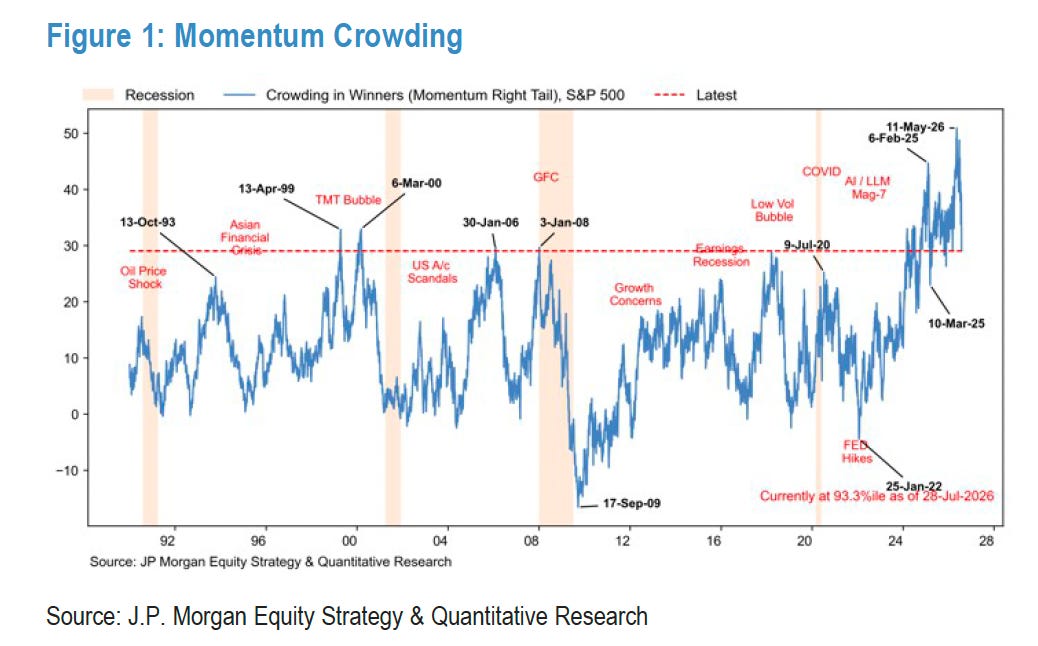
Image: Crowding of S&P 500 momentum leaders (JPMorgan, currently at a high of 93.3%, close to pre-peak levels in July 2026). Source: J.P. Morgan
A parabolic bull market almost always ends with a long bear market. The more extreme the emotions, prices, and leverage during the rise, the more severe the hangover later. Once margin calls have been made, that part of the capital becomes impaired and is rarely able to return. For the bull market to return to new highs, this impaired capital must, in some way, be replaced by new funds and a completely new narrative—this restoration process takes a long time and may not even happen.
Those waiting for a new narrative to reignite the AI bull market will likely be sorely disappointed. If there is any change, the narrative over the past few weeks has only gotten worse. China's AI lab Moonside has released Kimi K3, which outperformed Claude Fable on Code Arena.
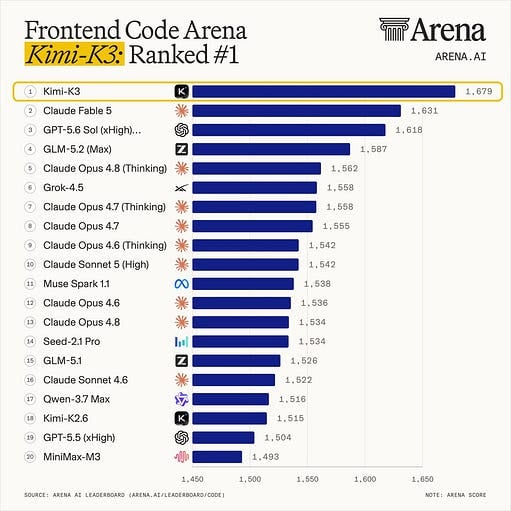
Image: Frontend Code Arena rankings, Moonside's Kimi-K3 at the top (1,679 points), surpassing Claude Fable 5 (1,631 points). Source: Arena
Alibaba has closely followed Moonside's footsteps, launching Qwen 3.8, a large open-source weight model with 2.4 trillion parameters. Market sentiment is also leaning towards open-source models, with Nvidia's Jensen Huang being the latest heavyweight in the AI field to publicly support open-source.
Global macro master Louis Gave once said, "When China enters the scene, profits disappear." This has been proven in the electric vehicle and solar panel sectors, and now the market is worried that competition from China will commoditize intelligence. All signs point in the same direction: the cost of intelligence is converging with the computing cost it requires. Users can obtain nearly equivalent performance from open-source models at a price far below closed-source models, and enjoy better data privacy and no lock-in, making it difficult to justify paying a premium to OpenAI and Anthropic.
Cheaper intelligence is good for end users, but it is bad news for closed-source AI labs (OpenAI, Anthropic, Google) that have committed to massive spending on computing power leases or purchases. As profit margins and market shares are eroded, their ability to finance at higher valuations also weakens, undermining their capacity to fulfill their computing promises. OpenAI's decision to postpone its IPO until next year is most likely due to a lack of confidence in achieving a $1 trillion valuation. SpaceX dropping to $112, 27% lower than its IPO price, may also further dampen their IPO prospects. Due to cyclic transactions with other participants in the ecosystem, OpenAI and Anthropic have become single points of failure for the entire AI industry.
The Imminent Surplus of Computing Power
AI bulls point out that the computing power and components like memory and optical networks remain in short supply, but this logic is flawed. Every commodity trader knows that the time when supply shocks and bottlenecks feel most intense is often at the top of the bull market. By the time supply and demand rebalance, the bull market has usually completely reversed. Often, shortages can indeed evolve into surpluses, leading to long bear markets.
Given the scale of computing power that emerging cloud vendors and mega-cloud vendors have committed to or begun construction on, I wouldn’t be surprised at all if we see a computing surplus in a year or two.
The shift of computing power from shortage to surplus can very well occur concurrently with the continued rapid growth of token consumption and AI model revenues. The pace of improvement in hardware and AI algorithms is already surpassing the rate at which users increase token consumption, leading to a decline in total token spending since June of this year. Silicon Data's token spending index shows that overall token spending has continued to decline after peaking in June.
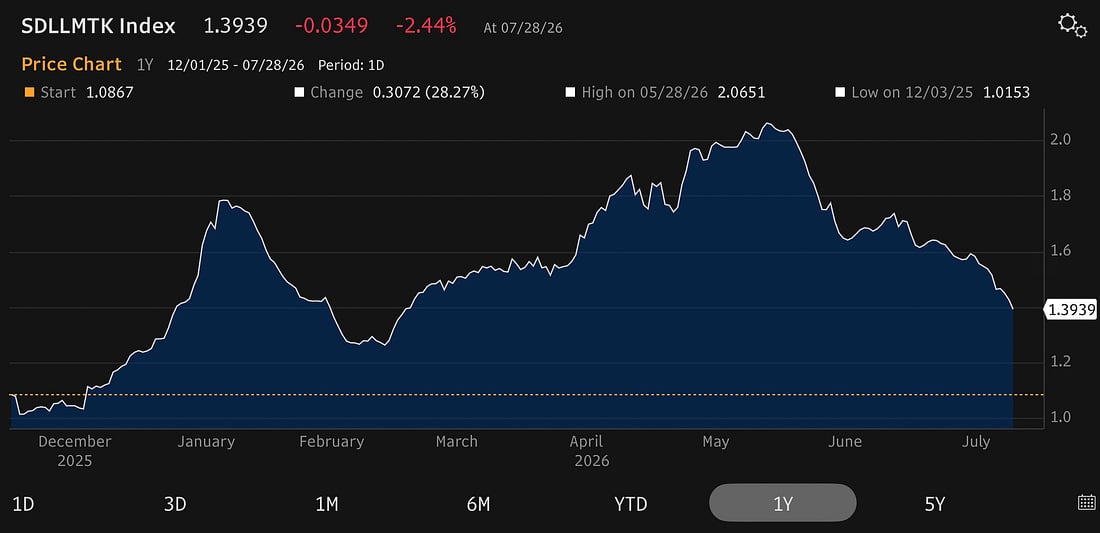
Image: SDLLMTK index (token spending index), continuing to decline after peaking in June. Source: Silicon Data
What might a surplus of computing power look like? Abandoned data centers, defaulted commitments, and in some cases, debt defaults. The scene could be quite ugly. The corporate bond spreads for data centers and mega-cloud vendors are signaling that exorbitant investments in computing power are becoming an increasingly dangerous business decision.
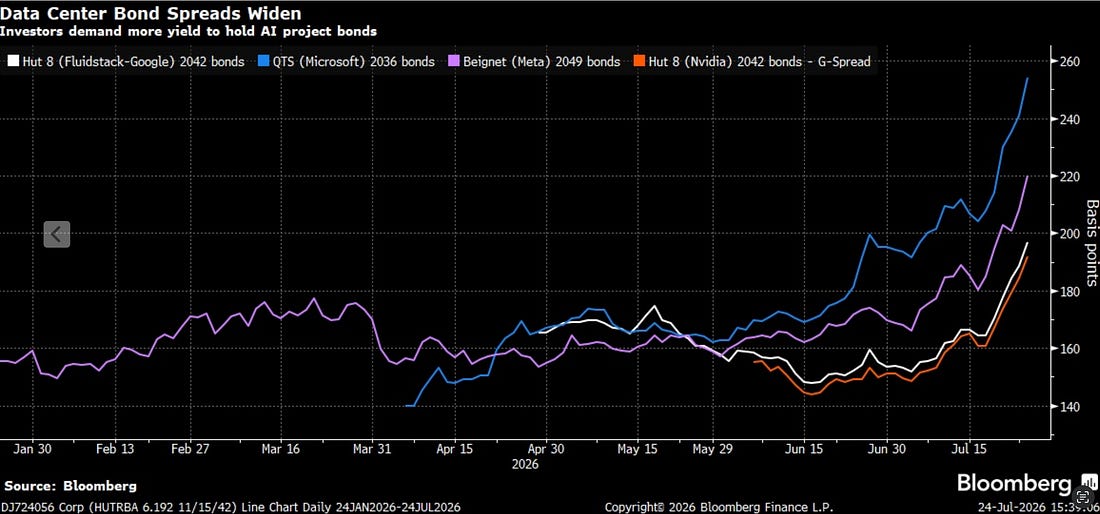
Image: Widening spreads on AI data center bonds (Hut 8, QTS, Meta, etc.). Source: Bloomberg
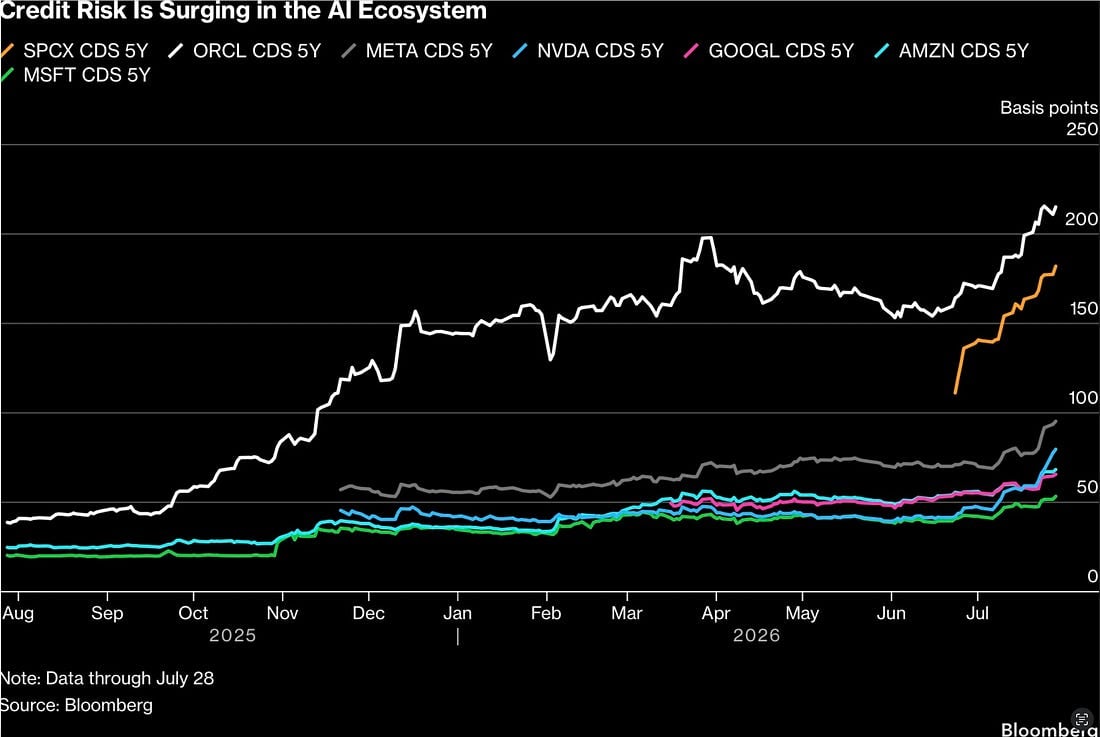
Image: Surge in credit risk within the AI ecosystem (5-year CDS basis points, SPCX soaring). Source: Bloomberg
The stock market no longer rewards mega-cloud vendors who announce increased AI capital expenditures, yet they ignore this signal and continue to increase investment.
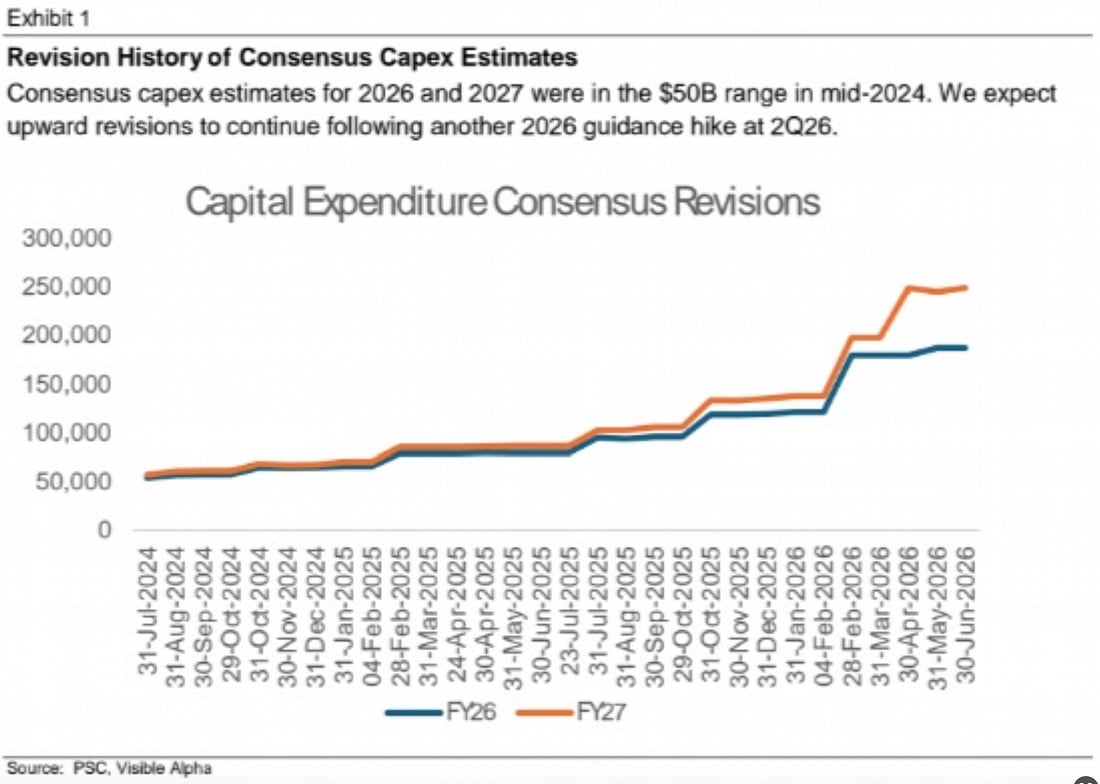
Image: Revisions to consensus estimates for capital expenditures FY2024–2026. Source: Bloomberg
Google announced it is raising its AI capital expenditure for 2026 from $195 billion to $205 billion, and the stock price fell 7% that day.
I know this pessimistic scenario is hard to imagine, but recent history provides plenty of reminders. When the Strait of Hormuz was blocked in April, almost no one anticipated that oil prices would fall back to $70 so quickly. In January of this year, when silver was trading at $120, very few people thought it would drop to $55 within a year. In 2021, hardly anyone believed that those soaring growth stocks in the bull market would drop 80% to 90% the following year. Shortages can flip quickly into surpluses, and positions can change just as swiftly.
Iran—The Next Endless War
I previously thought the war in Iran would have a limited long-term impact on the stock market, but my view has changed. This conflict is evolving into a protracted quagmire. Iran's hardliners have no intention of relinquishing their two trump cards: stockpiles of weapons-grade enriched uranium and control over the Strait of Hormuz. Seizing both would require a protracted ground war, and even then, the chances of success are hard to quantify. This war also has the potential to evolve into a proxy war between the US and China.
The US Department of Defense estimates that the war has cost American taxpayers $37.5 billion to date, but this is likely an underestimation, not accounting for the economic costs and future expenses needed to replenish equipment and ammunition back to pre-war levels. Dragging the nation into a costly, unfinished war without congressional approval will go down in history as one of the most typical cases of the fragmentation of American democracy.
Over the past six years, the world has experienced four inflationary shocks (COVID-19 pandemic, Ukraine-Russia war, Trump tariffs, Strait of Hormuz blockade). Each has led to tighter monetary policies and significant market pullbacks. The Iran war may represent the strongest persistent stagflation force among them, as it affects global energy and commodity supplies while raising government financing costs.
The Fed Under Walsh's Leadership
Kevin Walsh is attempting to comprehensively reform how the Fed measures inflation, responds to inflation, and communicates with the public under the dual pressures of supply shocks and the burst of the AI bull market bubble. It's akin to replacing all the parts of an airplane while flying through a storm.
In a context of runaway inflation and expanding fiscal deficits, Walsh faces two bad choices. He can tighten early to flatten the yield curve, but this comes with the risk of triggering a recession. Alternatively, he can delay tightening and let the long end of the bond market do the work. Currently, he seems to have chosen the latter.
At yesterday's FOMC meeting, the Fed had the opportunity to validate Walsh's hawkish rhetoric with an interest rate hike, but they did not. The bond market's reaction was a sharp steepening of the bear market, signaling that the Fed's credibility in controlling inflation is waning. Joseph Wang pointed out that while Walsh commits to price stability and sets a 2% inflation target, he is simultaneously modifying how inflation is measured in ways he cannot publicly disclose. Without a clear framework, bond investors lack a basis for anchoring expectations, causing volatility to rise in a way that the stock market struggles to digest.
The long-end yield has exceeded 5.2%, reaching a two-year high. This technical breakthrough marks the entry of the US Treasury bear market into a new phase, bringing new headwinds for the stock market.
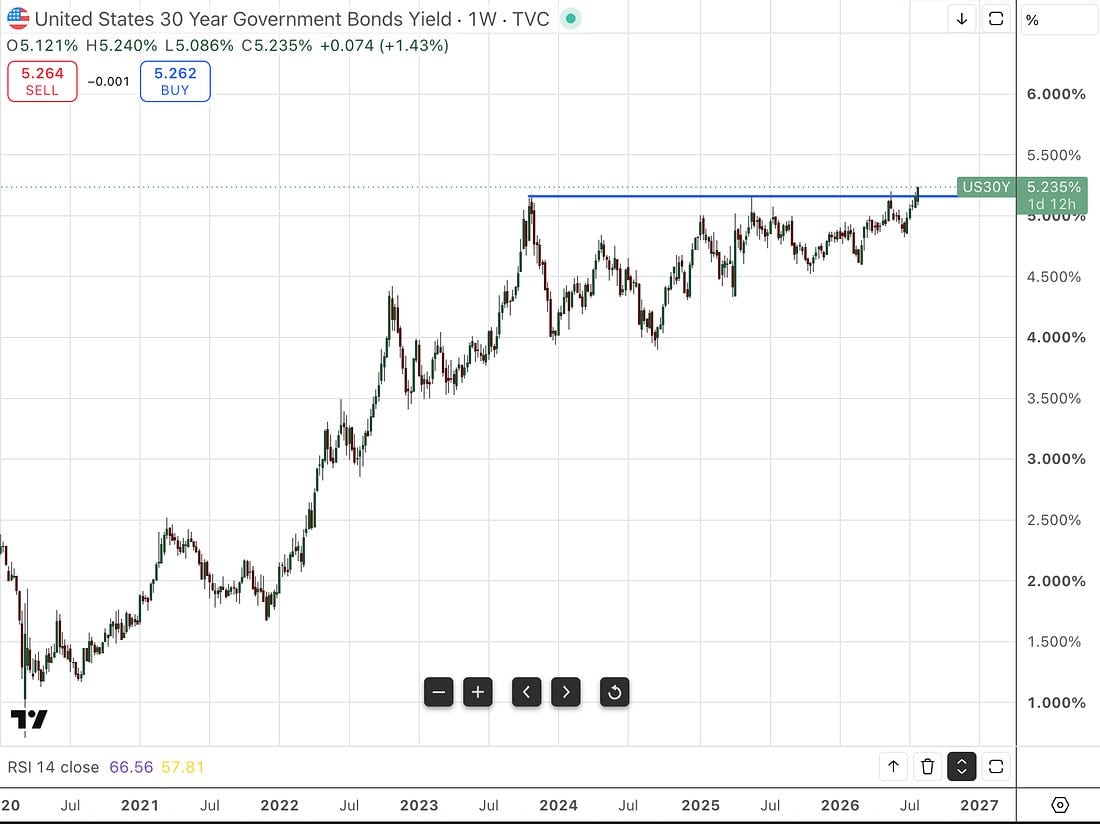
Image: US 30-year Treasury yield weekly, surpassing 5.2%, hitting a two-year high. Source: Bloomberg
Disclaimer: The contents of this communication are for informational and educational purposes only and do not constitute professional financial advice, investment recommendations, or solicitations to buy or sell any securities or instruments. This communication is not a trading signal service, and the author strongly advises readers not to follow his trading actions without relevant market experience and research. The author of this communication is not a registered investment adviser or financial planner. The information presented in this communication is based on the author's own research and experience and should not be viewed as personalized investment advice. Any investment or trading decision made based on the content of this communication is at your own risk. Past performance does not guarantee future results. All investments carry the risk of loss, and any trades or strategies discussed in this communication do not guarantee profits or suitability for your specific situation. The author assumes no responsibility for any actions taken or not taken based on the content of this communication. The author is not liable for any losses, damages, or liabilities arising from the use or misuse of the provided information.
免责声明:本文章仅代表作者个人观点,不代表本平台的立场和观点。本文章仅供信息分享,不构成对任何人的任何投资建议。用户与作者之间的任何争议,与本平台无关。如网页中刊载的文章或图片涉及侵权,请提供相关的权利证明和身份证明发送邮件到support@aicoin.com,本平台相关工作人员将会进行核查。


