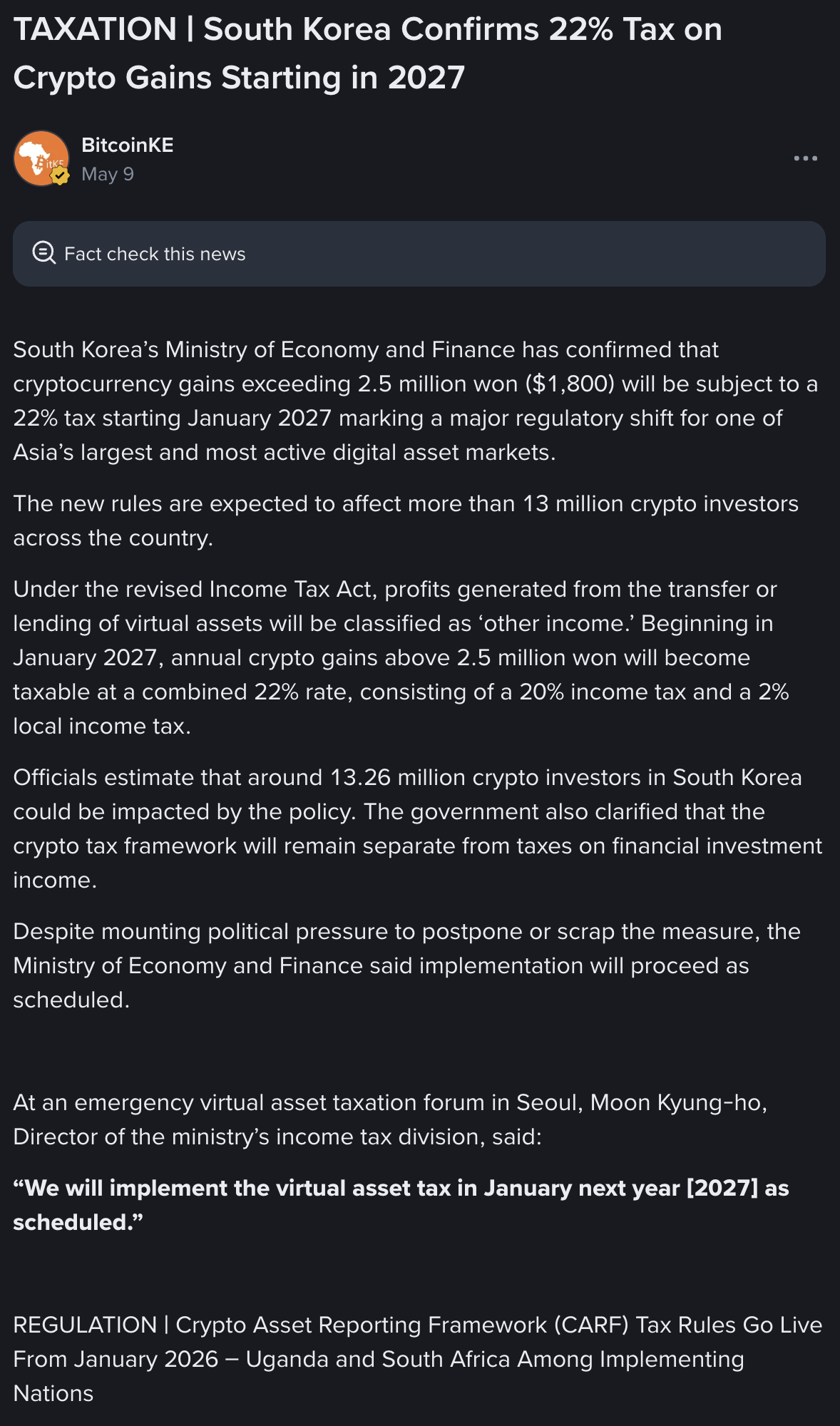
On July 30, 2026, the South Korean Ministry of Finance and the Financial Services Commission (FSC) officially confirmed that after three postponements and years of debate, the "Virtual Asset Capital Gains Tax" will be enforced starting January 1, 2027, with no buffer period. On the day the policy is implemented, not only did the cryptocurrency market plummet, but the South Korean KOSPI index also experienced a severe chain reaction of declines. Faced with the impending "22% tax scythe" and the National Tax Service's full online monitoring, how can ordinary retail investors save themselves? What new trends are revealed behind the macro liquidity in the financial reports of tech giants?

Introduction: The Scythe Falls, the "Bloody Morning" of Korea's Crypto Market
"After three postponements, the market finally sees the worst certainty."
On the morning of July 30, 2026, South Korean Deputy Prime Minister and Minister of Strategy and Finance Kim Yun-chul firmly confirmed at a National Assembly Finance Committee meeting: The capital gains tax on the income from virtual asset transactions will officially take effect on January 1, 2027, strictly according to the original plan.
Kim emphasized that over the past few years, the government has provided the market with ample time for policy adaptation and system integration, stating, "Tax fairness is the foundation of national finance; virtual assets are no longer a legal gray area. 2027 will be the final implementation point, and there will be no further buffered period."
Upon the official announcement, financial street in Seoul and the crypto community were in an uproar. As one of the world's most fervent places for digital asset trading, South Korea has approximately 15 million real-name cryptocurrency trading accounts.
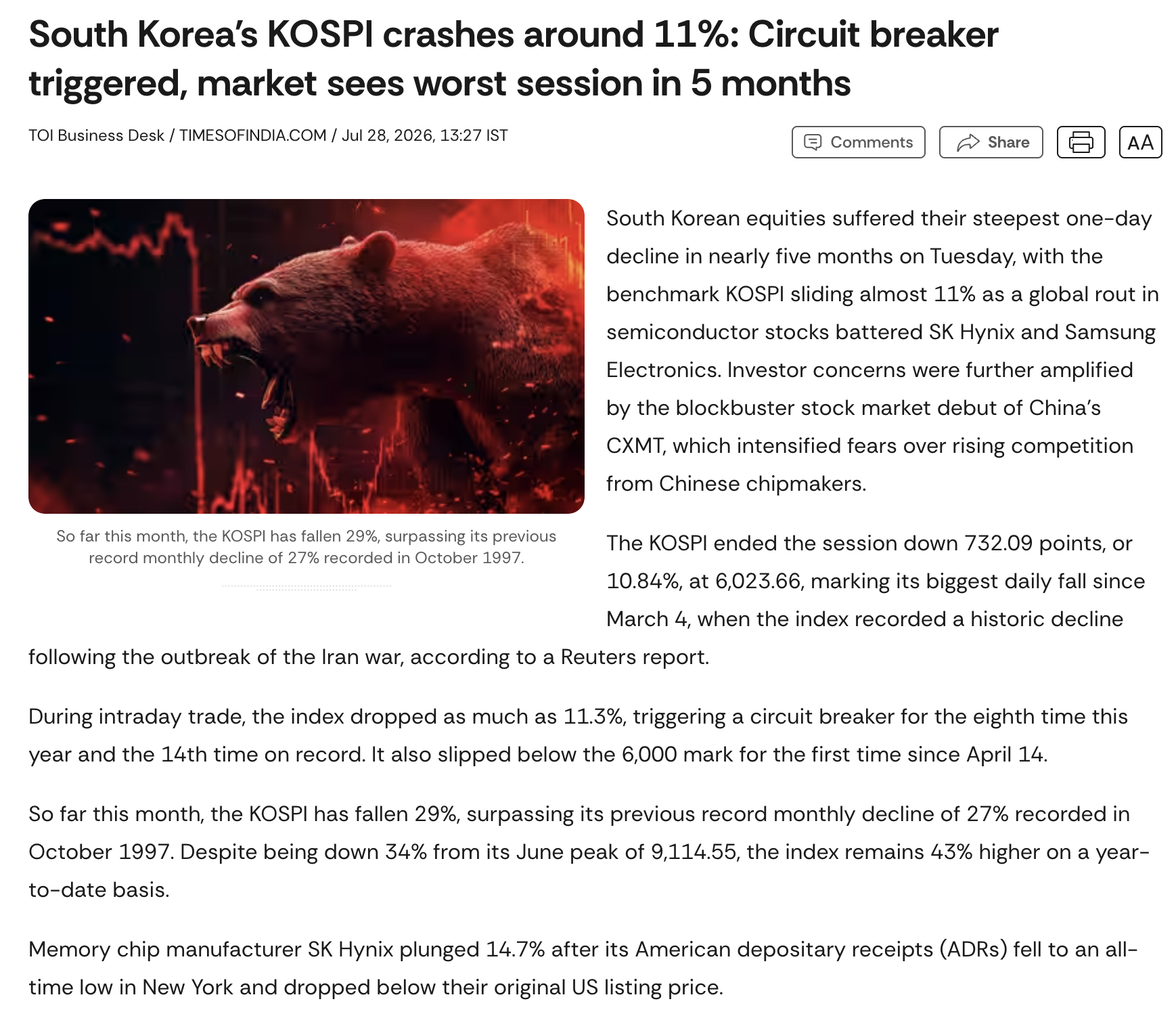
The negative implications of the policy hit the market like a meteor crashing into a still surface, instantly causing massive shockwaves across various markets. The Seoul Composite Stock Price Index (KOSPI) rapidly plummeted after the opening, with declines reaching 11% at one point, triggering the market's circuit breaker mechanism; major stocks like SK Hynix and Samsung Electronics also faced significant declines. Meanwhile, the famed "Kimchi Premium" in the local crypto market drastically narrowed or even turned negative, signaling the onset of a storm of asset migrations and liquidations triggered by tax policies.
Under the 22% Combination Attack, Who is Being "Blooded"? Calculate This Deadly Account
Many new investors may ask: It's just a tax, why does it lead to such severe panic? The answer lies in the "specific terms" and "extremely strict taxation logic" of this tax system.
1. Tax Rate Structure: 20% Capital Gains Tax + 2% Local Income Tax
According to the latest established tax system, net gains from virtual asset transactions for South Korean residents within a tax year will be taxed according to the following rules:
- Tax-Free Allowance: Annual net income 2.5 million Korean Won (approximately 12,500 RMB).
- Excess Tax Rate: The portion exceeding 2.5 million Korean Won directly incurs a 20% national capital gains tax, plus 2% local income tax, resulting in a comprehensive tax rate of up to 22%.
2. The Deadly Move: "Losses Cannot Be Carried Forward into the Next Year"
In traditional financial instruments (such as US stocks, certain derivatives or options in some countries), if an investor suffers a loss of 100,000 in the first year and makes a profit of 100,000 in the second year, they can usually offset the tax amount through "loss carryforward." However, Korea's crypto tax system explicitly states: Virtual asset gains are settled independently on an annual basis, and losses cannot be carried forward into the next year.
Let’s calculate this with a brutally realistic case:
Case Analysis:
Assuming investor Park made 1 million Korean Won from cryptocurrency trading in 2027, but suffered a severe loss of 800,000 Korean Won in the bear market of 2028.
Over the two years, Park's actual net profit would only be 200,000 Korean Won (1 million - 800,000).
According to conventional logic: A net gain of 200,000 Korean Won is far below the 2.5 million Won tax-free threshold, so no tax should be owed.
According to South Korean crypto tax logic:
- In 2027: Profit of 1 million Won, and since the annual profit does not exceed the 2.5 million Won tax-free threshold, tax is 0 Won.
- If Park had a stroke of luck in 2027 and earned 5 million Won: After deducting the 2.5 million tax-free allowance, the excess of 2.5 million Won would mean he must pay: $2.5 million \times 22\% = 550,000 Won in taxes by the 2028 filing season!
- By 2028: Even if Park lost all his money, he still must pay the 550,000 Won tax generated in 2027 – not a single penny less!
"If he makes money, the government takes 20%, but if he loses, the government takes no responsibility." This one-sided blood extraction mechanism directly pushes high-frequency traders and medium-leveraged players into desperation.
3. Different Fates Under the Same Country: "Discriminatory Clauses" Against Cryptocurrency
What infuriates the Korean crypto community even more is the policy's "double standard." In the South Korean stock market, retail investors trading stocks on local exchanges typically only need to pay a very low transaction stamp tax and do not face the capital gains tax as high as 22% (unless they are super large players holding a significant amount of a single stock).
Under the same financial system, trading Samsung stocks enjoys tax benefits, while trading Bitcoin is treated as "lottery or gambling income" and subject to higher taxes. This unequal treatment makes South Korean retail investors feel like "financial second-class citizens" in the eyes of the authorities.

The National Tax Service's "Sky-Net" Pressures, Traditional Stock Market and Crypto Market Resonance
If the 22% tax rate is a sword hanging over one’s head, the long-prepared regulatory technology system of the South Korean National Tax Service (NTS) is the net that brings that sword to bear.
1. Monitoring 15 Million Accounts, On-chain Privacy is Obliterated
The four major mainstream cryptocurrency exchanges in South Korea—Upbit, Bithumb, Coinone, and Korbit—currently have more than 15 million real-name authenticated (KYC) accounts. In conjunction with the implementation of this tax law, the NTS has officially launched a "Digital Asset Comprehensive Analysis System."
This system is deeply integrated with the APIs of major exchanges and the settlement network of the South Korean bank (central bank):
- Fiat Currency Deposits and Withdrawals: Every transaction of Korean Won (KRW) transferred from a bank card to an exchange is marked in real-time.
- On-chain Withdrawal Tracking: When users withdraw cryptocurrency from Upbit to personal on-chain wallets (like MetaMask), the system automatically cross-references with Travel Rule information and records the target address.
- OTC and Offshore Recovery: For accounts making large interactions frequently with unregistered overseas platforms, the NTS has the right to demand investors provide detailed evidence of funding sources and transaction details; those who cannot provide proof will be directly subjected to the highest tax rate and charged additional penalties.
2. Technology Stock Earnings Season in Crisis: The Macro Chain Reaction Behind KOSPI's Plunge
The news of the tax's implementation coincides with the concentrated disclosure period for global tech giants' second-quarter earnings.
Recently, semiconductor giants like SK Hynix and Samsung Electronics have released their latest financial data. Despite continued strong demand for AI server chips, the earnings reports show a phase shift in gross margins for consumer-side storage chips, with capital markets beginning to show doubts about the return on investment (ROI) for AI hardware.
The risk-averse sentiment in traditional financial markets rapidly transmits to the crypto market through highly leveraged retail investors:
- Many South Korean retail investors have become accustomed to "pledging stocks to borrow Korean Won, then transferring to Upbit for leveraged crypto trading."
- As the KOSPI index fell sharply due to disappointing semiconductor earnings, brokers sent margin call notices to retail investors.
- To maintain stock positions, retail investors were forced to sell Bitcoin and Altcoins on platforms like Upbit, converting to Korean Won to supplement the stock market.
- This vicious cycle of "stock market drop $\rightarrow$ crypto sell-off $\rightarrow$ crypto plunge $\rightarrow$ pledge value depreciation $\rightarrow$ further liquidation" ultimately led to an 11% crash in the KOSPI and a chain reaction of a plunge in the entire crypto market.
Differentiated Impact on Coins and the "Escape Route" for Capital
The enactment of the tax law does not mean that all crypto assets will suffer indiscriminate, catastrophic strikes. From a market structure perspective, different asset categories will present distinctly different evolutionary paths.
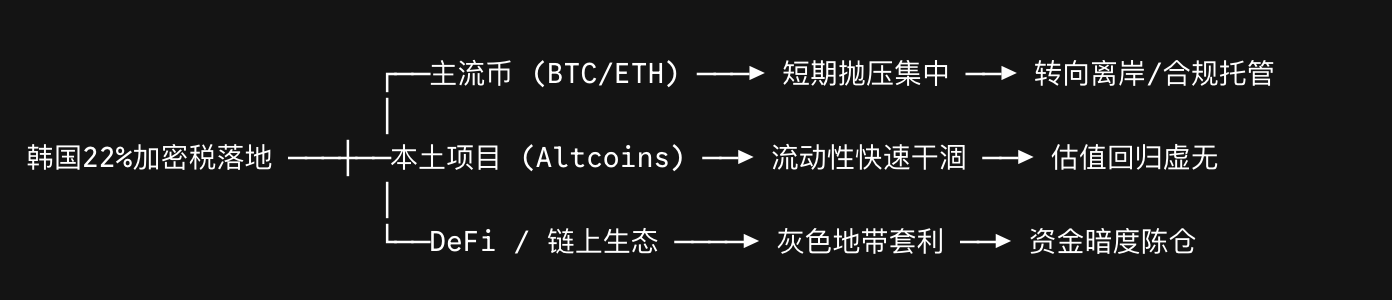
1. Mainstream Coins like BTC / ETH: Short-term Pressure, Long-term Institutionalization Trend
Bitcoin and Ethereum have the deepest liquidity globally, but in the South Korean local market, due to a large number of retail investors holding directly in Korean Won (KRW), there is likely to be a significant "cost-locking sell-off" before the end of 2026 (that is, just before the tax takes effect). Many investors who held BTC at a low cost in early days will choose to take profits before December 31, 2026, to avoid being subject to the 22% tax category in 2027.
2. South Korean Local Meme Coins (Kimchi Coins): Facing Catastrophe
South Korean retail investors are known for their love of speculation in highly volatile, high-leverage small-cap coins (such as Klaytn, Orbs, WEMIX, etc.). These projects are heavily dependent on liquidity injected through KRW trading pairs on platforms like Upbit.
With the determination of the 22% tax rate, the profit margins for high-frequency trading players and market makers will be completely erased. Once market makers exit, the liquidity of these local projects will instantly dry up, falling into a "no market to crash, no hands to catch" death spiral; many worthless coins without practical application scenarios may directly face zero valuation.
3. DeFi and Cold Wallets: Grey Areas Triggering "Covert Funds Movement"
Currently, there remains considerable legal ambiguity in South Korean tax law regarding "DeFi (decentralized finance) staking yields," "liquidity mining," and "NFT royalty income."
Decentralized on-chain interactions do not require the intermediation of centralized exchanges, resulting in significant technical barriers for the NTS when it comes to regulatory oversight. It is foreseeable that in the next 1-2 years, many high-net-worth players in Korea will accelerate the transfer of funds from centralized platforms like Upbit to self-custodied cold wallets, shifting their focus to on-chain protocols like Uniswap and Aave, seeking to evade heavy tax burdens within gray regulatory areas.
A Safe Haven in the Cold Winter—How OKX Delivers "Trading Warmth" through Product Innovation
Faced with the shadow of macro tax policies, the panic triggered by the KOSPI crash, and the severe fluctuations across the global crypto market, ordinary retail investors do not need endless emotional outpouring but rather a secure, efficient, diversified, and highly risk-resistant global trading platform.
As a leading global crypto asset exchange and Web3 technology company, OKX is becoming a steadfast safe haven for global and Asian investors amid this wave of market panic, owing to its profound product foundation and innovative tools, helping them navigate through the fog and assuage their fears.
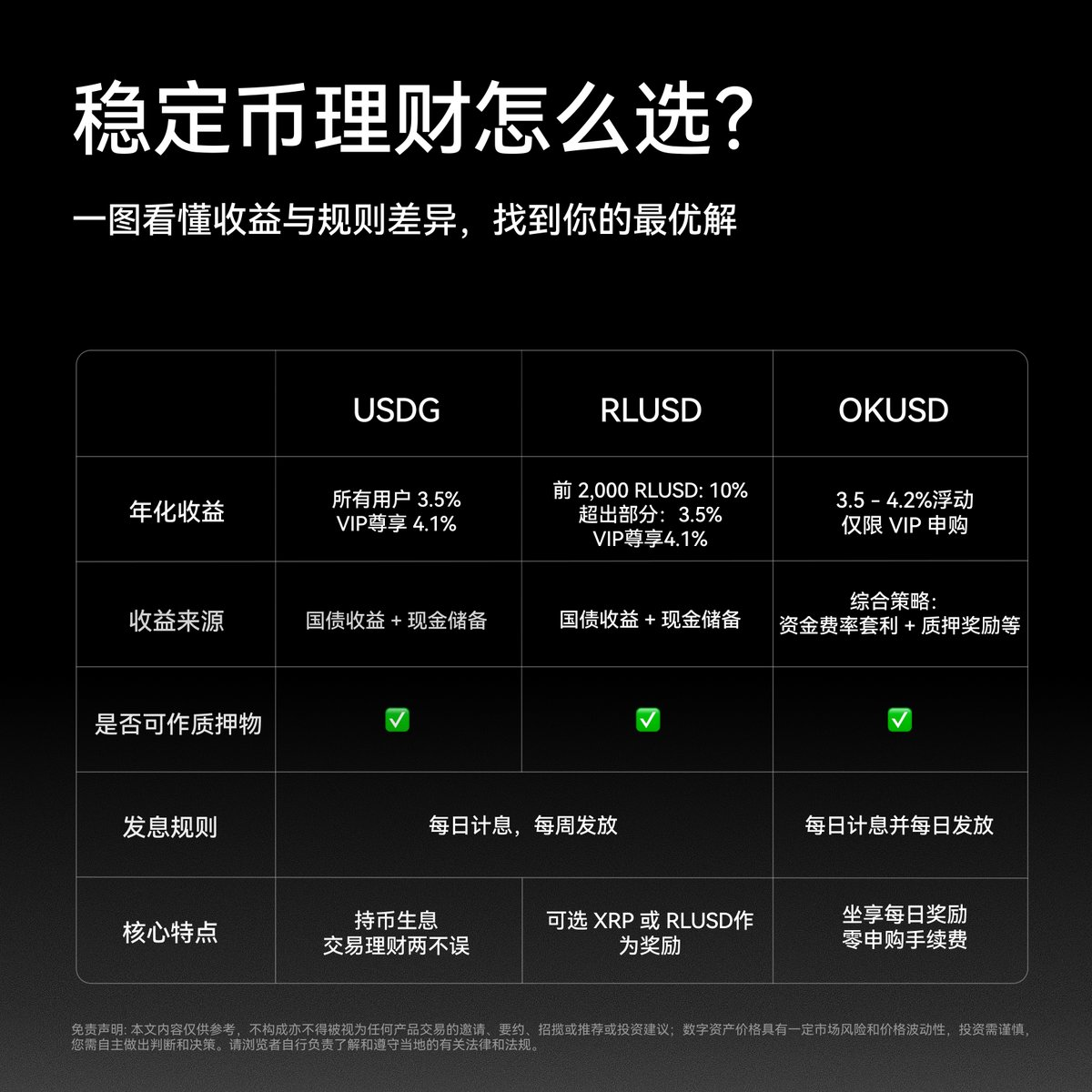
OKX Structured Investments (Earn Plus): Equipping Volatile Markets with "Shock Absorbers"
When the market falls into a crash due to negative tax implications and retail investors hesitate to blindly bottom-fish, OKX's wealth management section offers diverse structured products, including "shark fins," "dual currency winning," and "snowballs."
- Investors do not need to predict the exact rise and fall points of the market; they only need to place idle assets into OKX's structured investments to lock in downside risks while earning annualized returns far exceeding traditional bank interest rates.
- During the panic selling phase in the market, this "capital protection + floating returns" mechanism provides an excellent refuge for retail investors’ funds.
The heavy-handed regulations may bring temporary pain, but every significant wave of deluge is a necessary path towards market maturity and compliance. In a financial world full of uncertainties, both policies and market conditions are unpredictable, but choosing a trading platform with high transparency, top risk control technology, and humanistic care will provide every investor with the strongest assurance to light their way through the winter and protect their wealth.
🎁 AiCoin Exclusive Registration Benefits Are Here!
Register OKX through the AiCoin exclusive link for a permanent 20% rebate
👉 Register for OKX now:
https://jump.do/zh-Hans/xlink?checkProxy=true&proxyId=2
📢 Join the AiCoin community for more information on new coins and earning opportunities on exchanges
Official Telegram community:
AiCoin Chinese Twitter:
OKX Benefits Group:
https://aicoin.com/link/chat?cid=l61eM4owQ
The content of this article represents the author's personal views and does not reflect the position of this platform. The opinions, conclusions, and suggestions in the article are for investors' reference only and do not constitute any investment advice related to this platform. The market has risks, and investment should be done cautiously.
免责声明:本文章仅代表作者个人观点,不代表本平台的立场和观点。本文章仅供信息分享,不构成对任何人的任何投资建议。用户与作者之间的任何争议,与本平台无关。如网页中刊载的文章或图片涉及侵权,请提供相关的权利证明和身份证明发送邮件到support@aicoin.com,本平台相关工作人员将会进行核查。