Written by: Raoul Pal, Founder of Real Vision
Translated by: Chopper, Foresight News
Now, opening the information flow, you'll find the market sentiment is very pessimistic. The cycle is over, the crypto industry is dead, the four-year bull-bear cycle has declared itself invalid, and everyone who advised you to buy has been wrong. The price movement has deviated from public expectations; once the price moves beyond comprehension, pessimism spreads. History always keeps repeating itself.
I have witnessed countless cycles like this and know the ending to the story well. Having entered the crypto industry thirteen years ago, I have experienced almost every mistake that can be made. Before explaining the logic behind my continued bullish outlook, let me talk about the pitfalls I have fallen into; real experience always comes from failure.
In 2013, I entered the market when Bitcoin was priced at $200. But the buying timing was not the focus. Before purchasing my first Bitcoin, I wrote the first macro valuation analysis specifically for Bitcoin.
By today's standards, this valuation model is very crude. I borrowed the valuation approach from commodities, tallying the total above-ground and underground reserves of gold, and then applied this framework to Bitcoin. The conclusion was: If Bitcoin could become digital gold, assuming the price of gold remained at current levels, a single Bitcoin could reach a value of $1 million.
This article quickly spread through Silicon Valley and the finance world; at that time, no one had established a valuation system for Bitcoin from a macro perspective. I didn’t just express my opinion; I recommended Bitcoin to all GMI subscribers, including several hedge funds and family offices. In 2013, recommending a $200 Bitcoin to such investors required immense courage.
My core conclusion at that time was: “Bitcoin is currently priced at $200, and the long-term target price could potentially hit a million dollars. Considering the high probability of misjudgment, I actively offered a 10% discount, giving a ten-year target price of $100,000.”
The final outcome roughly matched my prediction; Bitcoin indeed reached that price level.
However, understanding the endpoint and comprehending the fluctuations along the way are completely different things.
Looking back at this journey, I entered at a perfect price point. The price doubled, tripled, and then plummeted by 84%. I comforted myself, saying this was a long-term bet, so no operation was necessary. Then, the market surged again at the end of 2017; one day, while watching the market, the price climbed to an unbelievable number, and I chose to sell.
Why? Because of fear (FUD). The controversies around forks were endless, discussions of “bubble theory” filled the air, and I constantly told myself: secure your profits from a tenfold increase, don’t let all the gains evaporate.
I sold everything. However, after I sold, Bitcoin continued to rise tenfold.
I tried hard to act as if I wasn’t regretting it, but deep down I knew I had made a huge mistake. Worse yet, during the pandemic, the price dropped again. I re-entered the market, thinking I was extremely clever in timing the bottom. The reality was quite the opposite: I sold at $2000 but bought back at eight to nine thousand dollars. Frequent buying and selling, locking in profits at highs, repeatedly trading in and out around my positions... all these actions hindered the one correct long-term strategy from functioning.
I had roughly calculated that if I had just held onto the $200,000 principal from the start, it would now be worth about $100 million. The power of compound interest was evident here, while also proving that people easily make foolish decisions. The assets themselves continued to appreciate, while I continuously interrupted that process.
A massive unrealized profit slipped away; this expensive lesson taught me one principle: extend the time frame perspective, discard the noise, and hold long-term. For any brokerage, “dormant accounts” often have the best returns, as holders do not casually operate their assets.
This is my recap. Next, let's discuss the logic I have come to realize now, which I did not fully comprehend back then.
Bitcoin is the vault for value storage
In the past few weeks, I have continued to write about the issue of currency devaluation; all analyses ultimately point here. Demographics spawn debt, debt drives continuous currency devaluation, and cash loses about 8% of purchasing power annually compared to long-term assets. To fully understand this transmission logic, you can read my previous article. In short, holding cash is like holding a block of ice that is constantly melting; the rational choice is to hold assets that cannot be artificially expanded in quantity.
Bitcoin is the purest asset among these types. The total amount is forever locked at 21 million coins, with no committee voting to increase. It is the hardest currency ever created by humanity, serving the function of value storage—a digital vault.
But the vault has a growth ceiling, and understanding this is crucial. Bitcoin's target market is the global savings seeking safe havens. Its size is roughly equivalent to the approximately $35 trillion gold market, plus some other assets used for wealth preservation. My judgment is that Bitcoin will continue to capture a portion of this allocation of funds. Its true competitor is only Zcash, a privacy-focused cryptocurrency, which may capture about 10% of the market; the remaining share will be taken by Bitcoin.
Therefore, the logic of the digital vault holds; Bitcoin is a quality asset. However, the vault is only half of the story, or even just a small part.
The economic system built on top of the vault
Bitcoin does not have programmability. Based on its original design, it is only good at one thing and does not take on any other functions. Smart contract public chains are a completely different track. There are many public chains in the market, and I am continuously optimistic about three: Ethereum, Solana, and Sui. The most common mistake the public makes is to lump them together with Bitcoin and discuss which coin will ultimately win.
People overlook the key fact that they serve fundamentally different missions. Bitcoin solves value storage, while smart contract platforms solve multi-party cooperation and collaboration.
I propose that the framework for the era of exponential growth views: artificial intelligence, robotics, energy, and crypto technology are all entering a period of explosive development simultaneously. The future economy will no longer rely on human labor but will be dominated by machines. Billions of AI intelligent agents will continuously conduct transactions, purchasing computational power and settling with each other far beyond human speeds.
This brings up an obvious question: what will they rely on to complete transactions? The traditional banking system is not suitable. The machine economy cannot tolerate three-day settlement cycles, reliance on proxy banks, or weekend closure of settlement institutions. Intelligent agents require a programmable, instant settlement, 24/7 operational underlying channel—this is precisely the value of smart contract public chains. They will become the settlement base of the machine economy in the era of exponential growth.
Therefore, investing in such public chains is not betting on a specific token, but rather betting on the infrastructure that the next generation of economy relies on to operate. The tokens themselves are not just currency; they represent the holders' rights in the network, serving as the collaborative base of the digital age.
This also means that the Bitcoin valuation model cannot be applied to public chains, let alone traditional enterprise valuation methods. Public chains are not a company; they are an economic ecosystem. To evaluate the economic ecosystem's value, one must look at the total economic activity occurring on it.
If we compare the target markets of these two major tracks, the core argument is clear. Bitcoin targets global savings, corresponding to about $35 trillion in size, equivalent to gold, and is worth allocating to. The smart contract platforms are expected to cater to the settlement needs of the global real estate market (approximately $400 trillion), global debt (approximately $325 trillion), and global stock markets (approximately $125 trillion). This is not just a larger scale, but an order of magnitude greater.
The conclusion is self-evident: in the long term, the total market capitalization of quality smart contract public chains will be several times that of Bitcoin. This does not mean Bitcoin will fail; it will achieve its mission of value storage perfectly. The reason is that the economy built on the vault will naturally be larger than the vault itself. The vault stores savings, while the underlying channel carries the flow of the entire economic system.
Counterarguments: They are just functional tokens?
I can foresee the mainstream bearish views in the market, which deserve careful dissection rather than simple rebuttal. This set of arguments goes as follows: Bitcoin is designed from the ground up to preserve capital, continuously accumulating value as currency. Ethereum, Solana, and Sui are merely functional assets and financial infrastructure; infrastructure will not continuously appreciate like pure monetary assets. No matter how good the technology, it does not qualify as a quality investment target.
But reverse reasoning reveals the flaws. Pure value storage assets have a growth ceiling determined by the total size of savings seeking preservation. The scale is enormous, but there is a clear cap. The ceiling for infrastructure assets, however, depends on all applications that can be built on top of them; every time a new project is born, the cap will be raised further. Low transaction fees do not equate to low value. The underlying network's large-scale adoption relies precisely on low costs, and as a result, the network value continues to rise.
There is a clear dividing line here: lending protocols and exchanges built on Ethereum are commercial projects, generating revenue and competitive barriers, and can be valued based on cash flow. Ethereum itself is not a commercial project. The value of Ethereum comes from the sum of all ecosystems built on it. If Ethereum were to halt, it would not just mean the disappearance of a single company; all Layer 2 networks, most stablecoin markets, and the entire decentralized finance ecosystem would collapse instantly. This is its core value; it is the foundational base upon which all projects rely for survival, not just one among many.
A similar explanation can account for why Layer 2 networks struggle to replicate the value of Layer 1 public chains. Layer 2 networks borrow security from the underlying main chain, and substantial revenues ultimately flow back to the base layer. Even if a prosperous Layer 2 network emerges on Ethereum, it essentially continues to boost Ethereum's value. Ultimately, all value is deposited back into the underlying Layer 1 public chain.
Why is the market generally pessimistic now?
Returning to the market sentiment mentioned at the beginning of the article. If the long-term logic is so solid, why is the current market so agonizing? The macro environment of sustained loose liquidity and a trending easing financial situation has already taken shape. The unexpected disruption in the market rhythm lies in the fact that the anticipated price rise has not materialized. The market crash in October 2025, and the government shutdown triggered a series of disturbances, disrupting the original market rhythm and delaying the timing of market initiation. Many investors directly interpret “delay” as “the logic has completely failed.”
The underlying logic has never collapsed. The gap between crypto asset prices and liquidity expectations has lasted longer than I anticipated, but the gap will only bring about a correction, not a permanent closure.
Previously, the U.S. manufacturing PMI index had long been below the threshold line, and the business cycle was in recession. The crypto industry is highly dependent on market activity and investment willingness, and naturally requires a macro cycle to warm up. For a long time, the macro environment has been under pressure. In addition, Bitcoin has experienced a liquidity discount trend temporarily, decoupling from the overall liquidity trend; this phenomenon recurs cyclically. Crypto asset volatility is higher than liquidity indicators; when the market is overheated, the gains exceed expectations, and when the market cools down, the losses also exceed expectations. Extending the time dimension, the correlation coefficient between the two maintains around 87%.
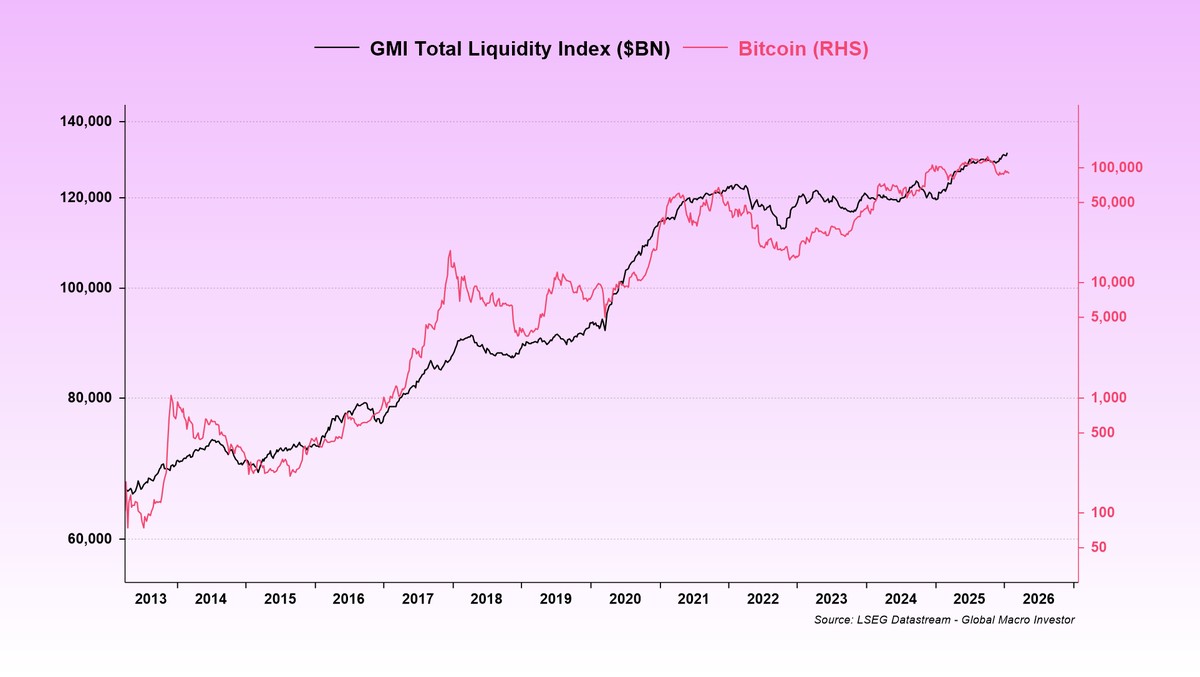
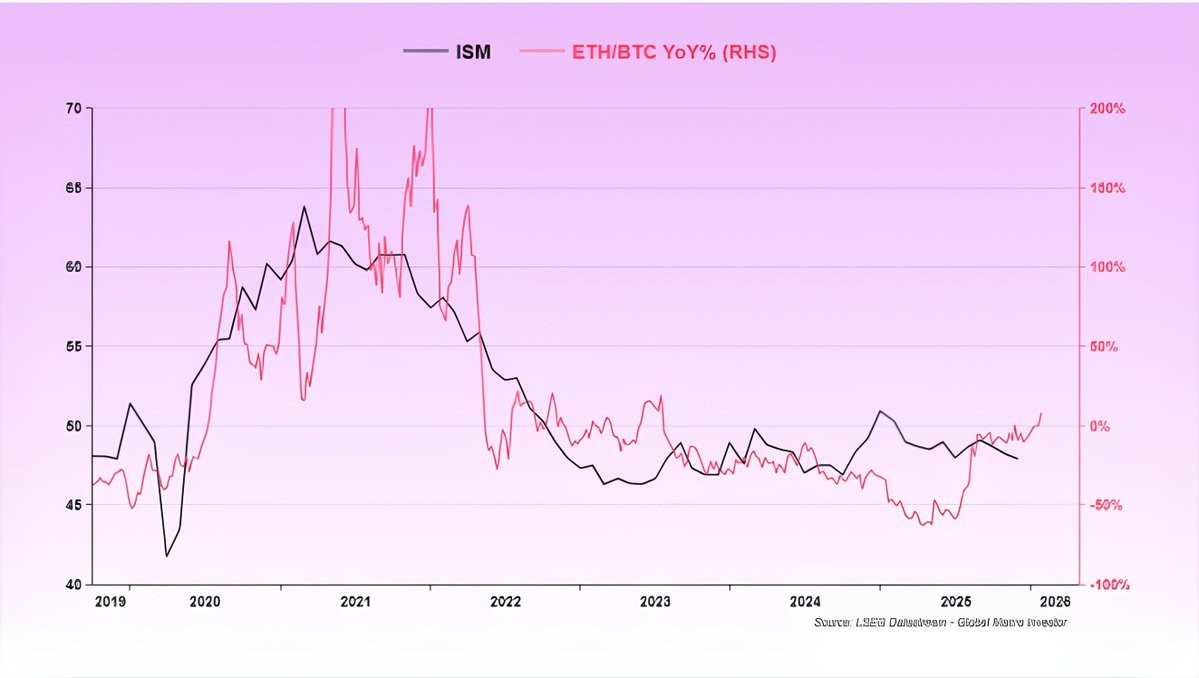
We are currently in a period of market coolness, so many people conclude that the long-term logic has failed, but this is not the case. The business cycle has bottomed out and is rebounding. The manufacturing PMI index has been in the expansion range for six consecutive months, with the latest July data at 53.3. Historical trends indicate that in such macro environments, the crypto market often welcomes a warming market. During the upward cycle, investor risk appetite increases, and internal differentiation will appear in the crypto market: junk bonds outperform government bonds, small-cap targets outperform major large-cap targets; smart contract public chains like Ethereum outperform Bitcoin. The reason is that economic activity boosts demand for block space, while savings demand drives Bitcoin's market.
How to operate
I will not provide a fixed investment portfolio nor predict the bottom. Thirteen years of experience in the industry have taught me that no one can time the market precisely; forcing predictions may ultimately recreate the tragedy of selling Bitcoin at $2000.
The recap at the beginning of the article is the most important insight. The crypto track is a long-term game and greatly tests one's mentality; many people's income and assets are deeply tied to the industry. The final winners are not necessarily the individuals with the strongest short-term trading abilities, but those who can clearly understand the essence of their held assets, believe in the ongoing trend of network proliferation, and can endure every few years a round of 50% deep pullbacks.
Broaden your perspective, stripping away market noise. At the same time, lay out digital vaults (Bitcoin) and economic underlying channels (quality smart contract public chains), aligning with the industry growth curve without expending energy trying to beat the cycle.
免责声明:本文章仅代表作者个人观点,不代表本平台的立场和观点。本文章仅供信息分享,不构成对任何人的任何投资建议。用户与作者之间的任何争议,与本平台无关。如网页中刊载的文章或图片涉及侵权,请提供相关的权利证明和身份证明发送邮件到support@aicoin.com,本平台相关工作人员将会进行核查。


