American investors have borrowed $1.53 trillion to buy stocks, leveraging up in pursuit of historical highs.
I have previously discussed how South Korean retail investors are taking on foreign sell orders through leveraged ETFs, margin accounts, and CFDs; now the same issue has emerged in the U.S. market, but on a larger scale with a more widespread distribution of leverage.
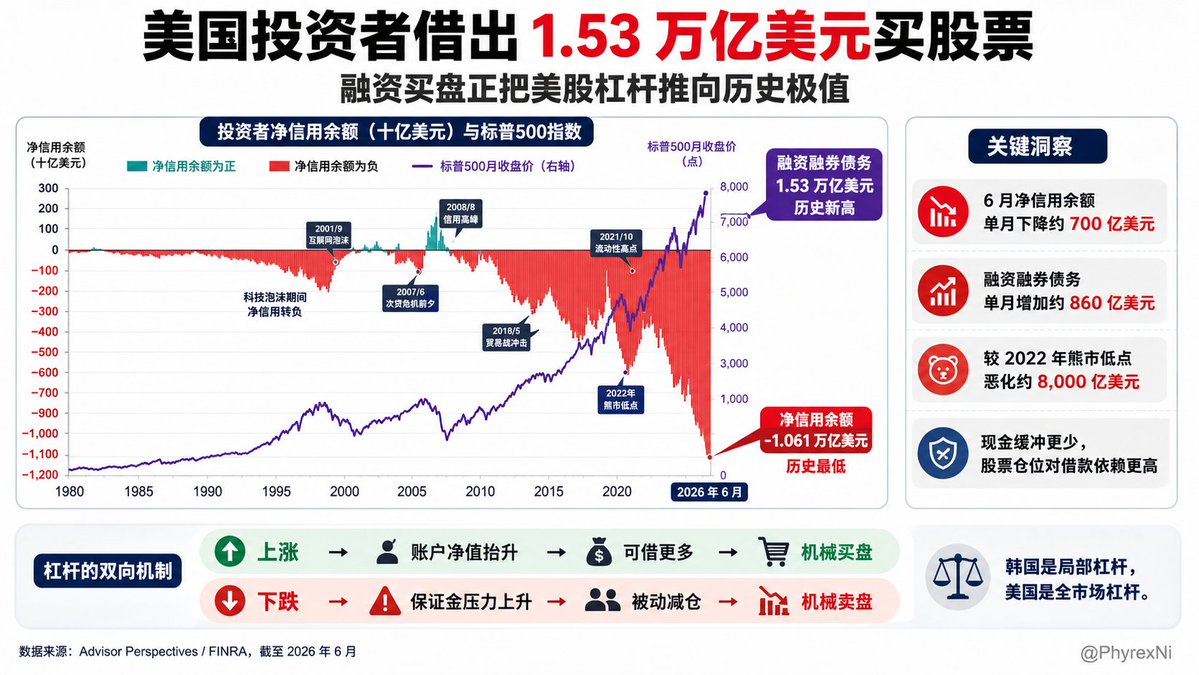
As of June, the net credit balance in U.S. brokerage accounts fell by approximately $70 billion in a single month to negative $1.061 trillion, setting a historical low. During the same period, the debt from margin trading increased by about $86 billion, reaching a record $1.53 trillion, marking the third consecutive month of increase.
The net credit balance can be understood as the cash and credit balance in investors' brokerage accounts, minus the margin debt. It has now dropped to negative $1 trillion, indicating that investors have decreasing cash buffers and are increasingly reliant on borrowing for their stock positions.
Compared to the bear market low in 2022, the net credit balance in the U.S. has deteriorated by approximately $800 billion. Behind this round of U.S. stock market gains, alongside corporate earnings, AI narratives, and inflows into indices, the increase in margin funds is also a key driver.
Currently, leverage in the Korean market is mainly concentrated on products related to Samsung Electronics and SK Hynix, while leverage in the U.S. market is widespread throughout the entire brokerage system. South Korean retail investors leveraged up to absorb foreign capital outflows, whereas American investors continue to borrow money to expand their stock positions as indices rise.
During the uptrend, rising stock prices boost account net worth, allowing investors to obtain more margin capacity, and new borrowing continues to flow into the stock market, creating a sustained mechanical buying pattern. Once the market weakens, account net worth declines, margin ratios increase, and investors need to add cash or sell stocks, turning the originally growth-driving margin funds into mechanical sell orders.
In simple terms, American investors are using increasingly less cash to maintain increasingly larger stock and margin positions.
The South Korean stock market has already demonstrated the side effects of high leverage. Leverage can amplify capital inflows during uptrends, but it can also accelerate deleveraging during downturns. The U.S. stock market currently faces high valuations and high margin levels, and if new capital slows, the ever-increasing margin positions will directly amplify market fluctuations.
@Gate Crypto, U.S. stocks, Hong Kong stocks, Korean stocks, gold, CFD, one-stop trading for prediction markets
免责声明:本文章仅代表作者个人观点,不代表本平台的立场和观点。本文章仅供信息分享,不构成对任何人的任何投资建议。用户与作者之间的任何争议,与本平台无关。如网页中刊载的文章或图片涉及侵权,请提供相关的权利证明和身份证明发送邮件到support@aicoin.com,本平台相关工作人员将会进行核查。


