Original Author: Yang Chen
Original Source: Wall Street Journal
SpaceX's stock price is under pressure due to the impending lock-up expiration, but Morgan Stanley believes this actually creates a buy window due to valuation misalignment.
During trading on Monday, SpaceX's stock price fell to 108.66, hitting a new low since its IPO, having dropped more than half from its peak of $225.64. As the lock-up period approaches its end, some investors believe the stock price may dip further to $100.
According to Wind Trading Desk, Morgan Stanley analyst Adam Jonas recently released a report stating that if the stock price indeed falls to $100, it would mean the market is valuing SpaceX’s AI business at zero or even negative, while the implied expectations for the rockets and Starlink business’s 2028 EBITDA would be approximately 30% lower than the firm’s baseline forecast.
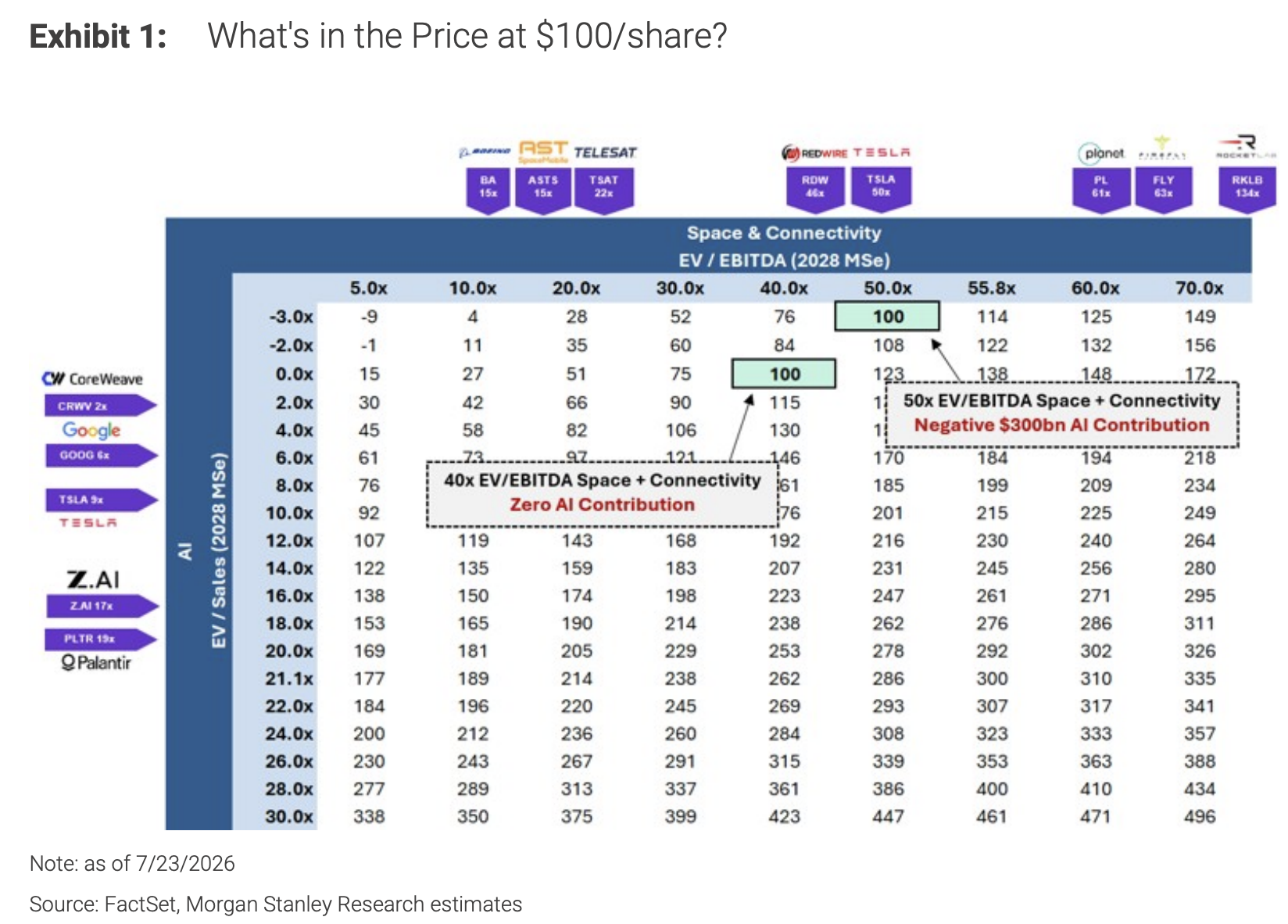
The firm maintains its "overweight" rating on SpaceX with a target price of $300. It believes that the current pessimism, combined with the divergence from fundamentals, creates an attractive entry point—investors are effectively getting the entire value of the company’s AI business at nearly "zero cost" at prices below $120, while the core rockets and Starlink business itself already covers the current stock price.
Divergence Between Market Sentiment and Fundamentals
Despite no significant changes in SpaceX's fundamentals over the past few weeks, bearish sentiment has been gradually strengthening, while bullish investors seem more inclined to wait for clearer catalysts.
From conversations with investors, the core of the disagreement lies in the pricing of the AI business. Most investors significantly discount or completely ignore the value of Grok and Cursor, believing that AI monetization opportunities are mainly focused on the new cloud computing (neocloud) space.
Reasons include: the capital expenditures for the AI business are too high compared to the rockets and Starlink business, great uncertainty in the economic model, and management's excessive focus on the business.
Some investors even assign a negative value to AI, believing that high capital expenditures will erode overall value. Morgan Stanley disagrees, arguing that this pricing approach is overly conservative and ignores several potential monetization paths for AI.
What Does $100 Mean?
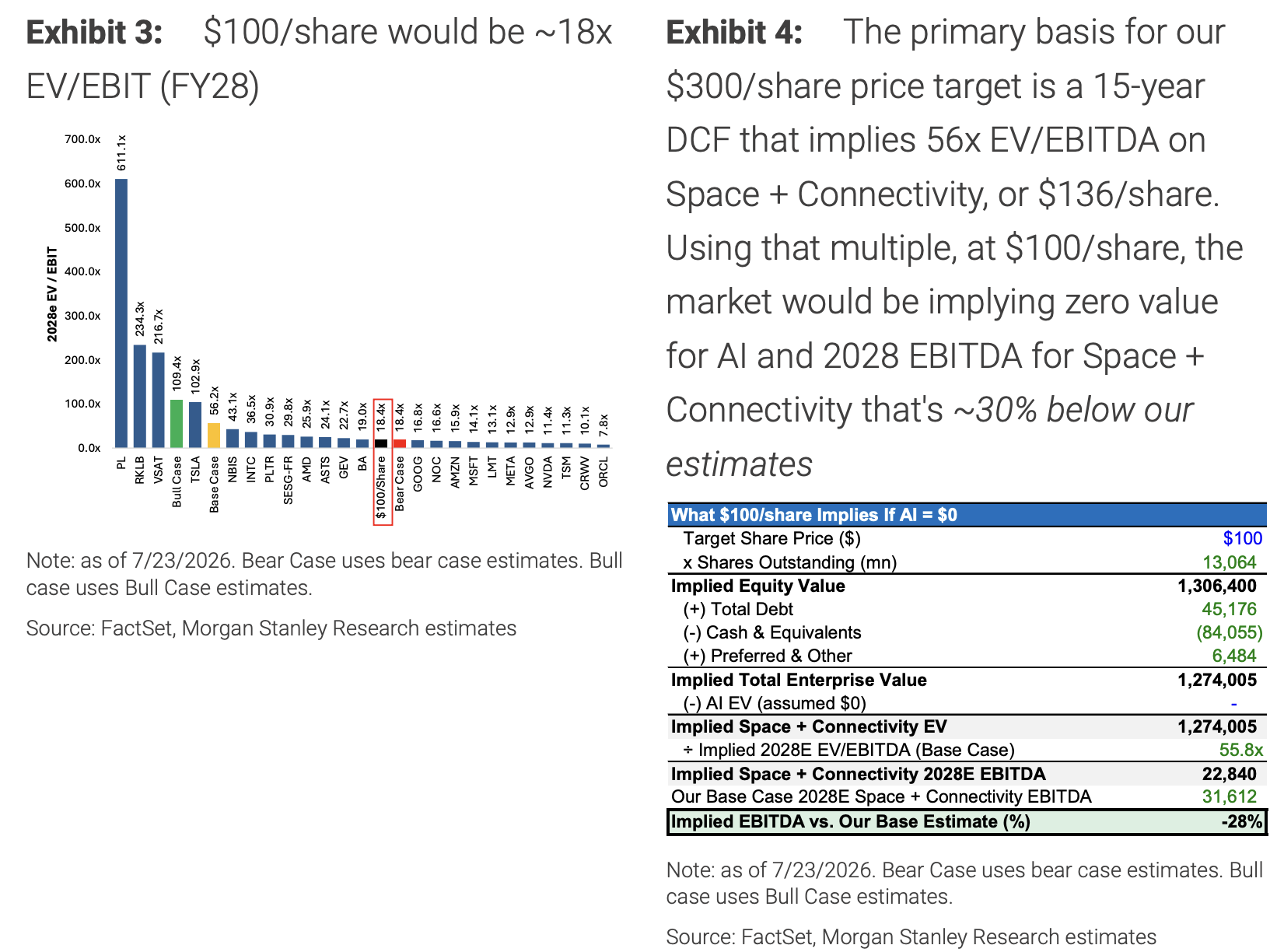
Based on the firm's baseline forecast for 2028—revenue of $157 billion (including an average of 6 gigawatts of computing power valued at $16.5 per watt, and 35 million average consumer users calculated at $46 ARPU per month), EBIT is around $69 billion—if the stock price drops to $100, SpaceX's corresponding FY28 EV/EBIT would be 18 times, roughly equal to the median level of comparable companies, but its revenue compound annual growth rate from 2025 to 2030 would reach 76%, about three times the median of comparable companies at 26%.
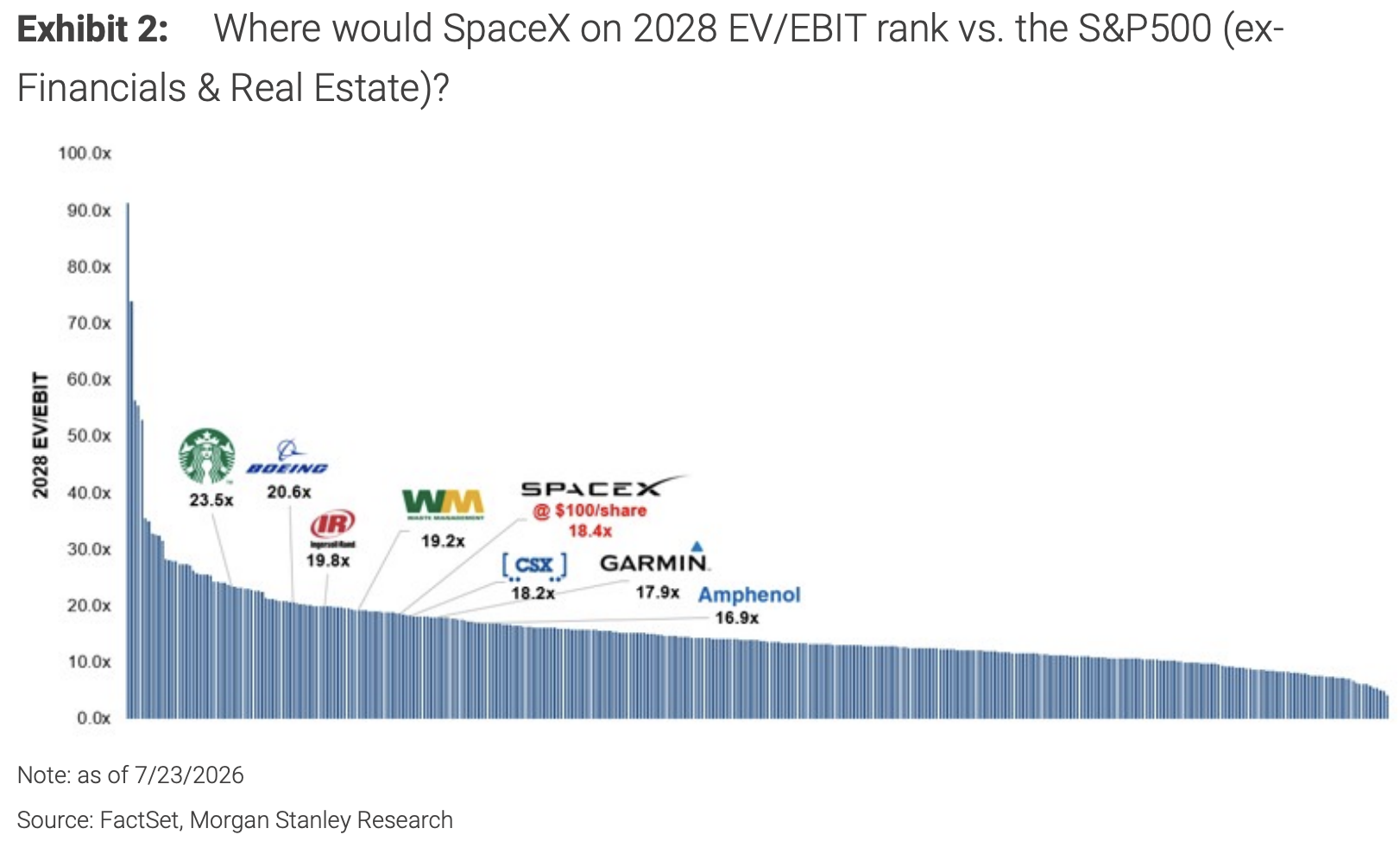
In comparative terms, an 18 times EV/EBIT would rank approximately 81st among the S&P 500 (excluding financials and real estate), positioned similarly to Boeing (21 times), Waste Management (19 times), CSX (18 times), and Garmin (18 times).
Further breaking down the business, if the rockets and Starlink businesses are priced at a slightly lower than median comparable company level of 40 times EV/EBITDA (46 times median), the implicit value of the AI business would be exactly zero; if priced slightly higher than the median at 50 times, the implicit value of the AI business would be negative $300 billion. Morgan Stanley believes both scenarios are unreasonable.
Core Business Supports Current Stock Price
Even if the AI value is completely stripped away, SpaceX's rockets and Starlink business alone are sufficient to support the current stock price.
The firm’s 15-year DCF model values the rockets and Starlink business separately at about $136 per share, using an EV/EBITDA multiple of 56 times. At an assumed price of $100, this implies the market is valuing this business at an EBITDA for 2028 that is approximately 28% lower than Morgan Stanley’s baseline forecast, while assigning zero value to AI.
Currently, SpaceX holds over three-quarters of the global share in high-quality orbit entry and maneuverable satellites in orbit, with this year's connectivity business growth approaching 50%, and EBITDA margins reaching 40%. Purchasing SpaceX at the current valuation is equivalent to securing a market-leading, stable, and highly certain growth space and connectivity business at a discounted price, while all AI option values are effectively "free."
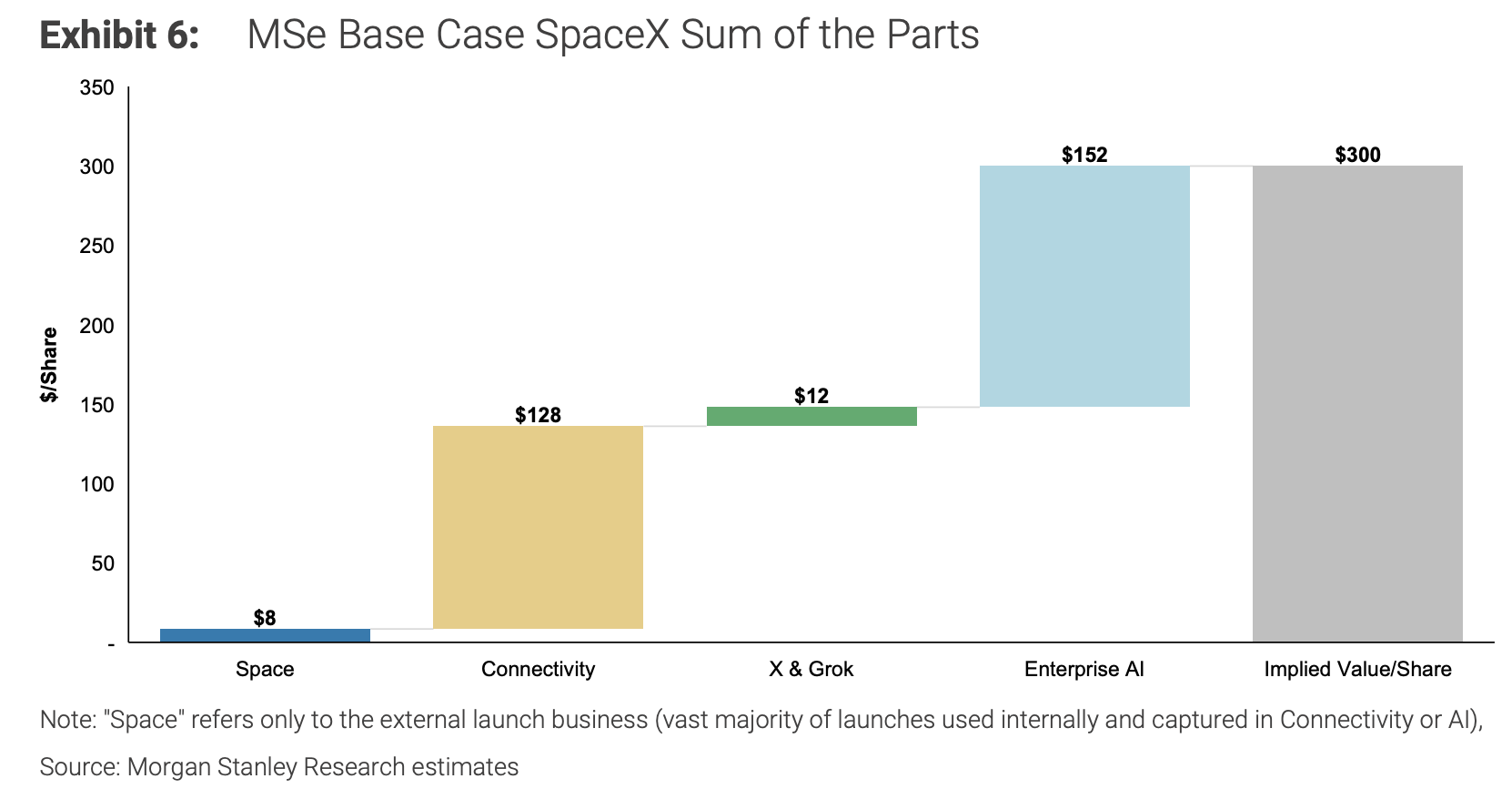
From a segment valuation perspective, Morgan Stanley's baseline target price of $300 breaks down as follows: Space business $8, Connectivity business $128, X and Grok business $12, Enterprise AI business $152.
Overview of Recent Positive Catalysts
On the launch front, the 14th and 15th test flights of Starship are expected to take place in September and October, respectively, which may cover the first capture of the V3 Starship booster, the first orbital flight (synchronously deploying V3 operational satellites), and the first capture of the upper stage of Starship.
In terms of AI business, Grok 4.6 (a 20 trillion parameter model) is expected to be released within the next month, while Grok 5.0 (a 60 trillion parameter model) is anticipated to launch within the year. The acquisition of Cursor is expected to be completed by the end of Q3, at which point substantial updates on Cursor's annual recurring revenue (ARR) and Grok platform adoption rates will be disclosed.
In terms of computing power expansion, SpaceX expects to double its computing capabilities from current levels to 2 gigawatts before the end of the year, which may drive more large neocloud contracts to fruition.
Given that the market currently places almost no value on AI, any of the above positive developments could serve as catalysts for an upward correction in stock price.
Major Risks Should Not Be Ignored
In the short term, the stock price faces dual pressures: first, the upcoming lock-up expiration will create additional supply pressure; second, the forthcoming earnings report may not answer investors' most pressing questions.
In a bearish scenario (target price of $75), it is assumed that delays in Starship progress compress the narrative, the AI monetization speed is significantly below expectations, the rockets and Starlink business accounts for over 90% of the total valuation, and the Starship operational timeline is pushed to 2029.
Other major downside risks include: a slowdown in Starlink user growth, high costs per watt for AI infrastructure, prolonged construction cycles for AI business, expanded financing needs leading to equity dilution, and regulatory uncertainties.
The bullish scenario (target price of $600) assumes full acceleration of Starship, orbital computing, and Terafab, with AI accounting for over 60% of the overall valuation and computing deployment compound annual growth rate reaching 46%.
免责声明:本文章仅代表作者个人观点,不代表本平台的立场和观点。本文章仅供信息分享,不构成对任何人的任何投资建议。用户与作者之间的任何争议,与本平台无关。如网页中刊载的文章或图片涉及侵权,请提供相关的权利证明和身份证明发送邮件到support@aicoin.com,本平台相关工作人员将会进行核查。


