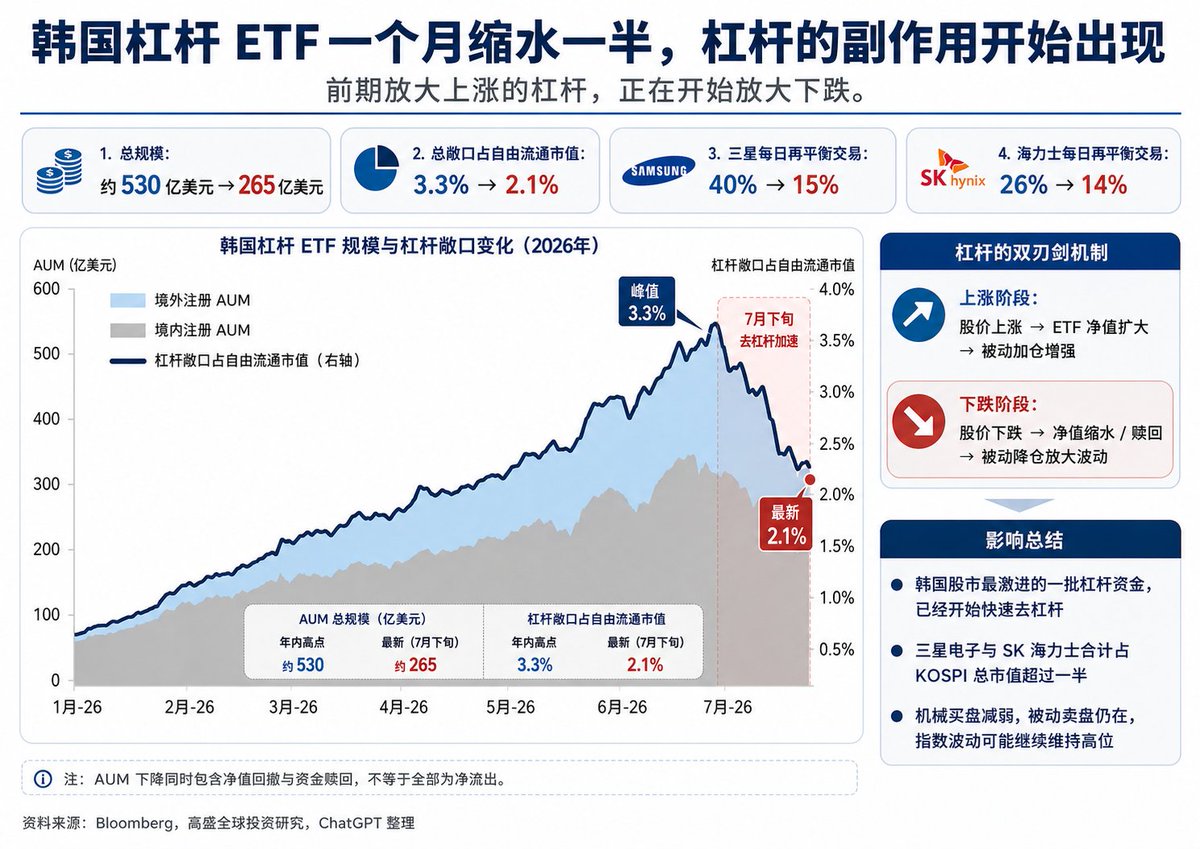
The South Korean leveraged ETF has shrunk by half in a month, and the side effects of leverage are beginning to appear.
The total scale of South Korean leveraged ETFs has decreased by nearly half from its peak in the past month, currently standing at approximately 26.5 billion US dollars. The total exposure, amplified by leverage, now accounts for only 2.1% of the free-float market capitalization of the South Korean stock market, down from 3.3%. The batch of funds that aggressively drove the rise of the South Korean stock market in previous months has begun to rapidly deleverage.
Leveraged ETFs must adjust their positions daily to maintain a fixed multiple. When the market rises, the net value of the funds increases, necessitating continued purchases of stocks to expand exposure. The larger the scale, the stronger the mechanical buying pressure before the market closes. After a decline, the shrinkage in net value, investor redemptions, and daily rebalancing collectively push the funds to reduce their positions, and the leverage that initially amplified the rise begins to amplify the fall.
At its peak, the daily rebalancing trades of the leveraged ETF for Samsung accounted for as much as 40% of its average daily trading volume over the past month, which has now decreased to 15%, while SK Hynix has dropped from 26% to 14%. Samsung and SK Hynix together account for over half of the total market capitalization of KOSPI. After the shrinkage of the leveraged ETF, the South Korean stock market sees a reduction in the incremental buying power that has the biggest impact on heavyweight stocks.
In simple terms, after the prices of Samsung Electronics and SK Hynix rose earlier, the leveraged ETFs continued to chase and buy. The higher the stock prices rose, the larger the fund scale became, leading to stronger passive buying later. Now, this mechanism has reversed; falling stock prices lead to a reduction in net value, the decrease in scale requires the funds to lower exposure, ultimately creating a cycle of falling prices, reducing positions, and continuing to fall.
Currently, the scale of South Korean leveraged ETFs is still nearly three times that of the beginning of the year, with nominal exposure more than double the proportion of free-float market capitalization at the beginning of the year. This round of deleveraging has begun, but it is not yet over. As long as the South Korean stock market continues to decline, the redemptions of leveraged ETFs and daily rebalancing will still generate passive selling, further amplifying the volatility of Samsung Electronics, SK Hynix, and KOSPI.
In summary, the leverage that previously amplified the rises of Samsung and SK Hynix is now accelerating the decline of the South Korean stock market. Only when the scale of the leveraged ETFs continues to decrease can this round of deleveraging be considered to be truly nearing an end.
@Gate Crypto, US stocks, Hong Kong stocks, South Korean stocks, gold, CFDs, one-stop trading for prediction markets
免责声明:本文章仅代表作者个人观点,不代表本平台的立场和观点。本文章仅供信息分享,不构成对任何人的任何投资建议。用户与作者之间的任何争议,与本平台无关。如网页中刊载的文章或图片涉及侵权,请提供相关的权利证明和身份证明发送邮件到support@aicoin.com,本平台相关工作人员将会进行核查。


