Introduction
In July 2026, the global AI trading underwent a real stress test. Since hitting a peak on June 22, the SOXX, which tracks the semiconductor industry, retraced by about 20%; during the same period, Intel and Micron fell by approximately 33% and 30% respectively, while the Philadelphia Semiconductor Index dropped more than 20% from its peak, and the triple-leveraged semiconductor ETF SOXL saw its maximum decline exceeding 50%. However, the overall decline of the S&P 500 Index during this period remained relatively limited, indicating that the market was not entirely pulling away from risk assets, but rather concentrating on unwinding the previously overcrowded positions in AI, chips, and momentum trading.
What is truly noteworthy is not merely the decline in AI stocks, but the fact that this round of adjustments has exposed changes in the global market’s leverage structure. The same stock can first be packaged into a double or triple-leveraged ETF, and then repackaged by cryptocurrency trading platforms into 24/7 perpetual contracts; thus, the same risk can simultaneously exist within stocks, funds, swaps, futures, perpetual contracts, and on-chain collateral. In the past, investors mainly judged a company’s earnings and valuation; now, they must also understand when the leveraged products surrounding that company will be forced to buy or sell, and how these trades will in turn impact the actual stock. This article attempts to address a more specific question: when leveraged ETFs meet stock perpetual contracts, is the market acquiring a more efficient risk management tool or creating a volatility amplifier that transcends traditional finance and the cryptocurrency market?
1. From Stocks to Leveraged ETFs and Perpetual Contracts: The Leverage Forms of Stocks
To understand this round of leveraged product expansion, one must not only look at the product names and multiples but also need to first answer what the users are actually purchasing. Ordinary stocks, leveraged ETFs, stock perpetual contracts, and leveraged ETF perpetual contracts may all display similar company or index names, but the legal rights, return objectives, cost structures, and risk boundaries they represent are completely different. On the surface, the market is increasing the varieties of trades, but in essence, it is increasing the levels at which the same asset risk is replicated, amplified, and redistributed.
1.1 The Four Risk Forms of US Stock Products
Ordinary stocks represent direct or beneficial ownership in listed companies or under brokerage accounts. Investors typically receive economic rights such as dividends and have voting rights based on their account and shareholding arrangements. As long as financing is not used, a downturn in stocks will not trigger automatic liquidation, and investors bear the risks of declining enterprise value and market price fluctuations.
Leveraged ETFs are different. Investors hold fund shares, not the stocks tracked by the ETF. The fund seeks to achieve a daily return of 2x, 3x or inverse returns through swaps, futures, options, margin, and cash management. Users receive a path of fund net asset value that is reset daily rather than additional ownership in the enterprise.
Stock perpetual contracts go a step further. Users neither hold stocks nor fund shares, but instead hold a position in a derivative linked to a reference price with no fixed expiry date. Dividends, voting rights, and shareholder rights typically do not exist; instead, there are margin, funding rates, marked prices, and liquidation mechanisms.
Leveraged ETF perpetual contracts combine the two: the contracts reference not ordinary stocks but an ETF that already incorporates daily leverage. Therefore, what investors are trading is not a "stock perpetual contract," but a "leveraged fund price perpetual contract." The first layer of leverage already exists internally in the fund, while the trading account offers a second layer of leverage.
The comparison table of the four types of US stock product mechanisms is as follows:
Comparison Dimension | Ordinary Stock | Leveraged ETF | Stock Perpetual Contract | Leveraged ETF Perpetual Contract |
Product Substance | Equity in a listed company or beneficial ownership under brokerage accounts | Fund shares aiming for multiple or inverse daily returns | A no-expiration derivative linked to the price of stocks or indexes | A no-expiration derivative linked to the price of the leveraged ETF |
Is Leverage Adjustable | Usually no built-in leverage, but can use broker financing | Multiplier preset by fund goals, usually 2x, 3x, or inverse | User can choose leverage within platform-set maximum limits | User can adjust account leverage but cannot cancel internal ETF leverage |
Trading Hours | Exchange sessions and part of pre and after-hours trading | Follows stock exchange trading hours | Generally 24/7 | Generally 24/7, but the underlying ETF does not trade all day |
Holding Costs | Commission, taxes, and financing interest | Management fees, derivative financing costs, tracking error | Trading fees, spreads, funding rates, and margin costs | Costs contained in ETF plus perpetual funding rates, spreads, and trading fees |
Loss Boundaries | Cash accounts typically limited to invested principal | Usually limited by the value of fund shares, but can close to full loss | Can lose all margin; whether additional loss occurs depends on platform rules | High volatility may trigger liquidation faster and result in margin loss |
Main Risks | Enterprise fundamentals, valuation, and market risks | Compounding bias, volatility erosion, derivative and concentration risks | Liquidation, funding rates, oracle, platform, and basis risks | Nesting leverage, dual path dependence, out-of-hours pricing, and liquidity risks |
1.2 Leveraged ETFs Transforming from Index Tools to Individual Stock Sentiment Tools
Traditional leveraged ETFs primarily revolve around broad-based or sector indices such as the S&P 500, Nasdaq 100, and semiconductor indexes; products like TQQQ, SQQQ, and SOXL have been around for a long time. However, in the last two years, the issuance focus has rapidly shifted towards high-volatility individual stocks like Nvidia, Tesla, Micron, AMD, Palantir, and Strategy.
As of July 21, 2026, the official product listing from Direxion alone showcased 52 leveraged or inverse ETFs on individual stocks, covering a substantial number of AI, semiconductor, and high-beta assets, including NVDA, MU, AMD, TSM, AVGO, PLTR, HOOD, etc. Most of these products pursue a daily long return of 200% or an inverse return of 100%, no longer acting as traditional long-term asset allocation tools, but rather as short-cycle instruments that trade direction and volatility in brokerage accounts.
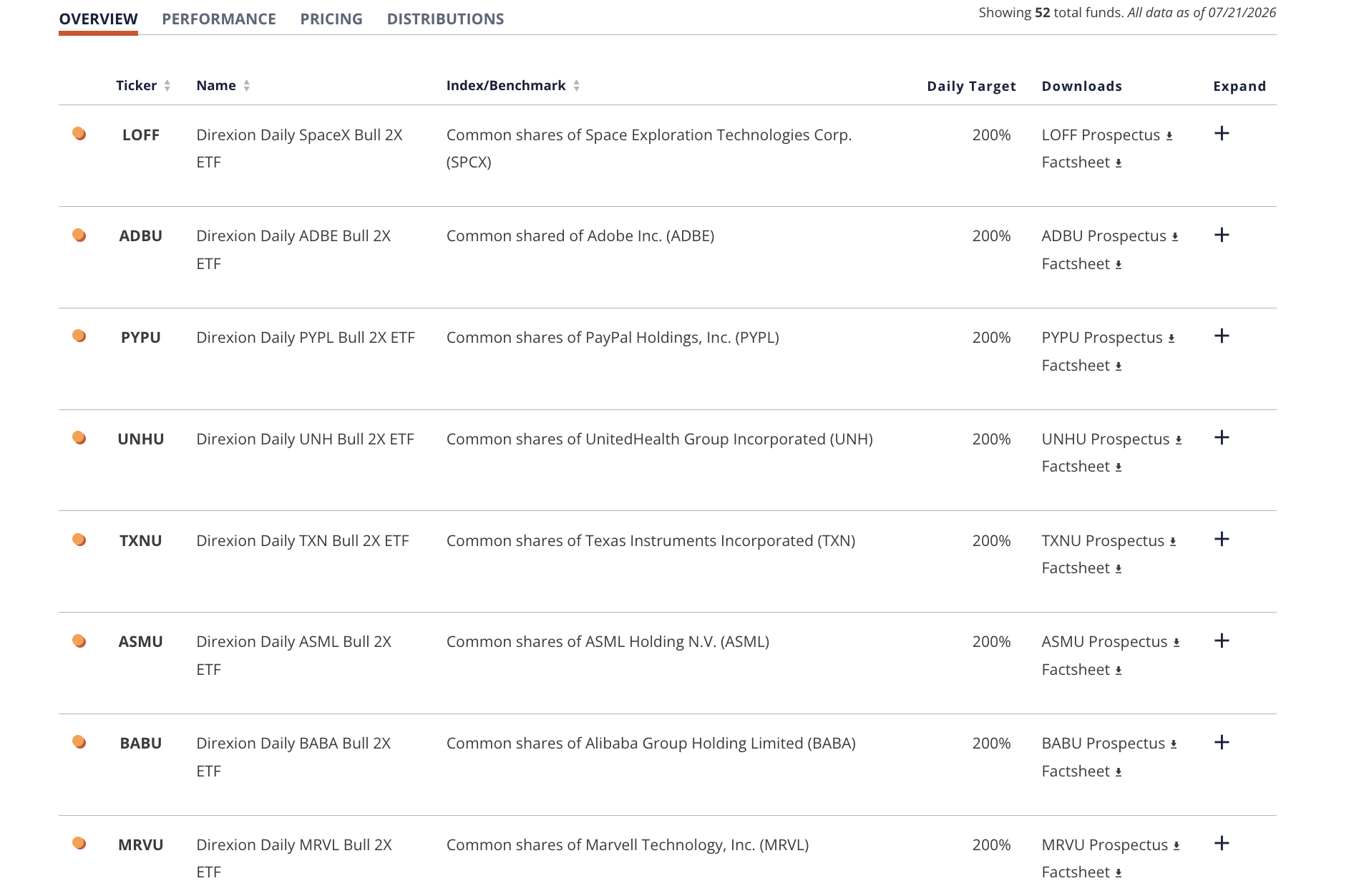
Source: https://www.direxion.com/single-stock-etfs
According to a report by Mirae Asset Securities Research, by June 30, 2026, the net assets of leveraged ETFs in the US and Asia had year-on-year growth of 82% to 249 billion USD. This figure does not yet include the approximately 14 billion USD in the US and around 4.8 billion USD in Asia from inverse ETFs. In other words, leveraged ETFs have already transitioned from marginal products to global market structural variables with a scale exceeding 250 billion USD.
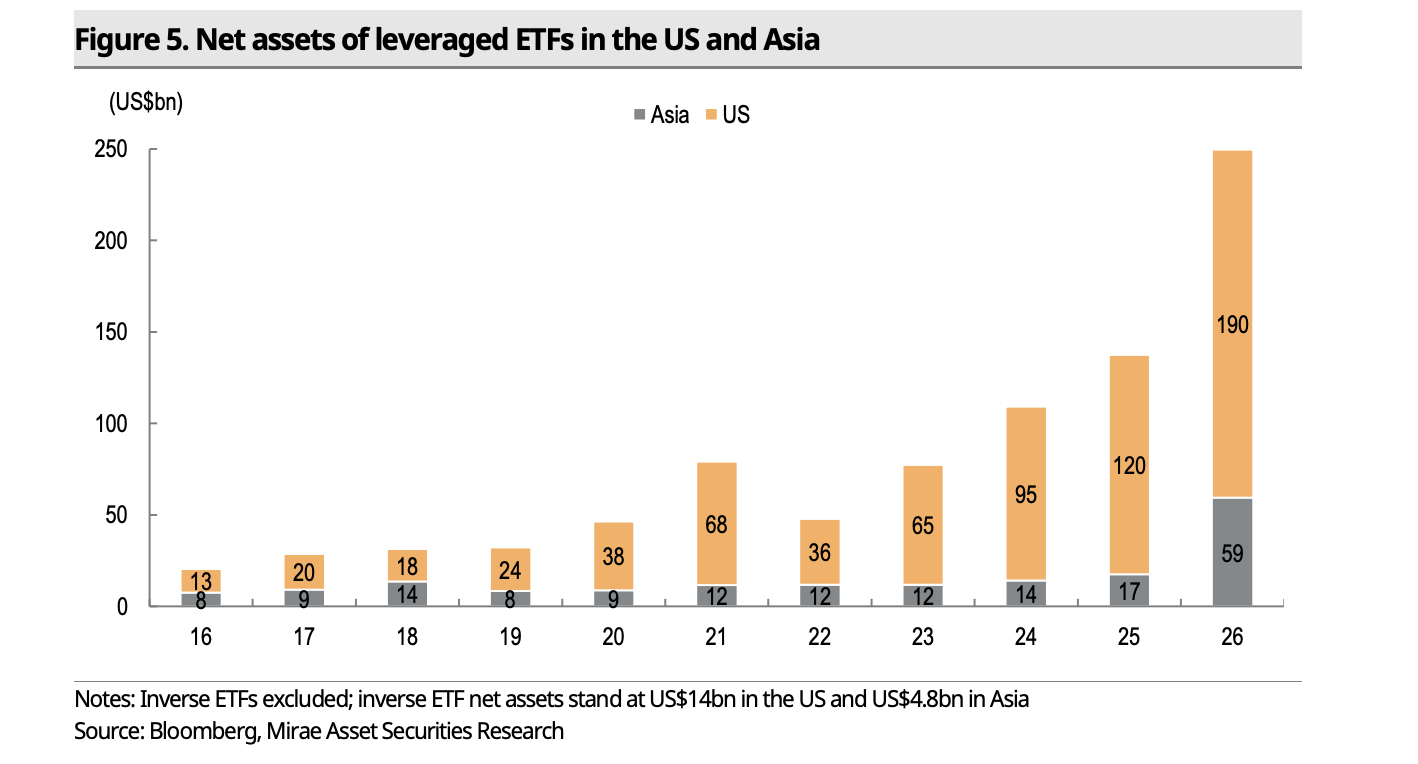
Source: https://securities.miraeasset.com/
1.3 AI and Semiconductors Becoming the Most Crowded Leveraged Trades
Leveraged products typically concentrate in three directions: high volatility, strong narratives, and high liquidity. AI and semiconductors just happen to meet all three conditions simultaneously.
On one hand, the capital expenditure for AI, computing power demand, and the cycle of storage chips have driven stocks like Nvidia, Micron, SK Hynix, and Samsung Electronics to rise significantly; on the other hand, these related stocks have been incorporated into index ETFs, sector ETFs, single stock leveraged ETFs, options, and perpetual contracts. Funds are not simply buying one stock but rather betting in the same direction across multiple product layers.
This structure reinforces trends during upward phases. An increase in stock prices drives the net value of leveraged ETFs higher, and the fund needs to increase risk exposure to restore target leverage; strong performance also attracts more momentum funds, and market makers and derivative trading counterparts need to adjust their hedging positions. Price increases, fund inflow, and mechanical buybacks create a self-reinforcing effect.
However, during adjustment phases, the same structure operates in reverse. In mid-July 2026, the Philadelphia Semiconductor Index fell by about 10% in a single week, retreating over 20% from its June peak; SOXL dropped more than 50% from its high. This does not imply that the logic of the AI industry has ended, but it indicates that when valuation, positioning, and leverage are at high levels, the market does not require a comprehensive deterioration of fundamentals; it only needs marginal buying to weaken, and the leverage structure may amplify a profit-taking move into concentrated deleveraging.
2. The Operating Mechanism of Leveraged ETFs: How Daily Reset Changes Returns and Risks
The most common misunderstanding of leveraged ETFs is interpreting "2x or 3x daily" as "long-term returns always equal to 2x or 3x the underlying's price movements." In fact, these products typically only aim for multipliers of returns for a single trading day. When held for more than one day, the final result is also influenced by daily resets, the sequence of price changes, volatility, financing costs, and compounding effects. Thus, leveraged ETFs are not simply tools for amplifying direction. They not only amplify the rise and fall of the underlying asset but also alter the process by which returns are formed. Whether the trend is continuous, the volatility repeated, and whether the underlying is sufficiently diversified all affect the returns that investors ultimately receive.
2.1 Daily Reset: 2x Leverage Does Not Equal 2x Returns
Suppose an asset falls by 20% on the first day and rises by 25% on the second day, the price would drop from 100 to 80, and then back to 100, resulting in a cumulative return of zero over two days. An idealized 2x leveraged ETF would fall 40% on the first day, with the net value dropping from 100 to 60; on the second day, although it rises by 50%, the net value can only recover to 90 from 60. The underlying asset returned to its original point, but the leveraged ETF still incurs a loss of 10%.
In a continuously rising market, compounding may also yield opposite results. If the underlying rises 10% for two consecutive days, the cumulative increase is 21%; an idealized 2x leveraged ETF rising for two consecutive days at 20% has a cumulative increase reaching 44%, higher than the simple calculation of 42%. This indicates that the more continuous the trend, the more likely compounding will be beneficial; the more repeated price directions and intense volatility, the more noticeable the net value erosion.
The daily reset alters not the leverage multiplier of a given day but rather the way multi-day returns are calculated. Even if investors correctly predict the long-term direction, they may obtain completely different outcomes due to significant fluctuations experienced in between. Hence, leveraged ETFs are complex products where direction, volatility, and holding path jointly determine returns, not tools that can uniformly apply fixed multiples over the long term.
2.2 Mechanical Rebalancing: Buy More as Prices Rise, Sell More as Prices Fall
Ordinary investors "chasing high and killing low" are usually considered to be acting on emotion or behavioral biases, but the chasing of highs and lows in leveraged ETFs is a mechanical operation required by product rules. To maintain the target leverage every day, the fund must adjust its exposures in stocks, futures, swaps, or other derivatives based on changes in net assets.
Assuming a fund’s net assets are 100, with a target of maintaining a 2x exposure, therefore holding about 200 in risk assets. If the underlying rises by 10%, the fund earns about 20 in profits, and net assets increase to 120, causing the original risk exposure to change to 220. To reattain the 2x target, the fund must increase its exposure to 240, meaning it continues to buy about 20 more. Conversely, if the underlying falls by 10%, the fund’s net assets decrease to 80, requiring a reduced 160 in target exposure, therefore needing to decrease by about 20 from the remaining 180.
This implies that positive leveraged ETFs often need to increase exposure after rising and reduce exposure after falling. The larger the fund size, the more concentrated the underlying, and the weaker the market liquidity, the more likely this directionally consistent rebalancing will affect prices. In an upward movement, it may reinforce the trend; in a downturn, mechanical selling can amplify a normal adjustment into more concentrated selling pressure.
2.3 The More Concentrated the Underlying, the More Fragile the Leveraged Structure
Index leveraged ETFs consist of a basket of assets, and negative events in individual companies can be partially diversified out by other constituent stocks. Single-stock leveraged ETFs, however, concentrate company event risk, holding concentration, and daily leverage all on a single underlying. Poor earnings reports, regulatory changes, industry news, or sudden drops in liquidity can cause significant impacts in just one day.
If a stock drops 20% in one day, the theoretical drop of a 2x long ETF approaches 40%; if the stock falls nearly 50% in one day, the fund may lose most or even nearly all net value. Products typically do not directly require holders to add margin like a margin account might, but they may continue to operate through reducing derivative exposure, reverse splits, or shutting down products.
Therefore, "investors did not receive a liquidation notice" does not mean that the product has not undergone deleveraging. Leveraged ETFs enforce forced liquidation internally within the fund, and what investors see is a rapid shrinkage of net value. The more concentrated the underlying, the more evident this risk becomes. Index declines usually involve joint actions from multiple components, while a single stock can experience a gap due to an unexpected event. The leverage mechanism does not distinguish whether price changes arise from short-term emotions or long-term fundamentals; it simply adjusts positions according to daily price changes, which is why single-stock leveraged ETFs are more fragile compared to index products.
2.4 Leveraged ETFs for Crypto Assets: Expansion from BTC to Long-tail Assets
The application scope of leveraged ETFs has expanded from stock indices, sectors, and individual stocks to include crypto assets. Investors in traditional securities accounts do not need to directly hold tokens, as they can gain single-day leveraged exposure to crypto assets through funds. The same daily reset, path-dependent, and mechanical rebalancing mechanisms are thus replicated into the higher volatility and longer trading hours of the crypto market.
As of July 23, 2026, the Volatility Shares official product list includes 9 double leveraged crypto asset ETFs such as BITX, ETHU, SOLT, XRPT, CHNU, CRDX, STLU, SUIL, and AVAZ. In terms of product coverage, crypto leveraged ETFs have expanded from BTC and ETH to include more long-tail assets. However, in terms of capital distribution, the vast majority of net assets are still concentrated in BTC and ETH.
3. From TQQQ to TQQQ Perpetual: How the Second Layer of Leverage Forms
If leveraged ETFs repackage the daily returns of an index or stock into fund shares, then leveraged ETF perpetual contracts repackage the price fluctuations of these funds into margin products. Traders do not need to purchase full ETF shares; they only need to pay a portion of the margin to establish a larger contract position. Although both layers of leverage track the same price path, they come from completely different systems. The first layer is achieved by the fund through derivatives, centered on daily resets; the second layer is obtained by traders through margin, centered on marked prices and liquidation mechanisms.
3.1 Fund Leverage and Account Leverage: Two Independent Systems
The first layer of leverage exists within the fund. Products like TQQQ and SOXL typically pursue fixed multiples of the underlying index's daily returns using swaps, futures, or other derivatives. The fund adjusts its exposure according to net assets and target multiples, thus investors hold a daily-reset net fund value path, not a long-term fixed index multiple.
The second layer of leverage comes from perpetual contract accounts. Traders pay a portion of the margin to establish a larger TQQQ perpetual position. The platform continuously calculates the position value, maintenance margin rate, marked price, and liquidation price. When losses make the margin fall below requirements, the platform may reduce or directly liquidate user positions.
The leverage bases of the two systems are also different. The fund's 2x or 3x is calculated relative to the net assets of the ETF for daily target exposure; the perpetual contract's 5x or 10x is the ratio of the contract's nominal value to the user's margin. The former determines how the ETF price responds to the underlying assets, while the latter dictates how much profit or loss such price changes will bring to the trading account.
3.2 How Perpetual Contracts Are Priced: Index, Marked Price, and Funding Rates
Perpetual contracts have no fixed expiry date, and platforms typically use reference indexes, marked prices, and funding rates to keep the contract prices running around the reference underlying. The reference index determines what price the contract tracks; the marked price is mainly used to calculate unrealized profits and losses and to determine whether to trigger liquidation; the funding rate limits the long-term divergence of the contract price from the reference price through periodic payments between long and short parties.
Exchanges such as Binance and Hotcoin have launched USDT-based perpetual contracts like TQQQ, MVLL, and MUU, supporting 24/7 trading. The relevant contracts usually settle funding rates every 8 hours; these contracts track ETFs that already apply daily leverage, and the perpetual account's leverage will further amplify profit, loss, and liquidation risks. During US stock trading hours, the market prices of leveraged ETFs, fund net values, and related derivatives can provide considerable pricing references for perpetual contracts; however, after US stock market close, contracts continue to trade, but price calculations rely more on the index sources and marked price rules set by the platform.
In addition to price changes, traders also need to bear funding rates and trading costs. If the market's long positions are concentrated, funding rates may consistently be positive; long-term holders might continuously pay fees even if they correctly judge the direction. Conversely, if funding rates are negative, shorts may pay longs. The final returns on perpetual contracts, therefore, depend not only on the rise and fall of TQQQ but also on holding time, account leverage, funding rates, and the platform's liquidation rules.
3.3 A 3x ETF Plus a 10x Contract, Does It Really Equal 30x?
Assuming an ETF pursues a 3x return on the Nasdaq 100 index for a single day, and a trader uses 100 USD margin to establish a value of 1000 USD in ETF perpetual positions with 10x account leverage. In an ideal scenario, if the index rises by 1% in a single day, the ETF price may rise about 3%, leading to profit of about 30 USD from the perpetual position, which is 30% of the margin. In terms of short-term price sensitivity, the nominal exposure undertaken by the trader is close to 30 times the underlying index.
However, this does not imply that there exists a long-term fixed "30x Nasdaq product" in the market. The ETF's 3x target resets daily, and the calculation basis for the next day changes with the previous day's profits and losses; the actual account leverage of perpetual contracts also varies in real-time based on margin and unrealized profits and losses. Additionally, funding rates, trading fees, ETF premiums/discounts, and reference price deviations may further cause the final result to deviate from a simple multiple calculation. For example, after favorable market conditions change, the account equity increases, leading to a decrease in the actual leverage ratio; conversely, if market conditions turn unfavorable, the account equity decreases, potentially leading to an increase in the actual leverage ratio. Traders might be liquidated for insufficient maintenance margin before the underlying index experiences a corresponding cumulative decline of 30 times. Therefore, "30x" is better suited to describe an ideal point of price sensitivity at a given moment, rather than a sustained yield multiple over the long term.
The essence of dual-layer leverage is that two independent mechanisms act on different bases: the fund adjusts its internal exposure according to daily targets, while the platform manages user positions according to real-time margins. The two can create very high nominal price sensitivity in the short term, but actual returns and risks are always in dynamic flux.
4. Leveraged ETFs Combined with Perpetual Contracts: Four New Contradictions in Market Structure
The combination of leveraged ETFs with perpetual contracts brings changes beyond just higher leverage multiples. More importantly, the fund rebalancing, derivative hedging, and net value changes that originally belonged to the securities market begin to connect with the crypto market’s margin, liquidation, funding rates, and round-the-clock trading. As a result, the same stock risk is repeatedly packaged and transmitted across different accounts, platforms, and trading sessions.
4.1 The Contradiction Between All-day Trading and Non-All-day Liquidity
Stock perpetual contracts convert assets that are subject to US stock trading time limitations into products that can be traded 24 hours a day, reducing time zone and securities account barriers. However, just because the trading interface is open all day, it does not mean that the underlying assets and real liquidity are also operating all day.
After US stock markets close, stock and ETF subscriptions and redemptions are paused, fund net values are no longer updated continuously, and the liquidity of major hedging markets such as options and futures also declines. While perpetual contracts still have quotes, market makers cannot promptly hedge through the underlying assets, relying instead on their own inventory, related assets, and expectations of future opening prices. At this point, buy and sell orders resemble a kind of "synthetic liquidity."
In stable markets, this difference may not be obvious; however, once unexpected news or concentrated selling occurs, market makers may widen spreads and reduce orders, making prices more easily influenced by small amounts of capital. Therefore, 24/7 trading merely shifts risk from "not being able to trade during market closures" to "being able to place orders at any time, but not necessarily exiting at fair prices." All-day trading increases entry opportunities but does not concurrently improve the market's ability to absorb selling pressure in stressed environments.
4.2 The Contradiction Between Continuous Price Discovery and Fragile Price Anchors
Stock perpetual contracts continuing to trade after US stock market closure allow the market to digest earnings reports, policies, and unexpected events in advance. Investors do not have to wait for the next US stock market opening to express their judgments on price changes. From this perspective, perpetual contracts extend the price discovery time for stock risks.
However, continuous quoting does not equal reliable pricing. Prices for stocks, ETFs, options, and futures cease updating or diminish in liquidity following the US stock market closure, causing perpetual contracts to rely more on the latest closing price, oracle rules, movements of related assets, and models from market makers. If the reference indexes are leveraged ETFs like TQQQ, SOXL, daily resets, derivative valuations, and financing costs further increase the difficulties in pricing.
Thus, the perpetual prices during market closures are closer to "market expectations of the next opening price," rather than real net values that can be arbitraged immediately. Limited liquidity may cause basis expansion and price jumps, even leading to the liquidation of high-leverage positions due to temporary deviations. Price discovery is made more continuous, but the underlying support for pricing may not be equally stable.
4.3 The Contradiction Between Diversified Trading and Relay Deleveraging
Leveraged ETFs and perpetual contracts spread across different markets appear to disperse risks among fund holders, contract traders, market makers, and trading platforms. However, as long as these products track the same underlying asset, they will connect through price, hedging, and margins. Although the trading venues may be separate, the ultimate underlying asset carrying the risk may still be the same.
Perpetual contracts force liquidation in real-time based on margin rates, while leveraged ETFs adjust exposures primarily before and after market close. When the market declines, perpetual long liquidations may occur first, followed by ETFs reducing exposure at market close; after US stock markets are closed, contracts continue trading the remaining risks, and the next day, the stocks may absorb the price deviations formed overnight. Risk does not release all at once; instead, it may relay across markets and time zones.
According to the Seoul Economic Daily, citing a report from JPMorgan on July 21, 2026, the assets of related leveraged ETFs in South Korea once reached about 50 billion USD and subsequently fell to about 26 billion USD. If JPMorgan’s considered reasonable target is 18 billion USD, this round of asset scale contraction has completed about 75%. This indicates that when the market shifts from rising to falling, the daily rebalancing of leveraged ETFs, investor redemptions, and other leveraged fund reductions may combine, causing adjustments triggered by fundamentals or sector rotations to further evolve into liquidity-driven deleveraging processes.
4.4 The Contradiction Between Global Product Distribution and the Invisibility of Total Leverage
The same stock can simultaneously exist in margin trades, leveraged ETFs, options, swaps, centralized exchange perpetuals, and on-chain derivatives. Products distributed across different markets and jurisdictions provide more entry points for global investors, but they also make the total risk exposures around the same underlying increasingly difficult to aggregate.
Each fund discloses its own objectives and partial holdings, and each trading platform has its independent margin and liquidation rules, but they typically can only observe internal positions. Platforms cannot confirm whether users hold the same risks in other markets, and securities regulators find it hard to grasp the true exposures of offshore crypto platforms. Although partial information may seem transparent, the overall leverage might exist in a blind spot.
Therefore, in the future, monitoring should not only focus on the scale of a particular ETF or the contract holdings of a specific platform, but rather on the consolidated exposure of the same underlying across different products, the concentration of market maker hedging, and the common exits that might be used when multiple markets deleverage simultaneously. The more globalized the products become, the more the market needs to shift from single product regulation to monitoring total leverage.
5. Outlook and Conclusion: Dual-layer Leverage Accelerates and Amplifies Market Volatility
The combination of leveraged ETFs and perpetual contracts is bringing traditional securities products into an all-weather crypto trading system. As more underlying assets and platforms join, a more crucial question arises: does this structure merely expand trading entry, or is it changing the ways pricing, liquidity, and risk transmission operate between different markets? Its long-term viability will depend on whether the speed of product expansion can maintain a balance with the market’s capacity to absorb it.
5.1 Outlook: Crypto Platforms Will Bring More Traditional Leveraged Products into 24/7 Trading
Leveraged ETFs and stock perpetual contracts will not replace each other but may form a layered market: traditional finance is responsible for creating standardized asset exposures, while crypto platforms repackage and distribute them globally through stablecoin margins, cross-border accounts, and 24/7 trading. The coverage of stock perpetual contracts may further extend from indices and large tech stocks to include individual stocks, sector ETFs, leveraged ETFs, and more high-volatility assets.
As the market expands, crypto platforms may gradually transform from mere followers of US stock prices into risk rehearsal venues during market closures. However, in the future, the competition between CEX and DEX will focus not only on how many underlying assets are listed but also on who can provide more reliable prices, more stable liquidity, and more effective risk management during market closures or periods of significant price fluctuations.
Assessing market risks cannot solely look at the number of products; it is also necessary to observe the ratio of leveraged ETF scales to underlying liquidity, perpetual contract open interest, funding rates, market closure bases, and market maker hedging methods. Regulation also needs to shift from focusing on individual product entry to monitoring cross-market total leverage, identifying consolidated exposures across ETFs, options, swaps, and perpetual contracts in the same underlying.
5.2 Conclusion
The overlap of leveraged ETFs with perpetual contracts has created two distinctly different types of risk amplification. The first layer occurs within the fund: ETFs amplify the daily rises and falls of the underlying asset through daily leverage; the second layer occurs within trading accounts: perpetual contracts amplify ETF price fluctuations through margin. The same underlying asset's volatility is first reflected as larger changes in fund net values, and then transformed into more intense account profits and losses along with liquidation risks.
This amplification affects not only investor returns but may also alter the ways the market adjusts. During uptrends, the increase in ETF exposure and the expansion of perpetual long positions can mutually reinforce the trend; during downturns, contract liquidations, fund reductions, and market maker adjustments can create a directionally consistent selling pressure. Thus, risk extends from a single market's price change to a transmission process of "underlying declines—ETF amplification—contract liquidation—liquidity contraction—repricing."
Fundamentals still determine the medium to long-term direction of the market; dual-layer leverage is not the starting point of market reversals. However, during crowded trading, liquidity declines, or when the underlying market is closed, it may decide how quickly adjustments occur and how far prices deviate from fundamentals. When leveraged ETFs are paired with perpetual contracts, the market gains not only a higher-multiples trading tool but also a machine that links traditional finance and the crypto market, potentially amplifying ordinary volatility into continuous deleveraging.
About Us
Hotcoin Research, as the core research institution of Hotcoin Exchange, is dedicated to transforming professional analysis into your practical weapon. We analyze market trends through "Weekly Insights" and "In-depth Research Reports"; leveraging our exclusive column "Hotcoin Selection" (double-filtered by AI and experts), we help you identify potential assets and reduce trial-and-error costs. Every week, our researchers will also face to face with you through live broadcast, interpreting hot topics and forecasting trends. We believe that warm companionship and professional guidance can help more investors navigate through cycles and seize the value opportunities of Web3.
Risk Warning
The cryptocurrency market is highly volatile, and investment carries risks. We strongly recommend that investors proceed with investments based on a full understanding of these risks and within a strict risk management framework to ensure the safety of their funds.
Website: https://www.hotcoin.com/zh_CN/learn/index/
免责声明:本文章仅代表作者个人观点,不代表本平台的立场和观点。本文章仅供信息分享,不构成对任何人的任何投资建议。用户与作者之间的任何争议,与本平台无关。如网页中刊载的文章或图片涉及侵权,请提供相关的权利证明和身份证明发送邮件到support@aicoin.com,本平台相关工作人员将会进行核查。