Trump accepts ethical restrictions on cryptocurrency, major political resistance to the U.S. cryptocurrency market structure bill (hereinafter referred to as the CLARITY Act) decreases
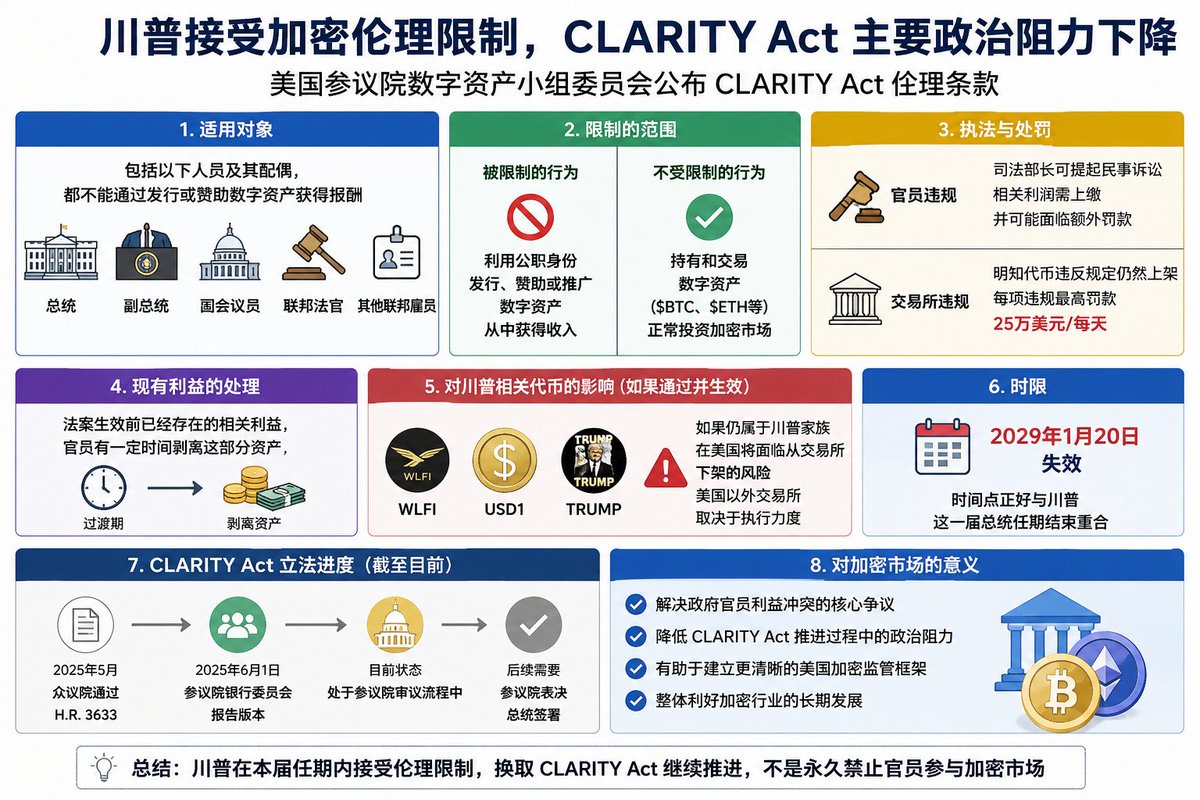
The U.S. Senate Digital Assets Subcommittee released the ethical provisions of the CLARITY Act. According to this plan, the President, Vice President, Members of Congress, federal judges, and other federal employees, as well as their spouses, are prohibited from receiving compensation through the issuance or sponsorship of digital assets (cryptocurrencies).
Of course, this set of rules does not restrict the holding and trading of cryptocurrencies.
Trump and other government officials can still hold bitcoin:native and ethereum:native, and can normally invest in the cryptocurrency market. What is restricted is the use of public office to issue, sponsor, or promote digital assets (cryptocurrencies) and then profit from it.
If officials violate the regulations, the Attorney General can file a civil lawsuit, and any related profits must be surrendered, with additional fines also possible. Exchanges that knowingly list a token that violates the rules can face a penalty of up to $250,000 per violation per day.
For relevant interests that exist before the bill takes effect, officials will have a certain amount of time to divest those assets.
PS: This indicates that if the bill is passed and takes effect, and ethereum:0xda5e1988097297dcdc1f90d4dfe7909e847cbef6, solana:6p6xgHyF7AeE6TZkSmFsko444wqoP15icUSqi2jfGiPN, and solana:USD1ttGY1N17NEEHLmELoaybftRBUSErhqYiQzvEmuB still belong to the Trump family, then at the very least they will face the risk of being delisted from exchanges in the U.S., while exchanges outside the U.S. will depend on enforcement strength.
The relevant restrictions will expire on January 20, 2029, coinciding with the end of Trump's current presidential term.
Therefore, this seems more like Trump proactively accepting limitations on profiting from the issuance or sponsorship of tokens during his term to address conflicts of interest issues faced by the CLARITY Act, rather than the U.S. preparing to establish a permanent prohibition on government officials participating in the cryptocurrency market.
Currently, this set of ethical requirements has not yet become formal law. As of the last action date listed on the GovInfo page, H.R. 3633 has formed a report version in the Senate but is still in the legislative process.
For the entire cryptocurrency market, this matter is still somewhat favorable. One of the biggest controversies surrounding the CLARITY Act was whether government officials could simultaneously formulate cryptocurrency regulations while profiting from associated tokens.
If this plan can gain sufficient support, ethical concerns will reduce the resistance to the CLARITY Act.
@Gate Crypto, U.S. stocks, Hong Kong stocks, Korean stocks, gold, CFD, and prediction markets all in one trading
免责声明:本文章仅代表作者个人观点,不代表本平台的立场和观点。本文章仅供信息分享,不构成对任何人的任何投资建议。用户与作者之间的任何争议,与本平台无关。如网页中刊载的文章或图片涉及侵权,请提供相关的权利证明和身份证明发送邮件到support@aicoin.com,本平台相关工作人员将会进行核查。


