Author: Oliver Knight
Translation: Baihua Blockchain
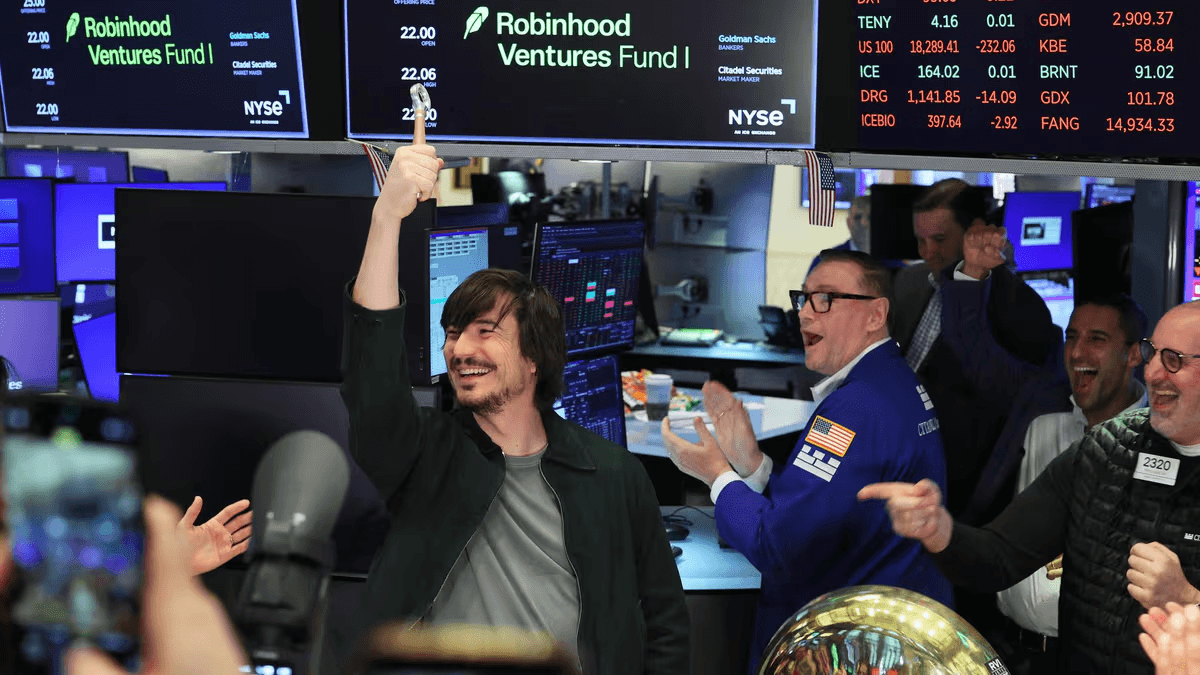
Robinhood (HOOD) stated that its new chain is not intended to compete with native crypto trading platforms like Hyperliquid, but rather to allow 27.6 million users with funded accounts to enter on-chain finance for the first time; however, current data shows that the reality is much more complex than this narrative.
Although the chain set a record with a $878 million 24-hour DEX trading volume on July 12, briefly surpassing Base and Ethereum, on-chain activity is still primarily dominated by Meme coin speculation, rather than its originally targeted tokenized stocks and ETFs.
Among the $734 million assets bridged into the chain, only $211 million has actually been deployed into lending or yield products; meanwhile, the market value of tokenized real-world assets (RWA) on this chain is only $12.66 million, which is even far less than the $156 million peak reached by the cat-themed meme coin CASHCAT.
Robinhood Chain shot up to the second place in decentralized trading platform (DEX) trading volume over the weekend, drawing comparisons to some of the largest networks in the crypto market. However, Robinhood believes this comparison misses the point.
This popular trading app sees its true opportunity not in capturing trading volume from existing native crypto trading platforms, but in leveraging Robinhood's more than 27.6 million "funded account users" to bring the next batch of investors into the tokenized asset and on-chain derivatives market.
Robinhood Crypto product lead Seong Seog Lee told CoinDesk, “Our opportunity does not lie in taking trading volume away from existing crypto traders. Most people have never been exposed to perpetual contracts, not necessarily because they don’t want that exposure, but because there has never been an entrance to that type of product. We are changing that.”
He also stated, “Now, users in over 120 countries can directly trade gold, silver, foreign exchange, and crypto perpetual contracts within the Robinhood Wallet through Lighter.”
Robinhood's bet seems to be that with its distribution capabilities, consumer relationships, and wallet integration, it can bring users who might not otherwise engage with on-chain finance directly into the blockchain market, without requiring them to seek out more specialized crypto platforms.
But the current issue is that activity on this network remains highly concentrated in speculative meme coin trading, while its initial narrative around real-world asset businesses is still very small in scale. According to DefiLlama data, Robinhood Chain's $878 million 24-hour DEX trading volume on July 12 briefly exceeded Coinbase's Base and Ethereum, sparking heated discussions in the crypto community.
However, the absolute scale is still quite limited.
On July 13, the trading volume of perpetual contracts on this chain was only $5.9 million; in contrast, the decentralized trading platform Hyperliquid, which has become the benchmark for on-chain derivatives, saw trading volumes of up to $8.9 billion that day. Meanwhile, the total bridged locked value (bridged TVL) on Robinhood's chain reached $734 million, far higher than its actual TVL of $211 million.
This gap indicates that many assets are merely sitting in wallets and have not truly been deployed to the chain's lending pools and yield products.
This was a situation previously seen on another network, Blast. Blast attracted over $2 billion in bridged assets due to its points incentive program, drawing many “yield-chasing” participants who were only there to wait for future airdrops. As the incentive program ended, its TVL ultimately collapsed significantly.
However, Robinhood's situation may not be entirely the same, as it does not have such yield incentives.
Even so, this contrast underscores that this mass-market trading platform's blockchain business is still at a very early stage. Although the network had a brief surge of spot trading, it has yet to develop the more mature, deeper trading activities and capital deployment that are common on blockchains.
“Very Suitable for Issuing Memes”
The initial core use case of this chain was tokenized real-world assets (RWA), including related narratives brought by equity products raised through Robinhood with unlisted companies like OpenAI and SpaceX. But at least so far, this part of the business has not formed a significant scale.
The active market capitalization of tokenized real-world assets is only $12.66 million, nearly negligible compared to the recent trading frenzy. Conversely, a larger share of activity comes from meme coin traders who flocked to a new token named CASHCAT—named after Robinhood's early corporate mascot.
This token surged over 2100% in its first week, with a market cap that once reached $156 million, making it 12 times the total market cap of all tokenized real-world assets on the chain.
Of course, it should also be pointed out that meme coins are inherently high-volatility, sentiment-driven asset classes that often lack a foundation for sustainable growth.
This unsustainability was already evident on Wednesday: the token issuance platform Noxa, which incubated CashCat, announced it would cease operations and stated it would transfer all revenues to the creators. Noxa's closure does not determine the fate of Robinhood Chain, but it highlights one point: activities built around the issuance of meme coins can disappear very quickly.
Ironically, Robinhood CEO Vlad Tenev told CNBC on July 2 that meme coins are a dead-end—these assets lack utility and practical use. Yet just six days later, he posted on X that Robinhood Chain “is also very suitable for issuing memes,” clearly responding after seeing the popularity of CASHCAT.
When asked about this seemingly contradictory statement, Lee expressed that although meme coins are not the core strategic focus of the team, the chain is indeed built with the goal of an “open financial system.”
Lee said, “I don't think there's a contradiction. If you're creating an open financial system, then it should certainly also support meme coins. The most exciting thing about Robinhood Chain is that we cannot fully foresee what all might happen in the future.”
“Democratizing Finance”
Robinhood Chain officially opened to the public earlier this month, having tested for several months since February. This network is built on Arbitrum and is an Ethereum Layer 2, primarily designed to host tokenized real-world assets, especially stocks and ETFs, rather than meme coin trading.
This launch reflects Robinhood's broader strategy: to bring traditional financial assets onto the blockchain through its own blockchain infrastructure aimed at retail users.
The situation that Robinhood Chain is currently experiencing is quite similar to the path of most new chains at launch. The market will always immediately compare it with past talkative networks, such as Blast—which saw its TVL drop from $2.2 billion to $29 million over two years.
For Robinhood Chain, a more valuable comparison is actually Coinbase's Base, launched in 2023. Base initially also carried an institutional narrative but gradually emerged to show real scale driven by meme coins.
The difference is that Base ultimately grew into a consumer-grade blockchain with real developer activity and broader user coverage.
The key question in the coming months is whether this current wave of speculative activity will settle into long-term usage, or whether the heat here will quickly fade as traders move on to the next hot concept.
Lee stated, “We look forward to users discovering the various possibilities that Robinhood Chain can bring, including bringing real-world assets onto the chain, 24/7 stock token trading, and on-chain lending, etc.”
Article link: https://www.hellobtc.com/kp/du/07/6389.html
Source: https://www.coindesk.com/business/2026/07/17/inside-robinhood-s-high-stakes-bet-to-onboard-10-million-casual-investors-onto-decentralized-finance
免责声明:本文章仅代表作者个人观点,不代表本平台的立场和观点。本文章仅供信息分享,不构成对任何人的任何投资建议。用户与作者之间的任何争议,与本平台无关。如网页中刊载的文章或图片涉及侵权,请提供相关的权利证明和身份证明发送邮件到support@aicoin.com,本平台相关工作人员将会进行核查。


