Last week, the new chairman of the Federal Reserve, Kevin Walsh, handed in his first monetary policy report since taking office.
The Federal Open Market Committee decided to maintain the target range for the federal funds rate at 3.50%—3.75%, with all 12 voting members in favor and no dissenting votes (see more reading in Walsh's debut eve: More important than rate cuts is how the Fed reshapes expectations?), marking a rather uneventful "hold" decision.
However, at the same time, this policy statement was condensed into three paragraphs, roughly a hundred words, significantly shorter than in previous meetings, with parts previously used to describe the balance of risks, future policy adjustments, and data dependency directly removed; even the "forward guidance" that the market had grown accustomed to over the years disappeared.
Walsh made it clear at the press conference that the new statement is "shorter, simpler, and removes some old language." Having experienced the most severe phase of the 2008 financial crisis, he believes that the current environment is changing too quickly for the Fed to commit to future actions prematurely; instead, it should redirect market attention back to the economic data itself.
This may also be the true signal released by the June FOMC meeting: the Fed under Walsh is no longer trying to reduce market uncertainty; rather, it is prepared to return some uncertainty back to the market.
A new communication framework has begun.
1. Interest Rates Unchanged, Fed's Policy Language Changes
For many investors, Walsh remains a relatively unfamiliar name.
But he is not a newcomer to the Federal Reserve. From 2006 to 2011, Walsh served as a Fed governor, experiencing the 2008 financial crisis and subsequent quantitative easing. After leaving the Fed, he has long criticized the excessive expansion of the central bank's balance sheet, the proliferation of forward guidance, and the excessive intervention of monetary policy in financial markets.
Thus, compared to reducing market volatility through policy hints, Walsh trusts price signals more and emphasizes monetary discipline, encapsulated in the core idea that "the central bank should clearly state its targets but does not need to announce every operational step in advance to the market."
This thinking was fully reflected in his first FOMC meeting.
Apart from cancelling forward guidance, Walsh also refused to submit his own interest rate path in this economic forecast, believing that the current version of the dot plot could easily be misinterpreted by the market as a commitment to policy; in reality, each dot merely represents officials' conditional forecasts based on available information.
He even described that officials seemed to submit forecasts using "pencils with big erasers"—data might change, and forecasts could be erased and rewritten at any time.
However, even though Walsh attempted to downplay the significance of the dot plot, the market still recognized a very clear shift. Among the 18 participants in this forecast submission, 9 expected at least one rate hike before the end of 2026, 8 expected rates to remain unchanged, and only 1 anticipated a rate cut.
Moreover, it is noteworthy that among the 9 who expect rate hikes, 3 anticipate one hike, 5 anticipate two hikes, and 1 anticipates three hikes. The median policy rate at the end of the year has also risen from the 3.4% predicted in March to 3.8%, indicating that under the median scenario, the Fed may not only refrain from cutting rates this year but could actually raise them by 25 basis points.
Meanwhile, the Fed raised its 2026 PCE inflation forecast significantly from 2.7% in March to 3.6%, while the core PCE forecast increased from 2.7% to 3.3%.
In other words, the message released by the June meeting is not complicated: the economy is not weak enough to require rescue, yet inflation is already strong enough to preclude discussions of rate cuts, which is why the "Walsh rate cut trade" that the market once anticipated quickly exited after his debut.
Additionally, when Trump nominated Walsh, the market generally speculated that the new chairman might be more willing to cut rates than his predecessor, but at the hearing, Walsh made it clear that the president never asked him to commit to any interest rate decision in advance, and even if someone made such a request, he would not accept it.
It seems that Walsh is not in a rush to prove whether he is hawkish or dovish; what he first wants to demonstrate is that the Fed still has the ability to say no to inflation.
2. What Kind of "Hot Potato" Did Walsh Take Over?
Objectively speaking, the first challenge Walsh faces is still inflation.
The overall PCE in the U.S. rose by 3.8% year-on-year in April, while the core PCE increased by 3.3%, still showing a significant gap from the Fed's long-term target of 2%.
What complicates the situation is that the current inflation does not stem from a single factor.
On one hand, energy prices and geopolitical situations continue to affect upstream costs; on the other hand, supply chains, tariffs, and service costs are still generating broader transmission pressures. Should energy prices rise significantly and diffuse to transportation, manufacturing, and consumer spending, the Fed would have to deal not only with a short-term shock but also the risk of inflation expectations resurfacing.
At the same time, the employment market is much stronger than the market previously expected. The U.S. employment report for May, released on June 5, showed that non-farm payrolls increased by 172,000, about double the market expectation; the unemployment rate continued to hold at 4.3%.
Under normal circumstances, this would be welcome data. However, in the current environment, "good economic news" has translated into "bad monetary policy news" in the market; on the day the employment data was released, the Nasdaq Composite Index fell by 4.18%, marking its largest single-day drop in over a year. Semiconductor and high-valuation tech stocks were hit hard, while bond yields rose notably.
Trump later posted on Truth Social, confusingly writing: "With such a good employment report, stocks should rise, not fall. This has always been the case for the past 200 years."
This precisely reveals the most contradictory aspect of the current market: Walsh is not taking over an economy that, like during the pandemic, was on the brink and in dire need of central bank support in the form of unlimited easing to survive. Instead, he is dealing with an economy that, like in 1994, superficially shows a strong pulse but carries the hidden risk of stagflation, potentially stalling at any moment due to a monetary policy misstep.
Now, raising rates risks crushing the recovery, while cutting rates threatens inflation to rebound; this is precisely the most difficult situation for him to manage.
This is why, for Walsh, the challenge is not simply a choice between "raise or lower rates," but a precise control of policy timing.
It is also worth noting that in April this year, the Fed faced four dissenting votes, the first large-scale internal disagreement since 1992, and such division was not sudden. Over the past two years, deepening cracks within the Fed had long been accumulating: the dovish faction believed that the employment market had cooled down and that rate cuts should be initiated soon to prevent an economic hard landing, while the hawkish faction insisted that inflation had not truly been tamed, and that rate cuts would be counterproductive.
The unexpected 50 basis point cut in September 2024 caused fierce internal debate, with then-governor Michelle Bowman casting a dissenting vote, becoming the first Fed governor in nearly twenty years to publicly clash with the chairman on a rate decision. Trump's appointment of new members and pressure on the Fed’s independence escalated the political color permeating discussions on monetary policy at a visible speed.
Therefore, Walsh is taking over a team with deep divisions in policy direction; now, this chair has a new occupant, but the long-standing disagreements have not dissipated. Walsh has taken on not just a position, but a ticking time bomb that could explode in public meetings at any moment.
How to build internal consensus is, in itself, the first test Walsh faces.
3. How Are Global Assets Being Repriced?
For the market, the hawkish tone of this FOMC has also become a wind vane for the stock market.
Firstly, the most direct interest rate trades are the U.S. dollar and U.S. Treasury bonds.
On the asset side, the logic behind the U.S. dollar bull ETF UUP.M is relatively straightforward; after all, the higher the market's expectations for the policy rate, the more obvious the interest rate differential advantage of U.S. assets compared to other currency assets usually becomes. Therefore, after the June FOMC, the dollar index rose by about 0.5%, reflecting the market's revaluation of potential rate hikes.
The environment facing mid-term U.S. Treasury bond ETF IEF.M, however, is more complex. As is well known, bond prices move inversely to yields. If inflation forecasts continue to be revised upward and the market further bets on rate hikes, mid-term Treasury yields may remain high, creating pressure on IEF.M.
However, this does not mean that U.S. Treasuries are solely subject to a one-way decline. Should employment or consumer data suddenly weaken, concerns about an economic recession could cause safe-haven funds to swiftly return to Treasuries. Therefore, what affects U.S. Treasuries is not only whether the Federal Reserve will raise rates next but also how the market assesses growth prospects post-rate hikes.
Gold stocks GLD.M and IAU.M are currently relatively entangled assets in allocation; high real interest rates theoretically suppress gold, but geopolitical risks in the Middle East and central banks globally continuing to accumulate gold provide another support. Therefore, when these two forces pull against each other, gold is better understood as a hedge rather than an aggressive allocation.
Silver stocks SLV.M and SIVR.M offer an additional industrial logic compared to gold; the demand for electrical infrastructure and industrial metals driven by AI infrastructure has given silver independent demand support beyond its monetary attribute, making it comparatively more buffered under similar macro pressures.
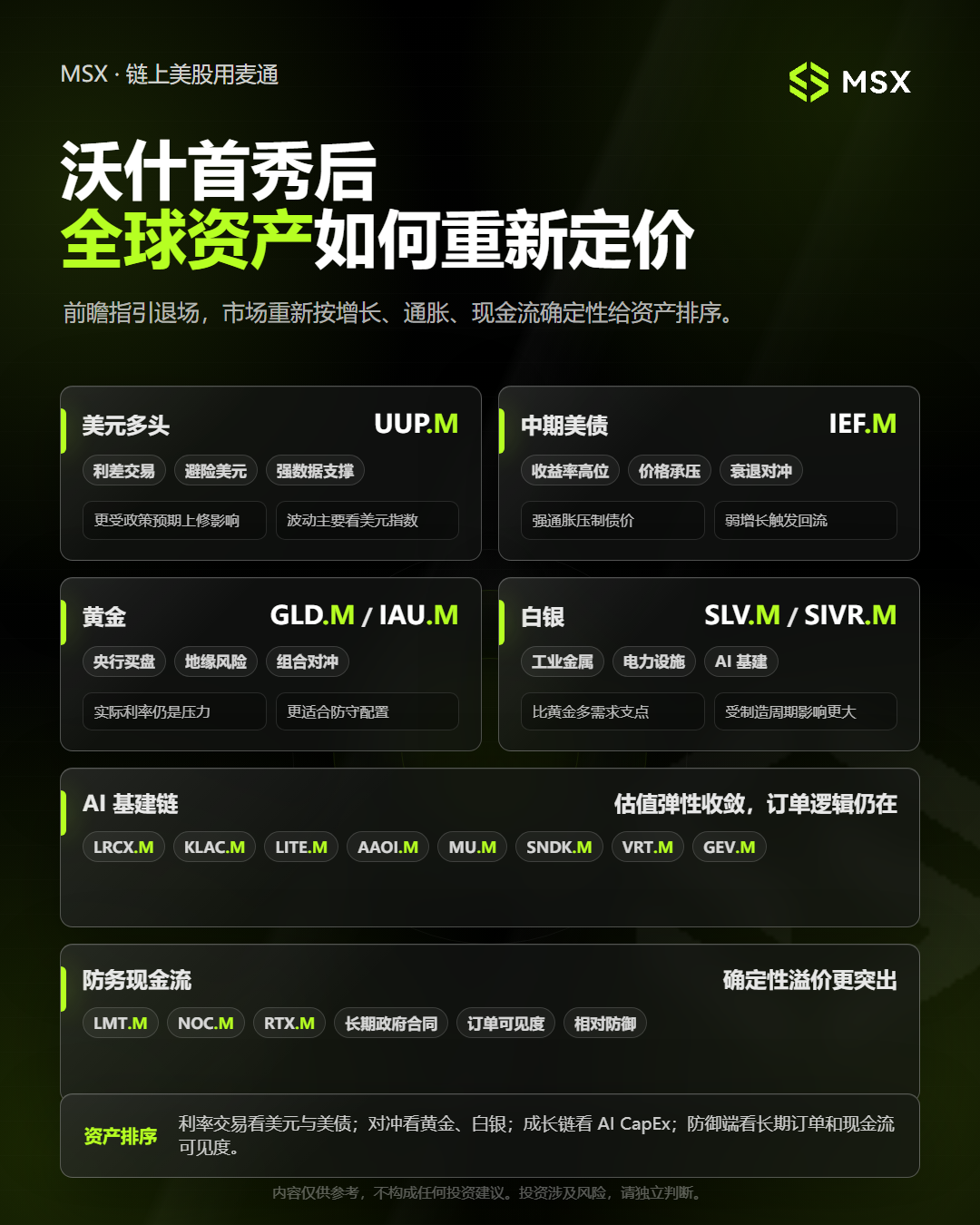
As for the impact of high interest rates on the AI infrastructure mainline, it can be discussed in two layers; it cannot simply be said that "raising rates will end AI infrastructure":
- First is valuation pressure: Stocks in semiconductor equipment like LRCX.M and KLAC.M, optical communication stocks like LITE.M and AAOI.M, storage stocks like MU.M and SNDK.M, and energy infrastructure stocks like VRT.M and GEV.M—all these companies' valuations are based on revenue expected to be realized in the coming years. Higher interest rates lead to higher discount rates, which decrease the present value of long-term cash flows;
- The second layer is capital expenditure risk: AI capital expenditure from cloud providers is the source for the entire chain. In a high-interest environment, as financing costs rise, will cloud providers reduce budgets? Currently, Microsoft, Google, and Amazon's capital expenditures are still expanding, and the logic of demand has not changed due to interest rate hikes; in addition, while interest rates suppress valuations, order quantities have not decreased, as long as cloud capital expenditures do not show contraction, the industry logic of AI infrastructure remains valid, though the space for valuation expansion has narrowed. We can draw this conclusion by reviewing Google's performance in Q1 2026;
The defense sector also has certain defensive attributes.
Companies like LMT.M, NOC.M, and RTX.M derive most of their revenue from long-term government contracts, and the visibility of orders and cash flows is usually higher than that of high-valuation growth stocks. In an environment of high interest rates, where market preferences lean towards certainty in cash flows, defense assets may gain relative advantage.
However, this does not mean that defense stocks are completely immune to interest rate impacts. Rising yields could still suppress their valuations; true support comes from the policy certainty of defense budgets and long-term orders, rather than being absolutely immune to interest rate risks.
4. Looking Ahead, What Should the Market Really Focus On?
Walsh's first FOMC has already provided an initial answer, namely that the Fed is not prepared to continue planning every step of the policy path for the market; future volatility will be more driven by the data itself.
But this is still only the beginning; in the coming months, there are several key milestones that investors should continue to monitor.
First is the June non-farm payrolls report on July 2. This is Walsh's first complete monthly employment report during his term and the most important labor market signal he will receive before the July meeting. If employment continues to be strong, the window for rate cuts will close further, and discussions of rate hikes will shift from expectation to reality; if the data substantially weakens, market expectations regarding the monetary policy path will loosen, providing space for the logic of rate cuts to be repriced.
Therefore, this data likely will directly determine the tone of the July meeting.

Secondly, the June CPI scheduled for mid-July is the data that cannot be overlooked between the two FOMCs. Walsh made it clear at the press conference that price stability is the current first priority, and if the CPI remains stubborn, his stance at the July meeting will only become more hawkish; if inflation shows a substantial decline, the market will have differing views on his next judgment. Regardless of the outcome, this data will likely trigger significant volatility on the day of release.
Finally, the second FOMC on July 28-29 may be Walsh's actual first interest rate decision. With the accumulation of non-farm and CPI data in July, he will have to make a real policy choice, at which point the market's judgment of him will be clearer, and the direction's outline will be more complete.
Of course, the midterm elections in the second half of the year are undoubtedly a variable with a longer time dimension; as the election approaches, the tension between the White House and the Fed will inevitably be amplified again. Trump's desire for rate cuts will not disappear, and Walsh’s statement at the hearing, "I won't promise," will be repeatedly tested whenever political pressure rises.
The question of monetary policy independence will continue to be background noise in the market in the second half of the year.
免责声明:本文章仅代表作者个人观点,不代表本平台的立场和观点。本文章仅供信息分享,不构成对任何人的任何投资建议。用户与作者之间的任何争议,与本平台无关。如网页中刊载的文章或图片涉及侵权,请提供相关的权利证明和身份证明发送邮件到support@aicoin.com,本平台相关工作人员将会进行核查。


