All platform parties are ready.
Written by: Maher, Foresight News
On June 11, the 2026 FIFA World Cup will officially take place, with the opening match between Mexico and South Africa kicking off at the Aztec Stadium in Mexico City; the final will be held in New Jersey on July 19. This is the first World Cup hosted jointly by the United States, Canada, and Mexico, featuring 48 teams. A total of 104 matches will be played across 12 groups over a span of 39 days, covering 16 cities.
The expansion not only brings more matches but also a significant increase in probability space—the qualification for the top 32 era was relatively certain, while now the top two teams plus the eight best third-place teams progressing increases the chances for "dark horses" and surprises, creating a natural trading ground for prediction markets.
At the same time, in the intersection of cryptocurrency and finance, a silent "second venue" has kicked off early. Hundreds of millions of dollars have flowed into Polymarket, Kalshi, and FIFA's officially designated blockchain prediction market ADI Predictstreet. Players are no longer satisfied with traditional betting odds; instead, they engage in buying and selling event contract shares, capturing tiny price differences between platforms, and combining data models to find marginal advantages, creating a duel of information and capital.
Prediction Markets as the New Battlefield for the World Cup
Traditional sports betting relies primarily on bookmakers opening lines and players betting on wins or losses, with funds flowing to the bookmakers and clear information asymmetry. In contrast, prediction markets are essentially probability markets: participants buy and sell "Yes/No" shares, with correct outcome shares paying out $1, and prices reflecting the consensus probability in real-time. Settlements strictly depend on official results or data sources, providing far greater transparency and auditability than traditional betting.
In the context of cryptocurrency, this model's advantages are particularly pronounced. Platforms like Polymarket support stablecoin settlements and direct wallet connections, allowing global users to trade 24/7 without waiting for bookmakers to adjust odds; on-chain records make large fund flows traceable; and some platforms even offer composability, where positions can be used as DeFi collateral. On the regulatory side, Kalshi, as a CFTC-licensed platform, provides a compliant path for U.S. users; ADI, backed by FIFA, attempts to resolve "data reliability" and "anti-manipulation" pain points through blockchain.
The global attention on the World Cup and its superstar effects (39-year-old Messi and 41-year-old Cristiano Ronaldo possibly facing the last stage of their careers, with Mbappé and Haaland set for a peak duel) make prediction markets even more attractive.
Many platforms are actively pursuing the 2026 World Cup prediction market due to various factors converging to create a "perfect storm." During the 2022 Qatar World Cup, Americans alone wagered about $1.8 billion in the U.S. market, with global betting volumes far exceeding $10 billion. As a transparent and auditable form of probability trading, prediction markets match the preferences of cryptocurrency users for decentralized settlements, 24/7 trading, and on-chain composability. The expansion to 48 teams in 2026 further amplifies uncertainty, creating more tradable outcomes (group qualification, dark horse probabilities, props markets, etc.) and significantly increasing trading opportunities.
Moreover, following the 2024 U.S. elections, prediction markets have validated product-market fit with matured infrastructure. For platforms, this represents not just trading volume opportunities but also strategic positioning: Polymarket aims to expand from political events to high-frequency sports scenes; Kalshi leverages its CFTC compliance advantage to capture regulated sports markets; ADI Predictstreet, backed by FIFA, addresses pain points in data reliability and anti-manipulation; and platforms like Hyperliquid and Coinbase attempt to build an "everything exchange" ecosystem.
The World Cup serves as a critical stress test for the prediction market as it transitions from niche to mainstream and provides the optimal window for platforms to build user flywheels (sports fans → probability trading → DeFi composition → long-term retention).
Polymarket
Polymarket is intensively preparing for the 2026 World Cup; on May 30, Polymarket released a weekly update reporting that the World Cup special page has been fully launched, including map views, elimination round progression charts, and real-time leaderboards, currently in the final testing phase and set to officially launch soon.
This does not mean that users can only participate in predictions once the relevant topics are launched, as the championship predictions have already gone live. As of June 3, the "World Cup Champion" market has seen a cumulative transaction volume exceeding $1.478 billion, far surpassing most single event contracts.
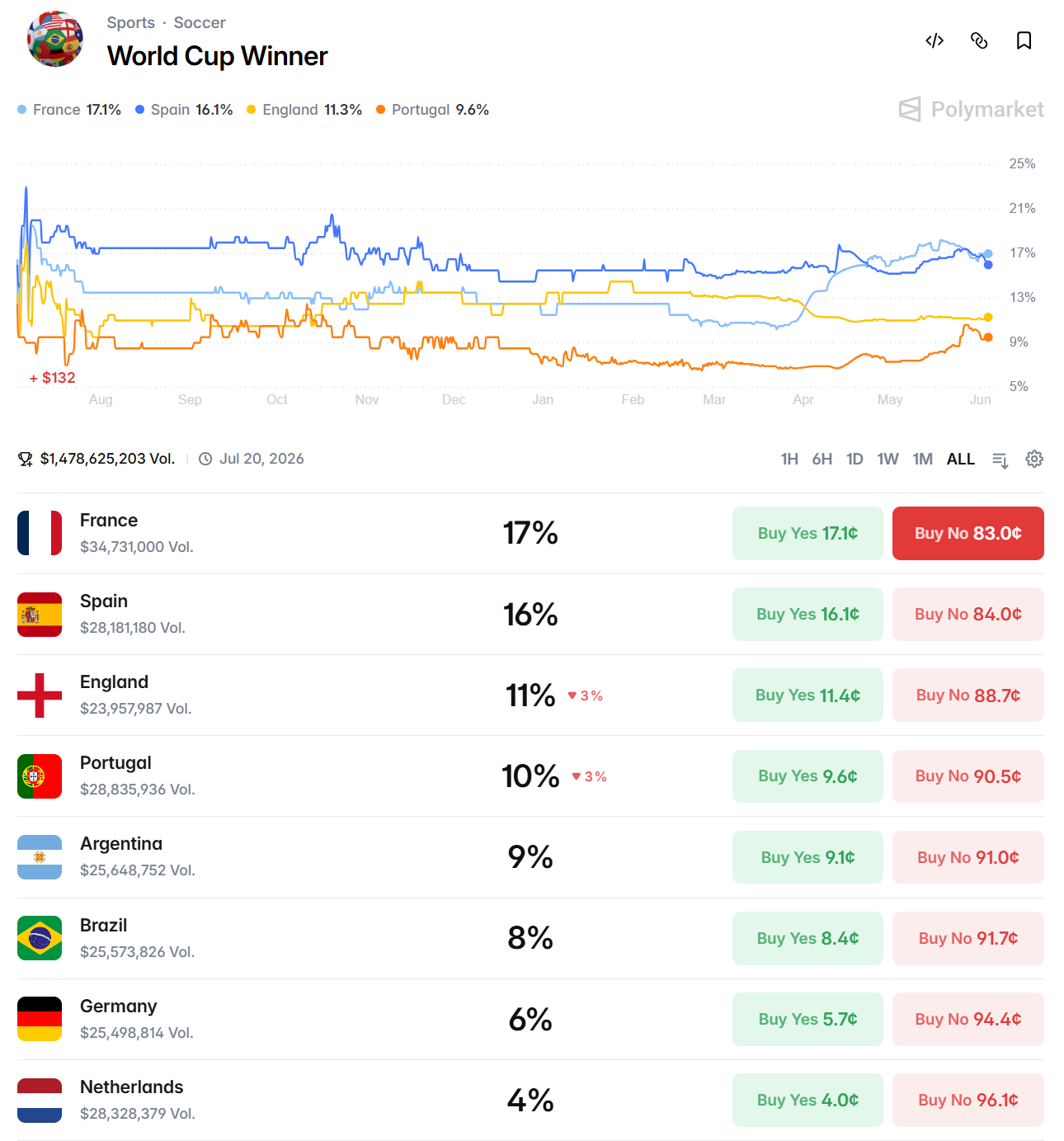
Current implied probabilities show: France 17%, Spain 16%, England 11%, Portugal 9%, Argentina 9%, Brazil 8%, Germany 5.7%.
The trading mechanism is simple yet efficient: buy "France Yes" shares, and if France wins the championship, each share pays out $1; otherwise, it becomes worthless. The price reflects the market consensus probability and supports limit orders and market orders, with sufficient liquidity allowing large positions to enter and exit.
The platform has also launched a variety of prop markets: will Spain reach the finals (about 31%), will they reach the semifinals (about 45%), Golden Boot winner, specific teams reaching group stage / knockout stage, and even marginal topics like whether Iran will participate.
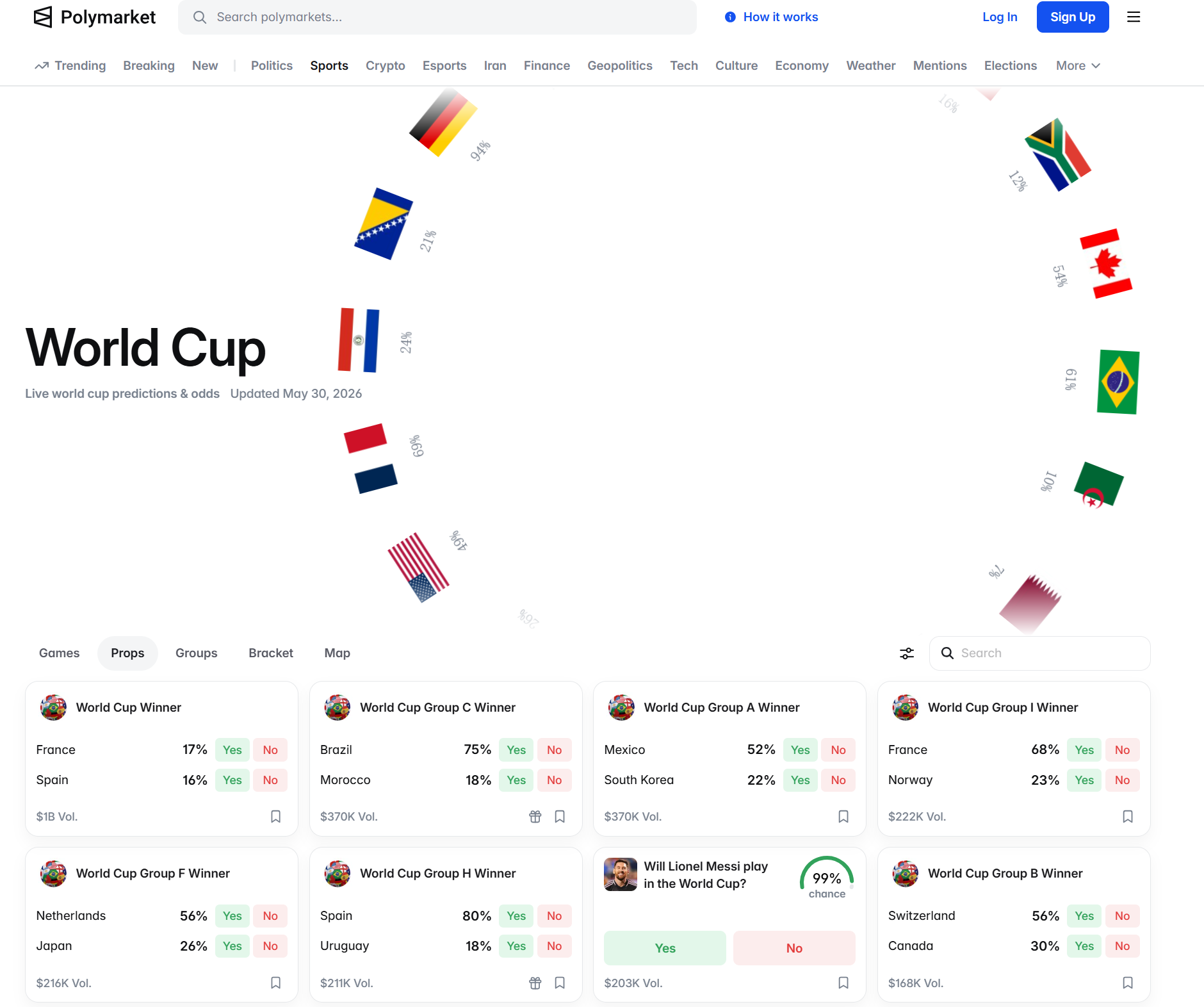
For crypto players, Polymarket's advantages lie in the native crypto experience and extreme liquidity. High transaction volumes mean narrower bid-ask spreads, and the impact of large players on prices is controllable but still has signal value—on-chain wallet monitoring tools can track large position builds and liquidations in real-time. Professional players often combine traditional soccer analysis (xG models, set-piece efficiency, player injury tracking) with market microstructure: when a team’s fundamentals deteriorate due to injuries or tactical changes by the coach while market prices lag behind, this creates an opportunity for entry. The existence of the "best third" spot after expansion also makes "qualification probability" markets a new battlefield suitable for high-frequency or event-driven trading.
Of course, cryptocurrency platforms also face geographic restrictions and regulatory gray areas. Users in certain jurisdictions may need to use VPNs or specific access points, and while settlements in stablecoins like USDC are convenient, attention must still be paid to KYC/AML compliance and the risks associated with the platforms themselves.
Kalshi
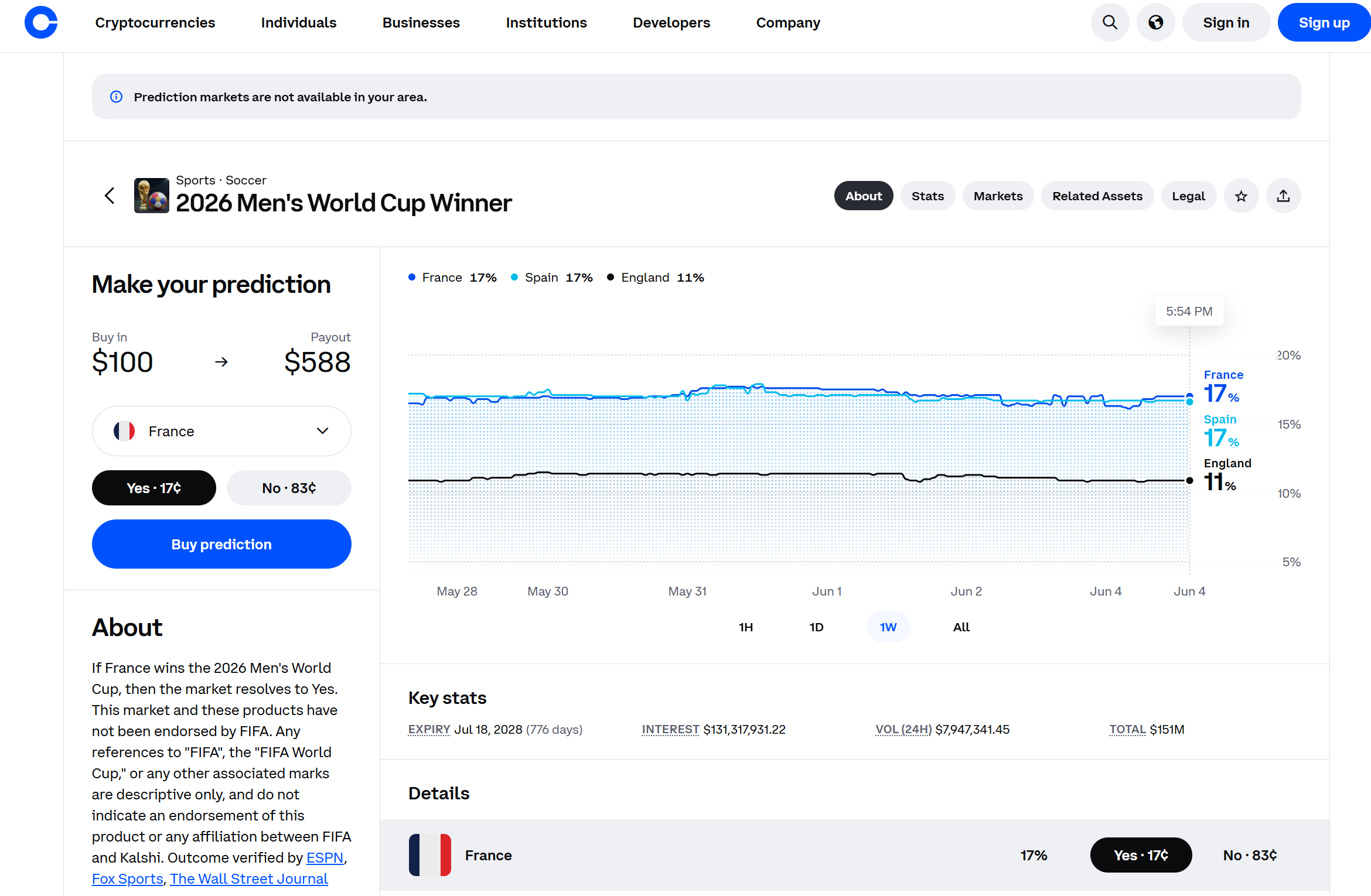
Unlike Polymarket's native crypto model, Kalshi is a CFTC-licensed prediction market platform in the U.S. that emphasizes compliance and clear resolution mechanisms. Its 2026 Men's World Cup champion market is similarly active, currently showing France 17%, Spain 16.6%, England 10.9%, with a cumulative transaction volume of approximately $68.38 million. Due to strict regulation, its transaction volume lags significantly behind native crypto platform Polymarket.
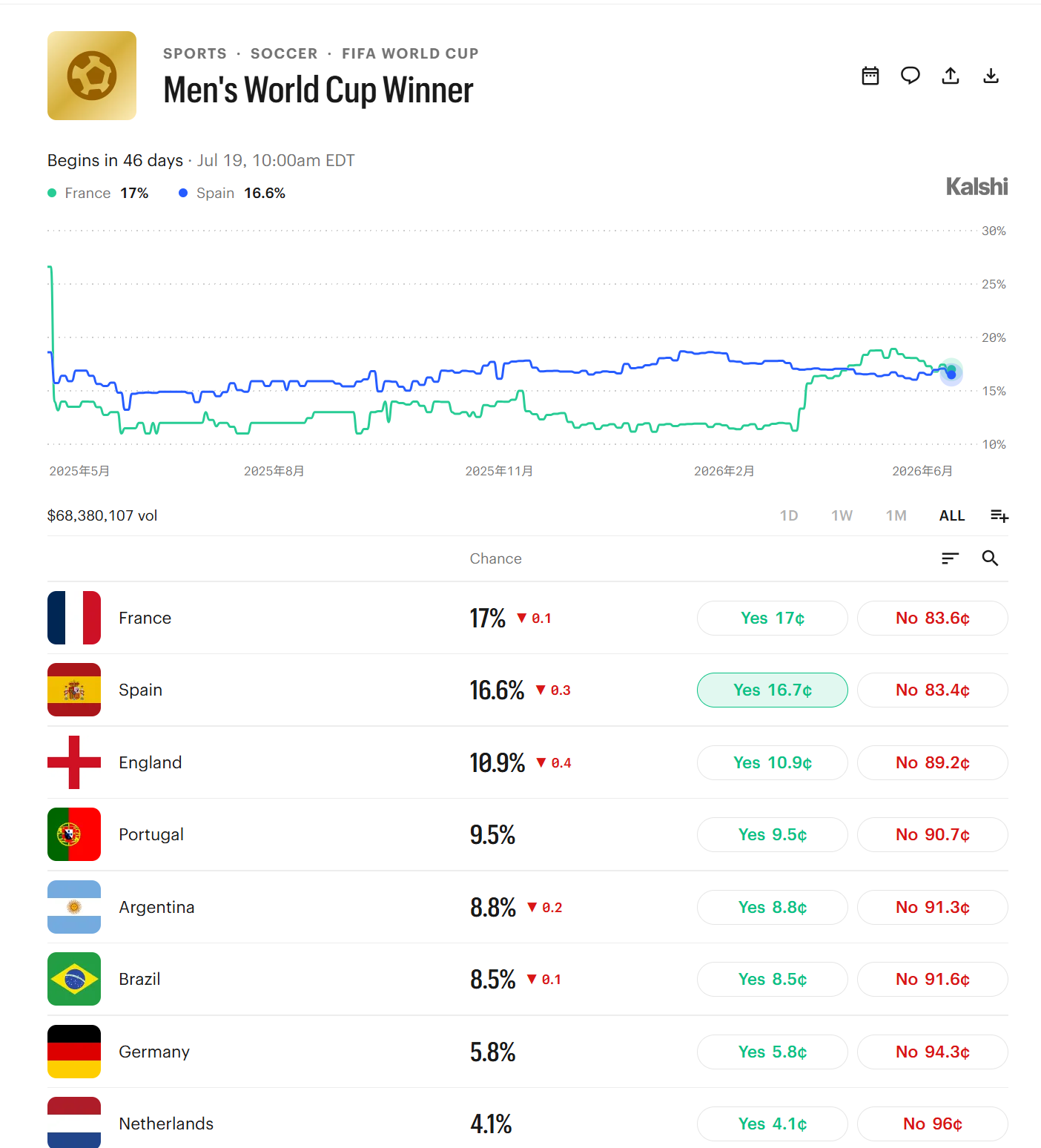
One significant feature of Kalshi is its provision of numerous single-match markets. For instance, in the opening match between Mexico and South Africa, the market has priced Mexico's chances of winning extremely high; the U.S. home match against Paraguay on June 12 also has an independent contract. The bases for resolution come clearly from authoritative media like Fox Sports, ESPN, and The Wall Street Journal, minimizing controversy.
Interestingly, the price differences between platforms create opportunities for cross-market arbitrage: for example, if Spain's implied probability on Polymarket is slightly lower than on Kalshi, a player could buy on the lower-priced platform and sell on the higher-priced platform, although they must also consider factors such as funding costs, withdrawal efficiency, and regulatory friction. This "platform duel" has become one of the important strategies for professional players.
Kalshi's limitations include a user base mainly concentrated in the U.S. and being constrained by CFTC event contract rules, which may limit certain purely sports betting markets. However, its coverage of single matches during the World Cup provides fans with a more transparent probability trading experience than traditional betting.
ADI Predictstreet: FIFA's Official Blockchain Prediction Market
In April 2026, FIFA announced a multi-year partnership with ADI Predictstreet, appointing it as the official prediction market partner for the World Cup. This is FIFA's first official partner in this category.
ADI Predictstreet is built on the AD blockchain, utilizing FIFA's official historical data to provide users with dynamic prediction markets for match outcomes, event statistics, player performance, and key moments. Additionally, its platform is open to users globally through dedicated mobile and desktop applications, with the U.S. market co-operated by Fanatics Markets.
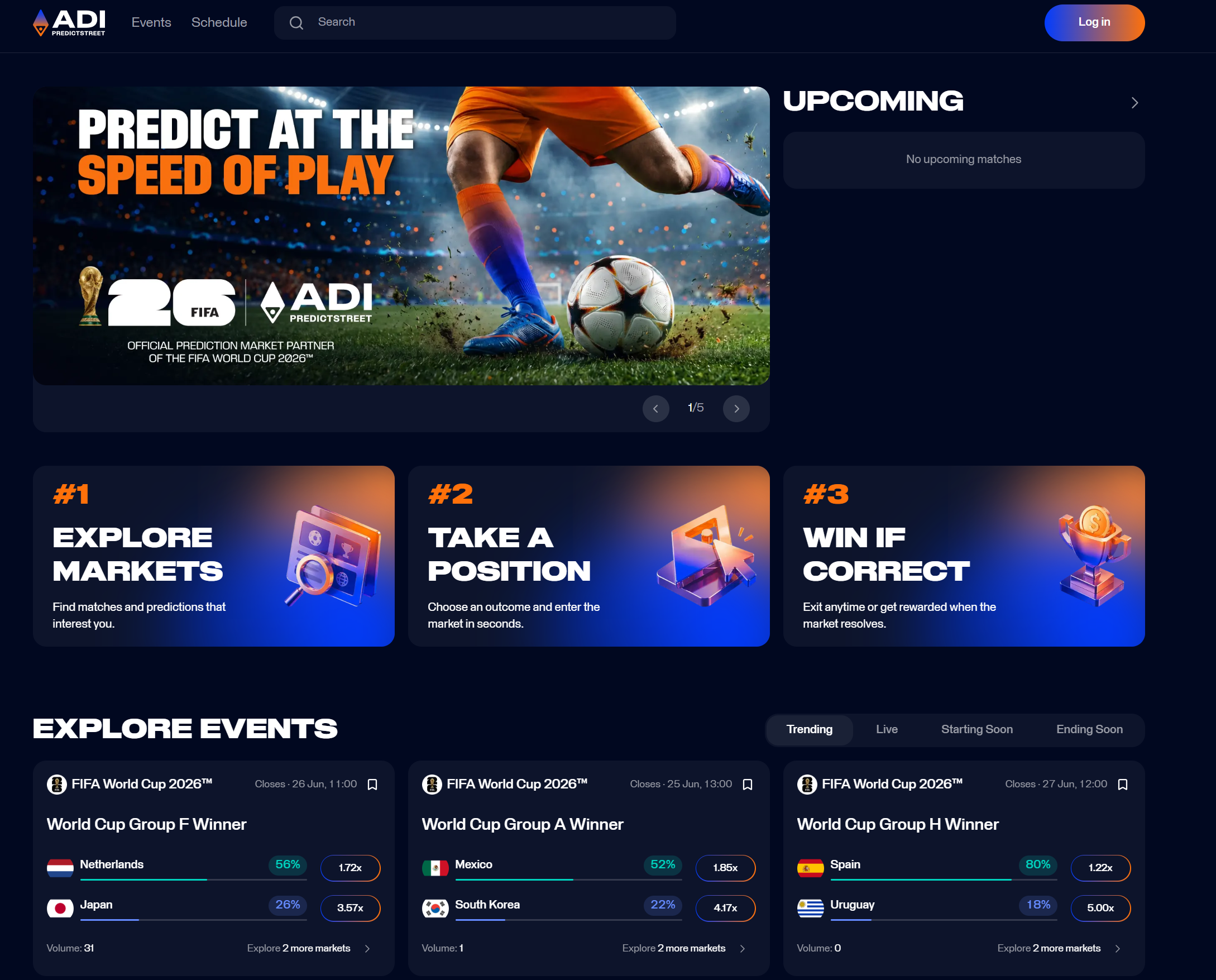
This official endorsement is significant for crypto players. First, the official data stream can reduce dispute risks; secondly, the platform emphasizes real-time monitoring of suspicious transaction activities, offering stronger transparency and anti-manipulation mechanisms.
However, the number of prediction markets currently available on their official website is still relatively small, and some prediction markets have very low transaction volumes, with some being zero or single-digit.
Exchanges and Emerging Platforms Set Their Sights on the World Cup
In addition to the native prediction market platforms, some exchanges are also participating in this event as channels. Binance Wallet has launched an event trench feature, supported by the 42.space protocol on BNB Chain, allowing users to engage in tokenized trading on real-world events such as sports events, cryptocurrency price targets, and news outcomes.
Coinbase has launched event contract markets such as the 2026 Men's World Cup Winner.
Robinhood has partnered with Kalshi to offer users the ability to bet through its Prediction Markets feature.
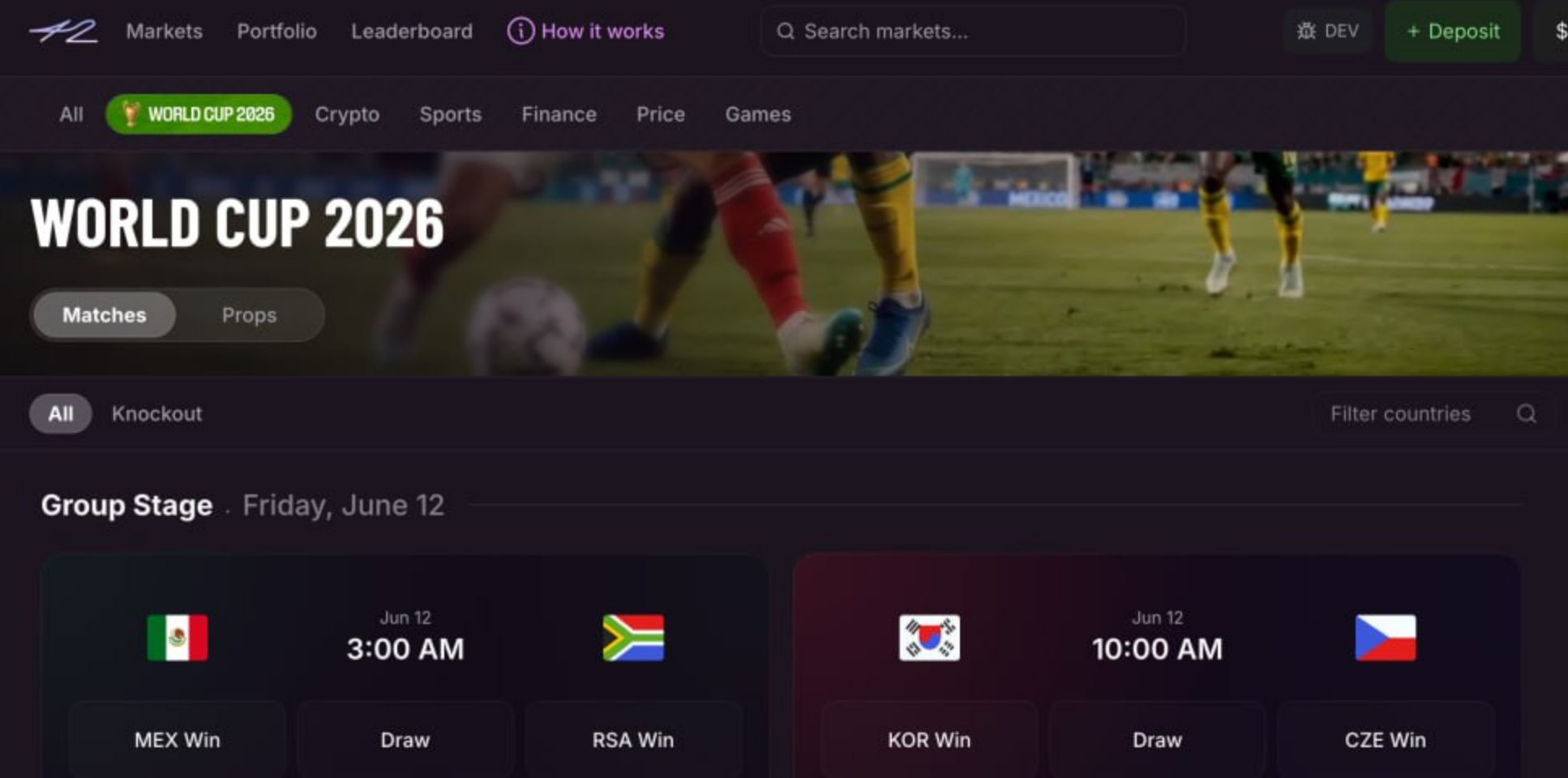
OKX has also launched a special event page for the World Cup on its app homepage, with six major sections including champion prediction results, Golden Boot prediction results, group matches, and match prediction results that continue to cover the entire schedule with simple operations. This is the first self-operated market established by OKX based on its recently released open protocol Exchange OS.
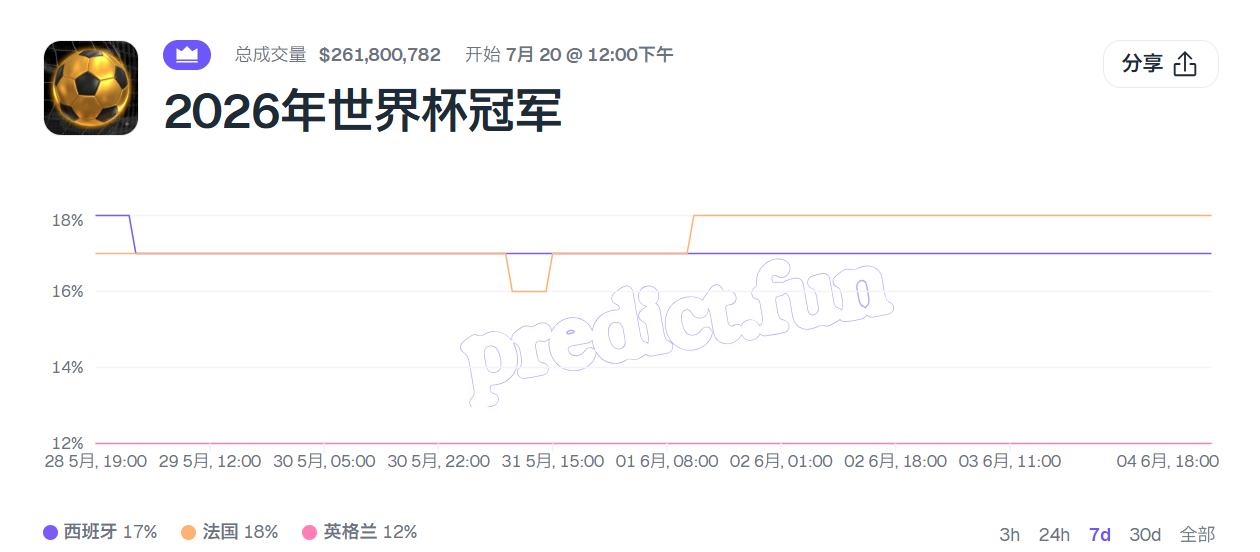
Some emerging prediction platforms like Predict.fun have also launched World Cup themes, and as of June 4, their transaction volume has even exceeded $260 million.
Additionally, Hyperliquid has also set its sights on the event, with its World Cup prediction market having gone live on the HIP-4 test network, with mainnet deployment expected around mid-June.
How Can Ordinary Players Navigate with Ease?
The core competitiveness of prediction market players lies in three points: probability calibration, cross-platform execution, and risk management.
The first is probability calibration. Currently, the championship markets on the three platforms are highly aligned (with France and Spain leading), yet small differences do exist. By analyzing historical data, current national teams, injury lists, coaching tactical preferences, and multi-country travel (long flights, time zone differences, climate from the cool Vancouver to the high altitude of Mexico City and then to the humid Miami), independent models can be constructed. If the model shows that a particular team's actual championship probability is higher than the market's implied probability, this constitutes a value betting window.
The second is cross-platform execution. Polymarket offers the strongest liquidity and the most props, suitable for large positions and high-frequency events; Kalshi is compliant and offers rich single-match markets, suitable for U.S. users. Other exchanges or emerging platforms can monitor multiple platforms simultaneously to achieve limited arbitrage or diversified layouts. For example, different prediction market platforms may have some price differences; for instance, buying YES on Polymarket and buying NO on platforms like OKX can lock in some risk-free profits if the opportunity is quickly captured.
The third is strict risk management. The high-leverage mentality in prediction markets can easily lead to liquidation. Professional players should pay attention to stop-loss discipline and be wary of "emotional betting" (supporting their own national team or idol). On-chain transparency makes tracking large players easy but can also be a source of herd behavior.
In the Qatar World Cup in November 2022, although Polymarket had already been established, its total transaction volume in the championship market was only $138,000. Three years later, we may have the opportunity to see continuously breaking historical records and witness the prediction markets truly moving into the mainstream.
免责声明:本文章仅代表作者个人观点,不代表本平台的立场和观点。本文章仅供信息分享,不构成对任何人的任何投资建议。用户与作者之间的任何争议,与本平台无关。如网页中刊载的文章或图片涉及侵权,请提供相关的权利证明和身份证明发送邮件到support@aicoin.com,本平台相关工作人员将会进行核查。


