Author: Xinyang & Ethan, IOSG
In 2026, the active GitHub curve of the crypto open-source community completed an astonishing "bottoming out." The number of monthly active developers fell from 45K at the peak in 2022 to about 23K, a halving that sparked discussions about "narrative exhaustion" on social media. However, when we break down this curve's cross-section, what we see is not a contraction of the industry, but a profound "deleveraging of talent."
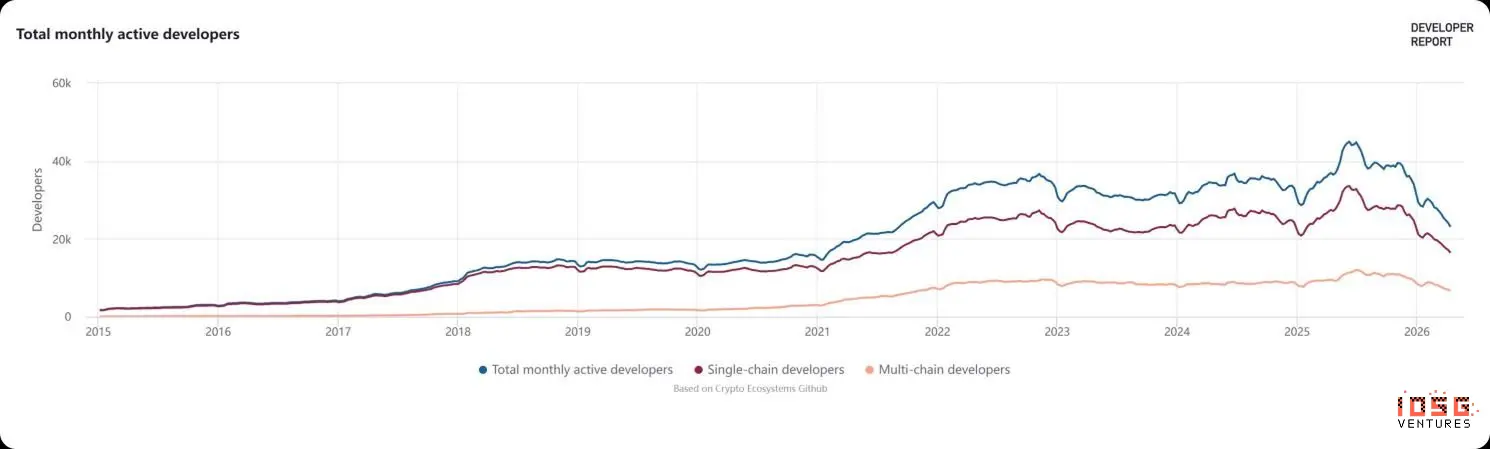
▲ Data source: Electric Capital Developer Report, based on Crypto Ecosystems Github
1. Who left? Who is still here?
The ones who left are mainly newcomers. The number of new developers in February 2024 reached 5,462, then saw a significant decline, with a 52% attrition rate among those in the industry for less than a year. Most of these individuals entered during the bull market, working on NFT minting contracts, forking DeFi protocols, and creating front ends for new L2s. These positions are highly dependent on market momentum; once the hype fades, projects stop operating, and the positions vanish. From the data, the code contributions from newcomers never exceeded 25% of the total, indicating they were never part of the core circle of the industry from the start.
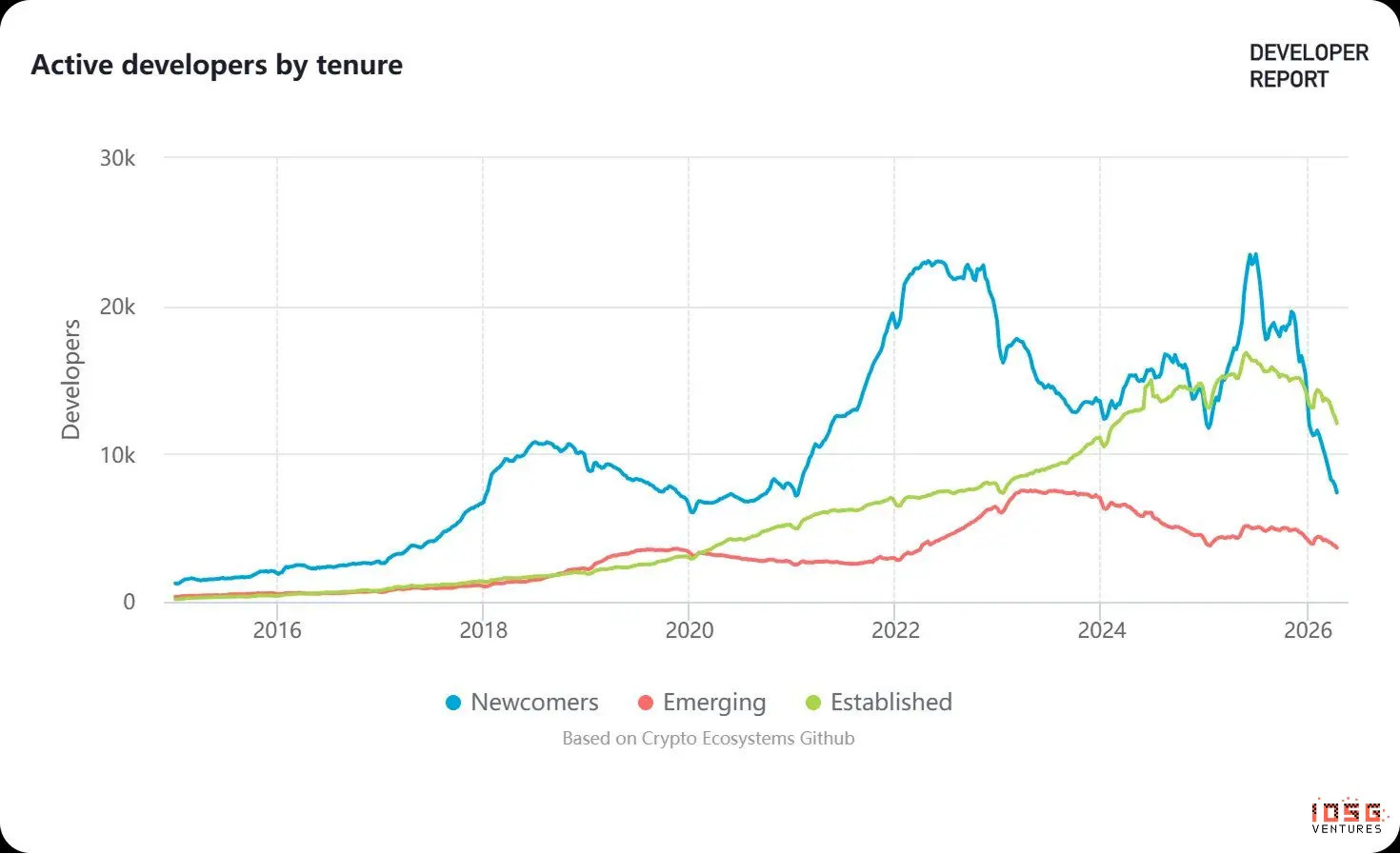
▲ Newcomers surged during the bull market and left in the bear market; Established devs (with over 2 years of experience) reached historical highs during the same period
Data source: Electric Capital Developer Report
On the other hand, developers with over two years of experience have actually increased during the same period, reaching a historical high and contributing about 70% of the code volume. GP Maria Shen from Electric Capital states directly, “When we look at the established developers group, it is growing, and it seems very healthy.”
They are staying not because they have no other choices.
Technically, the core work in crypto now involves infrastructure development that generally requires years of accumulation to understand: protocol layer development, security audits, cross-chain architecture; these roles require years of experience to truly engage with and cannot be easily eliminated by market fluctuations.
Economically, many veterans possess unvested tokens and governance rights and equity relationships within protocols; their accumulated value in this industry has created a real barrier and return on investment. From an ecological distribution perspective, they are voting with their feet: Bitcoin developers grew by 64.3% over two years, Solana by 11.1%, while Cosmos fell by 51.1% and Polkadot by 46.9%. Veterans are concentrating on ecosystems with real users and revenue, moving away from projects that still rely on narrative to sustain themselves.
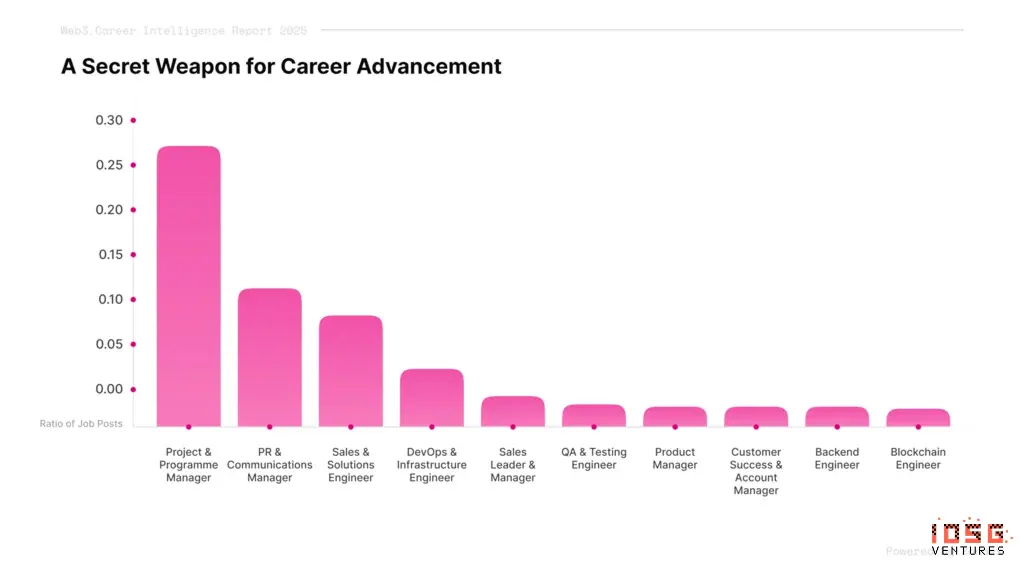
▲ Source: Coincub Web3 Jobs Report 2025
Data source: Web3.Career
The change in job structure also confirms the same idea. In 2025, the highest proportion of new Web3 positions was not developers, but Project & Programme Management, accounting for over 27%. For an industry renowned for being technology-driven, this is counterintuitive, but the underlying logic is not complicated: the sector has moved from a construction phase to an execution phase, with over 100 chains needing to be integrated, and institutional clients have different requirements for compliance and security once they enter. DAO governance needs to find a balance among stakeholders with varying interests. This is not traditional project management; it involves coordination and judgment in an environment where rules are still being formed.
On the surface, the industry appears to be shrinking, but the core density is actually increasing. The bear market between 2018-2019 also saw a significant loss of developers, yet afterward, phenomenon-like projects like Uniswap, Aave, and OpenSea emerged, defining the bull market of 2020-2021. The builders remaining this time have more developed infrastructure, and the AI era has given them a greater stage than in the previous cycle.
2. What skills do those who remain possess?
What special abilities has the crypto industry developed in its builders? To answer this question, we need to return to the underlying principles of blockchain. Between the alternating cycles of bull and bear markets, this industry consistently operates on the same fundamental rule: code is law, execution is final.
In 2016, the DAO incident saw an attacker exploit a recursive call vulnerability to steal $36 million. The code had no bugs, the logic executed exactly as expected; it was merely that the boundaries were not anticipated by the designers. In 2021, the Poly Network cross-chain bridge was attacked, with $610 million transferred within hours. No platform could call a halt, no institution could revoke, and no legal provisions could offer restitution. This is a structural characteristic that sets crypto apart from almost all other industries: the margin for error is zero, and post-incident intervention is nearly non-existent.
This environment demands a skillset that is rarely required in other sectors: building functional systems from scratch that strangers are willing to participate in under conditions of absent rules and trust.
This capability encompasses two aspects. One is building trust from scratch, relying on no external authority, allowing strangers to be willing to put in real assets solely based on code and mechanisms. The second is making judgments under dual uncertainties of technology and economics; without a regulatory framework, historical data, or industry standards for reference, one can still design functional systems.
Both aspects have concrete validations in crypto. Uniswap has no company guarantees, no KYC, no customer service; anyone can deposit funds into the liquidity pool, relying solely on trust in a few hundred lines of code and an economic mechanism, achieving daily trading volumes in the hundreds of billions. MakerDAO has no central bank endorsement, no deposit insurance, and purely relies on on-chain governance and collateral mechanisms to maintain DAI's stability. During DeFi Summer, conditions were even more extreme; lacking regulatory frameworks, audit standards, or any historical data to refer to, builders designed AMMs, loan protocols, and liquidity mining, moving from concept to tens of billions in TVL in just a few months. This capability manifests differently among builders at the protocol, application, and governance layers, but the underlying principles remain the same.
The AI era is creating a structurally similar problem. Model decision processes are opaque, and output results cannot be independently verified. AI agents are starting to execute transactions and allocate funds autonomously, while corresponding rule systems and constraints are still non-existent. Large model companies control both the models and the evaluation standards, and users lack effective verification means. Computing power is highly concentrated among a few top firms; when demand explodes, monopoly pricing occurs. These issues point to a core concern: the trust problem of autonomous systems is reappearing in the larger scale of AI.
Crypto builders have been handling such issues in an environment without external authoritative rules for years. Previously, the scenarios involved on-chain protocols, but now it has shifted to AI. And a group of individuals have directly brought the capabilities accumulated in crypto into AI, yielding results.
3. How are these capabilities being repriced in the AI era?
Cases of transitioning from crypto to AI have become more common in recent years, but looking closely, what they are taking away is not the same.
The most intuitive pathway is the direct transfer of hardware and experience. The three founders of CoreWeave, Michael Intrator, Brian Venturo, and Brannin McBee, started using GPUs to mine Ethereum in 2017, expanding from one machine to thousands of machines. They shut down their mining business in 2022, and two months later, ChatGPT was released, turning their GPUs directly into AI computing resources. In March 2025, they went public on NASDAQ, with an IPO valuation of about $23 billion, and afterward, their market cap peaked at nearly $70 billion.
OpenSea co-founder Alex Atallah dealt with the aggregation and routing problem of extremely heterogeneous assets in the NFT market. He applied the same experience to AI model routing by founding OpenRouter, which served over 5 million developers in two years and reached a valuation of $500 million.
Another type of migration deserves more attention. NEAR founder Illia Polosukhin is one of the co-authors of the Transformer paper. After leaving Google, he initially aimed to build AI applications with natural language but encountered a real-world issue in development: the need to provide cross-border payments to data annotators worldwide, most of whom lack bank accounts, and blockchain technology emerged as the best solution for this payment challenge.
Now, NEAR is transforming into an AI infrastructure platform, focusing on user-owned AI and decentralized confidential machine learning (DCML), allowing users to use AI services without exposing their data. The decentralized architecture experience accumulated in NEAR has become the most difficult starting point to replicate in this direction.
Sean Neville, co-founder of Circle, established Catena Labs after leaving, positioning it as an AI-native bank and directly transferring his understanding of stablecoin infrastructure into financial scenarios involving AI agents. A16z crypto led a $18 million seed round investment. Nader Dabit, a senior developer from Aave and Lens Protocol, shifted his focus to Cognition, bringing the experience he accumulated in building developer ecosystems across multiple crypto protocols into the AI agent tools sector.
This group of individuals is taking away not just GPU hardware or user networks, but also intuition for mechanism design, experience in building developer ecosystems, and the judgment for constructing trustworthy systems from scratch in the absence of rules. These abilities correspond directly to three structural gaps encountered in the scaling of AI.
Aggregation and Optimization of Computing Power
Computing power is the most direct bottleneck for AI scaling. Training and inference require a vast amount of GPUs, with fluctuating demand, and cloud providers being expensive and requiring queues; companies do not want to hoard hardware themselves. This issue has two facets: how to aggregate and allocate computing power, and how to use the aggregated power more efficiently. Crypto builders have direct transferable accumulations in both of these areas.
Hyperbolic addresses the distribution and trust issues. Founder Jasper Zhang has introduced decentralized mechanism design into the AI computing power track: tokens encourage scattered GPU holders to contribute idle computing power, but the more crucial issue is trust.
Why trust the computational results provided by a strange node? The core innovation, PoSP, employs random sampling and game theory to make honesty a dominant strategy for nodes, eliminating the need for full verification, keeping costs low, ensuring scalability, and maintaining reliable results. This mechanism is directly transferred from the logic of verifying the behavior of strange nodes in crypto.
MoonMath tackles the efficiency issue. Its predecessor, Ingonyama, focused on ZK hardware acceleration, significantly increasing the speed of ZK proof generation under extreme computational constraints. Now, the focus has shifted to the Physical AI performance layer, accelerating sparse attention in video diffusion models (LiteAttention), low-rank decomposition in FFN layers (LiteLinear), and training backpropagation acceleration (BackLite). From ZK acceleration to AI inference acceleration, the underlying capability remains the same: making mathematics run faster under extreme computational constraints. While the track has changed, the accumulation has not gone to waste.
AI Governance and Incentive Mechanism Design
When multiple AI agents begin to collaborate on tasks, ensuring they do not compromise the overall system while pursuing their individual objectives becomes essential. Each participant is driven by their own objective function, and there is no guarantee that they will function normally together, especially since the agents' execution speed far exceeds the window for human intervention.
This is a type of problem crypto builders have repeatedly dealt with in DAO governance and tokenomics design: enabling stakeholders with completely different interests to operate in the desired direction of the system without a central authority. The answer provided by crypto is an economic mechanism, where violations incur real economic costs, the rules are written in code, and execution is automatic.
EigenLayer has directly transferred this mechanism to AI scenarios. Through a restaking mechanism, nodes must stake assets before participating in collaboration; non-compliance or violations will trigger automatic penalties, making the rules rigid boundaries with real economic consequences rather than mere suggestions. EigenCloud extends this logic to verifiable computing and collaborative governance for AI agents, ensuring that agents must operate within predetermined ranges while pursuing their own goals. Using economic mechanisms to constrain agents is far more reliable than using ethical principles.
Autonomous Payments for AI Agents
There is also a more fundamental question: how do agents make payments? Traditional payment systems are designed for humans; credit cards require account creation, bank transfers require authorization, and every step assumes the operator is a human with identity who will wait. Agents do not wait; they might initiate numerous requests every second, with each request potentially involving micro-payments. In this scenario, traditional payment pipelines fail completely.
Stablecoins and on-chain rules are the infrastructure already established by crypto builders that natively support programmability and authorization-free, 24/7 operation. These three features are precisely the rigid requirements of the agent payment scenario, with only a layer connecting stablecoins to the agent workflow missing.
x402, launched by Coinbase in May 2025, activates the HTTP 402 status code, embedding stablecoin payments directly into HTTP requests, allowing agents to complete payments simultaneously while initiating requests, with no accounts required and a settlement time of about two seconds. As of April 2026, the x402 protocol has processed over 165 million transactions, with a total transaction volume of about $50 million, and the number of active agents reached 69,000 (data source: x402 Foundation), with Cloudflare, AWS, Stripe, and Anthropic MCP all integrated. Agent payments have already become a track with genuine traffic.
The three directions correspond to three structural gaps encountered in AI scaling: aggregation and efficiency of computing power, incentive alignment for multi-agent cooperation, and infrastructure for autonomous payments. These three problems do not have ready-made answers in traditional software architecture but have corresponding handling experiences in the crypto industry. The capabilities have not vanished; they have merely found new operational scenarios.
4. The New Positioning of Builders: From Writers of Contracts to Rule Designers for AI
The scaling of AI is creating a functional gap that did not previously exist. It is not a gap in technical talent but rather a gap for individuals who can design trust mechanisms within autonomous systems. As the target of services shifts from humans to AI, the role of crypto builders is being redefined.
The table below compares the dimensional changes of specific functional paradigms:
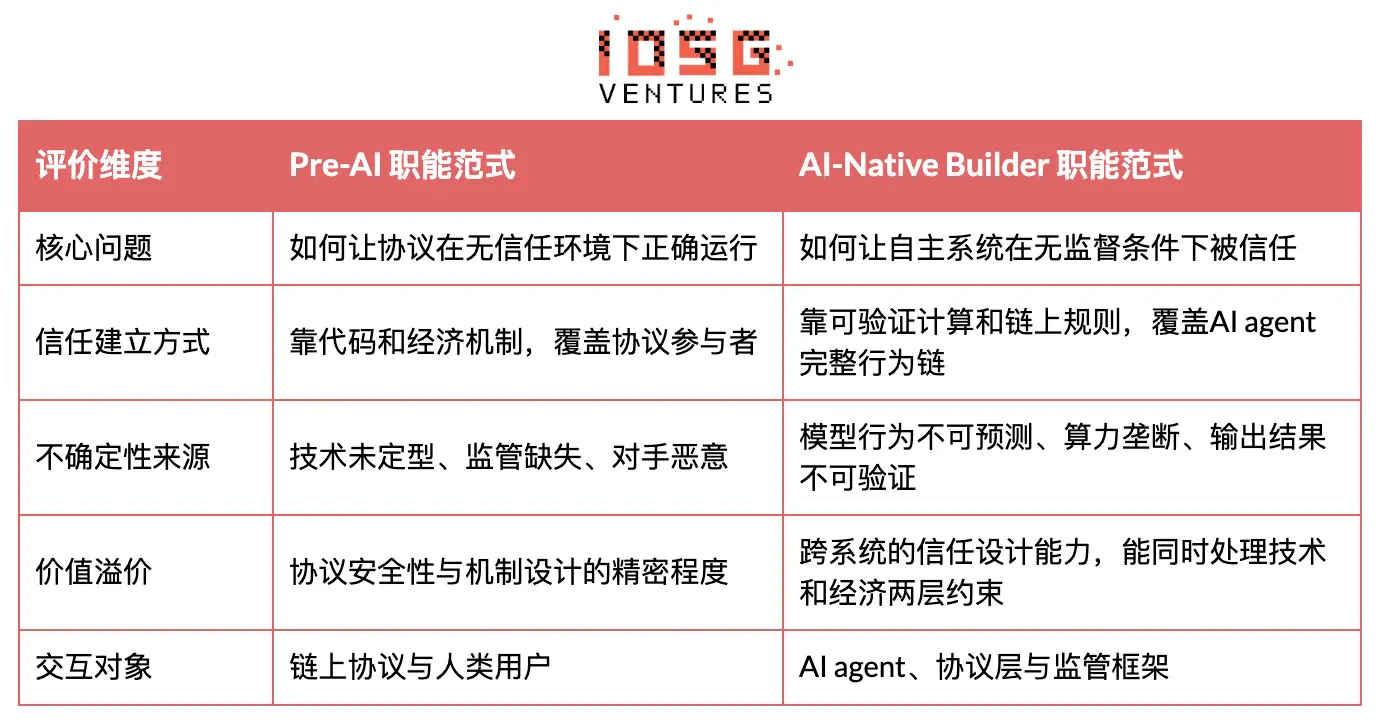
The core difference between the two paradigms lies not in the technology stack but in the methods of establishing trust and the logic of executing rules. In the Pre-AI era, crypto builders faced human participants; rules were written into contracts, with zero margin for error, but the boundaries of the system were relatively clear.
In the AI-Native era, as the interaction target shifts to autonomously operating AI agents, the problems that need resolution are: the behavior of agents is unpredictable, their execution speed far exceeds the human intervention window, and the boundaries of the system itself need to be redefined under greater uncertainty. The functional positioning of crypto builders is transitioning from "writing secure contracts" to "designing trustworthy mechanisms for AI autonomous systems."
Top institutions are already reflecting this change in their recruiting:
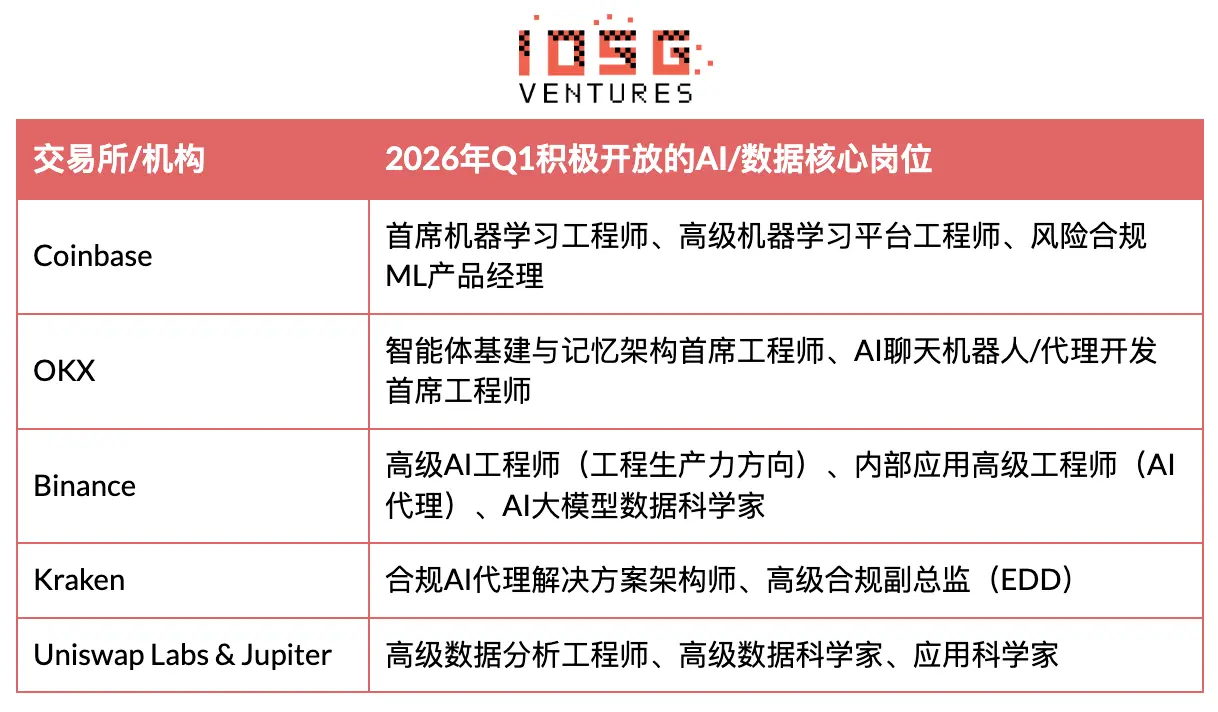
▲ Core AI/data positions actively opened by top exchanges in Q1 2026
Source: Gate Research Institute
Recruitment trends in top exchanges and institutions in 2026 clearly reflect this trend: they are no longer simply hiring AI engineers or crypto developers, but are looking for people who can connect the two sides—individuals who understand the distortions in on-chain incentives and governance games while also deeply integrating AI tools into crypto workflows and designing mechanisms that align agents with regulations and users in the long term.
The direction of capital allocation has also reflected this judgment. Paradigm is raising a new fund with a maximum size of $1.5 billion, expanding its investment scope from crypto to AI and robotics. Haun Ventures has completed a $1 billion Fund II, focusing on financial infrastructures that fuse crypto with AI, especially supporting payments, stablecoins, and agent-to-agent economic systems that allow for autonomous trading and coordination for AI agents.
A16z crypto has completed its $2.2 billion fifth fund (Crypto Fund V), explicitly stating that the fund will invest 100% in the crypto sector. In light of the complexity and opacity of the AI era, they will focus on the applications of crypto's transparency, verifiability, and decentralization features. Additionally, according to PitchBook data, in 2025, about 40% of VC investment in the U.S. crypto sector flowed into companies involved in AI businesses, a notable increase compared to 2024.
While both crypto builders turn towards AI, the paths chosen under different market environments show significant differences.
In the U.S., as the regulatory environment becomes relatively clearer, protocol layer innovations have gained real survival space. The density of capital networks is high, with short pathways from ideas to financing and greater margins for error. Projects like Hyperbolic, EigenCloud, Gensyn, and Ritual share a common characteristic of designing new mechanisms from scratch rather than simply integrating existing systems. Top VCs have clear investment theses for directions such as "verifiable computing, agent coordination, decentralized ML," and are willing to provide ample tolerance for early technology exploration.
The situation in Asia is different. Singapore and Hong Kong play more of a role in compliance implementation and institutional capital transfers, with a relatively conservative regulatory framework and low tolerance for pure protocol layer innovations. Builders with a crypto background transitioning to AI tend to choose application layer and industrial integration pathways—leveraging the user base, payment capabilities, or data assets accumulated in crypto to rapidly access AI products and services.
This difference is not one of abilities but rather a reflection of different pathway choices resulting from varying market signals and regulatory environments: the U.S. encourages foundational mechanism innovation and early technology exploration, while Asia emphasizes compliance-friendliness, quick monetization, and deep connections with traditional industries.
Returning to the initial GitHub curve. The number of monthly active developers fell from 45K to 23K, which on the surface suggests the industry is contracting. Yet, among those who remain, the proportion of established developers has reached an all-time high, converging towards ecosystems with real users, while being repriced in unprecedented ways by the AI industry.
As AI scaling encounters structural bottlenecks like computing power aggregation, autonomous payments for agents, and verifiability of data and decision-making, these builders are at the intersection of crypto and AI, where their long-accumulated sensitivity to rules, incentives, and authenticity is gradually transforming into a rare systems-level capability for the AI era.
As an investment institution that has been deeply engaged in crypto infrastructure since 2017, IOSG's judgment on this line is not limited to mere observation. We participated in early investments in EigenLayer's restaking mechanism even before it became widely recognized in the market, leading the seed round investment in Ingonyama (now MoonMath) betting on the migration of ZK hardware acceleration to the AI performance layer, and invested in Hyperbolic in 2024, optimistic about its path to solve the decentralized computing trust issue with crypto-native verification mechanisms.
The common logic behind these layouts is that the trust, coordination, and verification issues encountered during AI scaling will ultimately need the mechanism design capabilities accumulated by the crypto industry to be solved. We believe that the intersection of crypto and AI is not just narrative but represents a structural opportunity that is unfolding.
免责声明:本文章仅代表作者个人观点,不代表本平台的立场和观点。本文章仅供信息分享,不构成对任何人的任何投资建议。用户与作者之间的任何争议,与本平台无关。如网页中刊载的文章或图片涉及侵权,请提供相关的权利证明和身份证明发送邮件到support@aicoin.com,本平台相关工作人员将会进行核查。


