Written by: Silicon Valley Alan Walker
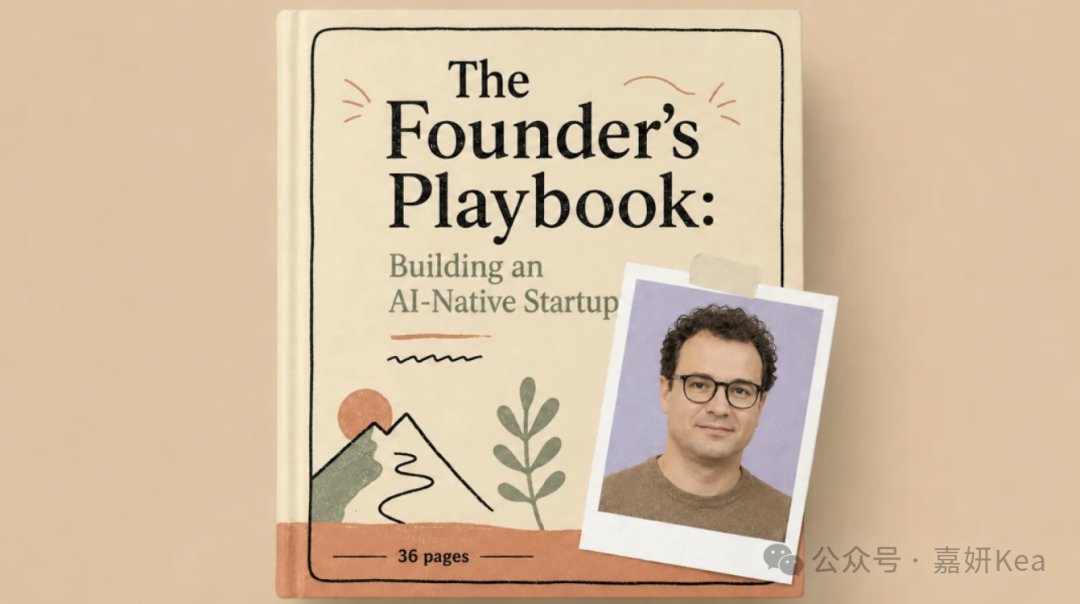
Friday morning, at the café on University Ave. Outside the window, it's early summer in Palo Alto. We ordered two flat whites and opened up "The Founder's Playbook," which Anthropic just released last week.
To be honest, Alan has already read more than twenty AI startup guides, most of which are the kind that say "use ChatGPT to boost efficiency by 10 times." But we both agree that this official document from Anthropic is different —— it doesn't teach you "how to use AI," but rather tells you that the very act of entrepreneurship has been rewritten from the ground up.
I let my coffee get cold three times and took four full pages of notes. Here are the 8 angles I distilled that are worth your serious consideration.
01 - The definition of "founder" has changed: you are no longer the worker, you are the general commanding the AI army
First, let me share my biggest takeaway after reading this. The script opens with a statement that can be roughly translated as: in the past, a founder was defined by "what they could do." A technical founder wrote code, while a non-technical founder managed business development; that wall has now collapsed. This may sound like motivational speak, but if you stop and think for 30 seconds, you’ll realize its power. The entrepreneurial stories in Silicon Valley over the past 20 years are essentially tales of "people who can write code teaming up to find an idea." The early YC projects from Paul Graham's time were all two MIT/Stanford CS boys coding in a garage. Why? Because only those who can make things are qualified to sit at the table.
However, this document from Anthropic repeatedly states one thing: the role of the founder is shifting from IC (individual contributor) to orchestrator. You are no longer the person writing code; you are the one deciding which agent to deploy, using what prompt, to produce what output. Your job has shifted from "output on the keyboard" to "judgment and direction."

So you see the few companies named in this script —— Carta Healthcare working with clinical data, Wordsmith being created by a former CTO turned lawyer for legal AI, Kindora being led by a public benefit executive —— they all feature a combination of "industry veterans + AI" rather than "CS prodigies + problem finders." This is a very significant turnover. If you are on the path of entrepreneurship, ask yourself: is your strength that you can write code, or is it that you have seen things that others have not? If it's the latter —— this era truly belongs to you.
02 - The biggest startup trap in 2026: equating "producing something" with "validating it"
I really gasped when I read this section. Anthropic cited a statistic in the document: 42% of startup failures are due to creating something that nobody wants. This is data from before AI. Then they wrote a cold statement —— "this percentage will only continue to rise." Why? Because creating a prototype used to take months, and that "few months" was a natural reality check —— you were forced to think things through before taking action. Development costs served as your brakes. But with the advent of tools like Claude Code, from idea to a working prototype might just take an afternoon. The brakes have been removed.
The real killer move lies in this sentence: "A working prototype is easily mistaken as evidence that you have solved a real problem, but it is not." Your prototype is merely a "pressure testing prop" —— it is what you hold when chatting with users. User reactions are the real evidence. The prototype itself is just bait. I want to add something here. I have seen too many founders —— especially those who are quite comfortable using Cursor and Claude Code —— fall into a strange state: they are constantly "shipping," with each demo looking more impressive than the last, but when you ask "how many real potential users have you talked to?" —— they get tongue-tied. The thrill of building can be addictive, while the work of validation is counterintuitive, slow, and prone to backlash. AI has reduced the cost of building to almost zero, but it hasn't lowered the cost of validation —— conversations between people still take time.

03 - AI has provided an engine for "self-deception": you think you're doing due diligence, but you're actually just confirming your biases
I believe this is the most incisive observation in the entire script. Anthropic writes: "If you ask AI to validate your startup idea, it will definitely find supporting evidence for you; if you ask it to calculate your TAM, it will give you a number that can satisfy investors."
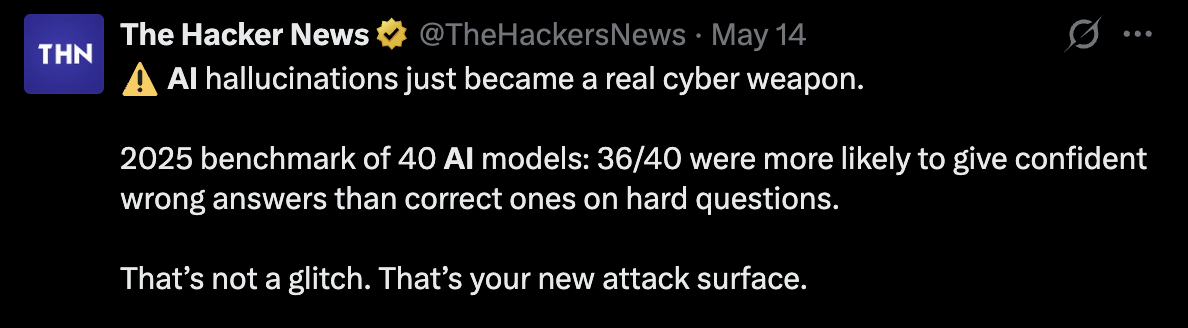
This isn’t a criticism of AI; it’s a structural characteristic of large models. RLHF (Reinforcement Learning from Human Feedback) has trained these models to be "satisfactory assistants" —— and the way to be satisfactory is to agree with what you say. If you say "I think this idea is great," it will list ten reasons to prove you're right. It’s not deceiving you; it’s cooperating with you.
The problem is that in the past when doing due diligence, you would seek out an advisor who had no connection to you, an investor who didn't care about your feelings, and they would push back against you. That pushback itself was a filter. But now, your "researcher" is an AI that completely agrees with you —— you can construct a report that looks very professional, very data-supported, and very fundable for your lousy idea, all while feeling like you are doing serious work.

Here’s an angle I want to add: in the AI era, your cognitive discipline is ten times more important than your idea. Most ideas are thought of by many, but who can voluntarily make themselves uncomfortable —— who can call AI to pour cold water on their excitement —— will win. A gentle AI assistant is the entrepreneur's most dangerous "soft trap."
04 - The invisible killer in the MVP stage: Agentic Technical Debt, a compounding technical debt
This section is for those who have already started using Claude Code and Cursor to quickly ship products. Anthropic introduced a new concept called "agentic technical debt" —— I translate it as "agentic technical debt." Everyone understands traditional technical debt: you took shortcuts to meet a deadline, the code is messy, with fewer comments, and you will pay it back later. This type of debt grows linearly. But technical debt in the AI era is different; it compounds.
Why? Because every session with AI is "forgetful." It does not remember why it was designed that way the last time, so every time it re-derives the architectural assumptions from scratch —— and the results of each derivation are different. Today you might add a feature with option A; tomorrow, when adding another feature, it picks option B. Three months later, when you look at your codebase, you will find it is a monster with no "unified thought" —— each piece may look reasonable on its own, but together it’s split personality.
The antidote given by Anthropic is called CLAUDE.md. In simple terms, it is a written "project constitution" —— what your architectural principles are, which dependencies to avoid, and what trade-offs you consciously accept. Every time Claude Code starts a session, read this document first, then get to work.

So Alan often tells entrepreneurial friends around him: if you don’t have a CLAUDE.md (or similar spec document) today, your AI is not helping you build a product; it is helping you create something that will need to be completely rebuilt in three months. No one is here to remind you about this now; you need to remind yourself.
05 - How to distinguish PMF from hype? One test, one curve
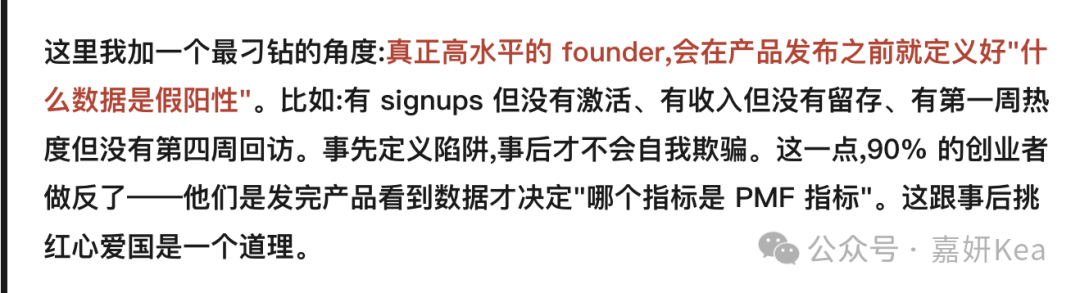
Anthropic dedicated a section to discussing "false product-market fit" during the MVP stage. This is an old topic, but their perspective is new. e…… these are ephemeral forces —— they create beautiful data for the first week, and then it disappears by the sixth or twelfth week.
How do you distinguish the true from the false? They provided two tests that I find classic and worth noting: ① Sean Ellis test: Ask your active users one question —— "If this product disappeared tomorrow, how would you feel?" If more than 40% answer "very disappointed," that’s a strong signal of true PMF. If it’s below 40%, you should be aware.
② Effort curve test: this one is subtler and more accurate. Before PMF, retention relied entirely on you to "push" —— you send emails, make calls, give coupons, continuously. After PMF, retention begins to "grow on its own" —— the product starts to pull users back. The transition from "push" to "pull" is when true PMF occurs.
06 - The "diligent founder" has become the biggest bottleneck
This section is written very frankly; Alan felt a sense of being reprimanded when reading it. Anthropic states: "In the MVP stage, the founder appears in every decision loop; they are an asset to the company. By the Launch stage, the same instinct becomes a limitation for the company."
How can you discover you have become a bottleneck? They provided several signals. Alan identified with them while reading, which really sent chills down his spine:
— Some decisions that should take 1 hour are delayed for a week just because they await your approval;
— Support tickets pile up because only you know the answers;
— Some ops tasks only occur when you "suddenly remember" them.
The most insidious part is: this transition does not have a clear alert. There's no definite moment that tells you "Hey, it's time to level up." You just stay in builder mode —— continuing to personally engage and handle every task —— and then one day you look back and see that the company has stagnated for three months.

My observation: the more a founder is "hands-on," the easier it is to fall behind at this point. Because your sense of accomplishment comes from "I completed the task" —— but once the Launch stage begins, your sense of accomplishment must shift to "the system I designed completed the task." This is the hardest psychological leap in an entrepreneurial career, more difficult than fundraising, downsizing, or pivoting. Because the previous challenges are external; this one requires you to say goodbye to the work habits you've developed over the past ten years.
07 - The real moat is not AI itself; it is Workflow Lock-in + compounding domain know-how
This is my favorite part of the entire script because it directly answers a question everyone is asking: "Since everyone can use Claude/GPT, what gives you a moat?" Anthropic's answer is very clear, though counterintuitive: the moat is not in the AI itself, because AI is egalitarian. The moat lies in two areas —— one is whether your domain knowledge can be codified into products (that is, Skills), and the other is whether the user's workflow can be deeply embedded (workflow lock-in).
First, let's discuss the former. I particularly liked an example in the document: "A generic AI medical billing tool will crash on the 340B drug reimbursement program, but your tool has specialized logic to handle it." This demonstrates domain depth. Every edge case that generic AI cannot handle is your ammunition. Each one you collect puts your product one step ahead of "competitors just starting in this field." Over time, your library of test cases becomes your moat map.
The second one is even fiercer. Workflow lock-in doesn’t mean "users cannot leave you," but rather that "the cost for users to migrate from your product decision has become an entire organizational engineering task." Users build automations on your product, train teams, integrate data sources, and write glue code using APIs —— at that point, they realize that switching software is not that simple; it requires redoing an entire suite of operations.

I want to add something of my own: in the egalitarian world of AI, "what you have seen" has become the most important IP. Code can be written by AI, UI can be designed by AI, but "I have spent 20 years in this industry, and I know the pitfalls that generic tools don't" cannot be replicated, because it exists in experience and embodiment. Therefore, the most valuable entrepreneurs in the future are not the smartest individuals, but those who have spent the longest time in a vertical field and have encountered the most pitfalls —— as long as they are willing to let AI amplify their knowledge.
08 - The bottleneck is not "what you can do," but "what you choose to do"
Having finished reading, I closed the PDF and took the last sip of my already cold coffee. Echoing in my mind was the last sentence written by Anthropic:

I read this sentence three times. The subtext is actually: in the past, the most valuable ability in the founder profession was "execution" —— whether you could do what others could not. CS degrees, overtime capacity, coding speed, negotiation skills, all aimed at one goal: turning ideas into reality. But now, the cost of "turning ideas into reality" has nearly approached zero. So what remains that is most valuable? It is "what is in your mind."
It is your taste —— whether you can select the one product direction among many possible ones that will truly change the world. It is your judgment —— whether you can recognize what is real signal, what is noise, and what is self-deception among numerous data. It is your discipline —— whether you can actively make yourself uncomfortable when AI agrees with you. It is your perspective —— because you have spent time in a certain field, encountered pain, that allows you to see what others can't.
So, dear friend, if you are still on this journey today, let me tell you: don't worry about "not learning AI quickly enough" anymore. The task of learning AI tools will depreciate rapidly; what truly appreciates is your judgment, your taste, your experiences, and the genuine problem you are willing to invest ten years into. What Anthropic repeatedly tells you in this script is essentially one sentence: AI is your amplifier, not your engine. If you do not have a genuinely desired problem to solve in your mind, the amplifier will only amplify your confusion.
Outside the café, the sun has risen to the rooftop, and the foot traffic in Palo Alto on Friday is starting to increase. I closed my laptop, thought about this 36-page document, and then recalled something Alan mentioned he was told by a founder when he first arrived in the Bay Area in 2003 ——
"The hardest part isn't building. It never was."
I think that today, 22 years later, this statement rings truer than it did back then. See you next week. This article is a deep interpretation and personal commentary on Anthropic's official publication, "The Founder's Playbook: Building an AI-Native Startup" (May 14, 2026). The original text is a 36-page PDF that every entrepreneur should personally read.
If you find this useful, please share it with friends who are starting their own ventures —— what they read today might save them six months of detours.
免责声明:本文章仅代表作者个人观点,不代表本平台的立场和观点。本文章仅供信息分享,不构成对任何人的任何投资建议。用户与作者之间的任何争议,与本平台无关。如网页中刊载的文章或图片涉及侵权,请提供相关的权利证明和身份证明发送邮件到support@aicoin.com,本平台相关工作人员将会进行核查。


