- Javier Milei admits his dollarization push stalled; citizens favor the peso, complicating future reforms.
- Milei’s currency competition policy, allowing currencies like the dollar to be used, failed, leaving the peso as the default currency.
- After lifting currency restrictions, Scott Bessent and the U.S. intervened in October to stabilize the peso’s value.
President Javier Milei has explained why the process of dollarizing Argentina might be more complex than expected, as it has hit a solid roadblock.
Milei, who campaigned and won the Argentine presidency on the promise of adopting the U.S. dollar as fiat currency, ending the Argentine peso, and disbanding the central bank, acknowledged a newfound obstacle to his plans.
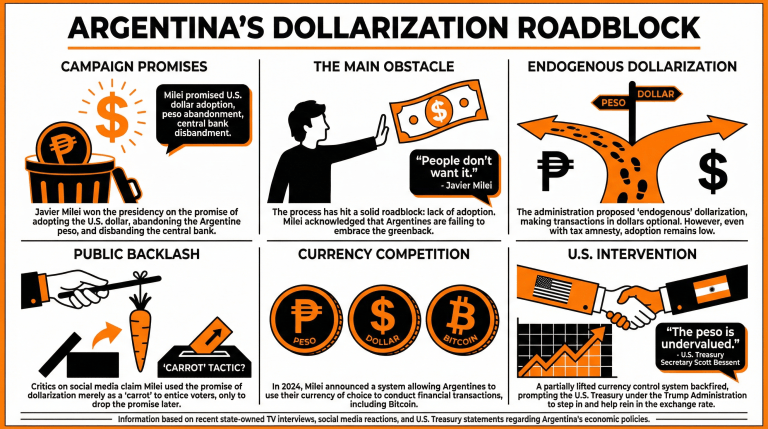
During a recent TV interview, Milei highlighted that the main issue when dollarizing the country was the lack of adoption by Argentines, who have failed to embrace the greenback and continue to use the Argentine peso.
“People don’t want it,” said Milei, referring to using the U.S. dollar instead of the Argentine peso. “We’ve proposed endogenous dollarization. Endogenous. That is, if you want, you can make your transactions in dollars, and yet people don’t. We’ve enacted tax amnesty, and yet people don’t take advantage of it,” he stressed.
Furthermore, Milei highlighted that, “strictly speaking, you can’t force things on people.” The remarks were criticized on social media, with some claiming that Milei had used dollarization as motivation to entice Argentines to vote for him, only to drop the promise later.
In 2024, Milei stated that he would implement a system of currency competition, allowing Argentines to use their currency of choice, including bitcoin, to conduct financial transactions.
He also lifted currency controls partially, establishing a floating system that would allow the dollar to float within a fixed price band. However, this backfired, and Milei had to receive help from the Trump Administration to rein in the dollar exchange rate. “Argentina is a beacon in Latin America. This isn’t a bailout; it’s buying low and selling high. The peso is undervalued,” said U.S. Treasury Secretary Scott Bessent in October.
免责声明:本文章仅代表作者个人观点,不代表本平台的立场和观点。本文章仅供信息分享,不构成对任何人的任何投资建议。用户与作者之间的任何争议,与本平台无关。如网页中刊载的文章或图片涉及侵权,请提供相关的权利证明和身份证明发送邮件到support@aicoin.com,本平台相关工作人员将会进行核查。


