- Peter Schiff and Michael Saylor clash as Schiff questions bitcoin’s 12% long-term return.
- Schiff urges selling Strategy stock (MSTR) after its 68.5% rise, warning of a sharp crash.
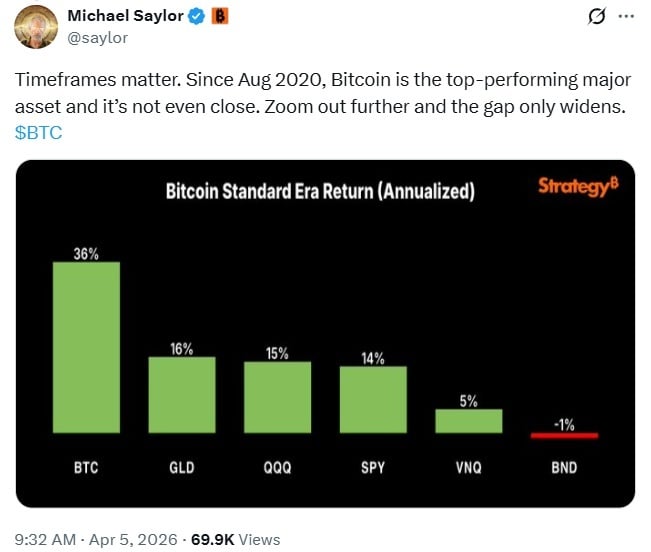
- Saylor defends bitcoin, citing a 36% annualized return and long-term strength.
Economist and gold advocate Peter Schiff and Strategy Executive Chairman Michael Saylor shared opposing views on social media platform X on April 5. Schiff criticized bitcoin and Strategy’s stock performance, questioning its sustainability. Saylor defended BTC’s long-term strength, emphasizing broader evaluation periods and structural demand.
Schiff stated: “Despite bitcoin’s mere 12% rise over the past five years, MSTR is up 68.5%, outperforming the NASDAQ. But that’s not due to bitcoin’s performance. It’s due to investors’ willingness to overpay for MSTR so Saylor could keep overpaying for bitcoin. Sell MSTR before it crashes.” The gold bug added in another X post:
“Over the past five years, the price of bitcoin is up by just 12%. Over the same time period, the NASDAQ is up 57.4%, the S&P 500 is up 59.4%, gold is up 163%, and silver is up 181%. If the appeal of bitcoin is its superior long-term performance, why should anyone keep HODLing it?”
Saylor replied to Schiff by emphasizing that evaluating BTC requires selecting appropriate timeframes, highlighting stronger performance over longer horizons. The chart he shared shows bitcoin leading with a 36% annualized return since August 2020, followed by gold at 16%, QQQ, which tracks the Nasdaq-100 index, at 15%, and SPY, an S&P 500 exchange-traded fund, at 14%. Real estate exposure through VNQ, a real estate investment trust ETF, appears at 5%, while bonds, represented by BND, a total bond market ETF, show a negative 1% return.
Saylor, on the other hand, detailed on April 4 his broader outlook of BTC’s role in global markets. He stressed:
“ Bitcoin has won. Global consensus is that BTC is digital capital. The four-year cycle is dead. Price is now driven by capital flows.”
“Bank and digital credit will determine bitcoin’s growth trajectory. The biggest risk is bad ideas driving iatrogenic protocol changes,” the Strategy executive chairman said. His remarks reinforce his position that BTC’s valuation is increasingly shaped by institutional adoption and macroeconomic liquidity conditions rather than historical market cycles.
免责声明:本文章仅代表作者个人观点,不代表本平台的立场和观点。本文章仅供信息分享,不构成对任何人的任何投资建议。用户与作者之间的任何争议,与本平台无关。如网页中刊载的文章或图片涉及侵权,请提供相关的权利证明和身份证明发送邮件到support@aicoin.com,本平台相关工作人员将会进行核查。


