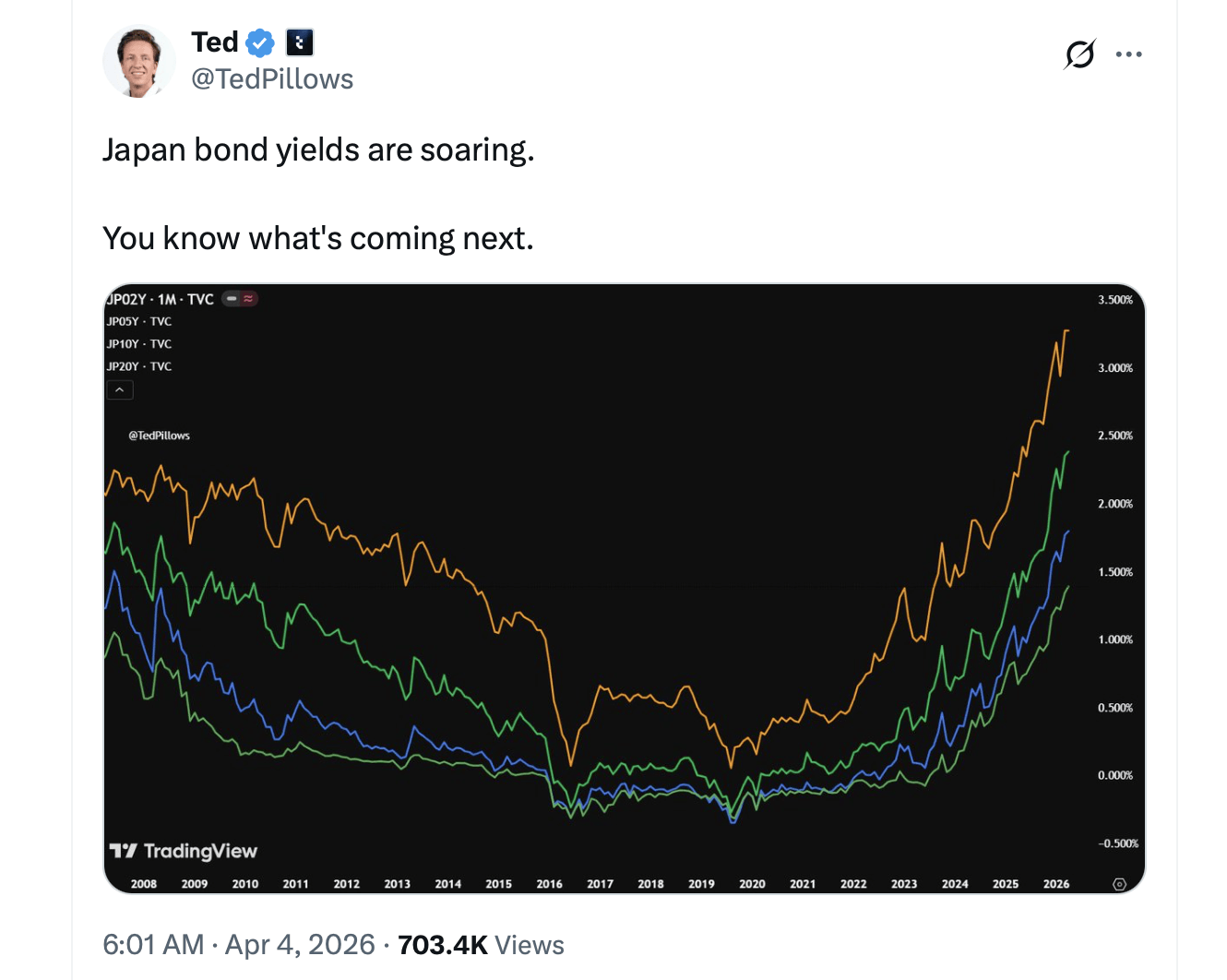
- Japan’s 10-year bond yield hit 2.39% by early April 2026, its highest level since 1999, as Iran’s Hormuz blockade fueled inflation fears.
- The Bank of Japan faces a rate hike decision at its April 27-28 meeting, with markets pricing in a 60-70% probability of action.
- Japan pledged a record 80 million barrel reserve release, but analysts warn prolonged disruption risks stagflation and global market volatility.
The 10-year Japanese government bond yield reached 2.38% to 2.39% by early April 2026, topping levels not seen in over two decades and clearing the 2008 financial crisis peak by roughly 30 basis points. The 5-year yield hit 1.72%, approaching its own record territory.
Iran imposed the de facto blockade on the Strait of Hormuz in late February and early March 2026 following U.S. and Israeli military operations against the country. Tanker flows through the strait fell below 10% of normal levels in some reports, pulling millions of barrels per day from global supply.
Japan was not positioned to absorb that kind of hit. In fiscal 2024, the Middle East supplied 95.9% of the country’s crude imports, with the UAE at 43.6%, Saudi Arabia at 40.1%, Kuwait at 6.4%, and Qatar at 4.1%. Every barrel from those suppliers travels through Hormuz.
Brent crude spiked above $113-$116 per barrel in March, with physical Dubai crude hitting $170 at points. Prices have eased into the $100 to $110 range as of early April, but remain elevated against a backdrop of diplomatic uncertainty. U.S. WTI also crossed $100. The International Energy Agency coordinated emergency reserve releases with affected nations to slow the damage.
Tokyo moved fast. The Ministry of Economy, Trade and Industry instructed ten domestic storage bases on March 9, 2026, to prepare state reserve releases. Japan later committed roughly 80 million barrels, about 45 days of supply, to cushion the shock. It is the largest such drawdown in Japanese history. Private-sector reserves were tapped earlier. Officials and analysts view the moves as temporary relief, not a solution.
Energy costs have fed directly into consumer prices. A weaker yen, trading near 160 against the dollar, has amplified the damage by making dollar-denominated imports more expensive. The Bank of Japan (BOJ) kept its short-term rate at 0.75% at its last meeting but held a tightening bias. Governor Kazuo Ueda has said further hikes remain on the table if underlying inflation tracks toward the 2% target.
Markets now price in a 60% to 70% probability of a rate hike at the BOJ’s April 27 to 28 policy meeting. Goldman Sachs sees July as a more likely timeline depending on how the Middle East situation develops. The BOJ’s dilemma is blunt: energy-driven inflation is rising while higher costs risk slowing the broader economy.
Higher rates would close a chapter on ultra-loose monetary policy that has defined Japan since the 1990s bubble. Major life insurers are already sitting on roughly $60 billion in unrealized losses on Japanese government bond holdings.
The spillovers stretch beyond Tokyo. Japan holds $1.225 trillion in U.S. Treasuries as of January 2026, making it the largest foreign holder. As domestic yields rise, appetite for foreign bonds falls. That puts upward pressure on U.S. borrowing costs.
Rising JGB yields also threaten to unwind an estimated $500 billion in yen-funded carry trade positions across equities, emerging market debt, and crypto. A BOJ rate hike in mid-2024 triggered significant liquidations. A repeat, with Hormuz still blocked, could hit harder.
Japan has not invoked the Armed Attack Situation Act, which would allow Maritime Self-Defense Force involvement in the strait. The government has joined a U.K.-led coalition of more than 30 countries, including France, Germany, and Italy, calling on Iran to restore free passage.
President Trump has signaled the Iran conflict could wind down within weeks, but has also left open the possibility of further escalation. No resolution was in sight as of this weekend.
免责声明:本文章仅代表作者个人观点,不代表本平台的立场和观点。本文章仅供信息分享,不构成对任何人的任何投资建议。用户与作者之间的任何争议,与本平台无关。如网页中刊载的文章或图片涉及侵权,请提供相关的权利证明和身份证明发送邮件到support@aicoin.com,本平台相关工作人员将会进行核查。


