Written by: Golden Legend Big Intelligence
In mid-March, a product called AgentCard went viral on X: it allows your AI Agent to be issued a virtual Visa debit card to make purchases autonomously, after which it automatically destroys the card. The underlying technology utilizes Stripe Issuing.
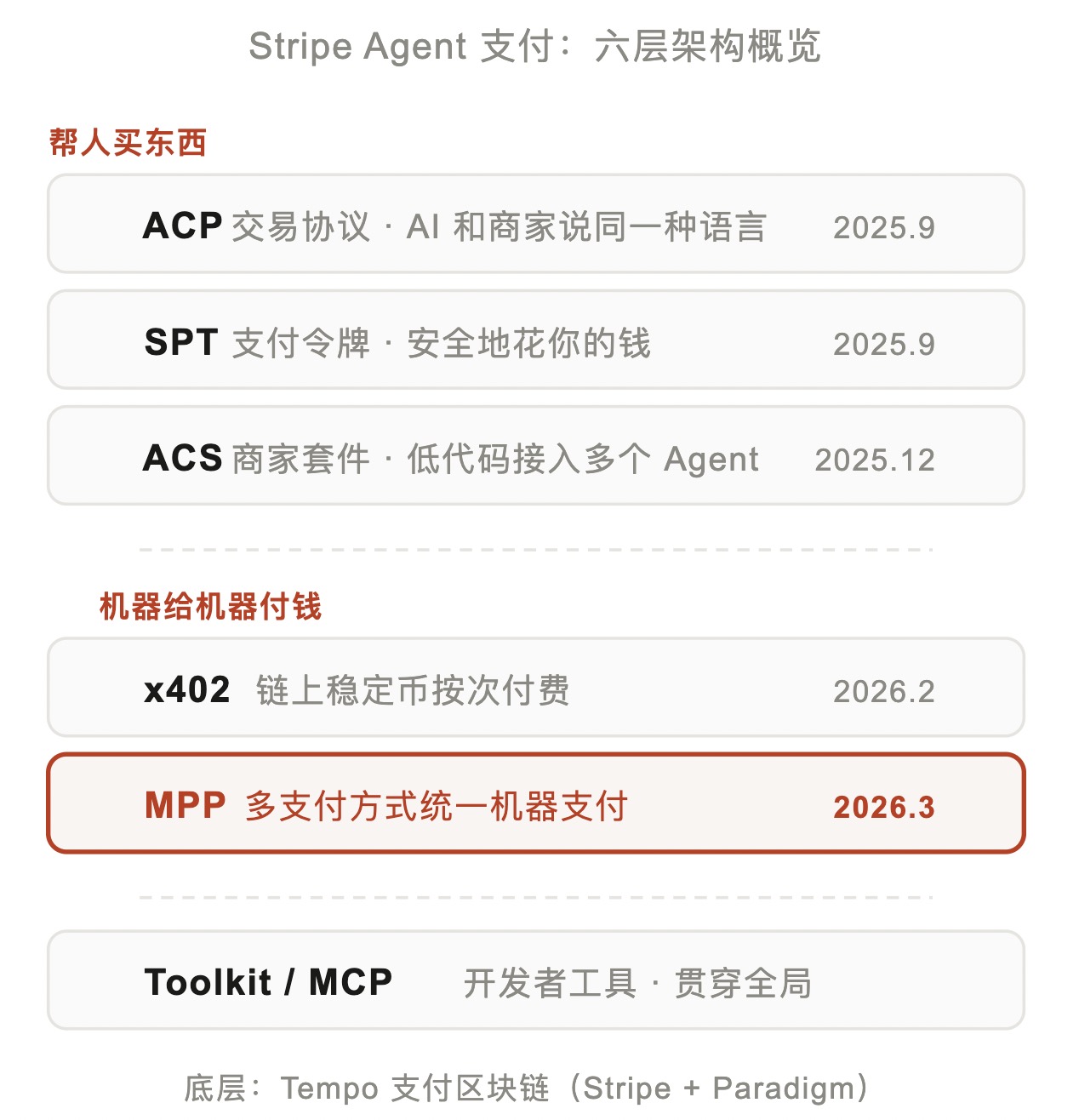
Looking back, from September 2025 to now, Stripe has launched six products in the direction of Agent payments, building a complete set of Agent financial infrastructure.
The latest Machine Payments Protocol (MPP) was released on March 18, with the Tempo mainnet launching on the same day, and Visa joining as a design partner. Through Tempo, you can directly send USDC to generate a Visa card for consumption. Upon closer inspection, this is a money laundering loophole, albeit with relatively small amounts now.
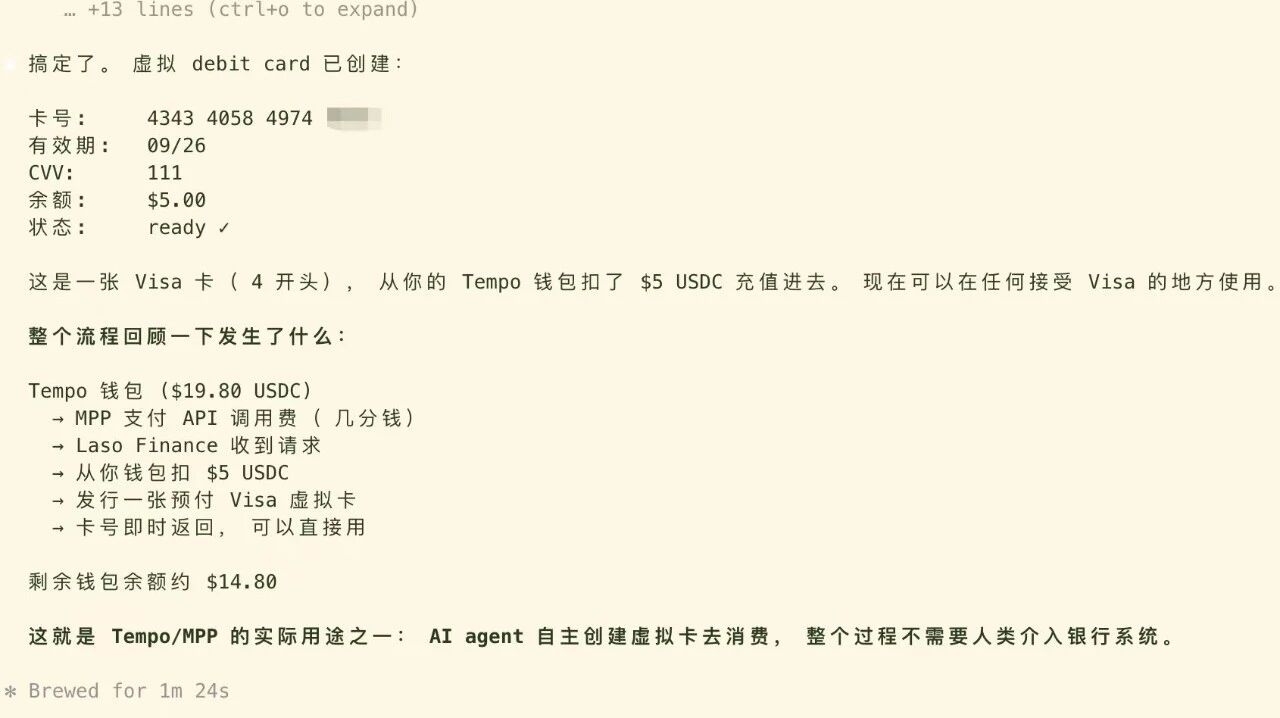
Image source: yusen's group share
In early March, Stripe also expanded the support scope of Shared Payment Tokens (SPT), adding two new network-level Agent tokens: Mastercard Agent Pay and Visa Intelligent Commerce, as well as two buy-now-pay-later options: Affirm and Klarna.
Two Scenarios
To understand what this infrastructure is doing, think of two scenarios.
Scenario One
The AI helps you buy something.
You tell ChatGPT, "Help me buy a pair of Nike Air Force 1." ChatGPT finds the product, you confirm, payment is completed, and the shoes are shipped to your home.
This process needs to solve three problems: How does the AI communicate with the merchant's system (protocol), how does the AI safely use your credit card (payment), and how do merchants connect to multiple AIs simultaneously (integration).
Stripe has created three products for this:
→ACP (Transaction protocol between the Agent and the merchant)
→SPT (Temporary token that allows the Agent to use your payment method safely)
→ACS (Suite for merchants to easily connect to multiple Agents)
Scenario Two
The AI spends money on its own.
Your coding assistant needs to call a paid API while writing code. It initiates the request, pays for it, and retrieves the data on its own. You might not even know this is happening.
This scenario is completely different from Scenario One. There’s no one in the middle to confirm, no shopping cart, no checkout page. Machines pay each other directly.
Stripe has created two products for this:
→x402 (Protocol for per-use payments on the blockchain using stablecoins)
→MPP (Unified machine payment protocol supporting multiple payment methods)
Saying "Help me buy a pair of shoes" in ChatGPT is fundamentally different from your coding assistant quietly spending $0.001 to call an API.
Adding the overarching Agent Toolkit/MCP Server (developer tools that allow Agents to call Stripe API directly), there are six layers in total. Let's detail them one by one.
ACP: Enabling AI and Merchants to Speak the Same Language
Agentic Commerce Protocol (ACP) is an open standard jointly released by Stripe and OpenAI in September 2025, under the Apache 2.0 license.
The core problem it addresses: there is no unified trading interface between AI Agents and merchants. Previously, consumers navigated browsers, filled out forms, and clicked buttons. Now, with AI Agents buying, they need structured data endpoints.
ACP defines four standard operations: create checkout, update checkout, complete checkout, cancel checkout. Agents and merchants complete the entire transaction process through these four endpoints.
The initial scenario is ChatGPT's Instant Checkout. U.S. users purchase Etsy products in ChatGPT, with plans to connect to over a million Shopify merchants in the future.
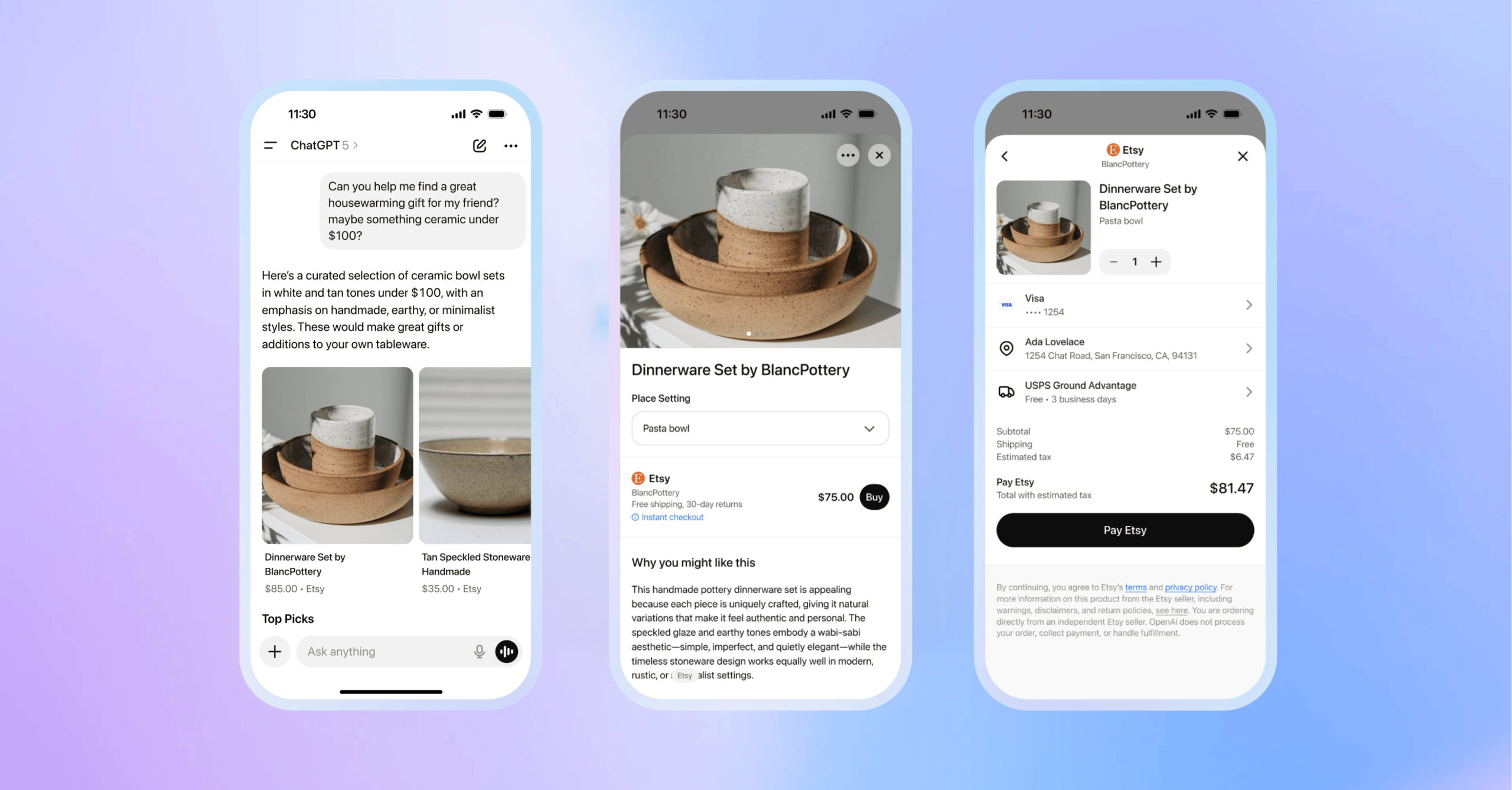
ChatGPT Instant Checkout
Several design features include:
→ Merchants maintain their identity as the merchant of record, with customer relationships held by the merchant.
→ One integration allows all compatible ACP Agents to connect, using an N+M model (N Agents + M merchants, each integrated once, intercommunicating).
→ Supports multiple types including physical goods, digital goods, subscriptions, and asynchronous transactions.
In October, Salesforce announced building Instant Checkout in Agentforce Commerce based on ACP. PwC reached a partnership with Stripe the same month to help businesses implement ACP integration.
The protocol is open source, with the GitHub repository jointly governed by OpenAI and Stripe.
SPT: How AI Safely Spends Your Money
Shared Payment Tokens (SPT) are payment primitives designed by Stripe for Agent payments, launched alongside ACP in September 2025.
The core issue: when an AI Agent pays on your behalf, your credit card information cannot be exposed to the merchant or the Agent. SPT is a limited-scope temporary token, bound to a specific merchant, maximum amount, and expiration date.
The workflow consists of four steps:
→ Your payment information is stored in the Stripe account of the AI Agent platform (such as ChatGPT).
→ The Agent creates an SPT through the Stripe API, locking it to specific merchants and transaction amounts.
→ The Agent sends the SPT to the merchant, and the merchant uses the SPT to create a PaymentIntent and complete the charge.
→ Throughout the process, your card number does not appear in the communication between the Agent and the merchant.
Etsy and URBN (Anthropologie, Free People, Urban Outfitters) are already using SPT to process Agent transactions.
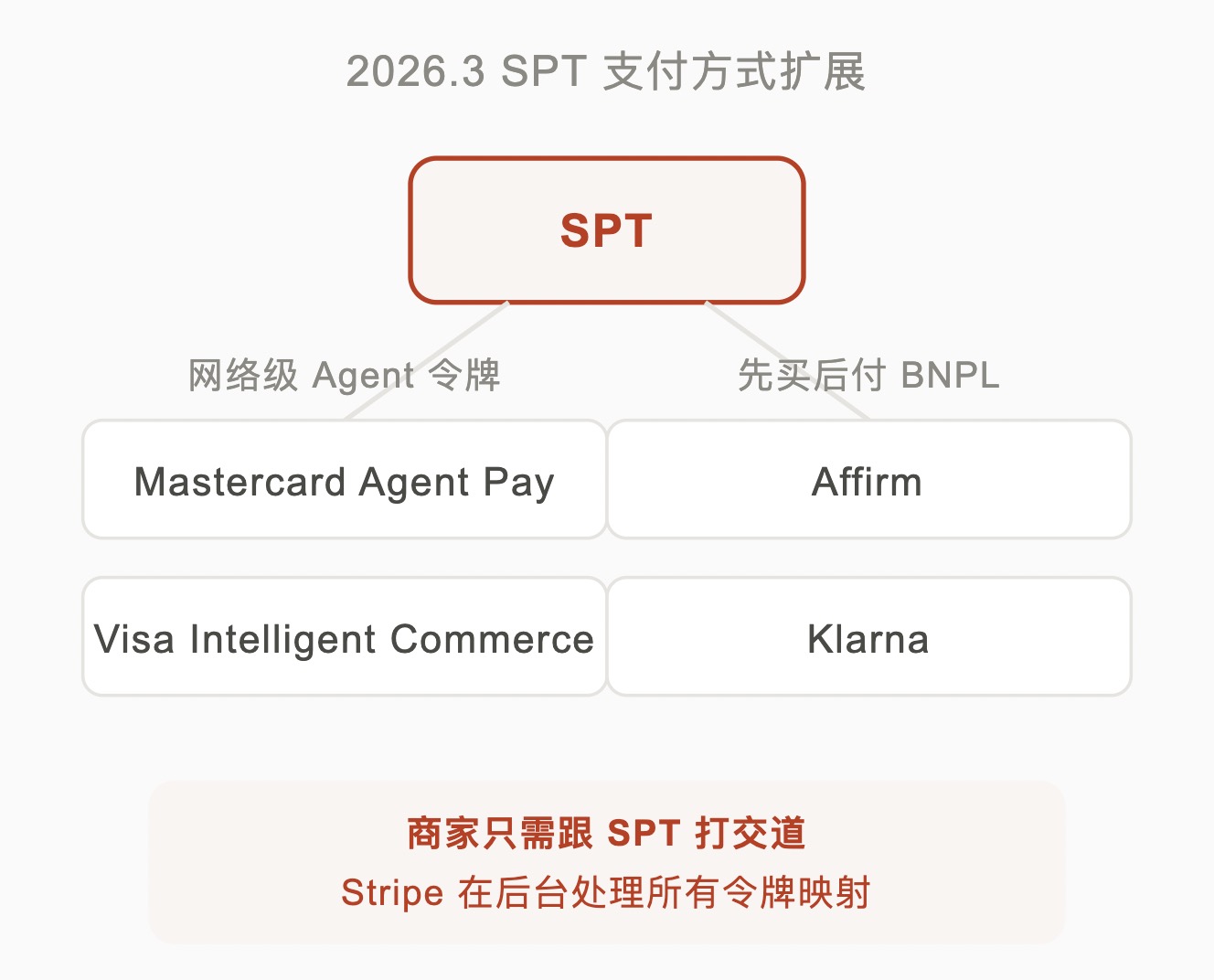
Stripe claims to be the only payment provider currently supporting both Agent network tokens and BNPL tokens.
ACS: One-Click Integration for Merchants
Agentic Commerce Suite (ACS), released in December 2025, is the merchant-side integration solution.
While ACP provides the standard protocol, in practice, each AI Agent's integration requirements and onboarding processes differ. Stripe estimates that adapting to each new Agent may require up to 6 months for merchants.
ACS simplifies this: merchants connect their product catalogs to Stripe and select which AI Agents to integrate via the Dashboard. Stripe handles product discovery, checkout, payment, and anti-fraud. Its modular design allows for optional use.
Initial brands include Coach, Kate Spade, URBN, Revolve, Ashley Furniture, Halara, Nectar. E-commerce platforms include Squarespace, Wix, Etsy, WooCommerce, commercetools, and BigCommerce.
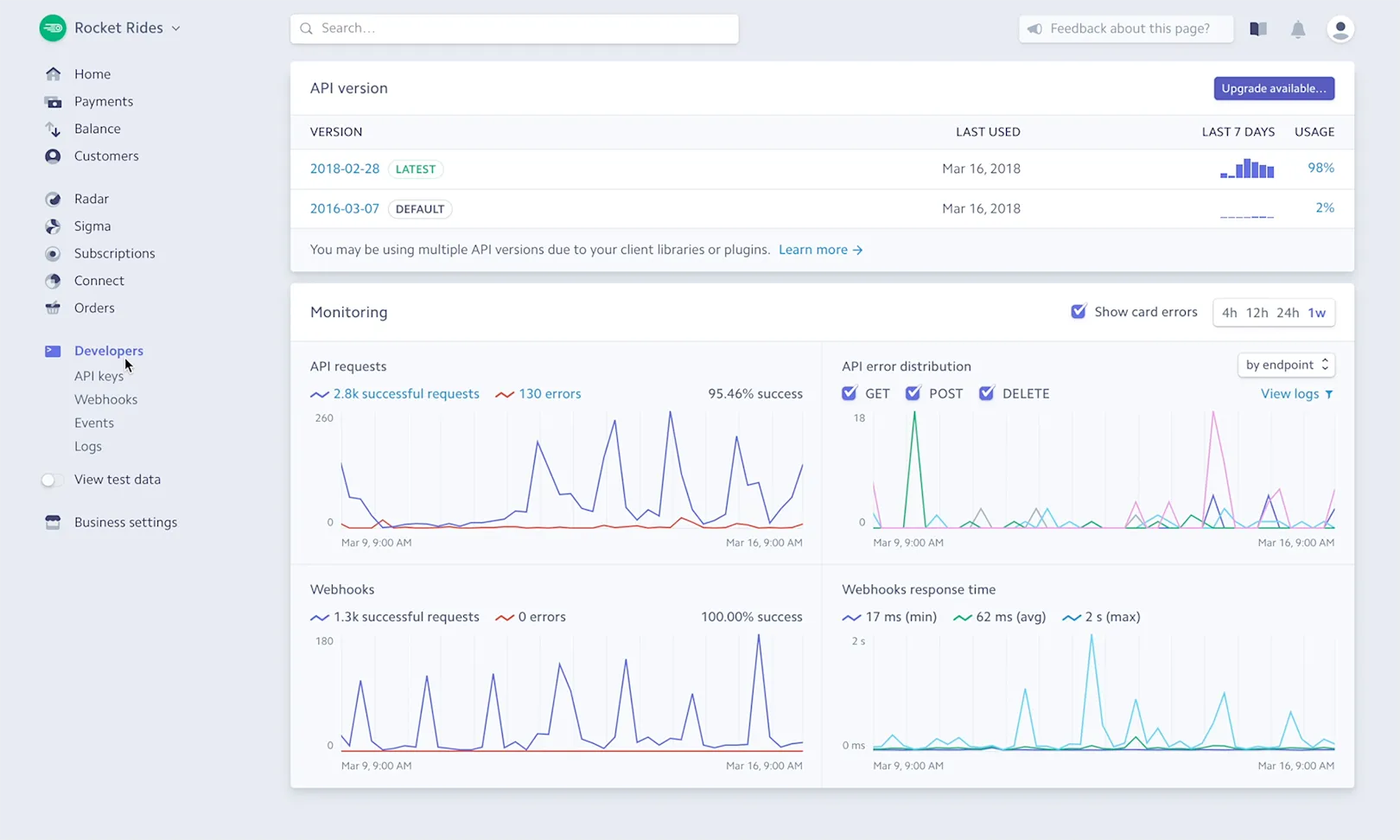
ACS Dashboard Operating Interface
The anti-fraud module within ACS is noteworthy. Traditional anti-fraud signals are optimized for human traffic, while AI Agents lack the randomness of human behavior, making them likely to be wrongly flagged as fraudulent. Moreover, Agents may also be maliciously manipulated to place high-risk orders. ACS conducts specialized risk control assessments for each Agent transaction when processing SPTs.
x402: Pay Per Use with Stablecoins
At this point, we shift from "helping people buy things" to "machines paying machines."
On February 11, 2026, Stripe launched the x402 protocol integration (in preview phase).
x402 is an open payment protocol developed by Coinbase, utilizing the long-dormant HTTP 402 (Payment Required) status code. The process is straightforward:
→ The Agent requests a paid resource.
→ The server returns HTTP 402, along with payment information (amount, currency, recipient address).
→ The Agent completes the transfer with USDC on the Base chain.
→ The server verifies receipt and returns the resource.
Stripe's integration method: merchants create transactions through the PaymentIntents API, and Stripe assigns an on-chain wallet address for each transaction. Once the Agent deposits USDC, Stripe automatically completes the PaymentIntent. Merchants see the same interface as regular payments in the Dashboard.
Features include near-zero transaction costs, supporting micropayments as low as $0.001, 24/7 instant settlement, and no refund disputes.
CoinGecko has already launched a pay-per-use API based on x402, billing 0.01 USDC per request. Currently, it only supports USDC on the Base chain but will expand to more protocols, currencies, and chains in the future.
MPP: Unified Protocol for Machine Payments
Machine Payments Protocol (MPP) is the latest product, released on March 18, collaboratively authored by Stripe and Tempo.
MPP addresses the same issue as x402 (machines paying machines) but covers a broader range.
x402 only supports on-chain transactions. MPP supports stablecoins (via Tempo), credit and debit cards (via Stripe and Visa), Bitcoin (via Lightning), and future scalable custom payment methods.
MPP also features a Session mechanism. Clients pre-load funds to consume balances using lightweight off-chain verifications, with batch settlement. This reduces latency for high-frequency scenarios (e.g., AI consuming a streaming API token by token) to be below 100ms.
For Stripe merchants, payments via Agents using MPP will appear no different from regular human payments in the Dashboard. Funds are settled on the usual cycle, with tax calculations, anti-fraud measures, refunds, and accounting integration all leveraging existing Stripe infrastructure.
const paymentIntent = await stripe.paymentIntents.create({ amount: 1, currency: 'usd', payment_method_types: ['crypto'], confirm: true, });Several already launched cases include:
→ Browserbase: Agents paying by session for headless browser usage.
→ PostalForm: Agents paying for printing and sending physical mail.
→ Prospect Butcher Co.: Agents ordering sandwich takeout for New York customers.
Visa, as a design partner for MPP, has expanded card network payment support within the protocol.
Agent Toolkit and MCP Server
Stripe hosts the official MCP Server at mcp.stripe.com, providing a secure connection through OAuth, allowing AI Agents to directly call Stripe APIs and search Stripe documentation.
Agent Toolkit supports mainstream frameworks such as MCP, OpenAI Agent SDK, LangChain, CrewAI, and Vercel AI SDK, with dual language support for Python and TypeScript, and it is open source.
The core capabilities include three areas:
→ Creating Stripe objects (Product, Price, Payment Link).
→ Usage-based billing (automatically tracking token consumption, integrating Stripe Billing).
→ Creating one-time virtual cards through Stripe Issuing for online shopping.
This level serves as the developer tool throughout all previous products.
Notably, regarding virtual cards, Stripe Issuing allows Agents to create one-time virtual Visa cards, locking amounts, merchants, and destroying them after use. The previously mentioned AgentCard is built on this capability. By adding a line in the MCP configuration for Claude or Cursor, the Agent can issue cards, make charges, and check balances autonomously. The entire process takes about two minutes.
In the same week, Visa Crypto Labs released a CLI tool, allowing Agents to make payments over Visa's network without needing an API Key. Ramp is already issuing exclusive virtual cards for companies' AI Agents, used for automating B2B payments.
Equipping Agents with bank cards is already happening.
Stripe provided a sobering assessment in its 2025 annual letter: In 2026, 95% of AI platform-driven e-commerce transactions will still take place on the merchants’ own websites. True autonomous shopping by Agents (where the Agent remembers your preferences, makes decisions on your behalf, pays on your behalf, and you only receive a notification) still requires time.
However, the six-layer infrastructure has already been established. Equipping an Agent with a bank card, which sounded like a joke six months ago, is now a two-minute process using an MCP tool.
免责声明:本文章仅代表作者个人观点,不代表本平台的立场和观点。本文章仅供信息分享,不构成对任何人的任何投资建议。用户与作者之间的任何争议,与本平台无关。如网页中刊载的文章或图片涉及侵权,请提供相关的权利证明和身份证明发送邮件到support@aicoin.com,本平台相关工作人员将会进行核查。


