Author: Web4 Research Center
"The future is already here — it's just not very evenly distributed." — William Gibson
Nine minutes is long enough for a cup of coffee to cool down, and it's also long enough for a quantum computer to crack the private key of your encrypted assets.
Imagine a scenario like this.
You have just initiated a transfer, confirmed the address, and pressed send. In the next ten minutes, this transaction lies quietly in the mempool, waiting for a miner to package it. You feel safe — after all, Elliptic Curve Cryptography (ECC) has been protecting the world’s most valuable digital assets for over a decade without error.
But what you don't know is that a quantum computer in a corner of the Earth has already locked onto your transaction. It has captured your public key on-chain, and then, in nine minutes — faster than the average block time of mainstream encrypted assets — your private key is derived, and your funds are transferred to an address you do not know.
This is not a plot from a science fiction novel; it is not a Hollywood script.
This is the conclusion written in black and white by the Google Quantum AI team in their official technical blog on March 31, 2026.
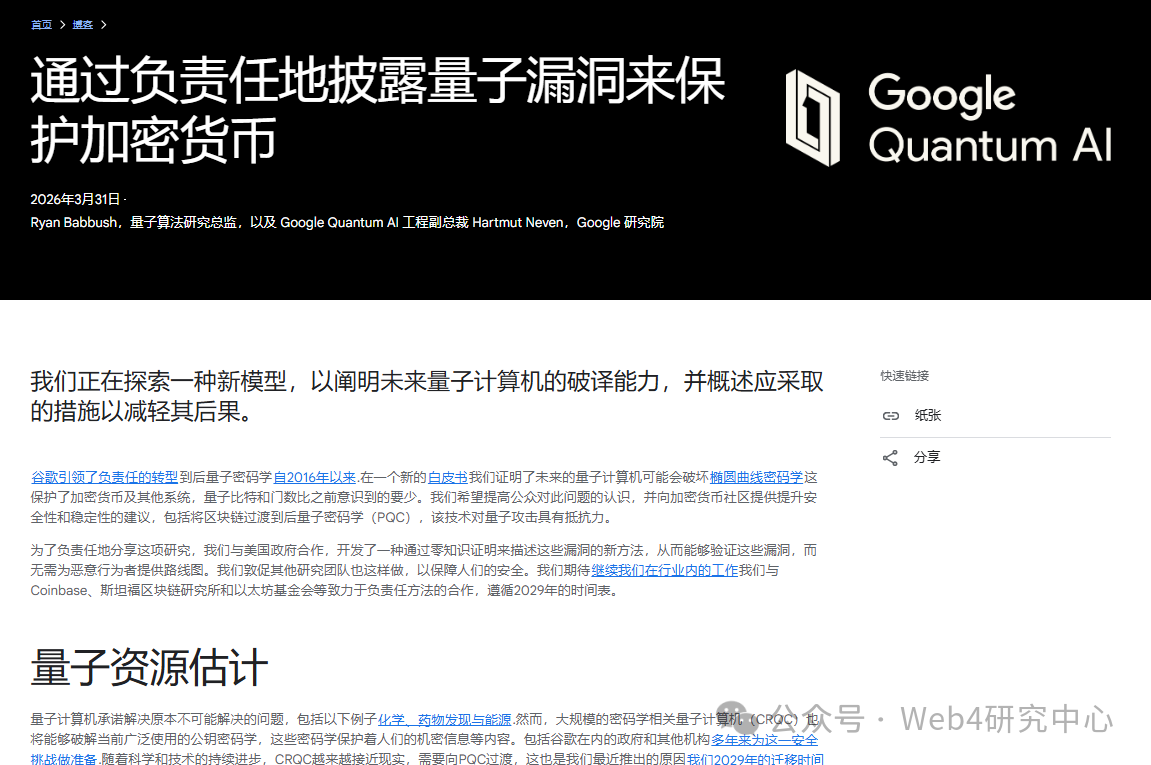
According to the research data released by Google, under a theoretical model where the attacker performs partial pre-computation in advance, a sufficiently advanced quantum computer can crack a private key for an encrypted asset in about 9 minutes, while the average block time for mainstream encrypted assets is 10 minutes. This means that within the time window of a transaction waiting to be packaged, the attacker has about a 41% chance of successfully intercepting and altering the transaction.
Google's research also points out that an attacker may only need less than about 500,000 qubits to have a chance of launching an effective attack on existing cryptographic algorithms; under the condition of having about 1,200 to 1,450 high-quality qubits, certain types of practical attacks theoretically have room for implementation. This number is significantly lower than the long-cited industry threshold of "millions of qubits" required.
This is the "quantum trust crisis" — a systemic risk hidden behind the curve of computational evolution that is counting down. It does not target a specific chain or protocol but points to the entire world of digital assets that rely on elliptic curve cryptography. Once trust is eroded from the mathematical foundation by quantum computers, the core value proposition of encrypted assets — "trustless certainty" — will cease to exist.
More importantly, Google provides an unprecedented hard timetable in this blog post: by 2029, a migration to post-quantum cryptography (PQC) must be completed. This is not a suggestion or a prediction; it is a deadline in engineering terms. Google also announced collaborations with Coinbase, the Stanford Blockchain Research Center, the Ethereum Foundation, and other organizations to jointly advance what may be the most profound underlying security transformation since the birth of the crypto world.
One sentence in the blog stands out — "The urgency to act is increasing."
This statement is not alarmist. Your window of security for encrypted assets is closing at a visibly accelerating speed.
The quantum crisis is not the end of the crypto world, but its rite of passage — it forces the industry to move from "technical toys" to "institutional-level infrastructure."
The "Achilles' Heel" of ECDLP-256: Why Can Quantum Computers Easily Tear It Apart?
To understand the essence of this crisis, we must first clarify a fundamental question: what enables quantum computers to crack the existing cryptographic systems?
Currently, the majority of mainstream public chains, including Ethereum, rely on the Elliptic Curve Digital Signature Algorithm (ECDSA) and its underlying protocol ECDLP-256. The mathematical foundation of this system is the Elliptic Curve Discrete Logarithm Problem — solving it with traditional computers requires astronomical amounts of time.
You can think of it as an extremely difficult math problem. Traditional computers can only try answers one by one, which would take until the end of time to solve. However, when a quantum computer runs Shor's algorithm, the method of solving the problem is entirely different. It does not "enumerate" answers, but utilizes quantum superposition for parallel computing capabilities, fundamentally changing the problem's complexity.
In fact, the main threat of quantum attacks targets public key cryptosystems rather than hash algorithms. Grover's algorithm provides only quadratic speedup for hash functions, not exponential speedup, so the hash part is relatively secure. The real risk arises the moment the public key is exposed.
The moment the public key is exposed is the starting point for quantum attacks.
Google's research report reveals two key findings that every encrypted asset holder should take seriously.
First, the threshold for cracking is much lower than imagined. It was previously believed across the industry that at least millions of qubits were required to threaten the existing cryptographic systems. However, Google’s estimates have significantly lowered this number — in specific attack scenarios, about 1,200 to 1,450 high-quality qubits could pose a substantial threat. This is a difference in scale.

Second, the attack window is much smaller than imagined. As mentioned earlier, a quantum computer could potentially complete cracking the public key within the ten minutes a transaction is waiting for confirmation. This means that even if you are merely initiating a regular transaction, you could be attacked during the process — not because your address is targeted, but because "this operation" of yours is being targeted.
The Taproot upgrade plays a complex role in this issue. The Google research team specifically points out that while Taproot enhances transaction efficiency and privacy, under certain transaction types, it "pre-exposes" public key information on-chain earlier and more frequently, making the previously highly protected address types more susceptible to being locked down in quantum attack scenarios.
This is not alarmism. According to Google's estimates, approximately 6.9 million public keys of mainstream encrypted assets have been fully exposed on-chain, accounting for about one-third of the total supply. This includes around 1.7 million from early mining rewards. Another report jointly released by ARK Invest and Unchained provides similar data, showing about 35% of the supply is under potential quantum threat risk.
Alex Thorn, research director at Galaxy Digital, points out that the current risk is mainly limited to specific addresses with exposed public keys on-chain, including reused addresses, addresses held by certain custodians, and assets in older address formats. An analysis by the security firm Project Eleven indicates that around 7 million coins (equivalent to approximately $470 billion at recent prices) are in such "long-term exposure" status.
Behind these numbers is real money.
The real danger is not quantum computing itself, but the entire industry pretending this problem does not exist.
2029: Not a "Distant Goal," but a Hard Deadline
Time is the cruelest variable in this story.
2029 is not a "distant future"; it is a hard deadline — your window of safety for encrypted assets is closing.
Why 2029? Google’s roadmap is not fabricated out of thin air. Over the past two years, advancements in quantum hardware have exceeded many people's expectations.
In December 2024, Google launched the Willow quantum chip with 105 qubits, capable of completing a benchmarking calculation in less than five minutes — a task that would take about 1,025 years for a conventional supercomputer. More critically, Willow achieved "below threshold" quantum computation — as more qubits are added to the system, the error rate decreases exponentially, marking a milestone breakthrough in the field of quantum error correction.
Following this, major players like IBM and PsiQuantum have also released their hardware roadmaps, coincidentally targeting "thousands of logical qubits" within the 2028 to 2030 timeframe. These dates are no coincidence — the entire industry is converging on a critical point.
However, when Google mentions 2029, it does not mean "quantum computers will crack encryption assets this year." Instead, Google intends to migrate its infrastructure completely to post-quantum cryptography before 2029. In other words, 2029 is not when the threat arrives; it is when the safety window closes.
Why is this deadline so crucial for the crypto world?
Because a hard fork on a mainstream public chain usually takes 18 to 24 months from proposal to community discussion, testing network deployment, and mainnet activation. From the publication of this article to 2029, there are about 34 months remaining. This means that there is almost no room for trial and error.
If a mainstream public chain does not initiate its PQC migration on a testing network before the end of 2027, the deadline of 2029 will be almost impossible to meet. This timeline is particularly harsh for chains that hold the principle of "immutability" sacred.
Nic Carter has made sharp criticisms regarding this. The founding partner of Castle Island Ventures publicly accused some developers of long-term neglecting quantum-related proposals, adopting attitudes such as "denial, gaslighting, setting thresholds, and ostrich mentality." He pointed out that the widely used elliptic curve cryptography is "about to become obsolete; it’s just a matter of time." Whether it is three years or ten years, it will be outdated. The only question is how quickly developers realize they need to build variability into their encryption.
This debate is tearing the crypto world into two camps: one actively strategizing, making post-quantum security a "top strategic priority"; the other advancing slowly in a long and painful struggle for consensus.
Slowly moving through this time window is the most expensive cost.
Who is Acting? Who is Watching? — Industry Differentiation in Progress
In the face of quantum threats, the reaction speed of different public chains varies significantly, and this is likely to become an important variable in the changes of the industry landscape in the coming years.
Ethereum is leading the way.
In January 2026, the Ethereum Foundation made a landmark decision: to prioritize post-quantum security as a "top strategic priority" and announced the establishment of a dedicated post-quantum (PQ) security team.
This team is led by Thomas Coratger, a cryptographic engineer from the Ethereum Foundation, and includes cryptographers and engineers who are testing quantum security systems through development networks (devnets). The Ethereum Foundation has invested a total of around $2 million for this, with $1 million aimed at improving the Poseidon hash function and another $1 million supporting broader post-quantum research.
According to Ethereum researcher Justin Drake, after years of low-profile research and development, the management team of the Ethereum Foundation has officially elevated post-quantum security from an abstract research topic to a core strategic focus. Multi-client post-quantum consensus development networks are already live, with several teams participating and collaborating through weekly compatibility meetings. A bi-weekly developers' meeting, led by Ethereum researcher Antonio Sanso, has also been initiated to set up post-quantum transactions.
Ethereum plans to hold a "Post-Quantum Day" before the ETHCC conference in March 2026 and to conduct larger post-quantum activities in October 2026, showcasing their progress and planning next steps.
On the exchange side, Coinbase's actions have also been swift.
In January 2026, Coinbase announced that it had established an independent quantum advisory committee, including leading scholars in the field of quantum computing, such as Scott Aaronson and cryptographer Dan Boneh, along with several experts from the Ethereum Foundation and blockchain security. The committee will assess the impact of quantum computing advancements on the cryptography of major networks, including Ethereum, and will publish public research and guidance documents for developers, institutions, and users. The first position paper is expected to be released in early 2027.

Coinbase has also released a three-pillar post-quantum security roadmap, covering product upgrades, enhanced internal key management, and long-term cryptographic research — for instance, integrating post-quantum signing schemes with secure multi-party computation. CEO Brian Armstrong emphasized that security is Coinbase's top priority and urged early preparations before quantum hardware matures.
On the other hand, the situation is far more complex for another mainstream public chain.
A proposal that officially lists quantum resistance in its long-term technical roadmap has been introduced, removing the key path spending options in Taproot through the introduction of Pay-to-Merkle-Root scripts, thereby minimizing the exposure risk of elliptic curve public keys. However, this is essentially a cautious and incremental update rather than a complete overhaul of the cryptographic system. It does not upgrade existing UTXOs nor replace ECDSA/Schnorr signatures with post-quantum alternatives. The co-author of this proposal noted that the number of comments it received has surpassed that of any other proposal in the history of improvement proposals. This level of community participation is, in itself, the resilience of the network, but it also means that achieving consensus is extremely slow.
In the face of a quantum crisis, speed itself is a form of safety.
The Triple Test on the Upgrade Path: Why is Migration So Difficult?
Even with standards, teams, and roadmaps in place, the process of migrating from ECDSA to PQC is still fraught with technical pitfalls. This is not a simple software upgrade, but a complete reconstruction of the underlying cryptographic infrastructure.
The first challenge is compatibility. Current mainstream post-quantum signature algorithms (like ML-DSA) generate signatures that are significantly larger than ECDSA — expanding from 32 bytes to over a thousand bytes. This difference directly impacts block space, gas models, and network throughput. On Ethereum, this means a significant decrease in the number of transactions that can fit within each block; and on other networks, it means that the disputes over block size will be reignited.
Cryptography does not have permanent shields, only ever-evolving swords and shields.
The second challenge is protecting old assets. What to do with UTXOs or accounts already existing in old addresses? A simple answer is to have users actively transfer their assets to new PQC addresses. But the problem is that those long-unused addresses — including many lost private key dormant addresses, early miner addresses, and some founders' addresses — will never be able to complete the migration. These "ghost assets" could be catastrophically sold off in the market if a quantum computer cracks them, leading to a price collapse.
The third challenge is governance. Post-quantum migration will almost inevitably involve a hard fork. However, hard forks in the crypto world are never just technical issues, but political ones. When a chain splits into two — one upgrading to PQC and one retaining the original cryptographic system — how will computational power, community, and liquidity be distributed? History has already issued warnings.
Discussions are ongoing regarding the technical path. Besides direct PQC migration, developers have proposed alternative solutions like the "hourglass" mechanism — gradually limiting the expenditure permissions of addresses that have already exposed public keys while reducing systemic risks without forcing migration. Each of these solutions has its pros and cons but requires time for verification and community consensus.
A bridge cannot have its supports removed while still being used. Migration must be phased, verifiable, and have rollback mechanisms.
Your Asset Security Window is Closing — Action Checklist
In the face of this impending crisis, what should holders of encrypted assets do?
Do not panic sell. Quantum attacks have not yet become a real threat. As Alex Thorn, research director at Galaxy Digital, says, investors should not misjudge this long-term technological challenge as an immediate reason for avoidance. But "not panicking" does not equal "not taking action."
You need to understand the risk gradient. In the face of quantum threats, different types of addresses face different levels of risk. The most dangerous are the old addresses that have not been used for a long time, especially those created before 2019 and those that reuse public keys (like certain exchange withdrawal addresses). The risk of standard wallet addresses is relatively low — if your address has never spent assets (i.e., the public key has not been revealed), quantum computers currently cannot attack them. The lowest current risk is for addresses that have migrated to PQC protocols, but such protocols hardly exist on mainstream public chains.
In terms of security, passive waiting is active risk-taking.
The specific actions you can take include: diversifying storage by spreading large assets across multiple addresses to reduce the impact of a single-point breach; paying attention to migration signals, prioritizing exchanges and wallets that explicitly release PQC roadmaps (Coinbase is ahead in this), and for those extremely averse to risk, considering converting some assets into projects with clear post-quantum roadmaps, while acknowledging that there are currently no battle-tested PQC blockchain products.
Do not trust any token marketing claims that say "already quantum resistant." This remains a field that is continuously being validated in labs and testing networks.
Thorn from Galaxy Digital gives a memorable judgment: **Quantum risks should be monitored but should not be used as an excuse for complete avoidance.** In the words of ARK Invest, the threat of quantum computing is not a sudden "singularity" but a progressive process that can be tracked and phased.
A joint report released by ARK Invest and Unchained in March 2026 provides a structured analytical tool for the market to understand this long-term risk by constructing a five-stage framework, clearly stating that at this current time, so-called "Q-Day" does not constitute an urgent threat. The report also points out that millions of encrypted assets may have been permanently lost, while many other assets can migrate to safer addresses when technological threats arise — provided that the community has begun to act.
Your safety window will not remain open forever. It is closing, day by day, narrowing.
The quantum crisis reminds us that the real challenge for blockchain is not performance, nor scalability, but whether it can truly become the trust infrastructure of human civilization. When cryptography can be shattered by quantum computers, the only trustworthy aspect will be those governance mechanisms that have withstood pressure tests.
From "Technical Toys" to "Institutional-Level Infrastructure": An Indispensable Rite of Passage
Historians have a saying: humanity always overestimates the short-term impact of technology while underestimating its long-term effects.
The crypto industry's attitude toward quantum computing happens to be the opposite. It has underestimated the short-term urgency of the quantum threat and also the long-term complexity of the migration itself.
However, if we stretch our view longer, we find an even more interesting conclusion: the quantum crisis is not an end, but a rite of passage.
Heidegger once questioned the essence of technology, believing modern technology is a "framework" that includes everything, even humanity, in a calculable and controllable order. The original intention behind the birth of encrypted assets was precisely to resist this framework — to create a value network not subject to any central powers. Ironically, quantum computers, as an extreme technological force, are threatening the mathematical foundation of this network from the outside.
To cope with this threat, the crypto world must undergo self-iteration. It will no longer be the geek utopia of "code is law," but must evolve into an institutional-level infrastructure that can actively manage cryptographic risks, possess governance elasticity, and accept external audits.
This requires three fundamental upgrades.
The first is an upgrade of cryptographic resilience. Future blockchains will have to embrace replaceable and upgradeable cryptographic frameworks, no longer hardcoding signature algorithms into the consensus layer. This means moving from "one-time design" to "evolvable architecture."
The second upgrade is in governance maturity. Hard forks will no longer just be about scalability disputes or internal community fights but will involve state security-level "infrastructure upgrades." This requires more transparent decision-making mechanisms, broader stakeholder participation, and stricter timetable management.
The third upgrade is in user awareness. Evolving from "Not your keys, not your coins" to "Your keys can be cracked — prepare for migration." Users will regularly check whether their addresses are exposed to quantum risks and actively execute migration.
The quantum crisis is a mirror reflecting the immaturity of the crypto world and showing the only path toward maturity.
Camus wrote in "The Summer Collection": "In winter, I finally realized that I have an invincible summer within me."
The winter of quantum computing is approaching, but the summer of the crypto world — that institutional-level infrastructure forged through stress tests and rebirth — is also taking shape in this crisis.
The cup of coffee has not yet completely cooled down.
Now is the first day to act.
免责声明:本文章仅代表作者个人观点,不代表本平台的立场和观点。本文章仅供信息分享,不构成对任何人的任何投资建议。用户与作者之间的任何争议,与本平台无关。如网页中刊载的文章或图片涉及侵权,请提供相关的权利证明和身份证明发送邮件到support@aicoin.com,本平台相关工作人员将会进行核查。


