Federal Reserve Vice Chair for Supervision Michelle Bowman previewed the coming regulatory thunder on March 12 during remarks at the Cato Institute, revealing that U.S. regulators will soon release a proposal detailing how the country plans to implement the global Basel III “endgame” capital framework.
Buried in the fine print is a rule that hits bitcoin with a staggering 1,250% risk weight — the regulatory equivalent of labeling an asset “handle with oven mitts.”

Source: Prudential treatment of cryptoasset exposures (December 2022) – BCBS Publication No. 545
“In the coming weeks, we will propose rules to implement the final phase of Basel III in the United States,” Bowman said during the speech.
The proposal, expected during the week of March 17–21, comes from the Federal Reserve in coordination with the Office of the Comptroller of the Currency (OCC) and the Federal Deposit Insurance Corp (FDIC). Once released, the draft rule will open a standard 90-day public comment period, giving banks, crypto firms, and policy groups their chance to politely scream into the regulatory void.
The source of the controversy is the Basel Committee’s global crypto framework, finalized in 2022 by the Basel Committee on Banking Supervision. That framework divides digital assets into categories, and bitcoin lands in the harshest one: Group 2b, reserved for cryptoassets regulators consider difficult to hedge and inherently volatile.
Under Basel math, that classification brings the infamous 1,250% risk weight — the maximum penalty allowed in the capital rulebook.
Here’s what that means in plain English. Banks calculate capital requirements using risk-weighted assets. If a bank holds $100 million in bitcoin exposure, regulators treat it as $1.25 billion in risk-weighted assets, forcing the institution to hold roughly $100 million in capital against it before buffers. In effect, every dollar of bitcoin exposure must be backed by a dollar of high-quality capital.
Compared with other assets, bitcoin suddenly looks like the financial system’s problem child. Cash, gold, and U.S. Treasurys carry a zero risk weight. Corporate loans typically range between 20% and 100%. Bitcoin? Regulators slapped it with the maximum setting on the dial.
The result is simple economics: banks can technically hold bitcoin, but the capital treatment makes it about as appealing as buying a sports car with a parking brake permanently engaged.
Industry voices have already started pushing back. The Bitcoin Policy Institute argues the Basel framework misclassifies bitcoin by treating it like an opaque securitization rather than a transparent digital commodity with deep liquidity and measurable market risk.
Managing Director Conner Brown has described the rule as a regulatory mismatch that discourages banks from offering services around bitcoin — including trading desks, lending against bitcoin collateral, and certain forms of balance-sheet exposure.
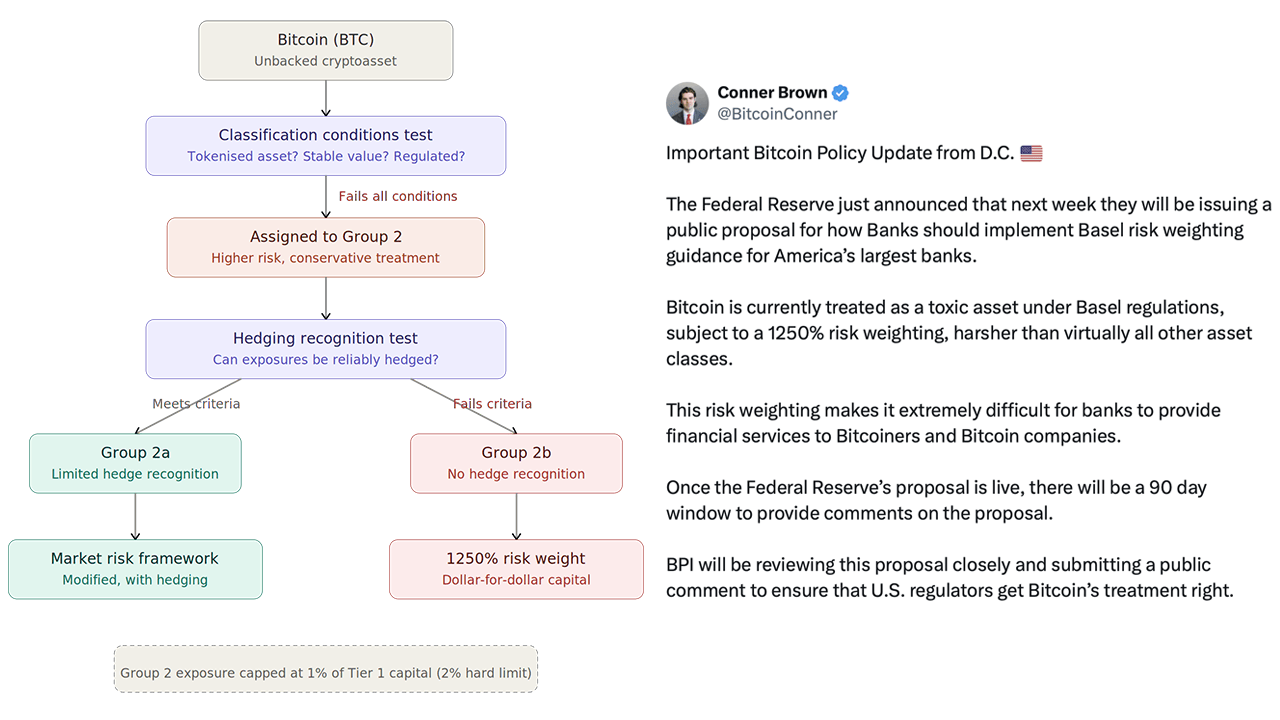
Left image: Diagram of how bitcoin and other crypto assets would be classified. Right image: Bitcoin Policy Institute’s Conner Brown posting about Bowman’s speech and the proposal on X.
And critics aren’t limited to policy groups.
On Feb. 19, Phong Le, CEO of Strategy (Nasdaq: MSTR), publicly called for U.S. regulators to revisit the Basel treatment of bitcoin. Writing on social media platform X, Le argued the capital rules have enormous influence over how banks approach digital assets.
“The Basel Accords set global bank capital standards and risk-weighting rules for assets,” Le wrote at the time. “These frameworks materially shape how banks engage with digital assets, including bitcoin.”
His comments echo a broader concern across the digital asset sector: the Basel framework effectively discourages regulated banks from holding or actively intermediating bitcoin markets, even as demand for exposure continues to grow.
Corporate treasuries already hold more than 1.1 million BTC, derivatives markets tied to bitcoin trade in massive volumes, and institutional products tied to the asset continue to expand. Yet the capital rules create a strange imbalance — demand exists, but the financial institutions most accustomed to managing risk face steep regulatory penalties for touching the asset directly.
Policy advocates say a better solution would rely on existing trading-book models and operational-risk frameworks to measure bitcoin exposure rather than applying a blanket capital penalty.
Suggestions include replacing the fixed 1,250% charge with risk-sensitive calculations, introducing graduated concentration limits, and recognizing hedging strategies already used in other asset classes.
Even the Basel Committee has hinted that the conversation is evolving. The group announced in late 2025 that it plans a targeted review of its cryptoasset framework as the market matures and regulatory understanding improves.
For now, though, the clock is ticking. Once the proposal drops next week, the 90-day comment window will begin — giving banks, crypto firms, and policy groups a rare opportunity to influence how the United States integrates bitcoin into its banking system.
In other words, the rulebook isn’t final yet, but regulators have made one thing abundantly clear — when it comes to banks holding bitcoin, they’re bringing the world’s largest capital cushion.
- Why does Basel III assign bitcoin a 1,250% risk weight?
Because regulators classify it as a high-risk “Group 2b” cryptoasset, triggering the strictest capital requirement allowed under the Basel framework. - What does a 1,250% risk weight mean for banks?
It effectively requires banks to hold capital equal to the full value of their bitcoin exposure, making significant holdings economically difficult. - What did Strategy CEO Phong Le say about the Basel rules?
Le argued the Basel capital framework strongly influences how banks interact with bitcoin and urged regulators to review the asset’s treatment. - When will the Federal Reserve release the Basel proposal?
Regulators expect the proposal during the week of March 17–21, followed by a 90-day public comment period.
免责声明:本文章仅代表作者个人观点,不代表本平台的立场和观点。本文章仅供信息分享,不构成对任何人的任何投资建议。用户与作者之间的任何争议,与本平台无关。如网页中刊载的文章或图片涉及侵权,请提供相关的权利证明和身份证明发送邮件到support@aicoin.com,本平台相关工作人员将会进行核查。


