The U.S. Dollar Index (DXY), which measures the greenback against a basket of major currencies, recorded its strongest weekly advance in more than a year, climbing roughly 1.4% to 1.5% as the conflict involving the United States, Israel, and Iran rattled global markets. The index jumped from the mid-97 range to highs near 99.20–99.43 intraday during the week of March 6–8, a move that pushed the dollar to multi-month highs against major peers.
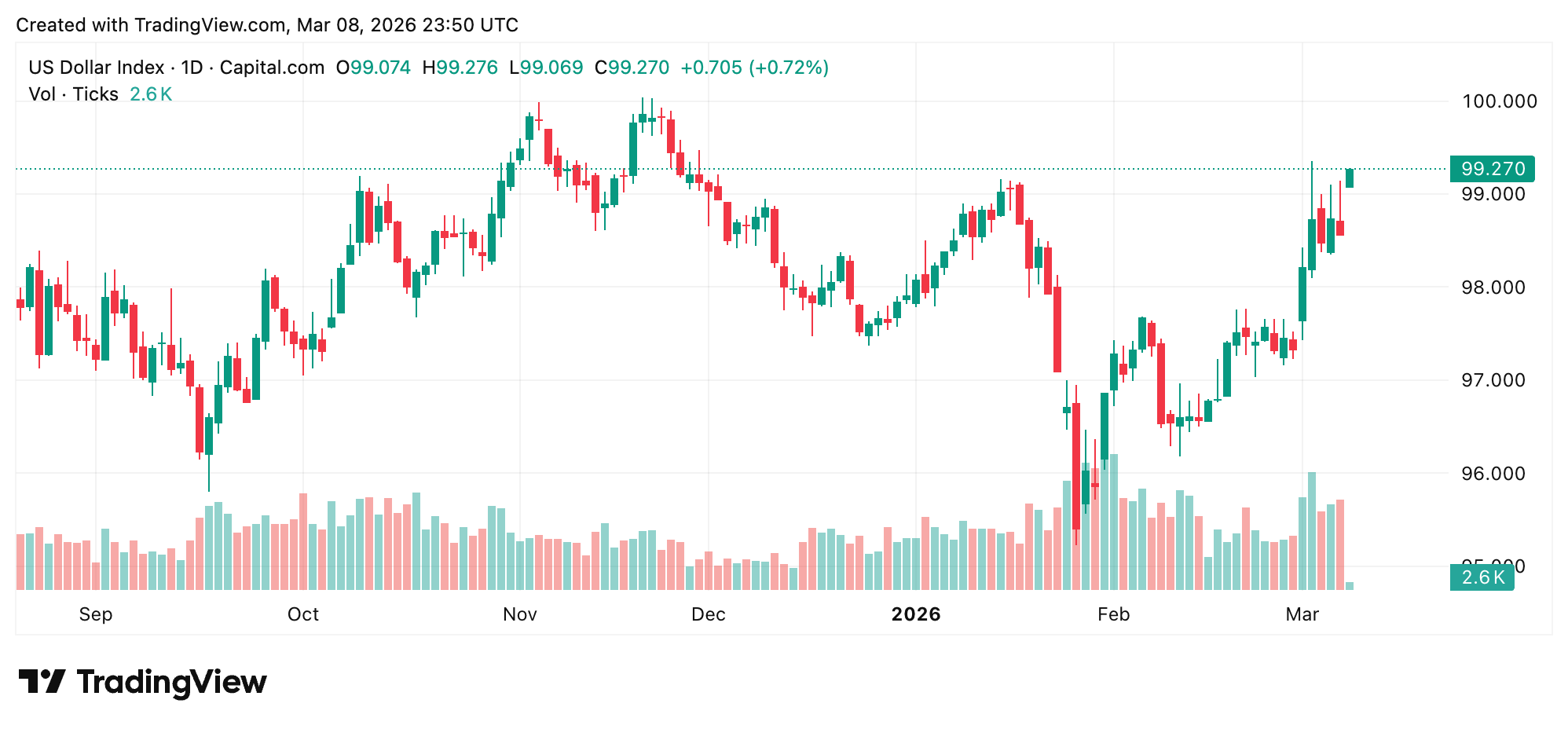
DYX on Sunday, March 8, 2026. Image source via tradingview.com
At press time, it stands at 99.27. The rally comes as investors pile into the dollar amid rising geopolitical uncertainty tied to widening U.S.-Israeli military operations against Iran. Iran’s retaliation and severe disruptions in shipping through the Strait of Hormuz—one of the world’s most important oil chokepoints—have fueled concerns about energy supply and inflation across global markets.
Roughly 20% of global oil shipments pass through the Strait of Hormuz, and tanker traffic through the corridor dropped sharply during periods of heightened tension. Energy traders reacted swiftly, sending Brent crude into the $93 per barrel range, with daily price moves of as much as 6% to 15% at their peaks.
West Texas Intermediate (WTI) crude followed closely, climbing into the low-$80s range and now $89. Hyperliquid perp DEX traders this weekend are seeing eye-popping $115 prices for WTI. Natural gas prices also jumped as traders priced in the possibility of prolonged supply disruptions and rising global energy demand.
Those higher energy prices have quickly translated into renewed inflation fears. Analysts estimate that a sustained $10 increase in oil prices could add roughly 0.2% to 0.4% to U.S. consumer price inflation, with larger increases possible if energy costs remain elevated for an extended period.
That inflation risk has forced markets to rethink expectations for Federal Reserve policy this year. Still, CME’s Fedwatch tool shows no change coming in nine days at the next Fed meeting. Futures markets now show a significantly lower probability of a June rate cut, with odds falling from roughly 50% to near 30%.
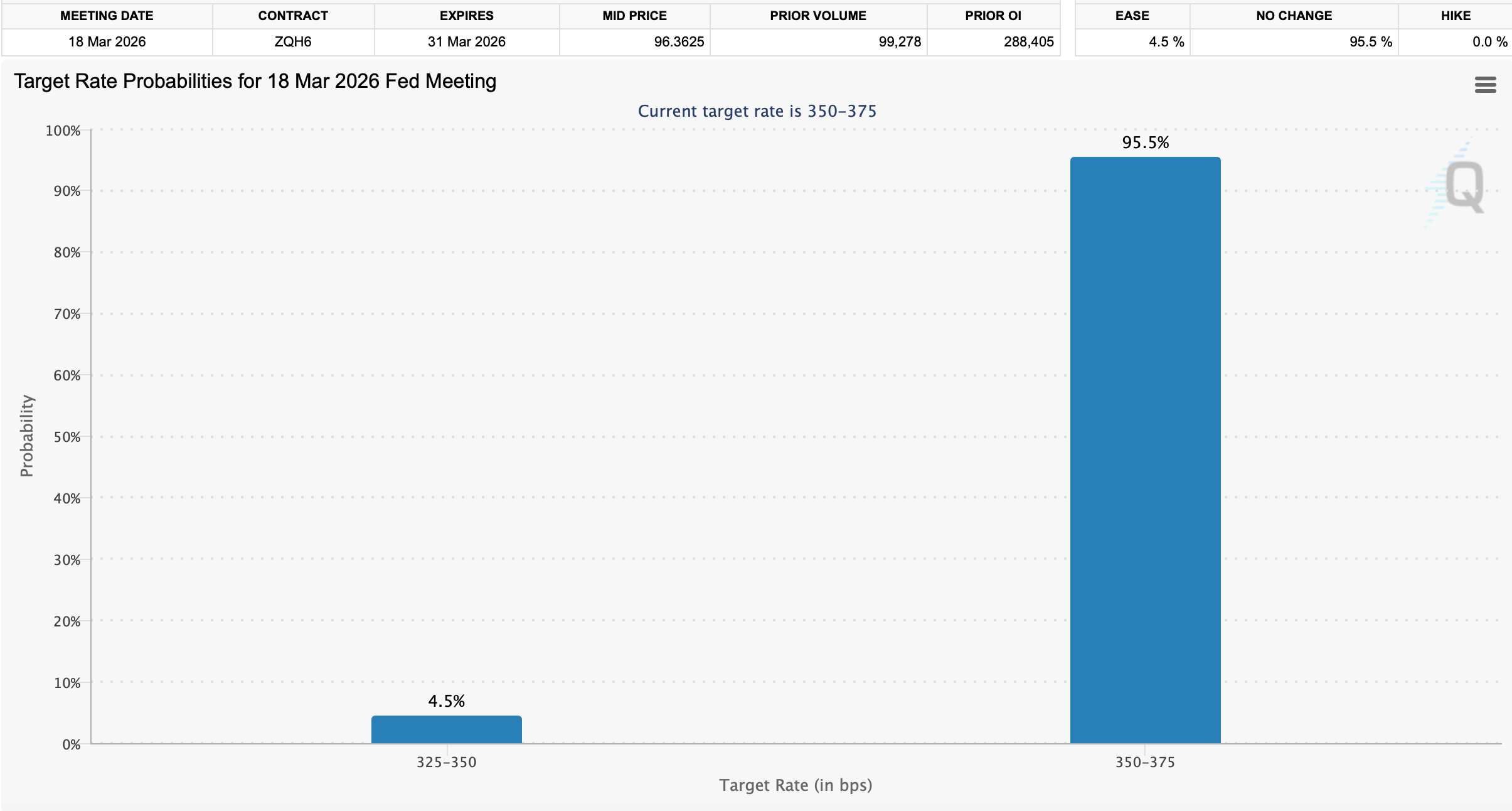
Image source: CME Fedwatch tool on Sunday, March 8, 2026.
Investors also scaled back expectations for total rate reductions in 2026 to about 40 basis points, down from earlier projections near 60 basis points. Higher U.S. Treasury yields have reinforced the dollar’s advantage. The 10-year Treasury yield climbed above the 4% level during the week, widening interest rate differentials between the United States and other major economies, particularly the eurozone and Japan.
The dollar strengthened broadly against major currencies this week. The euro weakened toward the $1.16 range during the rally, while the Japanese yen traded near 157 per dollar, and the British pound also slipped against the greenback.
Market strategists say the dollar’s move reflects classic “flight-to-safety” behavior during geopolitical crises. While traditional safe-haven assets such as gold and the Swiss franc typically benefit during times of instability, the dollar’s liquidity and role as the world’s reserve currency often make it the primary destination for global capital during market stress.
Another factor working in the dollar’s favor is the United States’ position as a major energy producer. Unlike Europe and Japan, which rely heavily on imported oil and gas, the U.S. now operates as a net energy exporter. Higher global energy prices can therefore improve the country’s trade balance and reinforce the greenback’s strength during commodity shocks.
President Donald Trump has also contributed to the geopolitical backdrop fueling the dollar’s rally. Trump told reporters he has “no yips with respect to boots on the ground” if military escalation becomes necessary in Iran, while also suggesting that a large-scale ground invasion could ultimately prove to be a “waste of time.”
Trump’s comments, statements from other U.S. leaders, Iranian authorities, and international players have kept geopolitical risk elevated, adding another layer of uncertainty to financial markets already adjusting to rising energy prices and shifting central bank expectations.
Technical factors have also played a role in the move. The Dollar Index broke above key resistance levels around the 98.4 to 98.5 range, triggering additional buying as traders unwound previously bearish bets on the currency.
At the same time, Iran has installed a new Supreme Leader, with Mojtaba Khamenei—the 56-year-old son of the late Supreme Leader Ayatollah Ali Khamenei—now assuming the role. The new regime dynamic could lead to firmer rhetoric and a tougher posture externally.
The combination of geopolitical stress, inflation risks tied to energy prices, and reduced expectations for Federal Reserve easing has created a powerful tailwind for the greenback.
Analysts now point to the psychological 100 level on the Dollar Index as a potential next target if tensions in the Middle East remain elevated. And depending on Mojtaba Khamenei’s governing style, many observers believe he may closely reflect his father’s doctrine, meaning Iran will probably maintain its deterrence-first strategy.
For now, the dollar’s message to global markets is simple: when uncertainty rises and oil prices climb, the world’s reserve currency still tends to take center stage.
- Why is the U.S. dollar rising in March 2026?
The dollar is strengthening due to geopolitical tensions in the Middle East, rising oil prices and reduced expectations for Federal Reserve rate cuts. - What is the U.S. Dollar Index (DXY)?
The DXY measures the value of the U.S. dollar against a basket of major currencies including the euro, yen and British pound. - How do oil prices affect the U.S. dollar?
Higher oil prices can strengthen the dollar because the United States is a major energy exporter and global investors seek dollar liquidity during energy shocks. - Could the dollar continue rising in 2026?
Analysts say the dollar could remain strong if Middle East tensions persist, oil prices stay elevated and the Federal Reserve delays interest rate cuts.
免责声明:本文章仅代表作者个人观点,不代表本平台的立场和观点。本文章仅供信息分享,不构成对任何人的任何投资建议。用户与作者之间的任何争议,与本平台无关。如网页中刊载的文章或图片涉及侵权,请提供相关的权利证明和身份证明发送邮件到support@aicoin.com,本平台相关工作人员将会进行核查。


