Hello everyone, I am the invited analyst Cody from Planet Daily Odaily, wishing all readers a happy Lantern Festival in advance!
Looking back at last week's Bitcoin market, the overall trend basically followed the previously established trading framework and rhythm. In terms of short-term strategy, the market operation was highly consistent with short-term judgment, completing a short position operation (1x leverage) based on short-term trading strategies, achieving approximately 2.12% profit per trade (see Table 2 for details). In terms of mid-term strategy, Bitcoin continued to use the previously established medium-term approach, holding a short position established at $89,000 (1x leverage). As of last week's closing, the price fell back to about $65,770, resulting in a paper profit of about 26.10% for this medium-term trade, with a maximum floating profit of approximately 32.58%.
From the perspective of market analysis, Bitcoin continued to operate within a weak range-bound structure last week, and the rhythm of the movement remained consistent with the previous judgment of the C-2 wave rebound phase, and the nature of the short-term rebound has not changed.
Furthermore, I continue to be optimistic about the trend of HYPE, so this week’s report continues to track and analyze the multi-period structural trend of HYPE. In the previous week, combining my own short-term structural judgment, I completed a short-term long position operation (1x leverage), achieving about 11.14% profit, with trading logic and execution results forming a good correspondence (see Table 1 for details).
The following will elaborate on the above content, focusing on market predictions, strategy logic, trading execution, and result reviews.
1. HYPE Trend – Prelude to the Start of Wave III?
In my weekly review on February 22, I first pointed out the investment opportunity of HYPE, explicitly stating that its original downward trend might reverse and that the current market is in the Ⅱ wave adjustment phase after the Ⅰ wave rising phase, with the potential for a main rising phase (Ⅲ wave) in the near future. The core basis is as follows: (see Figure 2)
• In the Ⅰ wave rising phase, the price effectively broke through the long-term downward trend line connecting the high point in September 2025 (about $59.48) and the high point in October 2025 (about $50.17) (the blue line in the figure);
• At the starting point of the Ⅰ wave, our self-constructed momentum quantification model issued a daily-level momentum divergence signal;
• At the starting point of the Ⅰ wave, our self-constructed price difference quantification model triggered a strong bottom warning signal (the white bar in the figure).
It is particularly noted that the validity of the signals issued by the two major models has been confirmed by the strong upward performance of the price during the Ⅰ wave phase, validated by the market.
1. HYPE Short-Term Operation Review (1x leverage): (02.22~03.01)
Last week, we strictly adhered to the trading signals issued by our self-constructed price difference trading model and momentum quantification model, and combined with our prediction of the main rising phase of Ⅲ wave, completed a short-term (long position) operation, successfully making a profit of 11.14%.
(See Table 1)
• HYPE Short-Term Trading Summary: (Leverage * 1x)

Table 1
• Opening Decision (see Figure 3): Based on the anticipation of the main rising phase; at the same time, the price difference quantification model repeatedly issued bottom warning signals (red dots in the figure), which then resonated with the bottom signal of the momentum quantification model; and the price effectively stabilized after breaking through the previous key area. Therefore, we opened a position at $27.28 (for long position).
• Closing Decision: The price difference quantification model and momentum quantification model issued a top resonance signal, so we closed near $30.32.
• Trading Summary: This operation successfully captured the upward opportunity in the initial stage of Ⅲ wave, achieving a profit of about 11.14%.
HYPE 30-Minute K-Line Chart
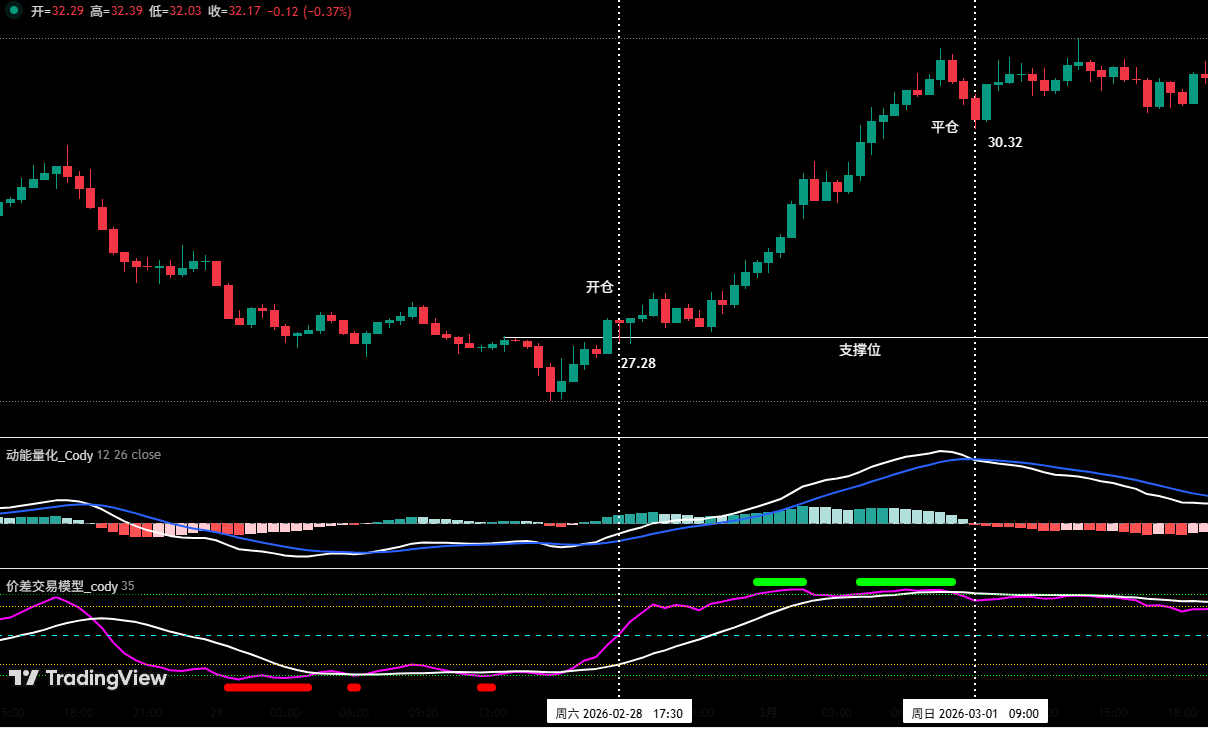
Figure 1 (Short-term trading illustration)
2. Preliminary Division of Daily Level Trend Structure: (Based on market evolution after January 21)
HYPE Daily K-Line Chart
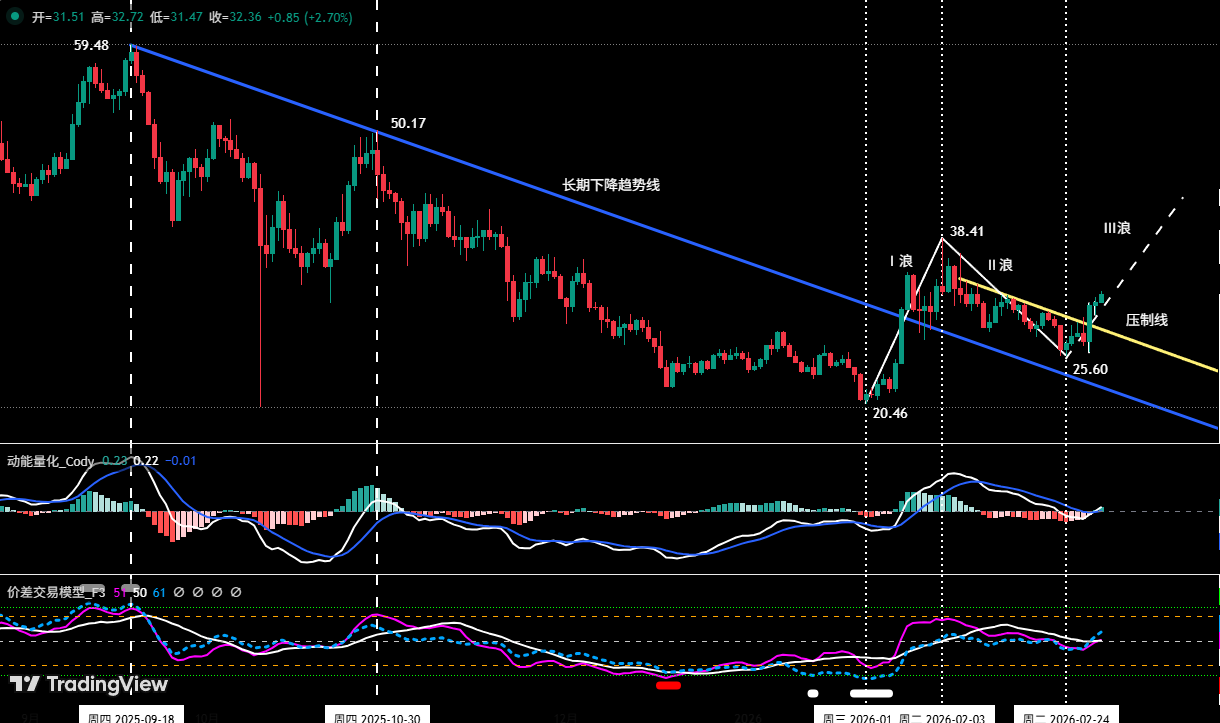
Figure 2
• I Wave (Driving Wave): Started from the January 21 low of $20.46, ending at the February 3 high of $38.41. Lasted for 14 days, with a maximum increase of 87.73%, forming the first main driving wave of this rising cycle.
• II Wave (Adjustment Wave): Started from the February 3 high of $38.41, ending at the February 24 low of $25.60. Lasted for 20 days, correcting the I wave, with a maximum retracement of 33.35%.
• III Wave (Potential Driving Wave): Launched from the February 24 low of $25.60, the current market is in progress, where the third driving wave is often the most explosive one.
• Confirmation of the Effectiveness of the Start Point of III Wave: The current trend has shown several technical characteristics that match the early phase of a strong driving wave:
a. Breakthrough of Key Resistance Line: The price successfully broke through an important resistance line since the II wave adjustment (the yellow line in the figure), which had previously been challenged three times without success. This marks a change in the balance of power between bulls and bears.
b. Strong Validation of Momentum: The rebound starting from the February 24 low has completely covered the decline of the previous 10 days in just 6 days. Notably, the large bullish candle recorded on February 28 with a growth of 14.25% is significant, which is consistent with the strong characteristics of the initial momentum of Ⅲ wave.
c. Structural Trend Reversal: The current price high has surpassed two important structural points adjacent to the adjustment process of II wave and the February 24 low, namely the high of $30.59 on February 21 and the low of $27.73 on February 19. This preliminarily constitutes a "high point moving up" trend, indicating that the original downward structure has been fundamentally reversed.
• Confirmation of the Endpoint of III Wave: The high point of Ⅲ wave must exceed the Ⅰ wave peak of $38.41. Otherwise, this segment may still belong to a rebound within a wide range or a downward structure.
3. HYPE 4-Hour Detailed Structure
HYPE 4-Hour K-Line Chart
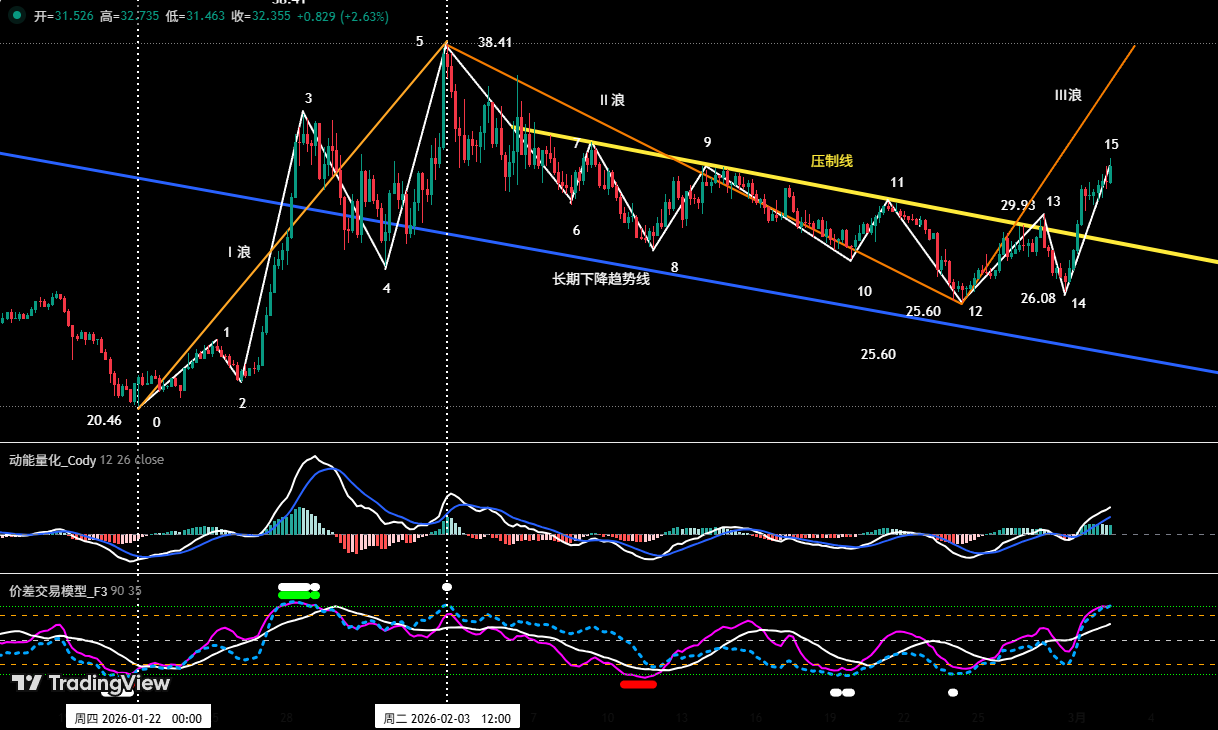
Figure 3
In Figure 3, we perform a more refined division of the daily level waves mentioned above.
• Internal Structure of I Wave: Can be subdivided into 0-1, 1-2, 2-3, 3-4, and 4-5, forming a complete rising trend.
• Internal Structure of II Wave: Can be subdivided into 5-6, 6-7, 7-8, 8-9, 9-10, 10-11, and 11-12, forming an orderly retracement trend.
• Internal Structure of III Wave: Currently in progress. It can be temporarily subdivided into 12-13, 13-14, and 14-15, of which the 14-15 rising segment has not yet ended.
2. Looking Back at Bitcoin – Mainly Range-Bound Consolidation: (02.22–03.01)
1. Short-Term Operation Strategy Review: (See Table 2)
We strictly adhered to trading signals issued by our self-constructed price difference trading model and momentum quantification model, and combined with market trend predictions to complete a short-term (short position) operation last week, achieving a trading profit of 2.12%.
① Bitcoin Short-Term Trading Summary: (Leverage * 1x)

Table 2
② Short-Term Trading Review: (See Figure 4)
• Opening: The pullback encountered pressure from the downward trend line, while the price difference trading model triggered a top warning signal (green dots in the figure), combined with two model short resonance signals, establishing a 15% short position at $68,876.
• Risk Control: Initial stop loss for the short position set at $72,000.
• Closing: As the price dropped near the support level, with model bottom resonance signals and K-line combination bottoming signals, closed the entire position at $67,415.
• Summary: This trade achieved a profit of 2.12%.
Bitcoin 30-Minute K-Line Chart: (Momentum quantification model + price difference trading model)
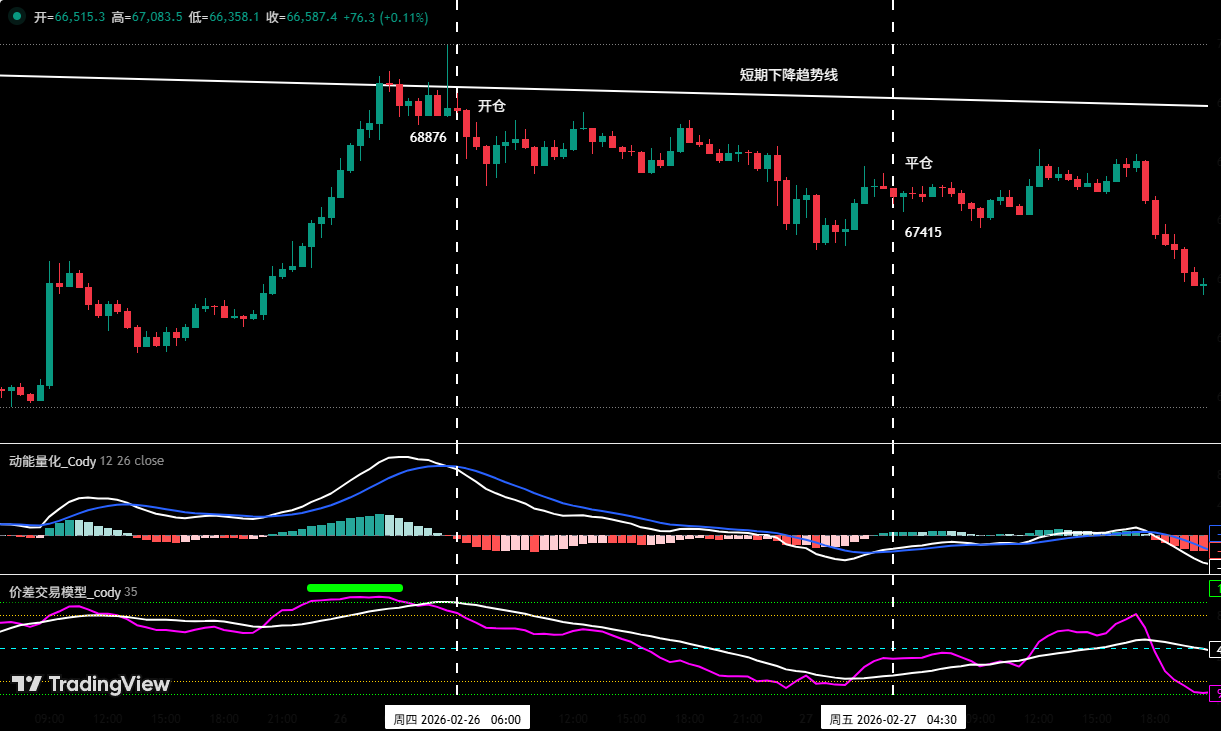
Figure 4 (Short-term trading illustration)
3. Bitcoin Indicator Analysis: Comprehensive Weekly and Daily Evaluation
Weekly Level: Mid-Term Bearish Structure Continues
From the weekly structure perspective, the momentum line in the momentum quantification model continues to decline. Although the negative momentum bars have shown a period shortening, no effective divergence signals have been formed, and the bearish trend has not changed substantially. The sentiment quantization model shows that the market has not yet entered a clearly oversold panic zone, and the conditions for bottom sentiment repair remain inadequate; at the same time, the digital monitoring model has not issued bottom confirmation signals.
From the market structure perspective, last week’s weekly K-line closed with a bearish candle showing a decline of about 2.76%, with the price breaking below the previous triangular convergence structure, and the center of gravity clearly shifting downward, making the overall pattern more consistent with the characteristics of a downward continuation, indicating that mid-term trend remains weak.
Daily Level: Oversold Rebound Continues, But Momentum is Limited
From the daily level perspective, the overall market maintains a horizontal consolidation pattern in the short term. The momentum line has slightly risen after forming a "golden cross" below the zero-axis, indicating the short-term rebound momentum is being released, but the positive momentum bars are arranged disorderly, lacking sustainability, making the rebound rhythm weak.
Regarding the sentiment quantization model, although the sentiment indicators are slowly moving away from the oversold range, the participation level of funds is still limited, and both bulls and bears generally adopt a wait-and-see attitude, making it difficult to form a trending upward movement in the market.
Comprehensive Multi-Period Judgment
Based on the analysis of both the weekly and daily levels, Bitcoin is still operating within a bear-dominated downward structure. The daily-level rebound seems more like a technical correction in the context of a downward process, and until the weekly trend is effectively reversed, caution must be taken regarding the height and sustainability of the rebound.
The above data suggests: the daily bearish trend has not changed, and the oversold rebound trend continues.
4. Market Prediction: (03.02–03.08)
1. Bitcoin Rising Center Construction (Based on market after the February 6 low)
Bitcoin 4-Hour K-Line Chart
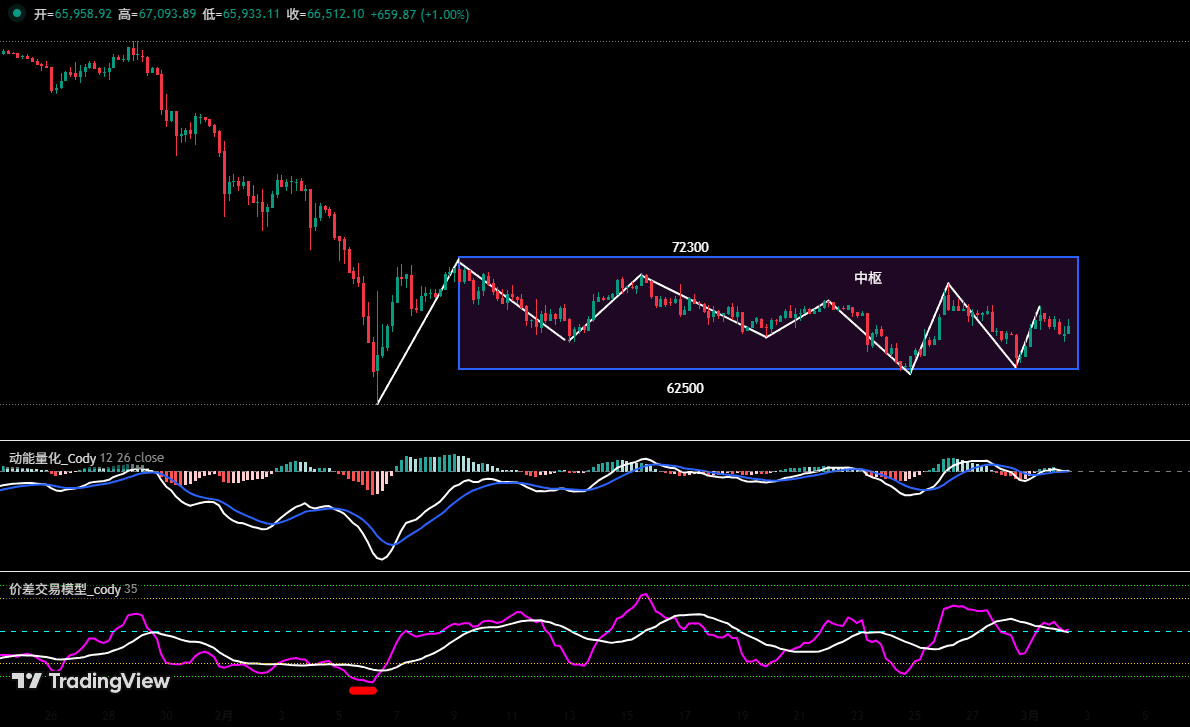
Figure 5
Using a 4-hour operation cycle for Bitcoin:
• Center Construction: According to the 4-hour chart, it is highly probable that we are still building an "upward center" structure, with the highest resistance level around $72,300 and the lowest support level shifting down to around $62,500.
• Core Operation Plan:
• Upward Rebound: If the coin price effectively breaks through the resistance near $72,300, falling away from the current "center gravity," then it may continue the oversold rebound trend of the C-2 segment, but the rebound space is expected to be limited.
• Downward Adjustment: The lowest support of the current center has shifted down to around $62,500, close to the February 6 low of $60,000. If the coin price falls below this support, the oversold rebound of the C-2 segment may end, or it could initiate the C-3 segment adjustment trend.
• Regardless of which trend the coin price operates, it is recommended that investors maintain a strategy of "short on the high."
2. This Week's Core Viewpoint: Maintain a range-bound consolidation pattern, focusing on the struggle between the bulls and bears near the edge of the range. Strategically, it should be firmly executed as "reduce long positions on highs, control risks."
3. Core Resistance Level:
• First Resistance Zone: $68,500–$70,000 area (previous dense transaction area)
• Second Resistance Zone: $72,300–$74,500 area (near last April's low)
4. Core Support Levels:
• First Support Level: near $65,000 (previous important support area)
• Second Support Level: $60,000–$62,500 area (near February 6 low)
• Third Support Level: around $57,400 (near the 210-week moving average)
5. Plan A, B Strategies (Excluding Sudden News Impact): (03.02–03.08)
1. Mid-Term Strategy: Maintain 60% short position. If the rebound effectively breaks through $74,500, the position can be reduced to 40%.
2. Short-Term Strategy: Use 30% of the position, set stop-loss points, and look for "price difference" opportunities based on support and resistance levels. (Using 30 minutes/60 minutes as the operation cycle).
3. Since the mid-term market direction is bearish, short-term operations for Bitcoin should follow the principle of "go with the trend, short on the high." To dynamically respond to the complex evolution of the market and combined with signals from our self-constructed trading model, we propose two short-term operation plans: A/B
• Plan A: If the coin price rebounds to the resistance area around $70,000–$72,300:
• Opening Position: When the rebound triggers resistance signals in this resistance area combined with model top signals, a 15% short position can be established.
• Risk Control: Initial stop loss for the short position set above $75,500.
• Closing: When it drops near the important support level and combined with model signals, it can gradually close the position to take profit.
• Plan B: If the coin price rebounds to around $74,500:
• Add Position: When the coin price continues to rebound and meets resistance in this area and combines with model top signals, an additional 15% short position can be added.
• Risk Control: Initial stop loss for the short position set above $75,500.
• Closing: When dropping to the support level and combining with model signals, it can gradually close the position to take profit.
6. Special Tips:
1. When opening a position: Immediately set the initial stop loss.
2. When profit reaches 1%: Move the stop loss to the opening cost price (breakeven point) to ensure capital safety.
3. When profit reaches 2%: Move the stop loss to the position of 1% profit.
4. Continuous Tracking: After this, every time the coin price makes another profit of 1%, the stop loss will move correspondingly by 1%, dynamically protecting and locking in profits.
The financial market is ever-changing, and all market analyses and trading strategies need dynamic adjustments. All opinions, analytical models, and operational strategies discussed in this article are based on personal technical analysis and are for personal trading log purposes only, not to be considered as any investment advice or operational basis. The market is risky, and investing requires caution; please do not make decisions based on this.
免责声明:本文章仅代表作者个人观点,不代表本平台的立场和观点。本文章仅供信息分享,不构成对任何人的任何投资建议。用户与作者之间的任何争议,与本平台无关。如网页中刊载的文章或图片涉及侵权,请提供相关的权利证明和身份证明发送邮件到support@aicoin.com,本平台相关工作人员将会进行核查。


