Text | Lin Wanwan
The world's busiest international airport, Dubai Airport, was bombed.
This is not an ordinary airport. Atlanta ranks first in total passenger flow, but relies on domestic flights in the U.S. The true king of international flights is Dubai, a super hub connecting Europe, Asia, and Africa with 1,200 flights landing and taking off daily. Two hours later, Abu Dhabi Airport was also bombed. The two major airports in the UAE disabled overnight.
The exits were cut off.
At 4 PM on February 28, a Chinese developer named Wu had just returned home from downtown when he heard three loud knocks outside the window. He immediately knew it was a missile. He had heard this sound before while engaging in activities in Lebanon and Iraq.
The rumbling grew louder and continued until midnight. He saw a missile being intercepted in the direction of Marina and explode in the air.
"I had only seen this in movies before," he said, "this time the Earth is showing me a blockbuster."
The Palm Island hotel, a Dubai landmark, was bombed, the seven-star Burj Al Arab caught fire, and the fire of intercepts flashed above the tallest building in the world, Burj Khalifa. These names usually appear in travel ads; now they are in war news.
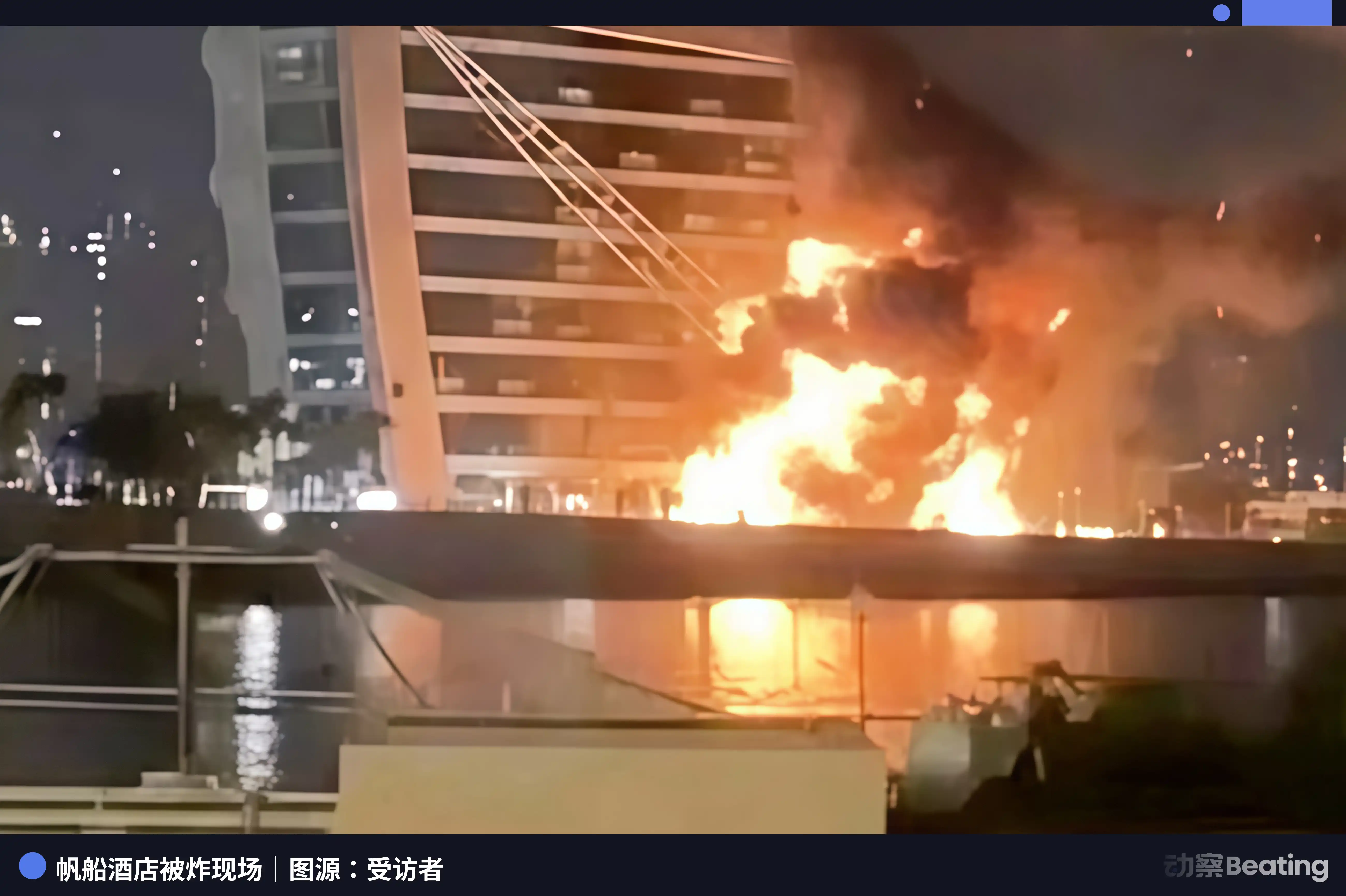
On that morning, the U.S. and Israel joined forces to strike Iran. Iran retaliated within hours, launching missiles towards Israel and the entire Gulf. Bahrain, Qatar, Kuwait, and Saudi Arabia all sounded alarms. Iran made it very clear: anyone helping the U.S. is a target.
As of the time of writing, Iran had launched at least six waves of attacks, firing 167 missiles and over 500 drones.
Binance CEO He Yi, who is currently in the UAE, mentioned in our exclusive interview, "Rationally speaking, because there are air defense systems, safety is overall guaranteed, but those lacking information retrieval capabilities may panic more."
Additionally, she noted, "Bombings and missiles will cause mass casualties. However, currently, the fragments of intercepts and drone attacks primarily add psychological pressure on the public and can cause more economic harm."
The Chinese population in Dubai is growing rapidly; by 2025, about 300,000 Chinese are expected to reside there. The Dragon City in Dubai, a Chinese commodity city built in the desert 15 kilometers from the old city, once claimed to be "the largest Chinese trade center outside mainland China." Moreover, Huawei, Xiaomi, and OPPO have established their Middle Eastern headquarters here, and Chinese internet companies treat it as a bastion for going overseas.
Chinese individuals across various sectors—those involved in Web3, trade, tourism, real estate, and finance—have all made their homes in this desert city.
For the past decade, they have become accustomed to the political stability of the UAE, accustomed to zero income tax, and accustomed to thinking "the chaos in the Middle East has nothing to do with me."
Until the missiles came.
A Chinese person wrote in their social circle, "I initially came to Dubai to avoid taxes, and now I am sitting in a bomb shelter to avoid bombs."
We interviewed four people in Dubai to discuss their real situation.
1. Although Bombed, Food Delivery Still Available
Wu works with developer tools in Dubai, living near Marina, not far from the entrance of Palm Island. This location is usually a selling point; now it's a problem: it's quite close to the U.S. military base in Jebel Ali.
At 4 PM on February 28, he had just finished eating near Burj Khalifa and had just returned home when he heard three loud knocks outside the window.
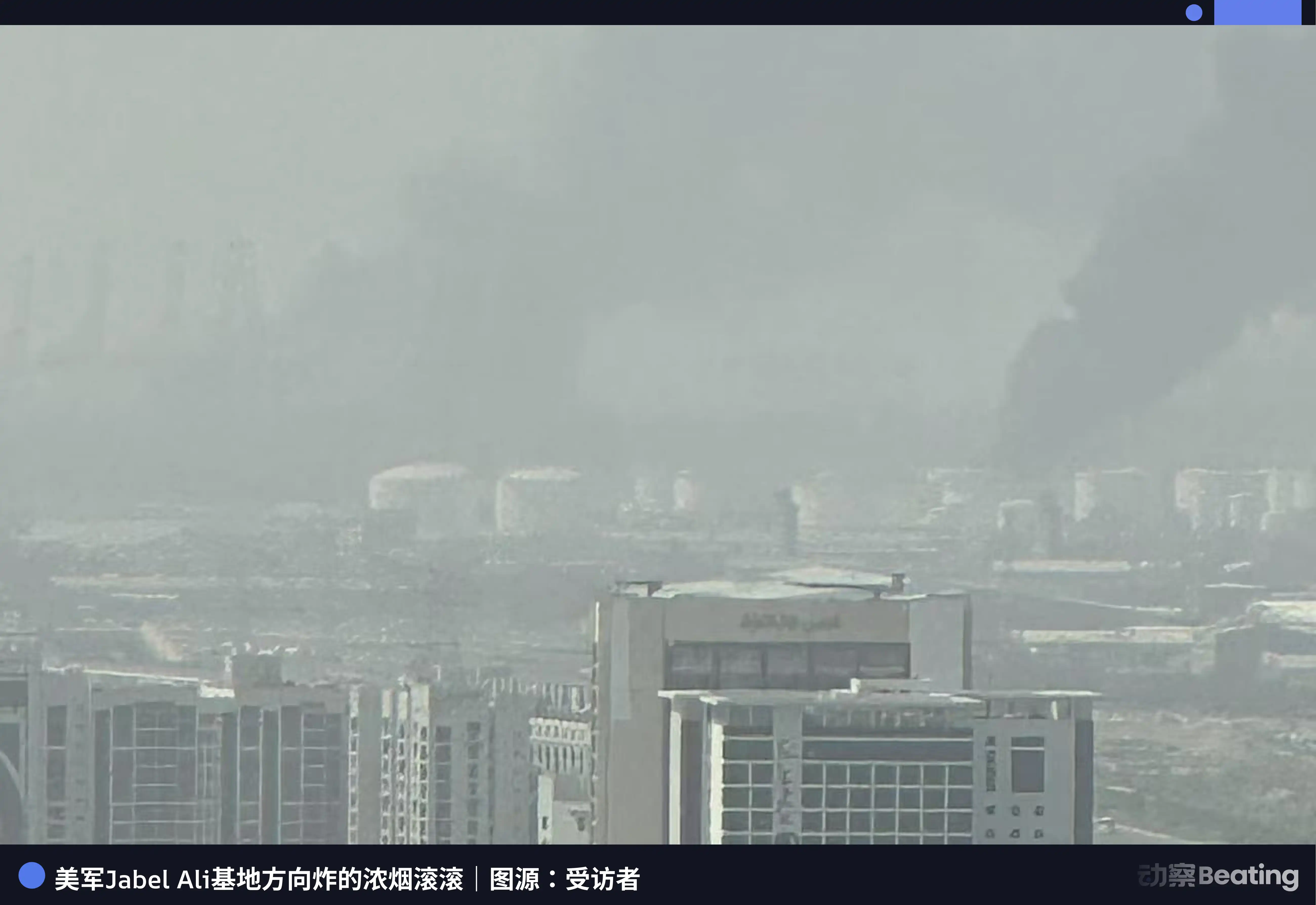
He didn’t hesitate; he recognized the sound from prior developer activities in Lebanon and Iraq.
But those places lack missile defense systems; if they drop, they drop, and one just needs to avoid the bombardment area. Dubai is different; it has THAAD. Missiles might be intercepted and detonated in the air or veered off course, leading to random landing spots, likely in civilian areas.
The rumbling grew louder, mixed with sirens and ambulances. People on the street were mostly on the phone communicating with their families to report safety, moving hurriedly.
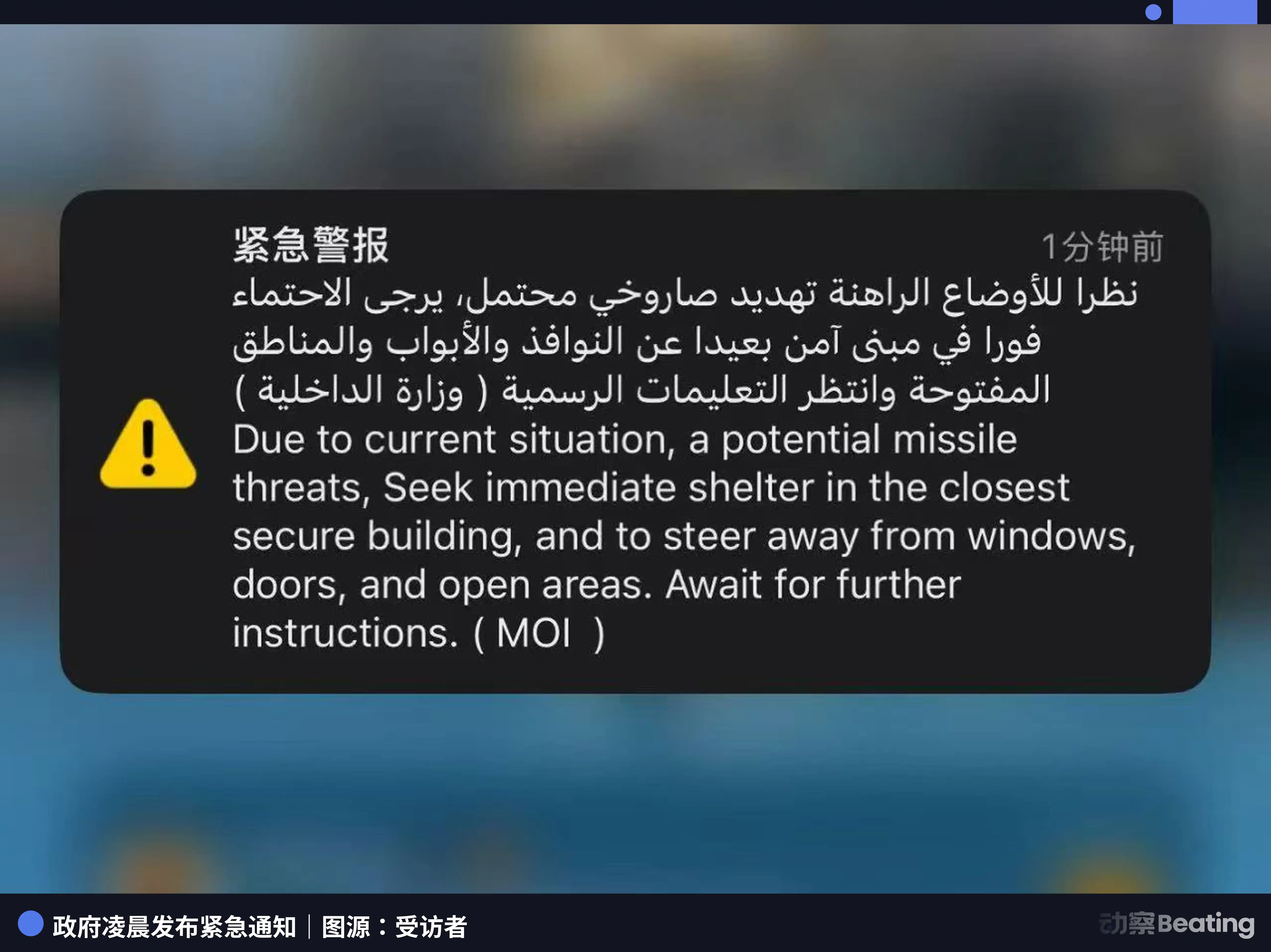
At midnight, government alarms went off on their phones. Beep beep beep beep beep, piercing, stopping only after three or four minutes. Then the building alarms went off. He and his wife headed to the underground garage.
The garage was already crowded. Some were clutching children, while others stuffed bottled water and cookies into their trunks. The engines were still running, ready to leave. In the worst-case scenario, they could drive away.
At 8 AM the next day, a loud noise jolted his wife awake. She shook him: "That sounded really close." He looked at the window, the glass was trembling. The glass in the building across was also shaking.
But today, the government did not trigger any alarms; he speculated that they didn't want to cause panic. Or perhaps they thought civilian areas would not be targeted.
Most of the city was still operating normally, and there was no panic as reported by the outside world.
Wu went down to the supermarket. The shelves were full, with milk and bread available, and no one was rushing. He ordered McDonald's, and it arrived in half an hour; the delivery guy even joked with him upon delivery.
However, the Chinese supermarket was the opposite. Last night at 9:30, he placed an order, but the system indicated it was too busy. Trying again at 10, it still couldn’t be processed. Today, the goods did not arrive. The official explanation was that there were too many people buying, and they couldn't keep up.
Wu's British neighbor left early in the morning, dragging a suitcase and moving quickly.
Currently, there are about three evacuation routes:
1. Some drove overnight to Oman, which is the only neighboring country not attacked by Iran, but the road to Oman is almost impassable.
2. Some retreated to Al Ain, in the desert, where missiles are unlikely to explode.
3. Others moved to Sharjah, where there are no military facilities. The border crossings are estimated to be completely blocked.
Wu plans to wait and see. "Iran can’t have an unlimited supply of missiles, so I expect the situation will be more controllable moving forward." Official reports stated that 137 missiles were intercepted and 132 were shot down; a few more explosions occurred today.
His escape route will also be chosen from the three directions; he already packed water and food in the car and kept an emergency wallet accessible.
He has a friend who works in sales at the airport. When Terminal 3 was bombed, he sent a message immediately: it was smoking and they were evacuating. The Chinese community's point-to-point network is faster than official sources and more accurate than the media. Who's building was bombed, which intersection is closed, and which supermarket still has supplies were all communicated through WeChat groups.
Chinese friends living in downtown have started moving out, looking for shorter buildings. Because Burj Khalifa is too tall, too noticeable. The Burj Al Arab and Palm Island have both been hit, raising suspicions that Iran seems interested in landmarks.
He said if Iran continues to create chaos like this, he might consider leaving. "Trust is hard to build. Once it's broken, you can't go back."
Now all they can do is wait. Wait for the U.S. to stop, wait for Iran to finish firing, wait to see if the sounds are getting closer or further away.
2. Want to Stroll to See the Bombing Site
Mason lives in Dubai Silicon Oasis, reportedly near a U.S. military base, which he never took seriously.
On February 28 in the afternoon, while he was eating, the hotel at the Palm Island landmark was hit by a missile. He finished his meal and wanted to drive to see the site, but the navigation showed that the road to the bombing site was completely blocked, so he had to give up.
Mason didn’t feel scared, "Maybe it's too far from me."
Ten minutes before he talked to me, he heard an explosion, this time right above him. A missile was intercepted and exploded in the air, making a huge noise. He looked outside, and there were still people strolling below.
Just last night, several of his phones rang continuously, the government alarms piercing the night, reporting roughly: avoid going outside, keep a distance from windows. He heard a tearing sound from above, unsure if it was a fighter jet or a missile; in any case, it flew past without detonating nearby. Then he went to sleep.
Upon waking up in the morning and reading the news, he learned that Terminal 3 had been hit by a drone at 1 AM. Mason initially wanted to fly to Milan to see the Winter Paralympic Games, but the airport is now indefinitely halted. Videos of the airport were everywhere on Twitter, and he glanced at them, finding them to contain both truth and lies.
People began evacuating. In some local communities in Dubai where Mason was, tour guides talked about VIP clients wanting to leave, but the Oman border was already completely blocked, and typically, getting a visa means long queues; now it’s even less likely. Some asked if he also wanted to evacuate; he calculated in his mind: over 1000 kilometers to Saudi Arabia and several hundred kilometers to Oman. "Going to Oman now might be even more dangerous; who knows what would happen on the way?"
Mason decided to stay put.
"It’s all exaggerated," he said about the videos online, "the Burj Al Arab is a landmark, so if it's bombed and someone films it, it spreads widely."
Mason believes that missiles are now precision-guided, aimed at bases, and won't strike wildly. Unless intercepted, shards might fall elsewhere.
He has a friend who is a real estate agent; they just spoke. Several clients who were supposed to come to Dubai to view properties can’t make it now. "Holidays will certainly be affected." But he thinks it's temporary. The real concern is how those outside perceive the situation; if planes are coming in, what if missiles are also flying? Once here, you can't return; what then?
"If you want to come here, you have to be prepared."
Mason still wanted to go see the ruined Burj Al Arab to check out the site. The doorman suggested against going outside, and he felt a bit regretful.
3. Alarms Penetrating Do Not Disturb Mode
Olivia lives in a densely populated residential area, 8 kilometers from the coastline. That coastline faces Iran, where Burj Al Arab, Palm Island, and Dubai Marina are located.
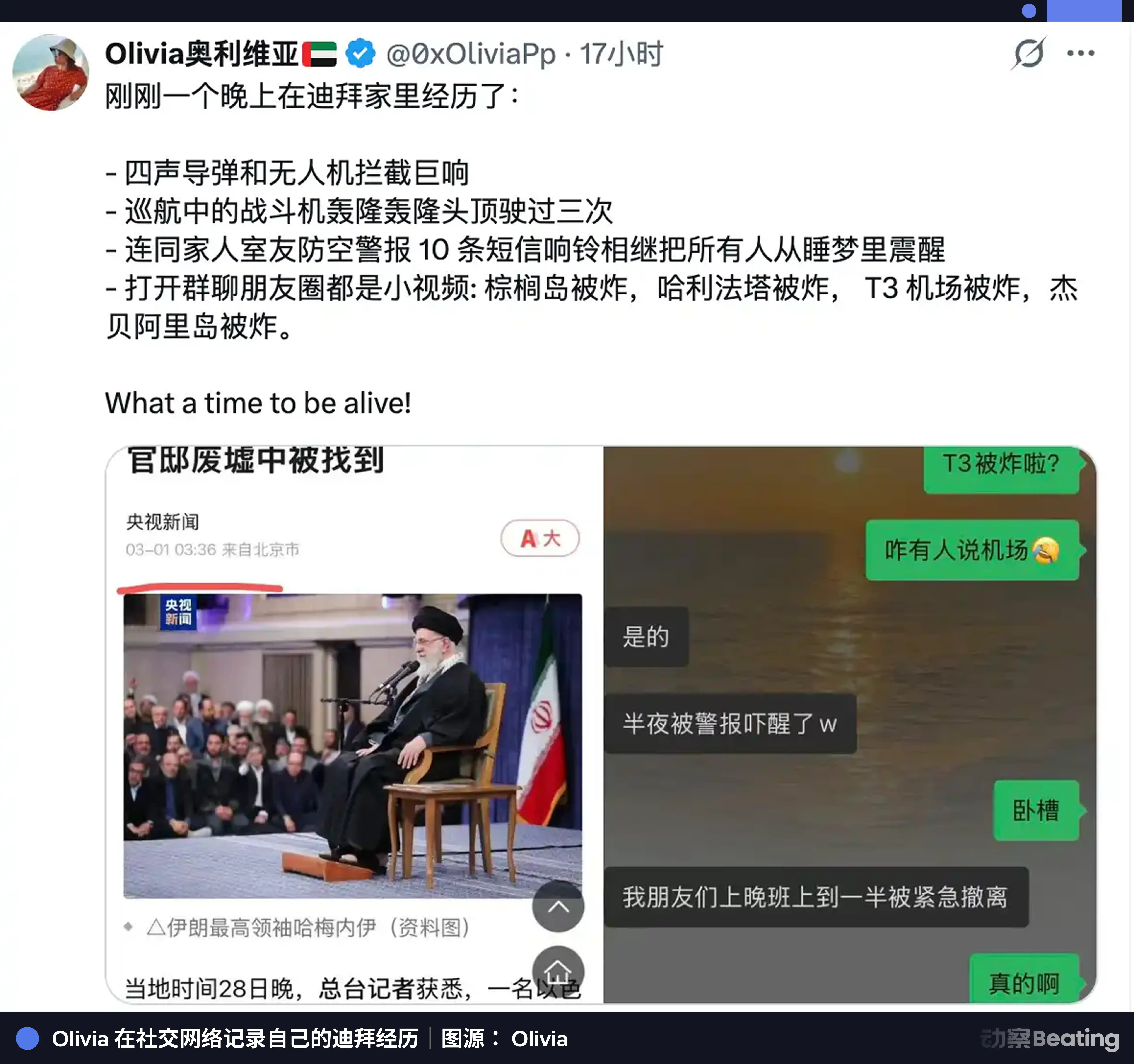
On the afternoon of February 28, she was napping and woke up to find a bunch of people on WeChat asking if she was safe, realizing something was wrong. A few hours later, she heard a bombing sound outside her window. Her window is modified, originally double-pane, and she had added another layer, making a total of four panes; the noise still penetrated violently.
She had originally scheduled a cosmetic procedure but canceled immediately. However, everyone’s life didn't seem too affected; by the pool downstairs, since it was the weekend, people were still sunbathing.
That evening, there were three consecutive explosions. Before sleep, fighter jets circled above, rumbling over and over. At midnight, she fell asleep, but the phone alarms woke up her entire family—set to Do Not Disturb mode, yet the alarms penetrated through. Three people at home, four or five phones ringing simultaneously.
Some friends went to Oman; the road was blocked. She has a friend who is the founder of a company in New York; they overnight sent employees on business to Oman and are now using a private jet to bring them back to the U.S.
Initially planning to return to the country in March or April, the airport is now indefinitely suspended, and if one can't get through, they will route through neighboring countries to fly.
Videos online are terrifying, but she doesn't think it's that exaggerated.
Olivia predicts that the situation will improve. Khamenei is dead, and the remaining people are fighting to the end, “Once they run out of ammunition, this will end.”
As she hung up the phone, she mentioned not sleeping well the previous night and was planning to nap again.
4. Waiting for the Wind to Die Down
Dubai does not have four seasons. There’s only hot and hotter.
But in these past few days, 300,000 Chinese have felt another kind of temperature. Uncertainty.
Wu saw neighbors holding children in the garage, Mason wanted to check the Burj Al Arab ruins, Olivia set her phone to Do Not Disturb but alarms still got in. He Yi was right; those with information retrieval skills are less panicked, but that underlying noise persists. The rumbling outside, alarms in phones, and continuously updating messages in groups. Which building was bombed, which road is blocked, which supermarket still has supplies.
We are all refreshing, all waiting.
Waiting for the U.S. to stop, waiting for Iran to finish firing, waiting for the airport to reopen, waiting for that notification saying "everything is normal."
Some fled overnight. Some decided to stay. Some are sunbathing by the pool, while others stuff their passports and cash into emergency bags. Each person's choice has no right or wrong, just betting on a probability.
Most Chinese coming to Dubai are not looking for adventure. Quite the opposite, they seek certainty. Tax certainty, regulatory certainty, business certainty. This city built a system in the desert over thirty years.
Palm Island, Burj Al Arab, Burj Khalifa are all monuments of that order. Humans can conquer the desert, can create prosperity in barrenness.
But some things are beyond human control.
When two countries collapsed negotiations at the table, missiles flew over. It has nothing to do with whether you have taken a side, whether you are a good person, or how much tax you have paid over the years or how many people you have employed or how many buildings you have built. You just happen to be here.
This is the world of 2026. Flights can be canceled, borders can be closed, and a meticulously planned life can be disrupted in an afternoon. Not because you did something wrong, but simply because in the board game of great power rivalry, no one asked the pieces for their opinions.
Wu said that if the situation stabilizes, he might stay. "Maybe it will be more peaceful in the future."
This might be the calm that only those who have experienced it can possess. After this round, the negotiations that need to happen will happen, and the fighting that needs to stop will stop. This is how the history of the Middle East is written—fighting and stopping, life continues.
Mason still wants to see the bombing site. Perhaps he just wants to confirm those images, confirm he really experienced all this, confirm the city is still there, and that he is still here.
Another sound rang out from outside.
Uncertain whether it was a missile or intercept, whether it was far or close.
It doesn’t matter. As long as the sound is still distant, life goes on. McDonald's is still delivering, there are still goods in the supermarket, if the alarm goes off, they go to the garage, if it doesn’t, they continue to sleep.
The 300,000 Chinese are just waiting like this.
Waiting for the wind to die down.
免责声明:本文章仅代表作者个人观点,不代表本平台的立场和观点。本文章仅供信息分享,不构成对任何人的任何投资建议。用户与作者之间的任何争议,与本平台无关。如网页中刊载的文章或图片涉及侵权,请提供相关的权利证明和身份证明发送邮件到support@aicoin.com,本平台相关工作人员将会进行核查。


