Written by: Glendon, Techub New
In the current fast-paced evolution of the cryptocurrency industry towards compliance, institutionalization, and asset integration, the shift towards asset tokenization seems to be a trend for the entire industry. Once a leader among Ethereum treasury companies, ETHZilla Corporation announced yesterday that it has officially changed its name to Forum Markets, Inc., and will conduct business under the name Forum moving forward. This marks a strategic breakthrough for a company that was once labeled as a "currency hoarder," now transforming into a real-world asset (RWA) tokenization platform with a new identity that concerns its survival and future.
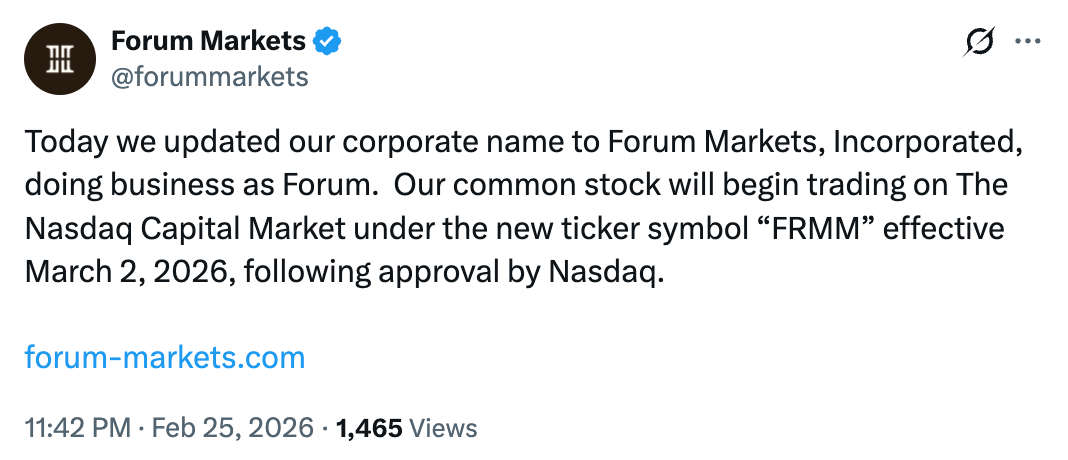
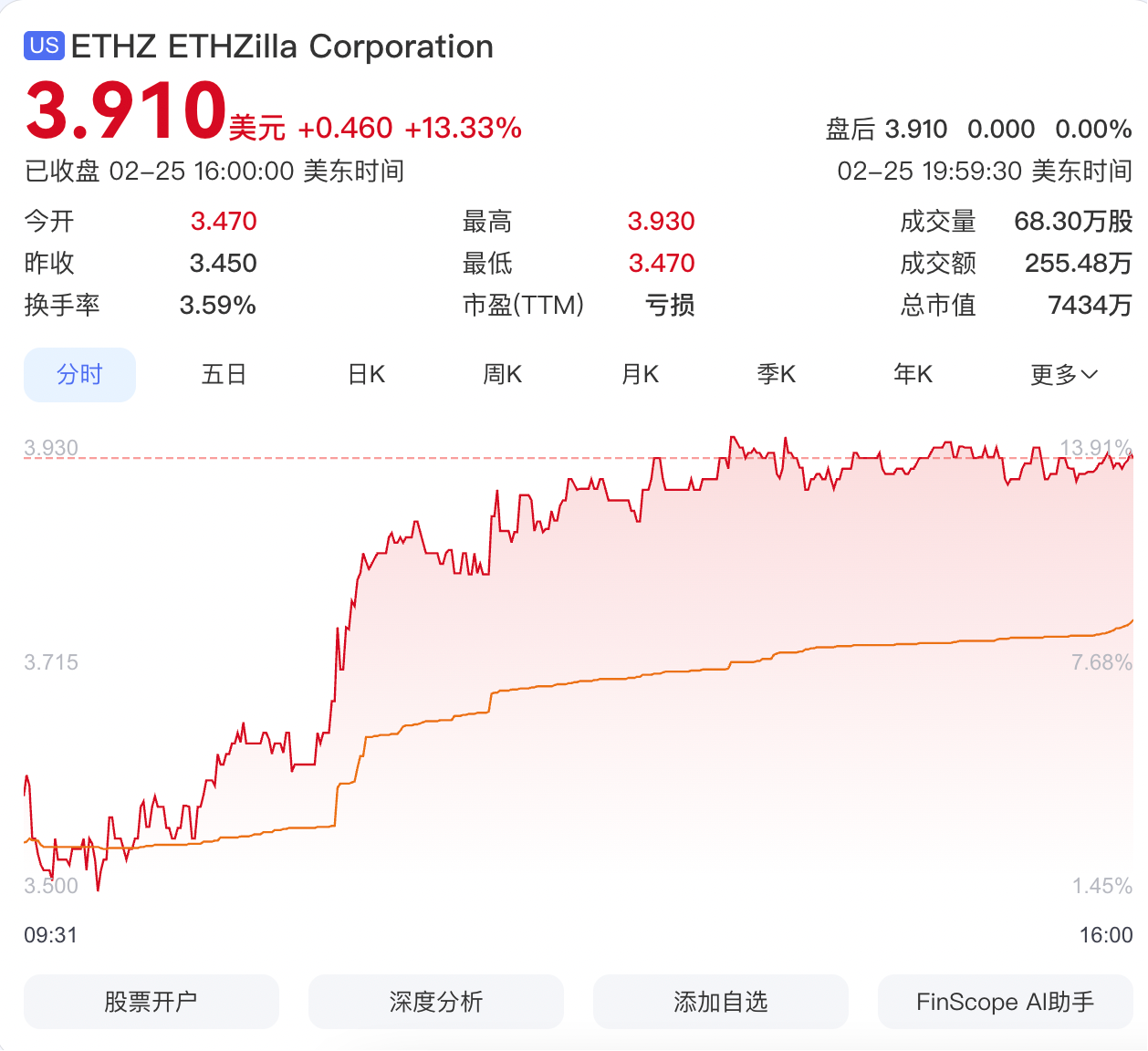
Approved by Nasdaq, the company's common stock will start trading on Nasdaq Capital Market under the new stock code "FRMM" from March 2. After the transformation, the company will strategically upgrade and build a digital asset platform focused on institutional-level RWA tokenization, connecting traditional capital markets with blockchain financial infrastructure. On the day the announcement was made, the price of ETHZilla (ETHZ) surged more than 13% to approximately $3.91, reaching the highest level in February, but still plummeting over 96% compared to the peak of $107 in August 2025.
It should be clear that this name change is not merely a simple rebranding, but a complete severance from the past Ethereum holding model. The new name "Forum Markets" conveys several strategic signals. Firstly, the name change strengthens the financial attributes. The term "Forum" reflects openness and collaboration, suggesting that the company will connect traditional capital markets with blockchain financial infrastructure; "Markets" indicates a shift from single asset holding to a diversified asset trading model.
Secondly, the renaming of ETHZilla is aimed at severing ties with the past and embracing the future. Even before the name change, ETHZilla had repeatedly sold Ethereum, practically ending the old model of "currency hoarding is growth." In fact, among various DAT companies, ETHZilla was one of the earlier participants to recognize the market situation and mitigate risks in a timely manner. After experiencing the market crash on "10.11," ETHZilla announced at the end of October that it would sell approximately $40 million worth of ETH to advance a $250 million stock buyback plan and emphasized that it would continue selling Ethereum until its stock price normalized relative to the net asset value (NAV). By December, ETHZilla sold another 24,000 ETH, raising about $74.5 million for stock buybacks and debt repayment. Meanwhile, the company made it clear that its value would be driven by revenue and cash flow growth from the RWA tokenization business and would cease providing the mNAV dashboard on its website. Thus, ETHZilla’s complete pivot towards the tokenization market has become inevitable.
In addition, this name change seems to align with ETHZilla's compliance and globalization development strategy. The new name better fits the naming standards for digital asset platforms set by regulatory bodies such as the U.S. Securities and Exchange Commission (SEC) and helps attract more institutional investors.
As described above, it is clear that ETHZilla's transformation is not a momentary impulse, but a proactive response to the rapidly changing market environment, which essentially aligns with the paradigm shift of cryptocurrency enterprises from "speculative holding" to "value creation." In short, ETHZilla's transformation aims to better seize the RWA trend and address its own developmental bottlenecks and crises, which is both a "breakthrough" and an "upgrade."
Over the past year, the global asset tokenization market has expanded at a compound annual growth rate of over 30%. At the policy level, the gradual improvement of the digital asset regulatory framework by the U.S. SEC and the implementation of the EU MiCA regulations have provided a fertile ground for the compliant development of asset tokenization; at the technical level, innovations such as zero-knowledge proofs reduce transaction costs, and the automation management of smart contracts enhances the feasibility of asset tokenization. Against this backdrop, traditional finance and crypto-native companies worldwide are increasingly intensifying their efforts in the tokenization arena. If ETHZilla continues to rely on Ethereum price fluctuations, it will undoubtedly miss this structural opportunity.
Thus, in the fourth quarter of last year, ETHZilla actively engaged in mergers and acquisitions, initially acquiring a 15% stake in the parent company of Liquidity.io for $15 million, followed by a $10 million purchase of 20% fully diluted equity in Karus and a $21.1 million acquisition of 15% equity in the digital lending platform Zippy, to explore the tokenization market for car and home loans.
Notably, Liquidity.io is an SEC-regulated broker-dealer and digital alternative trading system (ATS) operator, and its acquisition is significant. This acquisition combines Liquidity.io's regulated securitization platform and token market with ETHZilla's blockchain-native asset management platform, enabling ETHZilla to gain infrastructural support for the compliant issuance and trading of tokenized assets, allowing its issued tokenized RWA to convert into compliant, tradeable instruments with primary and secondary market liquidity.
On the other hand, ETHZilla has long faced a persistent financial crisis, making transformation urgent. According to the nine-month financial report released by ETHZilla last November, as of September 30, 2025, its net loss had surged to $212 million. Although the full-year report for 2025 has not yet been officially disclosed, considering the significant downturn in the crypto market over the past few months, it is nearly certain that ETHZilla's total annual losses have further increased. While ETHZilla's repeated sales of Ethereum to buy back stock have alleviated short-term liquidity pressures to some extent, they have exposed the lethal weakness of its singular business model, which indicates that merely relying on holding ETH is unsustainable.
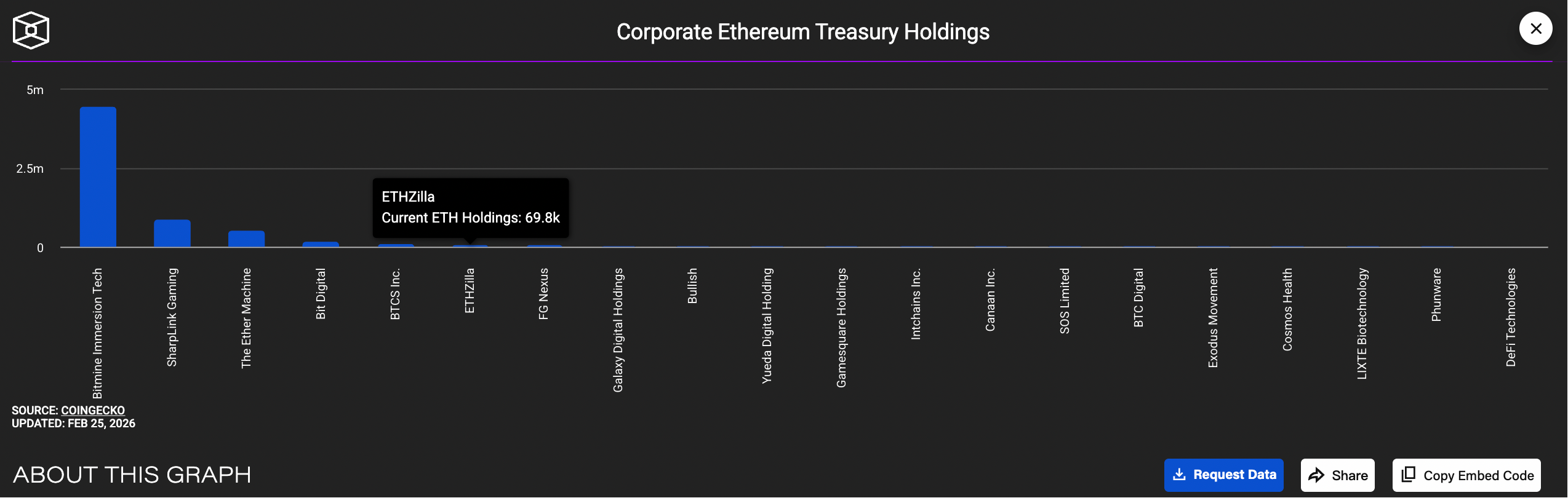
It is worth mentioning that authoritative institutions such as MSCI are considering excluding companies with a crypto asset ratio exceeding 50% from their indices, further adding systemic risk to the pure DAT model. Without timely transformation, ETHZilla is very likely to become another victim of the "cryptocurrency bubble." However, although ETHZilla has announced its transformation, as of the time of writing, it has not completely sold off its holdings of Ethereum. According to data from The Block, ETHZilla still holds approximately 69,802 ETH, worth about $145 million, ranking sixth among Ethereum treasury companies.
Currently, ETHZilla's transformation has long since departed from mere "talk." Its strategic upgrade and business model reconstruction are centered on RWA tokenization, marking a critical step from "holding crypto assets" to "operating real assets." Wisely, ETHZilla has not chosen the currently hottest sector of stock tokenization, but rather focused on tokenizing stable cash flow assets, including generating home loans and leasing rights for aircraft engines.
On January 25, ETHZilla, through the newly established subsidiary ETHZilla Aerospace LLC, spent $12.2 million to acquire two CFM56-7B24 aircraft engines and leased them to a major airline. On February 13, its subsidiary launched the first tokenized real asset "Eurus Aero Token I," backed by commercial aircraft engines, using the Liquidity.io platform. This token is built on the Ethereum Layer 2 network, supported by two aircraft engines, and targets an annual yield of approximately 11%.
Earlier this month, ETHZilla turned its attention to real estate tokenization, acquiring a portfolio of modular homes and prefab home loans worth $4.7 million, planning to tokenize a portfolio of 95 loans on the Ethereum Layer 2 network, with expected annual yields around 10%, aimed at converting these loans into digital tokens that generate cash flow, attainable through regulated brokerage and trading systems like Liquidity.io.
Therefore, after the transformation, the company's revenue structure has significantly changed, mainly deriving from three aspects: income during the asset holding period (such as monthly cash flow allocations from aircraft engine leases), product issuance fees (for the issuance and custody service fees of tokenized assets), and asset management fees as well as potential secondary market trading revenue (transaction fees collected via the Liquidity.io platform).
However, achieving a successful transformation for ETHZilla is not easy. In the face of stricter regulations and increasingly fierce market competition, it also encounters similar challenges faced by most asset tokenization companies, such as regulatory compliance, market demand, technical bottlenecks, and ecosystem building. If able to successfully launch RWA products and demonstrate the replicability of its business model, ETHZilla will no longer be an "Ethereum hoarding company" and is expected to become one of the infrastructure layers connecting the real world with digital finance. Conversely, if the transformation fails, it is likely to fall victim to the "cryptocurrency bubble." This "strategic breakthrough" represents both an opportunity and a challenge for ETHZilla.
免责声明:本文章仅代表作者个人观点,不代表本平台的立场和观点。本文章仅供信息分享,不构成对任何人的任何投资建议。用户与作者之间的任何争议,与本平台无关。如网页中刊载的文章或图片涉及侵权,请提供相关的权利证明和身份证明发送邮件到support@aicoin.com,本平台相关工作人员将会进行核查。


