Once might be a coincidence, three times might be luck, but what about the tenth time?
Starting from the second half of 2025, some traders on Twitter who follow Bitcoin movements discovered something strange. They reviewed the Bitcoin intraday charts from the past six months and felt increasingly uneasy: almost every day around 10 AM, just as the US stock market opened and market sentiment was most active, Bitcoin would experience a sharp drop, precisely erasing the previous gains.
He posted this discovery on Twitter, and to his surprise, many others in the comments echoed the same observation: "I noticed it too," "It's been happening for several months," "This is definitely not a coincidence."
Finance media outlet ZeroHedge directly pointed out that since last July, they had been tweeting one after another, calling out the mastermind behind this phenomenon, one of the main market makers for Bitcoin spot ETFs: Jane Street. After the drop at 10 AM, Jane Street silently accumulated positions; they held over $2.5 billion in BlackRock's Bitcoin ETF IBIT.
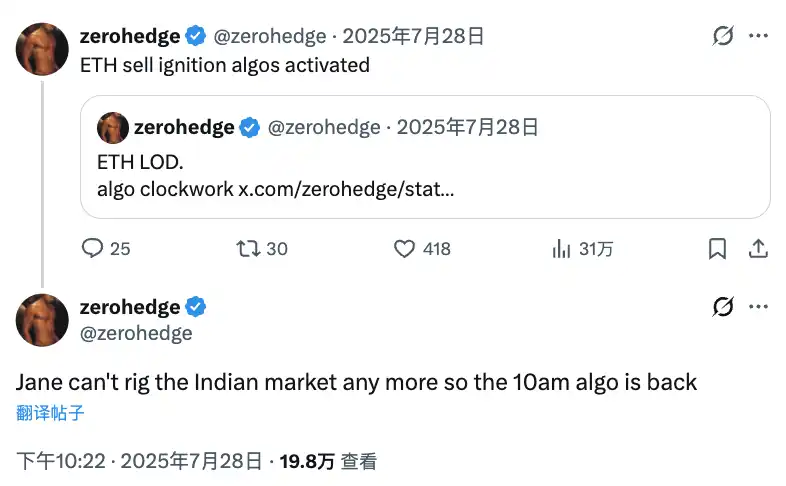
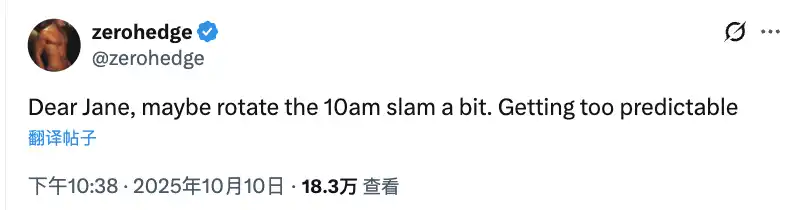
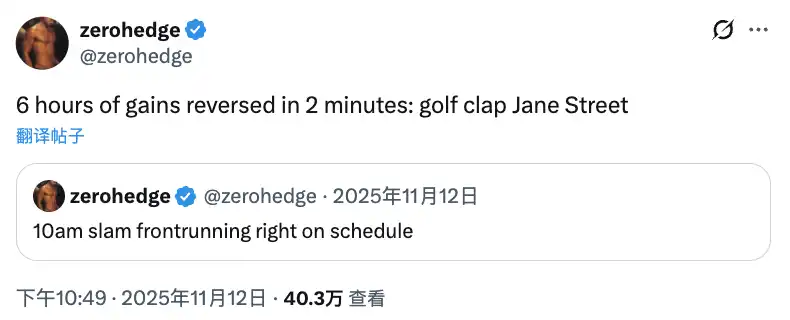
They even named this phenomenon the "Jane 10 AM Dump Strategy." Recently, a lawsuit from Terra has further fueled the widespread dissemination of this rumor.
An intern named Bryce
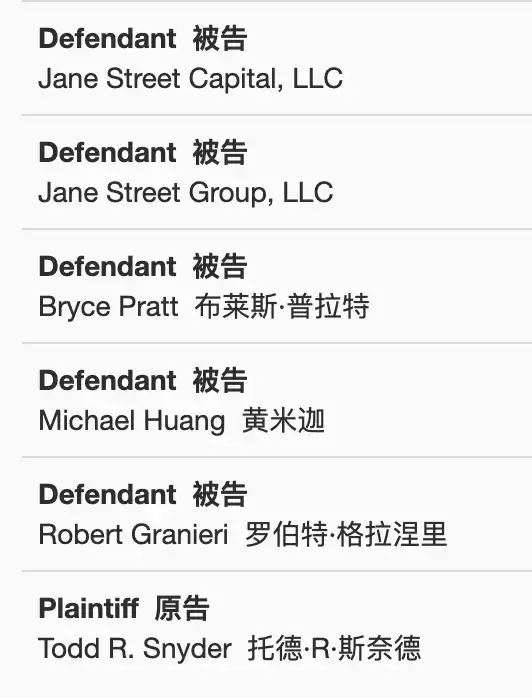
Recently, the bankruptcy administrator of Terraform Labs submitted a lawsuit to the court, with the defendants being Jane Street, Jane Street's co-founder Robert Granieri, and two traders, Bryce Pratt and Michael Huang.
This is a company that is extremely low-key on Wall Street. It never accepts media interviews, never boasts about profits, and for a long time, outsiders did not even know of its existence. Yet, within the financial industry, the name Jane Street is known to almost everyone—this is a firm that has made hundreds of billions of dollars through quantitative trading and market-making, with annual per capita profits unmatched across Wall Street.
The core facts of the lawsuit are not complicated: just before the collapse of UST (TerraUSD) in 2022, Jane Street used non-public information obtained from insiders to exit its positions early, quietly withdrawing before the entire Terra ecosystem was wiped out amid $40 billion.
The starting point of this "insider trading" involves a young man named Bryce Pratt.
Bryce Pratt interned at Terraform and later joined Jane Street. By normal logic, his previous internship experience would just be an inconspicuous line on a resume. However, the court's lawsuit devotes three pages, from pages 29 to 31, to describing him, and the only reason is: after leaving Terraform, he did not actually leave.
He created a private group chat and added Terraform's software engineers and business development heads into it; the chat was named "Bryce's Secret."
The name is quite straightforward and bold. According to the lawsuit document, the function of this group chat was to continuously relay internal information from Terraform back to Jane Street. Meanwhile, Bryce also facilitated introductions between Terraform's business development head and the leader of Jane Street's "DeFi Department," where both parties began regular communications under the guise of "discussing strategic investment cooperation."
From the perspective of the lawsuit, Jane Street effectively turned this communication channel into a continuous source for acquiring significant non-public information.
Jane and Terraform have an unknown history
Let's rewind a bit.
The relationship between Jane Street and Terraform did not begin with Bryce Pratt's group chat, but rather started earlier, in May 2021, when UST first depegged.
At that time, UST briefly deviated from its pegged price to the US dollar, causing a state of panic throughout the Terra ecosystem. To stabilize the situation, Terraform Labs began reaching out to institutional trading parties for large-scale over-the-counter arrangements. Jane Street was one of them.
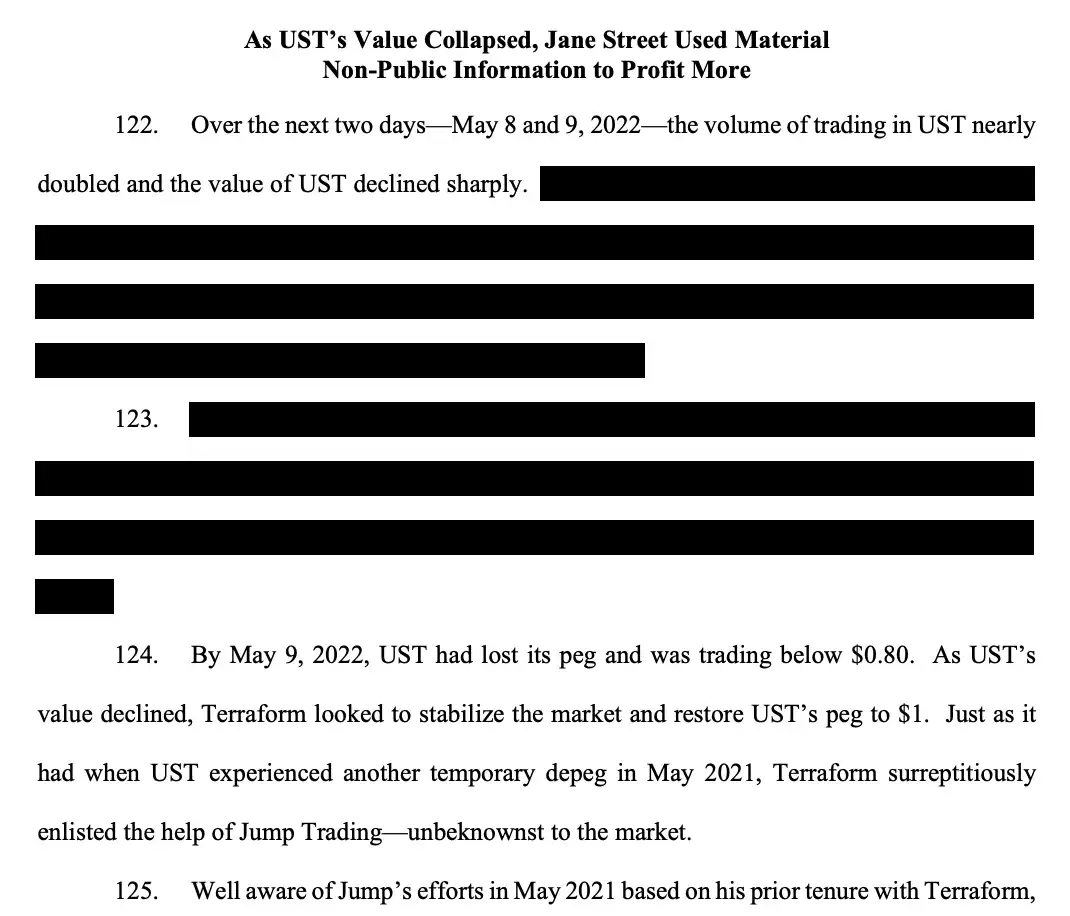
According to the lawsuit, during this relationship, Terraform provided Jane Street with large trading limits for UST and Luna, and at certain stages even offered discounts or structural incentives in exchange for their liquidity support at critical moments. These terms have never been disclosed to the public.
This means that the relationship between the two companies was not an ordinary market transaction from the start, but a partnership with a binding agreement. This relationship made it much harder to shrug off the insider trading allegations from a legal standpoint—when you have a secret agreement with the other party and at the same time possess insider information unbeknownst to them, any trades you make would appear extremely unusual.
Fast forward to early 2022. At this point, the Terra ecosystem seemed to be thriving: the Luna Foundation Guard (LFG) had just been established, amassing about $5.5 billion in Luna reserves, and had used $3 billion to buy other assets, giving the impression of an impenetrable stronghold. However, beneath this shiny exterior, some signs had started to emerge; the deposit scale of the Anchor protocol began to face pressure, UST's reliance on the pegged exchange rate grew heavier, and LFG's reserves were quietly depleting at an accelerating rate.
Few knew about this. But Jane Street was one of them.
10 minutes before the $40 billion empire collapsed
On May 7, 2022, at 5:44 PM Eastern Time.
Terraform quietly withdrew 150 million TerraUSD from Curve 3pool—a liquidity pool specifically for swapping US dollar stablecoins. There were no announcements, no warnings, and no public statements.
This action was completely unknown to the outside world at the time.
However, less than ten minutes after this fund withdrawal, a wallet marked by on-chain analysts as associated with Jane Street withdrew 85 million TerraUSD from the same liquidity pool.
The lawsuit further pointed out that Jane Street's abnormal actions did not stop there. Even before the clear de-pegging of UST began and market-wide panic started to spread, addresses linked to Jane Street had already completed systematic risk exits—massively reducing their UST holdings, adjusting related positions, and minimizing their net exposure to the Terra ecosystem. Some specific figures were concealed in the lawsuit, usually indicating involvement of trade secrets or evidence not yet publicly disclosed, but the funding flow traced by on-chain analysts was sufficient to illustrate the issue.
Meanwhile, Terraform and LFG were doing the exact opposite.
On May 7, Terraform purchased over 250 million UST. On May 8, they bought another 200 million. Over the following days, they accumulated over 1.9 billion UST, along with over 90 million Luna. By May 16, LFG’s UST holdings soared from around 700,000 to over 1.8 billion, an increase of over 1.7 billion; Luna holdings surged from 1.7 million to over 222 million.
Another piece of evidence is a report released on May 27 by on-chain data analytics firm Nansen, titled "On-chain Forensics: Unraveling the Mystery Behind TerraUSD's Decoupling." Although the report did not directly name Jane Street, it detailed several wallets that played key roles during the de-pegging process, including one later identified as linked to Jane Street. The report concluded with two points: first, the movement of these funds occurred before the market-wide panic was evident; second, there was a significant time gap between these operations and the publicly visible collapse timing.
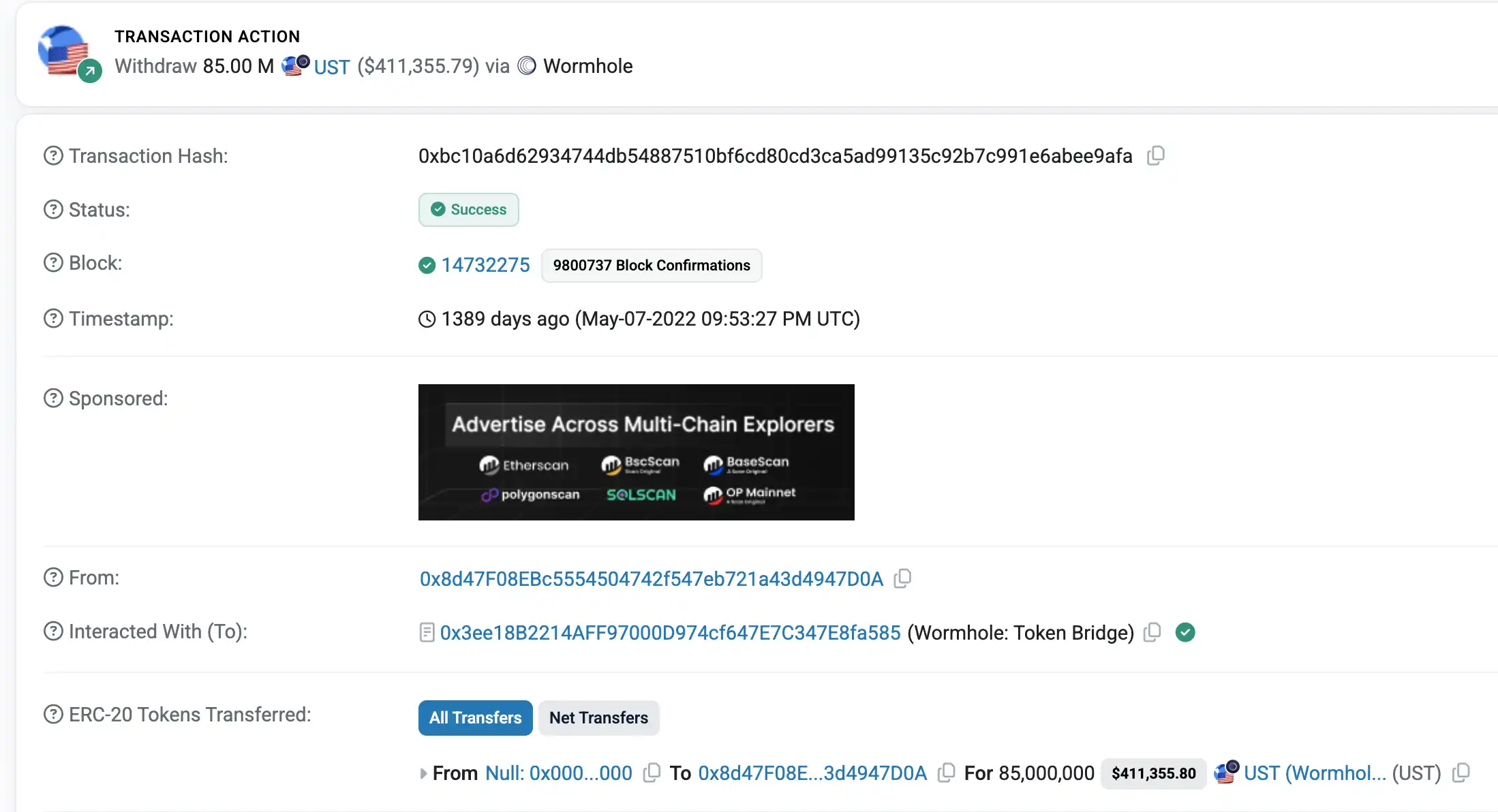
Addresses suspected to be linked to Jane Street withdrew 85 million TerraUSD
The lawsuit also mentioned that after the transaction on May 7, Jane Street did not let up. They continued to allegedly utilize confidential information obtained from Jump Trading to further trade TerraUSD, amplifying their gains. Jump Trading had previously reached a secret agreement to assist Terraform and ultimately profited billions from this collapse.
In India, they did the same thing
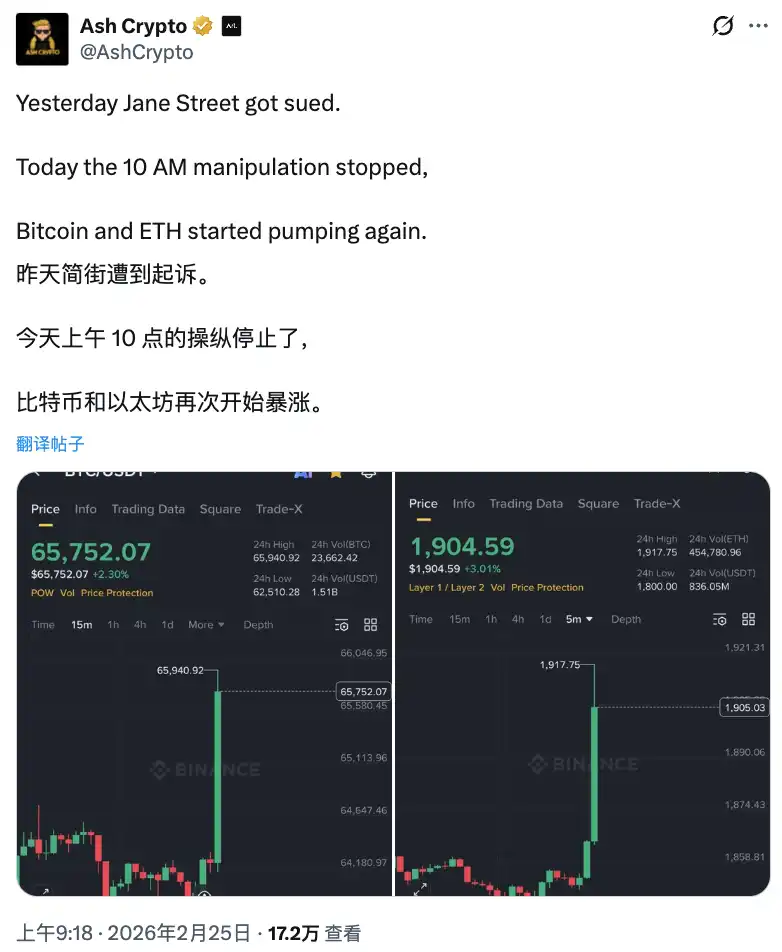
Now, attentive researchers have noted that after Jane Street was sued by Terra, the 10 AM dumps disappeared. This seems to further confirm the rumors about the "Jane 10 AM Dump Strategy."
On the other side of the globe in India, regulators have long formed their own judgments about Jane Street.
The Securities and Exchange Board of India (SEBI) issued a record fine of ₹484.3 billion—approximately $570 million—in a lengthy 105-page temporary order. This figure is unprecedented in the history of Indian regulation, and SEBI's investigation conclusions read strikingly similarly to the accusations in the Terra Luna case.
SEBI concluded that Jane Street implemented a meticulously designed "pump and dump" strategy in the Indian market.
The logic was as follows: first, through large directional buy orders in the relatively illiquid spot and futures markets, artificially drive the Indian banking index (BANK NIFTY) up or down; once the price is pushed to the expected level, immediately perform the reverse operation in the highly liquid options market, harvesting profits from following retail investors; finally, systematically offload previously established spot positions to cause the index to drop, rendering the options held by retail investors worthless while inflating the value of their own reverse positions.
SEBI's report cited a specific example: on January 17, 2024, Jane Street established a long position of about $67 million in just 8 minutes, with a trading volume more than three times that of the second-largest market participant, solely from this buy order, pushing the index up over 1%.
The regulators' wording was unambiguous, stating that Jane Street's actions constituted "trading to influence prices rather than trading guided by prices," forming a "deliberate, meticulously planned, malevolent conspiracy and scheme," with the sole intent to mislead the market, especially exploiting the large number of inexperienced retail investors.
For a long time, Jane Street has been a typical example of this narrative. The company is known for being extremely low-key, never accepting media interviews or boasting outwardly. They have accumulated astonishing wealth through quantitative trading and market-making and hold a near-mythical status in the industry. Each year during recruitment season, the salary figures they offer drive new graduates across Wall Street wild, with competition intensity rivaling that of any top institution.
However, starting from a certain point in time, the stories about this company began to become complex.
In the Terra Luna case, they have been accused of using insider information to escape early, retreating while Terraform and LFG poured billions to prop up the market. In the Indian market, regulators identified them as systematically manipulating spot and derivative prices to harvest ordinary investors. Alameda Research—the core team of FTX that dragged the entire crypto industry into a dark moment—saw many members come from Jane Street, and its founder SBF admitted that his market thinking framework was learned at Jane Street. Additionally, Jane Street is also known for aggressively suing former employees, a level of advocacy that is rare across Wall Street. An earlier investigative report even linked them to the procurement of weapons in a coup attempt in South Sudan, though details of the incident remain disputed to this day.
Information is power; information represents hierarchy.
Jane Street's "prior offenses" seem to be more than we imagine, and its reputation has indeed suffered in recent years. Though the conclusion of Jane Street's lawsuit is still undecided.
But a company that appears in so many negative stories is itself a signal.
免责声明:本文章仅代表作者个人观点,不代表本平台的立场和观点。本文章仅供信息分享,不构成对任何人的任何投资建议。用户与作者之间的任何争议,与本平台无关。如网页中刊载的文章或图片涉及侵权,请提供相关的权利证明和身份证明发送邮件到support@aicoin.com,本平台相关工作人员将会进行核查。


