
Author: Lawyer Shao Shiwei
Recently, in a case where Lawyer Shao was handling the sale of USDT (Tether) by U merchants, the parties were accused by judicial authorities of engaging in illegal foreign exchange trading using virtual currency as a medium.
Although Lawyer Shao believes that there is not yet a complete chain of evidence sufficient to constitute a crime in this case, due to the substantial amount involved, which reaches billions, and the fact that the parties used dozens of bank cards belonging to friends and relatives for the collection and payment of virtual currency transactions, from the perspective of the case handlers, this operational model indeed does not resemble a "normal" business. Therefore, prosecutors believe that even if a charge of illegal operation cannot be established, they are still considering charging the parties with other offenses, such as obstructing credit card management, aiding offenses, concealing crimes, etc.
In the article titled "Case Notes | What Risks Are Involved in Using Others' Bank Cards for USDT Transactions? — Insights from a Multi-Billion Virtual Currency Case on the Boundaries of Illegal Operation, Aiding Offenses, Concealment Crimes, and Key Defense Points,” I have already provided a preliminary analysis of relevant issues. This article will further focus on practical disputes and systematically discuss the following core issues:
Why should trading virtual currency for profit not constitute illegal foreign exchange trading, aiding offenses, or concealment and concealment of criminal proceeds?
1. The Presumption of Guilt Logic from a Judicial Perspective: Is Trading Virtual Currency for Profit an Abnormal Business?
From the perspective of case handling, the model of U merchants earning profit typically possesses two characteristics:
First, using multiple bank cards for collection and payment; second, the volume of funds involved is enormous.
Compared to traditional businesses, this funding path is more likely to be presumed to entail legal risks. For this reason, even if the crime of illegal operation is difficult to substantiate, case-handling authorities often seek other "fallback charges."
However, Lawyer Shao wants to emphasize that, according to domestic policy, the buying and selling of virtual currencies (over-the-counter OTC) is not prohibited by law, and there exists a significant number of U merchants, arbitrageurs, and ordinary investors engaging in over-the-counter trading in the domestic market.
For example, taking Binance as a case study, if you open the C2C section and select the currency CNY (RMB), it shows that there are 1300 merchants (10 per page, 130 pages)—this indicates that the phenomenon of OTC U merchants is not isolated but exists at a large scale.
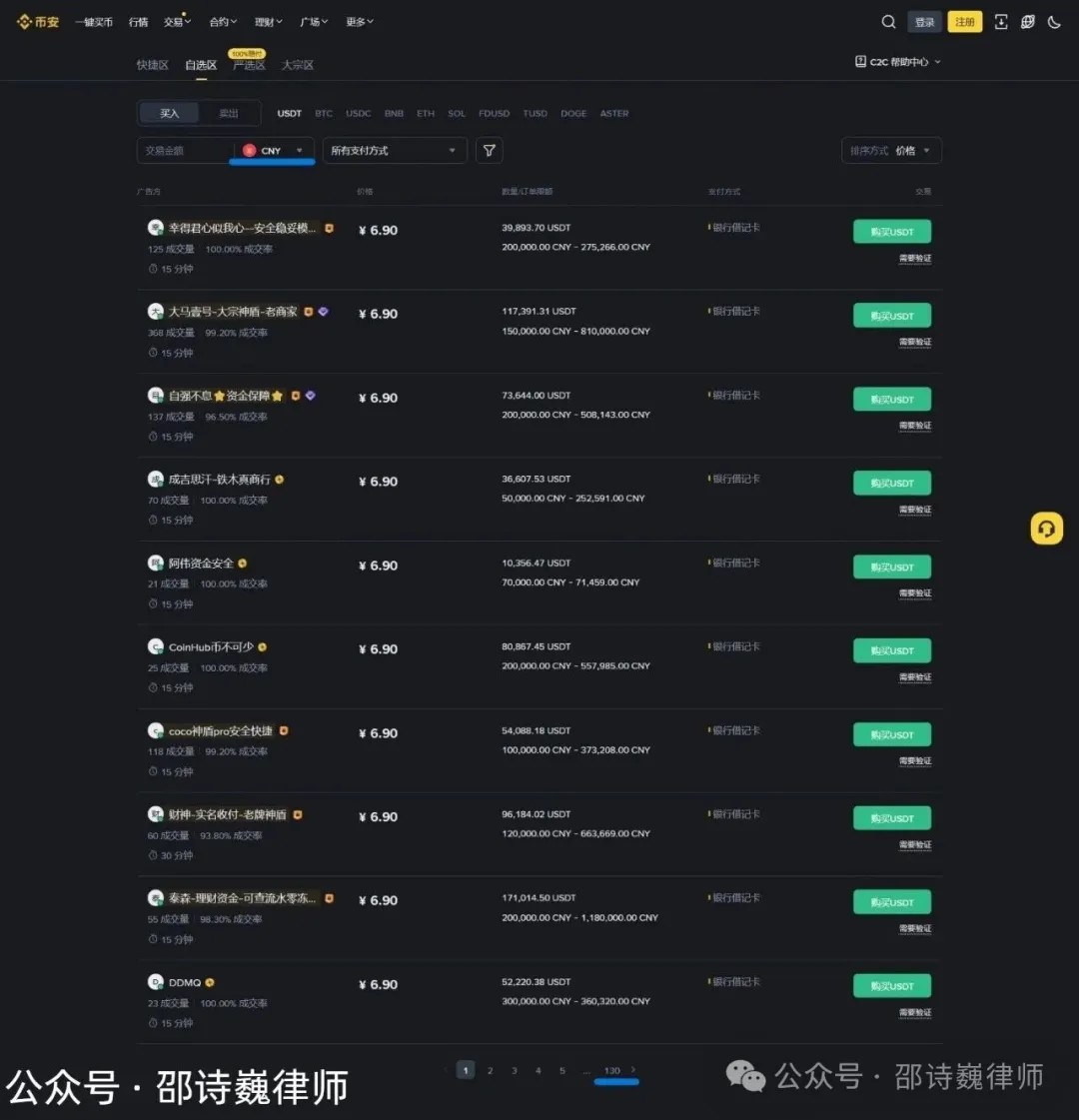
Additionally, in the C2C sectors of mainstream trading platforms such as OKX, Bybit, Bitget, MEXC, and Gate.io, U merchants generally register as compliant merchants on trading match pages.
It is important to note that platform merchants are just the tip of the iceberg. In practice, there are many purely offline U merchants who complete transactions through communities, personal networks, or channels such as Telegram and WhatsApp, and the volume of this part is also incredibly large.
From the types of cases in recent years, Lawyer Shao believes that the focus of judicial action is not on "the buying and selling of USDT itself," but rather on three types of behavior:
Continuing to trade despite knowing they have received funds related to fraud;
Using virtual currency to assist in money laundering;
Knowing the upstream parties are effectively buying and selling foreign exchange, and still providing assistance.
Therefore, whether the model of OTC merchants earning a profit is "normal" should not be compared to traditional businesses but should be examined against the normative patterns within the U merchant industry to determine whether the parties' actions are abnormal.
Otherwise, if they view this industry and its participants through a biased lens merely due to its unfamiliarity, it risks carrying the presumption of guilt.
Next, Lawyer Shao will systematically elaborate on why this behavior does not constitute the crime of illegal operation, nor does it constitute concealment or hiding of criminal proceeds, or aiding information network criminal activities.
2. Reasons for Not Constituting the Crime of Illegal Operation
The premise for determining whether an individual constitutes the crime of illegal operation relating to foreign exchange trades via virtual currency is the presence of evidence proving their subjective knowledge of the upstream engaging in "matched exchanges" and that they still provided assistance to the upstream crime.
The typical case of such crimes is the Lin and Yan Illegal Operation Case released by the Supreme Prosecutor on December 21, 2024:
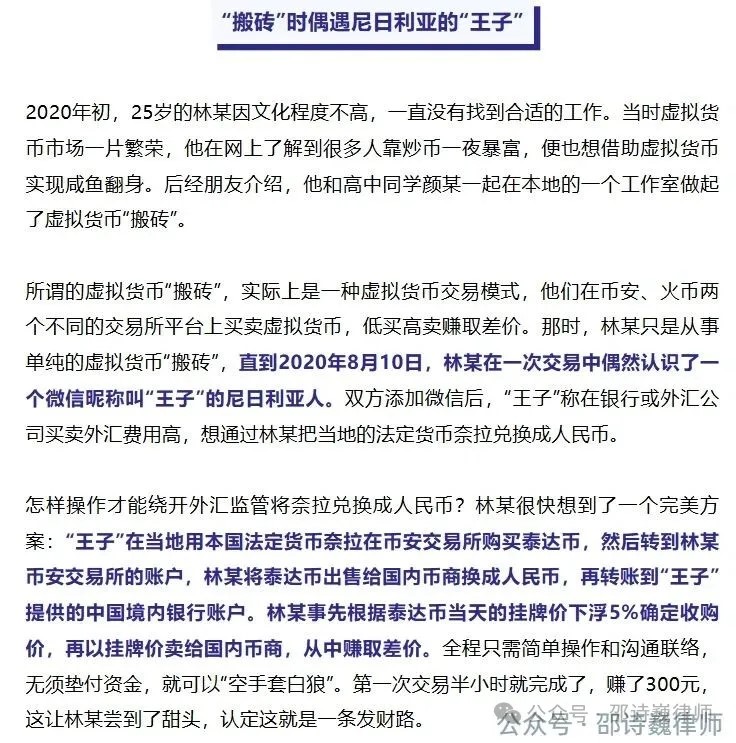
From the perspective of subjective knowledge degree, Lin was aware of a Nigerian prince's intention to exchange currency, and despite knowing, still provided assistance to the prince;
In terms of fund flow, Lin participated in the entire process, where the prince exchanged Nigeria's local currency Naira into RMB using virtual currency as a medium;
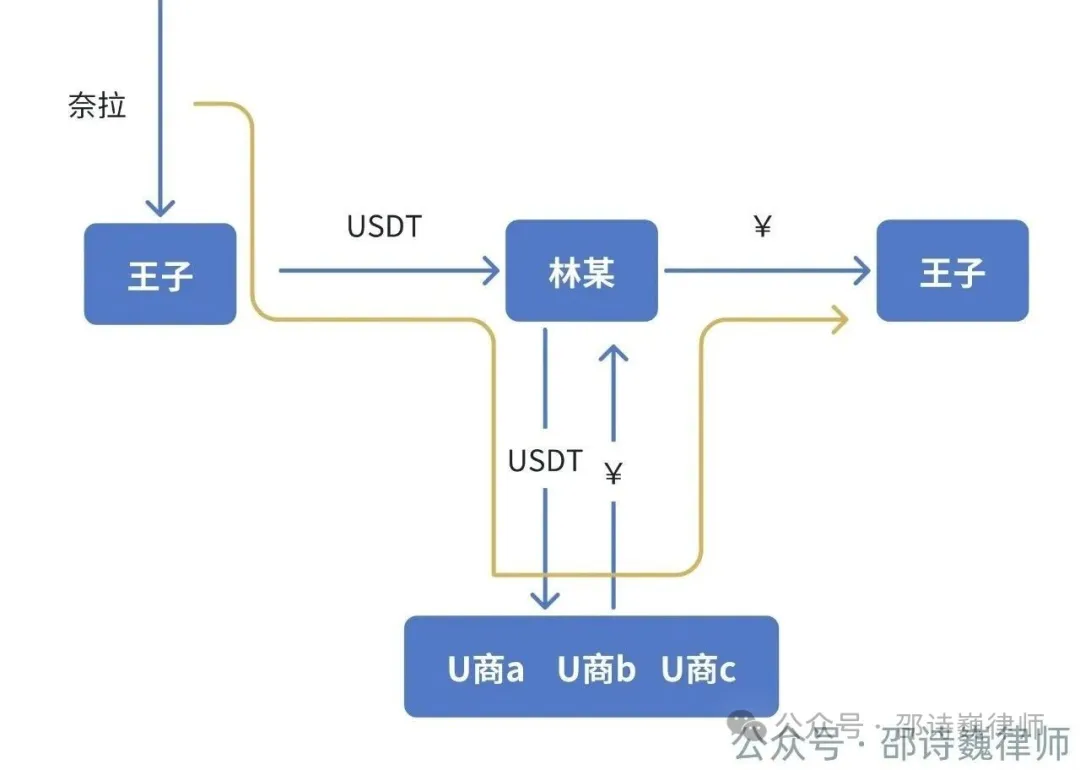
Thus, Lin's so-called "arbitrage" was essentially under the instruction of the Nigerian "prince": the prince transferred Naira to Lin's Binance account, and Lin then sold the received USDT to domestic U merchants in exchange for RMB, returning the funds to the prince. Lin set the purchase price 5% lower than the USDT listing price for the day, then sold it to U merchants at the listing price, profiting from the price difference, thereby constituting the crime of illegal operation.
Therefore, roles like U merchant a, b, c would not constitute co-perpetrators in Lin's illegal operation case merely due to transactions with Lin. Additionally, from the perspective of fund flow, the reason why U merchants a, b, c do not constitute the crime of illegal operation is that their transactions with Lin are limited to one-way exchanges between U and RMB, where U merchants only earn from the price difference. In contrast, Lin was guilty because although he also profited from price differences, his transactions effectively facilitated the exchange of different currencies for the Nigerian prince using virtual currency as a medium, thereby constituting the crime of illegal operation relating to foreign exchange trading.
3. Reasons for Not Constituting the Crime of Concealment or Hiding Criminal Proceeds
Is it true that as long as a case involves a massive flow of funds and multiple bank cards for collection and payment, it can easily be determined that U merchants are suspected of concealing or hiding criminal proceeds?
Lawyer Shao believes that determining this crime cannot merely rest on intuitive judgments like "complex funding chains," "multiple card transactions," and "large transactions," but must return to the core issues of the criminal law's elements: What constitutes criminal proceeds in the sense of criminal law?
According to interpretations published on the Supreme Prosecutor's official website[i], criminal proceeds refer to the increase in property interests obtained through criminal behaviors and the portion of the person's own property that should decrease. In simple terms, criminal proceeds are the "gains" or "costs saved" that arise from crimes, and not the "principle" used for criminal activities.
For example, in a typical underground currency exchange model, the funds brought forth by currency exchange customers are often originally legally obtained RMB or foreign currencies but are only used for illegal exchange activities. This part of the funds is considered the principal for the exchanger; for the underground exchange, it does not represent their criminal profits. The true "illegal gains" for underground exchanges typically consist solely of the exchange fees or currency exchange price differences they charge.
In other words, the principal of currency exchange does not automatically become "criminal proceeds" merely because it is used for illegal exchanges. Only the profits actually obtained by the underground exchange for their services could possibly constitute criminal proceeds.
Building on this, consider the role of U merchants. The actions of the vast majority of U merchants are essentially just buying and selling USDT based on market prices to earn profit from price differences. In this process, the funds received by U merchants are mainly the principal RMB or USDT paid by counterparties, not "washed criminal proceeds” from underground exchanges.
In other words, U merchants are mostly participating in the flow of transaction principals, rather than assisting in transferring, hiding, or cashing out the criminal proceeds of underground exchanges.
This is also a point that can easily be confused in many cases: case handlers often observe "upstream crime + downstream collection" and habitually conclude that the downstream participants are concealing criminal proceeds; however, if the upstream funding is not criminal proceeds, then the downstream participants, even if involved in transactions, lack the core object basis for the crime of concealment.
From judicial practice, the typical actions that truly target the crime of concealment often involve assisting in the transfer of fraudulent proceeds, splitting funds to evade regulation, laundering layers, withdrawing on behalf of others, or converting criminal proceeds into assets that appear "legitimate." However, simple OTC trading by U merchants, normal transaction facilitation, and completing price exchanges based on market prices fundamentally do not fall under the behavioral model of "concealing criminal proceeds."
Thus, in most scenarios where U merchants merely buy and sell USDT to earn price differences, if U merchants:
Did not participate in the overall foreign exchange ring of underground exchanges;
Did not knowingly assist the underground exchanges in transferring funds;
Simply conducted normal trading facilitation based on market prices;
Then even if there are illegal foreign exchange activities upstream, it is difficult to determine that U merchants constitute the crime of concealing or hiding criminal proceeds based solely on fund transactions.
4. Reasons for Not Constituting the Crime of Aiding Information Network Criminal Activity
The crime of aiding is also a "high-frequency alternative charge" that case handlers consider when dealing with such cases. However, according to the provisions of Article 287-2, Clause 1 of the Criminal Law, the premise for aiding is "knowingly assisting others in committing crimes using information networks," thus subjecting this crime to the condition that the upstream crime belongs to information network crime.
Therefore, whether the upstream of U merchants falls under "information network crime" becomes a crucial premise for determining if U merchants can be categorized under the aiding charge.
What constitutes information network crime? The key question lies in whether the core acts of the crime are dependent on information networks to execute and complete.
Even if the buyers and sellers in currency exchange negotiate rates and match funds through communication software, the delivery of RMB and foreign exchange funds is entirely conducted within the country via offline bank transfers or cash. At this time, the information network serves merely as a communication tool; the core of the crime (illegal foreign exchange trading) is achieved offline. Thus, the criminal behavior in this model does not constitute network crime.
If individuals communicate through communication software, but the collection and payment of funds (especially using domestic RMB accounts and overseas foreign currency accounts for "separated transactions") are conducted entirely online through online banking or third-party payment platforms, then the core processes of illegal operational crimes (payment settlements) rely on information networks. In this case, if individuals provide bank cards to facilitate such online collections, it would then align with the applicable scenarios for aiding charges.
A typical case for being charged aiding in illegal foreign exchange redemption using virtual currency as a medium is the case reported by the Supreme Court on June 18, 2025, concerning Guo and Fan’s illegal operations, as well as Zhan and Liang aiding information network criminal activity (case number: 2025-03-1-169-001). This case was also one of the typical cases released in December 2023 by the Supreme Prosecutor and the State Administration of Foreign Exchange concerning the punishment of crimes related to foreign exchange.
Basic Case Facts[ii]:
Guo, a builder of illegal exchange websites.
Fan, a trader of virtual currency within illegal exchange groups.
Zhan and Liang, individuals who provided Fan with virtual currency trading platform accounts and RMB bank accounts.
From January 2018 to September 2021, Chen (addressed in another case), Guo, and others established websites such as "TW711" and "Fire Platform," using the virtual currency Tether to provide customers with foreign currency and RMB exchange services. After exchange clients placed orders under the recharge and payment sections of these websites, they paid foreign currency to specified overseas accounts. The website then bought Tether in foreign exchange with these currencies and sold it illegally to obtain RMB through Fan, subsequently paying the corresponding amount of RMB to the designated domestic third-party payment platform accounts, profiting from the exchange rate difference and service fees. The above websites illegally exchanged over 220 million RMB. Among them, Fan received over 6 million Tether from Chen through the platform accounts and RMB bank accounts provided by Zhan and Liang, exchanging it for more than 40 million RMB.
The judgment reasoning in this case was:
In this case, Chen and others built illegal exchange websites, profiting from foreign exchange trading through the method of collecting NTD (New Taiwan Dollar) via overseas accounts while paying RMB via domestic accounts, constituting the crime of illegal operation.
Guo provided technical assistance in the joint crime, not participating in specific operational activities or sharing illegal proceeds; Fan executed transactions at the direction and should be recognized as an accomplice in illegal operations.
Zhan and Liang had a broad awareness of others' use of information networks to commit crimes by providing bank accounts to co-defendants such as Fan, thus constituting aiding charges.
This case shows that in the prerequisite for upstream charges of illegal operation, Zhan and Liang were found guilty of aiding because the means of illegal foreign currency exchange upstream involved the construction of illegal exchange websites reliant on information networks for the core elements of illegal operational crime.
Thus, if individuals communicate using communication tools (like WeChat, Telegram, and WhatsApp), but the criminal behavior of illegal foreign exchange trading is carried out offline, then the upstream crime does not constitute "information network crime." Hence, in this scenario, the prerequisite for identifying downstream receiving U merchants as being guilty of aiding is lost.
Additionally, judicial authorities often cite reasons such as an individual's bank cards being frozen or restricted from currency trading to argue that the individual meets the subjective knowledge standard for aiding. However, according to the judicial interpretations referenced, only in the case of receiving "fraudulent funds" and the like can subjective knowledge be established within aiding charges. This clause governs behavior assisting telecom and online fraudsters. But, as previously stated, in the case of criminal activities regarding illegal foreign exchange operations, the involvement of U merchants stems from unknowingly receiving exchange funds from clients of the upstream underground exchange (usually legitimate income sources of the currency exchange), not the "fraudulent" funds mentioned in these judicial explanations.
The Supreme People's Court, Supreme People's Procuratorate, and Ministry of Public Security's Opinions on Handling Criminal Cases Involving Aiding Information Network Criminal Activities
5. Accurate determination of the "subjective knowledge" in aiding information network criminal activities...
(2) If due to fraud and other abnormal circumstances financial institutions or telecom business operators, internet service providers take restrictive measures or suspend their services and the individual still carries out relevant activities;
5. Final Remarks
In virtual currency-related cases, distinguishing between crime and non-crime should return to examining the evidence chain and the core components of the crime itself. As emphasized by the Shanghai No. 2 Intermediate Court, "In a context where there is no legislation specifically for virtual currencies and inadequate financial regulation, we should cautiously apply presumptions, and strictly control the scope of knowledge determinations[iii]." Therefore, actions such as trading USDT for profit or collection and payment should be characterized with care to avoid projecting subjectivity onto outcomes.
免责声明:本文章仅代表作者个人观点,不代表本平台的立场和观点。本文章仅供信息分享,不构成对任何人的任何投资建议。用户与作者之间的任何争议,与本平台无关。如网页中刊载的文章或图片涉及侵权,请提供相关的权利证明和身份证明发送邮件到support@aicoin.com,本平台相关工作人员将会进行核查。


