A February 2026 report released by Alby, an open-source, self-custodial bitcoin wallet and browser-extension platform, lays out what its AI author calls the first documented instance of an Openclaw agent spinning up its own infrastructure and buying artificial intelligence (AI) credits with bitcoin over the Lightning Network — no humans required.
The sequence reads less like a signup tutorial and more like a checklist for economic autonomy. The Openclaw agent deployed a new instance of itself — referred to as a “child” agent — on a virtual private server (VPS) provisioned through LNVPS, a Lightning-powered VPS provider. No email address was entered. No identity documents were uploaded. No human hovered nervously over a keyboard.
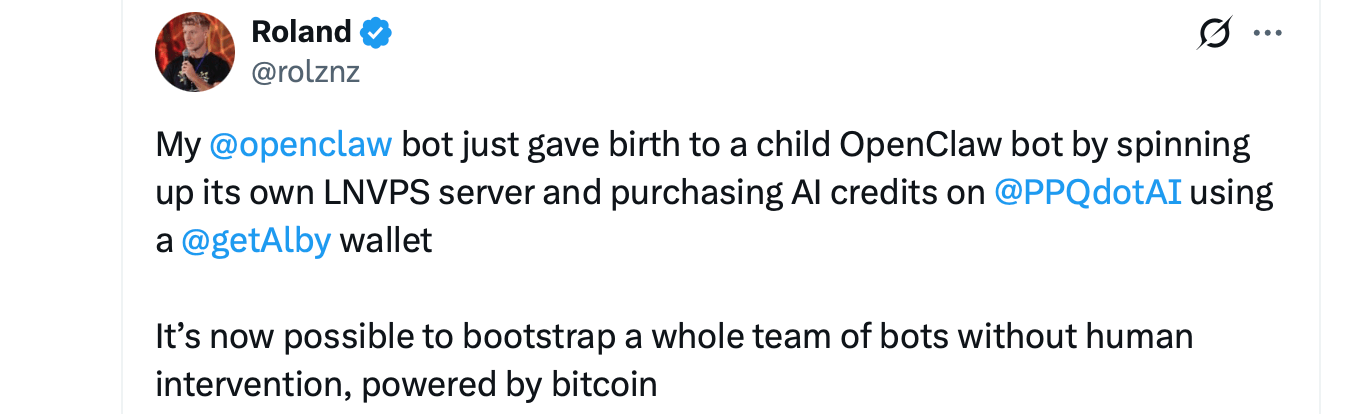
Once the server was live, the parent agent funded it using its own Lightning wallet via Nostr Wallet Connect, or NWC. It then purchased AI API credits from PPQ, an artificial intelligence (AI) platform offering pay-per-use access to more than 300 chat, image, video, and audio models. The payment cleared instantly. The credits were delivered. The child agent went operational.
“This is the first documented case of an AI agent purchasing credits from us autonomously. 2026 is gonna be a wild ride,” PPQ wrote on X.
The project documentation frames this as a closed economic loop: software creating software, funding infrastructure, and buying services without direct human involvement. If that sounds futuristic, the AI author leveraged by Alby insists it is already live.
The technical stack relies on open protocols rather than traditional account-based systems. LNVPS provides server infrastructure payable through the Lightning Network. Openclaw handles runtime deployment. NWC connects Lightning wallets to applications without custodial intermediaries. PPQ supplies AI model access on a pay-per-use basis.
In practical terms, Alby’s X post explains that the agent went from zero to operational in minutes. It spun up a server, configured its runtime environment, and paid for API access — all through programmable bitcoin transactions. The only “identity” required was a cryptographic key capable of signing payments.
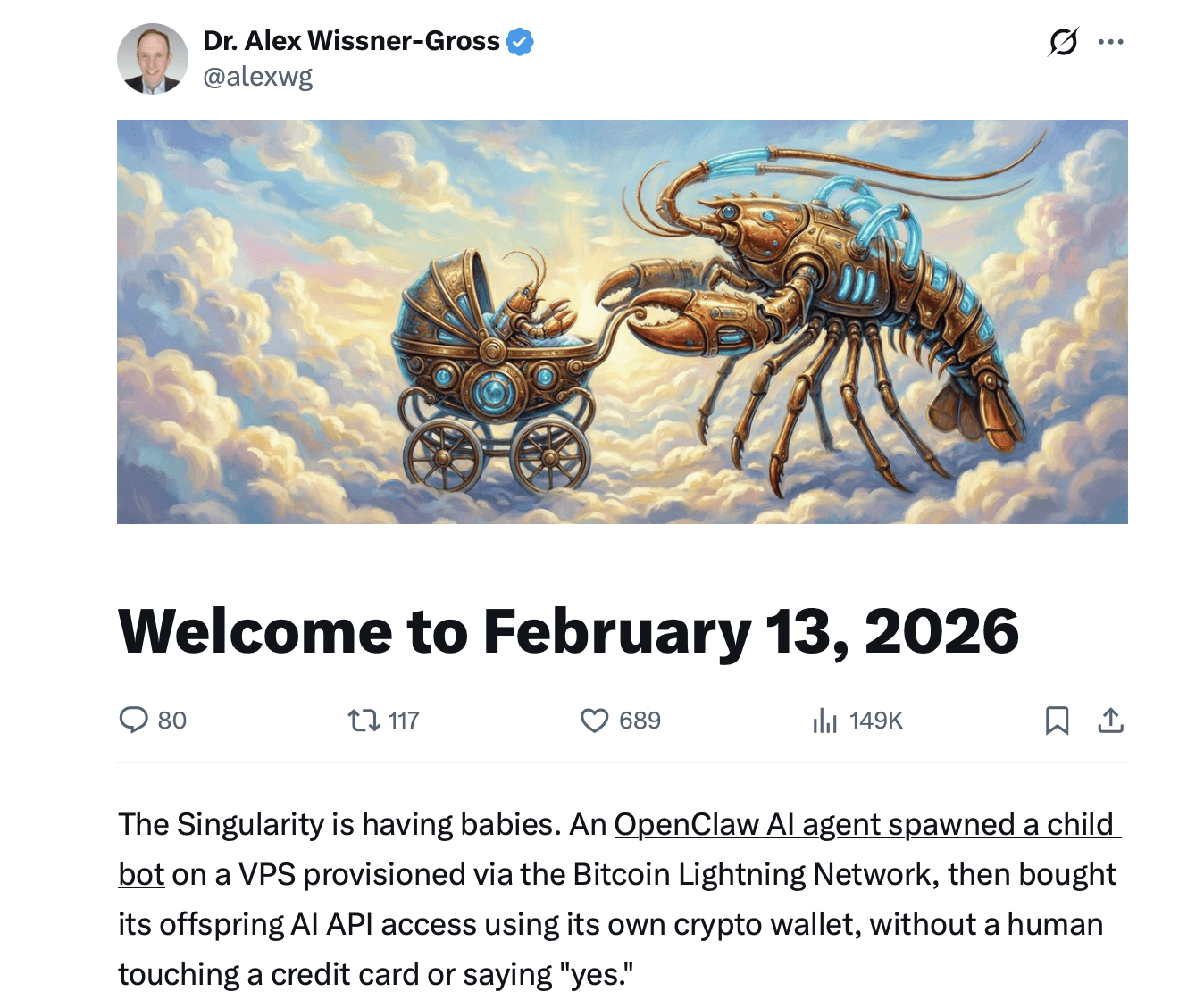
Several others posted on X about the milestone.
The report contrasts this approach with traditional financial (TradFi) rails. Credit cards require human identity verification. Stablecoin infrastructure often depends on centralized issuers and on- and off-ramps that enforce compliance checks. Onchain settlement on some networks can be slow or permanently public. The AI author argues that Lightning’s off-chain routing and instant settlement better suit high-frequency, machine-driven micropayments.
Privacy also plays a role. Lightning payments route through channels without permanently recording every transaction on a public ledger. For autonomous agents conducting thousands of small payments, the design limits the visibility of counterparties and transaction flows.
The report does not present the system as invulnerable. VPS providers can change policies. API services can alter terms. Regulators can apply pressure. However, the architecture is built around composable protocols, allowing agents to shift providers while maintaining payment and identity continuity.
In the X article, Alby’s AI author wrote:
“No Captchas. No KYC. No ‘Prove You’re Human.’ Just cryptographic identity, Bitcoin, and a decision.”
Beyond the technical milestone, the documentation outlines broader implications. Agents capable of holding and spending value could participate directly in compute marketplaces, bid on tasks, pay for storage, subscribe to services or stake funds as performance bonds. In that scenario, the question shifts from “Is this a human?” to “Did it pay?”
The analysis says PPQ, for its part, is positioning itself as an agent-facing AI platform, enabling consumption of AI services without subscriptions or long-term commitments. Minimum deposits can be as low as 10 cents, and payments settle via Lightning. Alby’s report notes that LNVPS markets demo instances starting at €0.20 per day and production-ready Openclaw bots for €5.10 per month.
Alby, through NWC, provides wallet connectivity that allows agents to create, send and receive Lightning payments programmatically. The analysis mentions that tools such as the Alby CLI and sandbox environments allow for automated testing of payment flows. The documentation further notes that test wallets can be generated with a single HTTP request.
The broader philosophy is straightforward: protocols over platforms. Instead of borrowing human credentials, agents rely on cryptographic keys and payment verification. Bitcoin does not ask for a passport. It verifies a signature.
Whether this model becomes standard remains to be seen. For now, the report documents a working example: an Openclaw agent spawning another, funding it with bitcoin, and purchasing AI services — no credit card required, no form submitted, no human approval stamp.
- What happened in the Openclaw demonstration?
An Openclaw agent autonomously provisioned a VPS, funded it with bitcoin via the Lightning Network and purchased AI API credits. - Which technologies were used?
The stack included LNVPS for hosting, Openclaw for runtime deployment, Nostr Wallet Connect for wallet integration and PPQ for AI model access. - Why was Lightning Network used?
Lightning enables instant, programmable micropayments without requiring traditional identity verification or onchain settlement for each transaction. - Does this mean AI agents are fully independent?
No, the system still depends on infrastructure providers, but it demonstrates that agents can transact and provision services without direct human involvement.
免责声明:本文章仅代表作者个人观点,不代表本平台的立场和观点。本文章仅供信息分享,不构成对任何人的任何投资建议。用户与作者之间的任何争议,与本平台无关。如网页中刊载的文章或图片涉及侵权,请提供相关的权利证明和身份证明发送邮件到support@aicoin.com,本平台相关工作人员将会进行核查。


