MegaETH Launches Mainnet, Targeting High-Frequency DeFi and Gaming
The MegaETH project frames its approach around ultra-low latency and high throughput, aiming to support applications that require near-instant feedback, including decentralized finance ( defi), gaming, and consumer-facing apps. According to project materials, MegaETH is settled on Ethereum for security while prioritizing speed at the execution layer, a trade-off that intentionally shifts focus away from conventional blockchain categorization.
Ahead of launch, MegaETH conducted a weeklong stress test in late January that processed 11.4 billion transactions and reached a peak of roughly 55,000 transactions per second (TPS). At mainnet launch, the network reported initial performance of about 50,000 TPS with block times near 10 milliseconds, figures that place it well above most existing Ethereum-compatible networks in raw speed.
That performance is driven by an architecture built around mini-blocks, which are emitted every few milliseconds and stream state updates continuously rather than waiting for traditional block intervals. The system also relies on node specialization and a high-performance sequencer that processes transactions without standard gas constraints, prioritizing responsiveness over immediate finality.
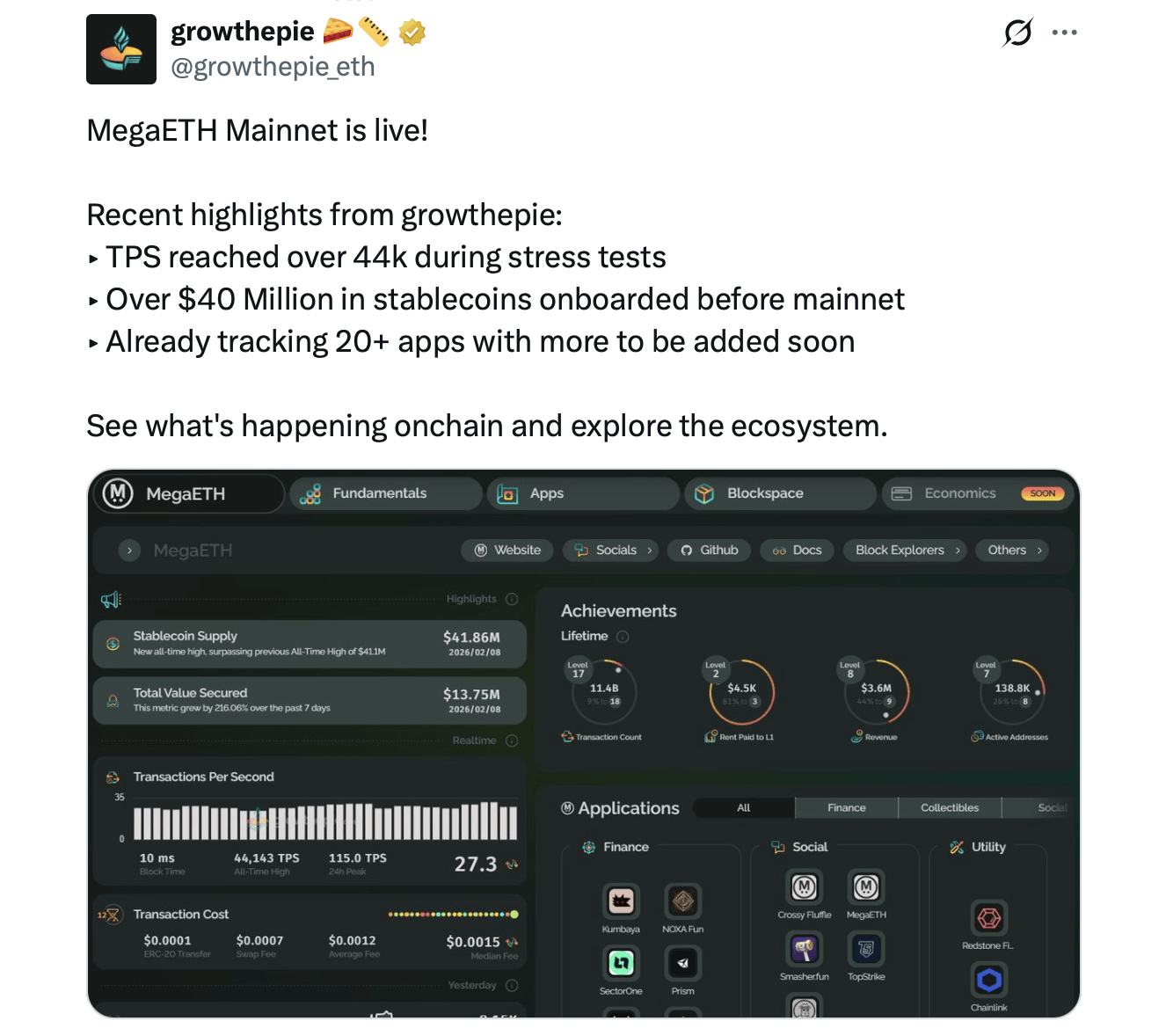
MegaETH maintains full Ethereum Virtual Machine ( EVM) compatibility, allowing developers to port existing smart contracts and tooling without rewrites. Data availability is handled off-chain, with settlement finalized on Ethereum, and the network integrates real-time oracle updates via RedStone, which can push pricing data into every mini-block for latency-sensitive applications.
The mainnet launched with more than 50 live applications spanning trading, lending, gaming, and social use cases, all accessible through a unified interface called “The Rabbithole.” Infrastructure support includes fast remote procedure call (RPC) providers, cross-chain bridges, and analytics integrations, signaling an effort to lower friction for both users and developers.
Also read: XRP Traders Brace for a Bottom: 3 Things to Watch This Week
While the launch marks a significant technical milestone, MegaETH’s design introduces trade-offs, including reliance on a single active sequencer at launch and the use of preconfirmations that favor speed over immediate finality. Whether the network can balance decentralization, security, and sustained performance remains an open question, but its mainnet debut adds another serious contender to Ethereum’s increasingly crowded scaling ecosystem.
FAQ ⏱️
- What is MegaETH?
MegaETH is an EVM-compatible blockchain designed for ultra-low latency and high transaction throughput. - When did MegaETH launch its mainnet?
MegaETH’s public mainnet launched on Feb. 9, 2026. - How fast is MegaETH compared to other networks?
At launch, MegaETH reported around 50,000 TPS and block times near 10 milliseconds. - What are the main trade-offs of MegaETH’s design?
The network prioritizes speed, currently relying on a single sequencer and preconfirmations rather than immediate finality.
免责声明:本文章仅代表作者个人观点,不代表本平台的立场和观点。本文章仅供信息分享,不构成对任何人的任何投资建议。用户与作者之间的任何争议,与本平台无关。如网页中刊载的文章或图片涉及侵权,请提供相关的权利证明和身份证明发送邮件到support@aicoin.com,本平台相关工作人员将会进行核查。


