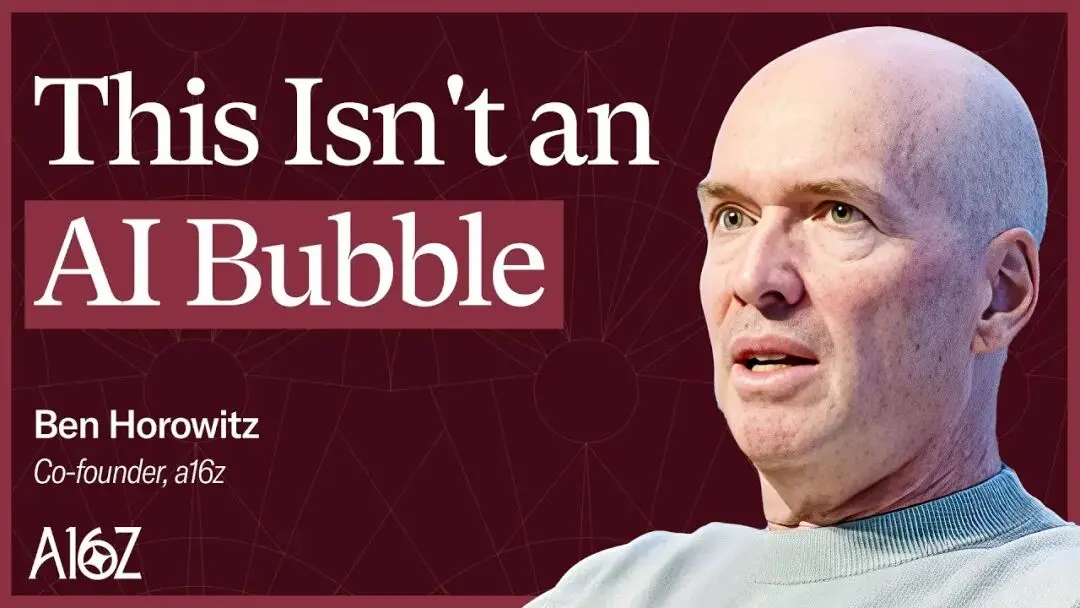
Why AI is Not a Bubble: Deep Thoughts on Demand, Investment, and Judgment from the Founder of a16z

CN
PANews
Follow
2 hours ago

Podcast: a16z

Translation: Deep Thinking Circle

If someone told you that the current AI boom is just another bubble, would you believe it? Valuations are soaring, capital is flooding in, and everyone is talking about AI; it certainly looks like history is repeating itself. But after listening to Ben Horowitz's recent talk, my perspective completely changed. The co-founder of Andreessen Horowitz provided a thought-provoking answer based on his 16 years of experience managing a top venture capital firm and his deep understanding of the tech industry: this time is different. Not because the technology is so cool, but because the demand is unprecedentedly real.

I've been pondering a question: why are some investors able to consistently find great companies while most can only rely on luck? In this talk, Ben revealed some perspectives I had never considered before. He discussed how to manage a group of people who are smarter than you, how to make the right judgments amid uncertainty, and why the current AI market is different from any previous tech cycle. These insights are valuable not only for investors but for anyone trying to make decisions in a rapidly changing environment.

The Art of Managing Geniuses: Why GPs Are Not Ordinary Employees

Ben made a striking point in his talk: managing GPs (General Partners) is completely different from managing a company. He said, "The talent density here is higher than in any company, purely from an IQ perspective. If you look at people like Chris Dixon, Martin Casado, and Alex Rampel, they have all run companies, and it's very difficult to gather so many high-IQ individuals in a company's executive team." This statement made me rethink what true talent management is.

I believe this point touches on a rarely discussed truth: when you are managing a group of world-class experts in their respective fields, traditional management methods become completely ineffective. Martin Casado has been one of the best architects in network software over the past 20 years and is also a talented investor. Ben said he wouldn't give Martin too much guidance but would help him understand the investment decision-making process and how the dialogue affects the investment process.

This led me to a deeper question: what is the value of a manager in knowledge work? If the people you manage know their fields better than you do, your role is no longer to tell them what to do but to help them maximize their value within the right framework. A key point Ben mentioned is that the biggest mistake in investing is getting too caught up in a company's weaknesses rather than focusing on what they truly excel at. This perspective seems simple, but it is extremely difficult to implement in practice.

I often see this situation in my own work: when we evaluate a project or partner, it's easy to fall into a "problem-finding" mode. We list all possible risks and all potential pitfalls, and then hesitate amid these concerns. But what Ben emphasizes is a different direction: the question you should be asking is whether this team is the best in the world at something. If they are, then they are worth investing in. If not, even if they are good in many areas, they may not be a good investment.

This shift in thinking is actually quite radical. It means you have to abandon the standard of "being excellent across the board" and instead look for the standard of "extreme excellence in a specific area." In a world full of uncertainty, having a world-class capability is far more valuable than having ten capabilities that are just okay.

The Essence of Judgment: Knowledge Plus Wisdom Equals Correct Decision-Making

When discussing how to make decisions, Ben provided a formula that I found very precise: decision-making ability equals wisdom plus knowledge, and knowledge often resides with those doing the actual work, not with the managers. He said, "If you think about what decision-making is, what makes you good at it? It's a combination of intellect and judgment, or you could say judgment is a combination of intellect and knowledge. So you know something, and then how smart you are in turning that into the right judgment."

This made me rethink how information flows within organizations. In most companies, information is filtered through multiple layers before it reaches decision-makers. Each layer of filtering loses some details and adds some interpretations, resulting in decision-makers often seeing a highly simplified version. But Ben's approach is completely different; he spends a lot of time attending team meetings, directly talking to deal partners, understanding what the accounting team is doing, what the IT team is doing, and even visiting LPs (Limited Partners) to get detailed insights from the front lines.

He mentioned a detail that impressed me: he wants employees to tell him immediately when they encounter a problem, even if it may seem unimportant. Because solving these problems might only take 14 seconds, but if employees feel they "shouldn't bother him" and don't speak up, the problem can escalate. This grasp of details is not micromanagement but ensuring he has enough knowledge to make the right judgments.

I believe there is a deeper insight here: in a rapidly changing environment, the quality of decision-making depends on how accurately you understand reality. If your information is second-hand, filtered, and delayed, then your decision-making is like driving a car with a blurry rearview mirror. Ben emphasizes that what leaders often need is not "correctness" but "clarity." Organizations need a clear direction; even if that direction is not 100% perfect, as long as it is clear, the team can act.

The Wisdom of Verticalization: Why a Basketball Team Can't Have 50 People

Regarding Andreessen Horowitz's verticalization strategy, Ben shared a key insight. He recalled a conversation in 2009 with the late Dave Swensen, who said that investment teams shouldn't be much larger than a basketball team. A basketball team has about five starting players because the conversations around investments need to truly become a dialogue. This analogy made me rethink the relationship between team size and efficiency.

Ben said, "I always remember that we really don't want any investment team to be much larger than this size, so how do we maintain that? The only way is through verticalization." At the same time, software is eating the world, and they must grow larger to meet the market demands, but he doesn't want the team to be larger than a basketball team. This contradiction drives the formation of a vertical structure.

I find this insight very profound. In many organizations, as the business grows, teams naturally expand. But the problem with expansion is that genuine dialogue becomes impossible. When there are 20 people in a meeting room, discussions turn into performances, with everyone waiting for their turn to speak rather than truly listening and thinking. By verticalizing, Andreessen Horowitz maintains small investment teams, thereby preserving high-quality dialogue and decision-making.

What’s more interesting is how they handle collaboration between vertical teams. For closely related teams, such as AI infrastructure and AI apps, they allow members from each team to attend the other team's meetings to establish direct connections. Additionally, they take all GPs out for meetings twice a year, with little agenda, just to facilitate communication.

Ben also mentioned a cultural perspective that impressed me. He said many people coming from other companies have reported that even though Andreessen Horowitz is already quite large, internal politics are less than in smaller companies with only 10-11 people. This is a result of culture. You either reward political behavior, leading to coups, infighting, and mutual dislike, or you do not encourage political behavior, which is their approach.

I believe this reveals a core principle of organizational design: structure should serve the behaviors you want, not the other way around. If you want true collaboration and high-quality dialogue, you need to design a structure that naturally facilitates those behaviors. Verticalization is not just a change in the organizational chart; it is a thoughtful choice to maintain the agility of small teams and high-quality decision-making while also serving a large market.

The Art of Market Selection: Not Too Early, Not Too Late

When discussing how to choose vertical markets, Ben mentioned an interesting case: they rejected investments related to ESG (Environmental, Social, and Governance). He said, "Investing is already hard enough; we don't need to introduce other criteria beyond 'this thing will become a giant company and make a lot of money.'" This perspective made me rethink the focus issue in investment decisions.

Ben explained that when the team proposed the concept of American Dynamism, his first question was, "Is this a marketing concept or a fund concept? What I want to know is the fund concept, which is how I make money. We have investors, and we must make money. This is a great marketing story, but we won't do all of this. The focus of the fund will be narrower than marketing." Ultimately, they identified three core verticals where real technological transformation is happening.

I think this thought process is very instructive. In many cases, people are attracted by a good story or concept but forget to verify whether there is a real economic opportunity behind that concept. American Dynamism sounds cool, but what really matters is: is there a genuine technological transformation in this field? Are there excellent entrepreneurs? Can it generate huge economic returns?

Ben emphasizes that when choosing a market, you cannot be too early or too late. It's somewhat like art. He said he is very confident that the markets they choose are correct because there is a lot of interesting activity in all these markets. But just because they appear and are Andreessen Horowitz does not mean they will win in that market. They must continuously evolve their team and thinking to ensure they can win.

I believe there is a key insight here: market opportunity and execution capability are two different things. Even if you find a perfect market, if your team, product, and strategy do not align, you will still fail. That’s why Ben says they need to keep evolving rather than thinking they have already won.

AI Is Not a Bubble: Unprecedented Demand Strength

When discussing whether AI is a bubble, Ben provided a perspective that impressed me. He said, "I get a lot of questions about the AI bubble, and I think one reason people are so worried about it being a bubble is that valuations are rising so quickly. But if you look at what’s happening underneath, customer adoption rates, revenue growth rates, etc., we have never seen such demand. So we have never seen valuations rise like this, but we have also never seen demand rise like this."

This perspective made me rethink what a bubble is. The definition of a bubble should not merely be rapid price increases but should be when prices detach from fundamentals. If demand growth and price growth are aligned, then it is not a bubble but a market's response to real value. Ben gave the example that even Nvidia's multiples are not outrageous, especially when you consider its growth rate, profitability scale, and so on.

I think there is a deeper insight here: many people compare AI to previous tech bubbles, such as the internet bubble of 2000. But they overlook a key difference: many companies back then had no revenue, no clear business model, and valuations were entirely based on future possibilities. In contrast, many current AI companies have real customers, real revenue, and real growth.

Ben mentioned that, from his career perspective, this is the largest tech market he has ever seen. Not the most promising, not the most hyped, but the largest. This judgment is based on the speed of customer adoption, revenue growth rates, and the intensity of market demand they are witnessing. These are measurable, real indicators, not castles in the air.

I believe this perspective is crucial for understanding the current AI wave. Many people assume that high valuations indicate a bubble, but they haven't looked deeply into what is happening on the demand side. If demand is indeed that strong, then high valuations may simply reflect the market's reasonable pricing of that demand. Of course, this doesn't mean every AI company is worth investing in, but it does mean that, as a whole, the AI market is not a bubble.

Limitations of Foundational Models: Why Application Layer Complexity Matters More

Ben highlighted a point in his talk that I think is very important but often overlooked: three or four years ago, people believed that large foundational models would become a massive brain capable of doing anything, better than anyone else. But that is not the case. He said, "Large models do provide very important infrastructure, and all our companies are built on that to some extent. But for any specific use case, not only is there a long tail of scenarios, but also a fat tail of human behavior, which is ultimately something you must model and understand very, very well."

He gave the example of Cursor. Cursor includes 13 different AI models, each modeling different aspects of programming, such as how you code, how you communicate with programmers, and so on. These models are so important that they actually released their own foundational model specifically for programming and coding. So they have a coding model that you can replace with Anthropic or OpenAI if you wish, or you can use the OpenAI or Anthropic models alongside their other models.

This example deepened my understanding of the importance of the application layer. Many people think that whoever has the largest and most powerful foundational model will win the entire AI market. But the reality is that the complexity of applications is very high and is not captured in foundational models. Cursor's success is not just because it uses good foundational models, but because it understands the workflow of programmers and has built 13 specialized models to handle different scenarios.

Ben also mentioned a great article written by Justine Moore from their team, discussing why there is no god-level video model. This article delves into the reasons why different use cases ultimately require different models, which again differs from expectations four years ago. I think this reveals an important technological trend: the balance between generality and specialization.

My understanding is that foundational models provide a powerful starting point, but real value creation happens at the application layer. Just as the internet provided infrastructure, but the real value was created by companies built on the internet. In the AI era, foundational models are the infrastructure, but the innovation space at the application layer is vast. This also explains why Ben believes there will be more winners, as the design space is enormous, far exceeding anything we have seen in the tech field.

A New Balance of Ownership: The Magic Number of 20%

When discussing ownership, Ben mentioned an interesting statistic: they have achieved 20% or higher ownership in many of their recent investments. While there are some companies where they did not reach this level, those companies appreciated so quickly that the outcomes were still very good. He said, "There have always been very, very special founders, and at some point, you know, this is the reality, but for us, for a lot of core infrastructure, core applications, etc., ownership has always been quite reasonable."

This made me think about the true meaning of ownership in venture capital. Many people believe VCs are pursuing the highest possible ownership percentage, but Ben's perspective is more nuanced. For truly special companies and founders, ownership may be diluted, but if the company grows fast enough, 20% of a $10 billion company is more valuable than 40% of a $1 billion company.

Ben also talked about the future of the VC industry. He said that while there are now over 3,000 VC firms, very few can actually help companies succeed. "Building a company is still very difficult. If you are just an engineer, an AI researcher, and you invent something and jump into this world, it is a very competitive world. Having a financial partner who can help you build your company—what's more important, initial valuation or the partner? I think most smart entrepreneurs realize it’s the partner."

I think this perspective is particularly important in the current environment. With the development of AI tools, the transition from idea to product has become easier. This is why Andreessen Horowitz has increased its investment in the Speedrun accelerator. They want to closely monitor those entrepreneurs who are just starting out and may not yet meet VC funding criteria.

My view is that the rules of the ownership game are changing. In the past, VCs may have focused more on having larger stakes, but now it is more important to find truly special companies and ensure you can win the opportunity to work with them. Even if it means accepting a smaller stake, if the company is great enough, the returns will still be significant.

Why AI Will Produce More Winners: The Scale of a New Computing Platform

When Ben answered why AI will produce more winners than previous tech cycles, he offered a thought-provoking analogy. He said, "AI is a new computing platform. So you have to think of it in terms of how many winners have been built on computers. That’s the scale level." He pointed out that if you ask how many businesses were built during the internet era, the actual number is quite large, from Meta to Netflix to Amazon to Google, all of which are very, very large winners.

He believes that in the AI field, products are generating a greater economic impact. Therefore, he thinks there will be more companies valued over $1 billion, over $10 billion, surpassing the last era. But this is a very large design space, a huge design space we have never seen in the tech field.

This perspective made me rethink the nature of AI. Many people view AI as a tool or technology, but Ben positions it as a new computing platform. This means AI is not just an application on existing computing platforms, but a whole new level, like personal computing or the internet. On this new platform, the possibilities for what can be built are limitless.

I find this perspective very important because it changes our understanding of the competitive landscape. If AI is just a tool, then perhaps only a few companies can master this tool and dominate the market. But if AI is a platform, then thousands of companies will build different applications on this platform, solve different problems, and serve different markets.

Ben mentioned that they have never seen such demand. This is not just hype, but real customer adoption and real revenue growth. The intensity of this demand indicates that AI is solving real problems and creating real value. And when a technology can create real value, the market will naturally support multiple winners because the space for value creation is large enough.

Giving People a Chance: The Ultimate Mission of Technology

Ben shared a profound point in his talk that left a strong impression on me. He and Mark Andreessen believe that the best thing society can do for a person is to give them a chance. A chance at life, a chance to contribute, a chance to do something greater than themselves and make the world a better place. This is the best thing society can do.

He said, "If you look at what is good in human history, what has benefited humanity is when people have the opportunity to do something greater than themselves and contribute. There are many systemic ideas, like if we could create a utopia or make everyone equal or this and that, but if you look at the history of communism or anything else, what it ultimately does is the opposite. It ends up being that everyone has equal opportunity to not get an opportunity."

I think this perspective touches on the essence of tech investment and entrepreneurship. We are not just chasing financial returns; we are creating opportunities. Every successful company creates jobs, creates products, solves problems, and ultimately gives more people the chance to realize their potential. The rise of America coincided with the rise of free markets, capitalism, and the rule of law; this is not a coincidence.

Ben pointed out that if you look at human history, wealth, life expectancy, and the scale of the Earth's population have all grown tremendously over the past 250 years. America has played a significant role in that. And today, America remains the country and system where people are most likely to gain real life opportunities. For America to maintain its importance in the world, it must win economically, it must win technologically, and it must win militarily, which means it must win technologically.

Their work is to help the country win technologically. This is important not only to them but also to the country and humanity. I think this perspective elevates the investment work to a higher level. It is not just about making money, but about participating in the grand narrative of human progress.

Ben gave a specific example of how this philosophy drives action. He and Jen recently went to Mexico, largely because a junior member of the team said, "What we are doing is very important. We need to help this alliance. We need to help protect the border. We need to help our own defense manufacturing. We must help solve the energy problem. I want to fight for this meeting." And then they got that meeting.

I think this reveals a profound truth: if you want to change the world, you must believe you can change the world. This is not arrogance, but a necessary belief. Without this belief, you will not take those seemingly impossible actions. And it is these actions that ultimately create real change.

The Return of M&A: AI Forces Everyone to Rethink

When Ben discussed the M&A (Mergers and Acquisitions) market, he made an interesting point. He said, "AI is such a disruptive phenomenon that every company, every existing enterprise is threatened by AI. Therefore, many ways to respond to that threat involve acquiring the DNA of the future. So I think there will be a lot of M&A because I believe people need to reconstruct how they work to survive."

This perspective made me rethink the impact of AI on existing companies. Many people focus on AI startups, but Ben points out that existing large companies are also under immense pressure. If they cannot quickly adapt to AI, they may be replaced by emerging AI-native companies. One of the fastest ways to adapt is to acquire companies that have already mastered AI technology and thinking.

I think this explains why the M&A market in the tech industry is reopening. In recent years, due to regulatory reasons and others, large acquisitions have been relatively few. But the emergence of AI has changed the game. Existing companies can no longer learn and adapt slowly; they need to quickly acquire capabilities, and acquisition is the most direct way.

What does this mean for startups? I believe this creates a new exit path. For those companies that have built strong AI capabilities but may not become independent giants, being acquired could be a great outcome. For large companies, this is also a survival strategy.

My view is that the increase in M&A activity is actually healthy. It indicates that the market is functioning effectively, and resources are flowing to where they can create the most value. At the same time, it also provides entrepreneurs with more options; not everyone wants or needs to build a billion-dollar independent company.

My Thoughts: Judgment is the Scarce Resource

After listening to Ben's talk, my biggest realization is that in this era of information explosion and rapid change, what is truly scarce is not information, not capital, and not even technology, but judgment. Judgment is the combination of knowledge and wisdom; it is the ability to make the right choices in uncertainty.

Ben's management style at Andreessen Horowitz has inspired me a lot. He does not manage by setting detailed rules and processes, but by cultivating the right judgment. He spends a lot of time understanding the details, not to micromanage, but to ensure he has enough knowledge to make good judgments. He focuses on how GPs perform at the moment of investment decision-making, rather than waiting to see the results ten years later, because ten years is too long.

Regarding the discussion of whether AI is a bubble, I now have a clearer view. The definition of a bubble should not only look at prices but should consider the relationship between price and value. If demand is real, growth is real, and value creation is real, then high valuations may simply be the market's response to that reality. Of course, this does not mean every company is worth that price, but as a whole, the AI market reflects real technological change and business opportunities.

I also deeply understand why foundational models are not everything. The value of technology ultimately lies in how it is applied, how it solves real problems, and how it serves users. Foundational models provide possibilities, but innovation at the application layer will determine who can truly win the market. This is also why there will be multiple winners, as the design space for applications is vast.

Finally, Ben's idea of "giving people a chance" has made me rethink the meaning of technology and investment. We are not just chasing returns; we are creating opportunities, helping people realize their potential, and driving human progress. This sense of mission is not an empty slogan, but a real force that drives action. When you believe you can change the world, you will take those actions that change the world.

免责声明:本文章仅代表作者个人观点,不代表本平台的立场和观点。本文章仅供信息分享,不构成对任何人的任何投资建议。用户与作者之间的任何争议,与本平台无关。如网页中刊载的文章或图片涉及侵权,请提供相关的权利证明和身份证明发送邮件到support@aicoin.com,本平台相关工作人员将会进行核查。

Share To
APP

X

Telegram

Facebook

Reddit

CopyLink