On-chain accounting records: How to understand the 2025 prediction market like a professional analyst?

CN
5 hours ago

Written by: Bitrace

Recently, a transaction has gone viral across various communities:

On the day before the U.S. raid on Venezuela, a newly registered mysterious account accurately placed a $30,000 bet on related predictions on Polymarket. Just 24 hours later, this amount skyrocketed to $400,000.

Prediction markets seem to always run faster than the news. From U.S. elections to geopolitical "black swans," everything is tradable. Everyone is talking about Polymarket, and some are optimistic about the compliant Kalshi or the newcomer Limitless. These platforms are located in the U.S. and Panama; some settle in USD, while others use cryptocurrencies; some record data in internal databases, while others use blockchain.

But to know who the real leader is, simply looking at press releases won't suffice. This article aims to delve deeper into how to clean and reconstruct on-chain trading data from six major prediction platforms based on the Prediction Markets Dashboard built on Dune Analytics @datadashboards, restoring the most authentic market flow.

1. Data Sources and Coverage

The data from prediction markets has inherent heterogeneity. To achieve a comprehensive network perspective, the analysis model covers the following core platforms and networks.

  • Polymarket (Polygon): Still the largest market by volume, featuring both AMM and Orderbook models.

  • Limitless (Base): An emerging platform based on the Base chain, also featuring a hybrid trading model.

  • Kalshi (Web2/Compliant): A platform approved by U.S. regulators, allowing only USD transactions.

  • Myriad (Abstract/BNB/Linea): A prediction protocol focusing on "multi-chain deployment," allowing users to create markets on different chains like Abstract, and has been very active recently.

  • Opinion (BNB): A decentralized platform based on the BNB chain, with extremely active trading.

  • Predict (BNB): Also deeply rooted in the BNB ecosystem, focusing on serving the large user base on Binance Chain, providing prediction services for various popular events, and is an important base for Binance ecosystem users.

The challenge is that these platforms are scattered across different blockchain networks, and their trading mechanisms vary, making direct comparisons impossible.

2. Core Analysis Logic

To construct a standardized "total flow" metric, we adopted the following three layers of cleaning logic:

1. Aggregation of Heterogeneous Data

This is the most complex step in the analysis. We need to write specific extraction logic for each platform's unique contract architecture:

  • AMM Model:

  • Basic Principle: Users trade directly with smart contracts (liquidity pools), with prices automatically calculated by mathematical formulas (e.g., constant product).

  • Core Advantage: Long-tail market friendly. For low-attention small predictions (e.g., "Will it rain in Paris next Tuesday?"), even without professional market maker orders, AMM ensures users can buy and sell at any time, completely solving the liquidity exhaustion problem in niche markets.

  • Data Extraction: For this data, we track all pools created by the FixedProductMarketMaker factory contract and listen for its Swap events.

  • Orderbook Model

  • Basic Principle: Buyers and sellers place orders (Bid/Ask), with a matching engine facilitating point-to-point transactions.

  • Core Advantage: Preferred for popular markets. For super events like the "U.S. election," which attract massive funding, the order book model can provide deep liquidity and low slippage. Under high-frequency trading, it is closer to real market pricing efficiency than AMM.

  • Data Extraction: For this trading, we directly track the OrderFilled events of the exchange contract. To accurately identify the direction and amount of trades, we need to make logical judgments in complex matching logs: identifying which party (the order placer or the taker) provided the underlying asset. Once we lock in the funding party, we can reverse-calculate the real principal investment value by dividing the number of prediction tokens held by the counterparty by 2.

We aggregate millions of trading logs scattered across multiple chains like Abstract, Base, Polygon, and BNB into a standardized trading dataset.

2. Standardization of Trading Volume

In on-chain data, raw values often cannot be used directly and must undergo meticulous standardization:

  • Precision Handling: Different prediction platforms support different token payments, so we introduced price oracles to convert all native token amounts into USD.

  • Bilateral Calculation Exclusion: In the order book model, a matched trade is usually recorded in the logs as both a buy and sell order, with the blockchain typically recording two logs: Address A sells, Address B buys. Or when minting tokens, 1 unit of principal corresponds to 2 units of tokens (YES+NO). To avoid overstating statistics, when calculating total flow, we strictly applied the Volume / 2 logic for Myriad, Limitless, Polymarket, Opinion, and Predict, ensuring only one side of the real capital inflow is counted.

3. Temporal Perspective

To capture market trends, we introduced a multi-dimensional temporal perspective in the final stage of querying. In addition to calculating "historical total flow," we constructed annual and monthly data pivot tables. This processing method helps us answer the following key questions:

  • Stock vs. Increment: Which platforms are supported by early stock funds, and which platforms showed strong increments in 2025?

  • Market Seasonality: How do the traffic retention rates of each platform behave before and after major events (e.g., elections, sports finals)?

3. Analysis Results and Insights

Through this rigorous "cleaning-conversion-deduplication" process, we obtained a complete market report as of the end of 2025, revealing three insights—

1. Strong Growth in Prediction Markets in 2025

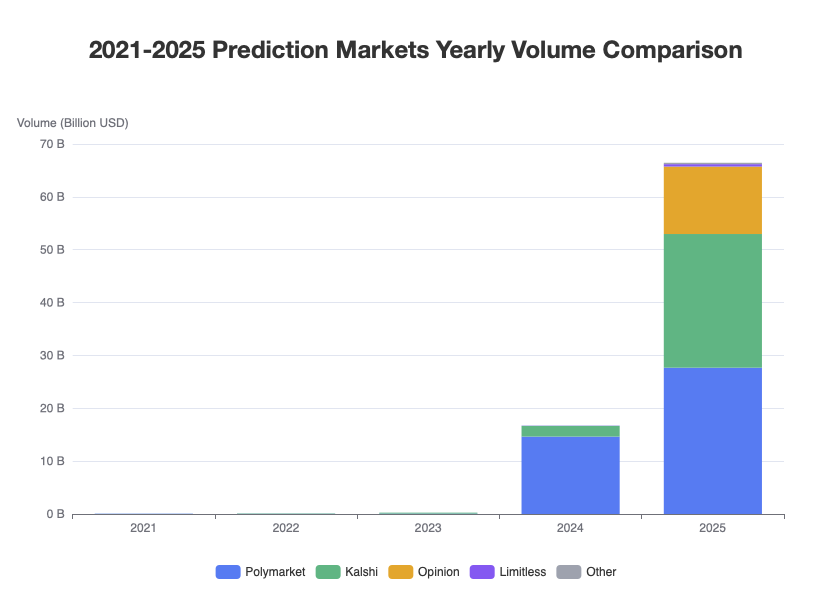
Data doesn't lie. Polymarket's total flow in 2024 was approximately $14.6 billion, and by 2025, this number soared to $27.6 billion. The entire sector's capital volume doubled within a year, and prediction markets are no longer a niche toy.

2. Compliance Takes the Lead as Kalshi Surges to the Top

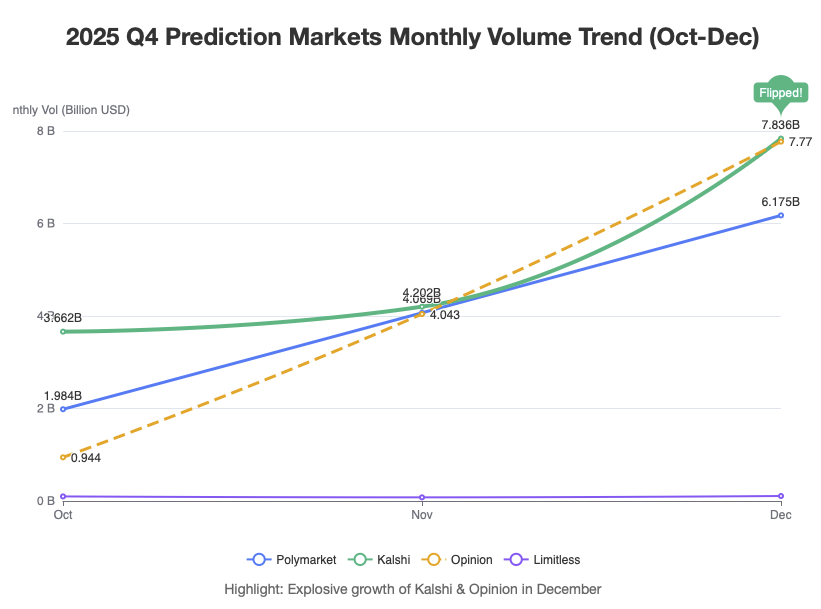
If you only look at the news, you might think Polymarket still dominates. But the data shows a stunning turning point: although Polymarket's annual total flow remains the highest, in December 2025, the compliant platform Kalshi achieved an astonishing monthly flow of $7.8 billion, surpassing Polymarket's $6.1 billion.

Compliant funds are entering the market in droves, and the market's barometer has quietly changed.

3. The Mysterious Dark Horse Opinion

This is the biggest surprise from data mining. The Opinion platform (based on the BNB chain) had almost no presence before October 2025.

However, in just three months in Q4, it achieved a terrifying growth from $0 to a monthly flow of $7.7 billion, and in December's data, it nearly matched Kalshi, leaving the old giants behind.

4. Conclusion

The value of on-chain data analysis lies not only in counting every number but also in smoothing out the technical differences between platforms through rigorous logic, constructing a fair horizontal comparison dimension, thereby gaining objective insights into the new type of prediction markets based on cryptocurrencies.

Although this type of platform is currently filled with controversy, the market undoubtedly shows a high level of enthusiasm for it. Bitrace will maintain data monitoring of the relevant industry with a cautious attitude in the future.

免责声明:本文章仅代表作者个人观点,不代表本平台的立场和观点。本文章仅供信息分享,不构成对任何人的任何投资建议。用户与作者之间的任何争议,与本平台无关。如网页中刊载的文章或图片涉及侵权,请提供相关的权利证明和身份证明发送邮件到support@aicoin.com,本平台相关工作人员将会进行核查。

Share To
APP

X

Telegram

Facebook

Reddit

CopyLink