Twitter post with tens of millions of views: If you have a wide range of interests, don't waste time in the next 2-3 years.

CN
PANews
Follow
1 hour ago

Author: DAN KOE

Translated by: randomarea

Introduction

Society makes you think that having a wide range of interests is a flaw.

Go to school.

Get a degree.

Find a job.

Retire at some point.

But this sequence of life has too many problems.

We no longer live in the industrial age. Betting on a single skill is almost equivalent to chronic suicide. I think by today, we all understand how dangerous a mechanical lifestyle and siloed learning can be for your mind and soul. People can also feel that we are experiencing a "second Renaissance." Your curiosity and thirst for knowledge are advantages in the contemporary world—but there is still a missing piece.

For a long time, I kept learning, learning, and learning. I was stuck in "tutorial hell." Some people would point to "shiny object syndrome" to indicate your lack of focus. I got dopamine from "feeling smart," but my life didn't change much. Honestly, I felt like I was just falling further behind. In college, I tried too many different things. I dreamed of doing my own thing… wanting to earn income from creative endeavors… but after spending 5 years "learning," reality hit: to survive, I had to find the best job I could get.

The missing piece was a "vehicle."

A vehicle that would allow me to channel all my interests into meaningful work and earn a decent income from it.

If you have ever felt guilty for not being able to "pick one thing"; if you have been told to "niche down," but your brain just wants to keep expanding; if you have ever doubted whether there is a path that doesn't lead to the kind of pain you see in others' eyes—then now is the best time to be alive.

Here are the 7 most compelling points I can think of. We will first understand why having a wide range of interests is a superpower in the contemporary world; then I will provide actionable steps to turn it into a lifelong career. We have a lot to discuss, and I hope you are ready to settle in for the ride.

I — The Three Elements of Personal Success and the End of "Expertise"

"If a person's entire life is spent repeating a few simple operations… he usually becomes as stupid and ignorant as possible." — Adam Smith

Mr. Smith, you have made a clever observation—because these people are exactly what you created, and we are still suffering from the backlash.

Specialization took over society during the industrial era: take a needle factory as an example, a worker could make 20 needles a day by completing all the processes from start to finish; when the processes were broken down into multiple steps, allowing different workers to each do a small part, the total output could reach 48,000 needles.

Thus, we built the entire world around this model.

Humans became nine-to-five assembly line workers. Ultimately, the government does not serve the national interest but its own; companies do not serve employee interests but their own.

The design of schools is precisely to serve this interest structure. Its sole goal is to mass-produce punctual, obedient factory workers.

But this is not how life should be lived.

If you want to have that kind of "expertise" to the extent that you can never run a business—especially your own—then you will rely on schools for education and jobs for wages. You will be deceived into believing that specialization is what makes a person "valuable." But the reality is clear: this system does not need "you" as a specific person to complete that task.

The difference lies here.

If pure specialization makes people dull and dependent, then what makes an individual smart and autonomous?

Three elements: self-education, self-interest, and self-sufficiency.

Self-education is clear: if you want results different from traditional education, you must take charge of your own learning.

Self-interest may sound alarming. It seems selfish and shortsighted; many people unthinkingly view it as "bad." But it simply means "caring for one's own interests." Because the alternative is to serve the interests of the organizations that make up the existing society—we have already discussed this. In other words, follow your interests, because your interests are likely to benefit others in a selfless way—depending on your level of cognition and moral development. By the way: indulging in fleeting pleasures (cheap dopamine) is often not in your interest, but in the interest of those companies profiting from your numbness.

"In Ayn Rand's view, a truly selfish person is one who is self-respecting and self-sufficient: neither sacrificing others for oneself nor sacrificing oneself for others. This rejects the roles of 'predator' and 'doormat.'"

Self-sufficiency is the refusal to outsource your judgment, learning, and agency. If self-education is the engine, self-interest is the compass, then self-sufficiency is the foundation: it ensures that the direction of your life is not hijacked by external forces. The three elements work together but are not completely dependent on each other.

Generalists will naturally emerge within this triad structure.

Self-interest drives self-education.

You learn because it genuinely serves your growth and prosperity, not because someone assigned you homework.

Self-education fosters self-sufficiency.

You can only maintain autonomy in areas you understand.

Self-sufficiency clarifies self-interest.

When you no longer rely on others' explanations, you can truly see what is beneficial for you. Most people chase multiple interests to escape work; when your interests become your work or your lifelong career, most of those interests will naturally filter out.

When we observe those CEOs, founders, or creators we truly admire, we find that they are almost all generalists.

They understand enough about marketing to provide directional guidance; they know enough about products to build them themselves; they understand enough about people to lead teams. But they must also steer the ship—when the environment changes, they must learn and adapt.

More importantly: they understand that cross-disciplinary ideas can complement each other, forming a unique worldview. This allows them to capture new ideas from the "ether" and translate them into market value.

If you see the direction of the current world clearly and understand the opportunities available to individuals (not just leaders), you will find that as a natural polymath, you have many paths to choose from. This should excite you.

II — You Are in the Second Renaissance: Seize the Opportunity

"Study the science of art, study the art of science. Train your senses—especially learn how to 'see.' Recognize that everything is interconnected." — Leonardo da Vinci

In my view, the ultimate moat—or the last competitive advantage worth paying for—is perspective.

A viewpoint that only you can see, shaped by your unique life experiences. It may be the last thing that others cannot replicate.

Since this is the case, why not prioritize it now? Especially when automation is already at our doorstep.

But the question is: how do you prioritize it? How do you develop it?

The answer is: pursue multiple interests and build something with them.

You see, every interest you pursue leaves a residue. Each interest increases the number of connections you can build. Each interest expands and enhances the complexity with which you model and interpret reality. The more complex your model of reality, the more problems you can solve, the more opportunities you can see, and the more value you can create. Specialization will completely halt this process, while your "shiny object syndrome" keeps reminding you of this.

From birth until now, you are cultivating a "way of seeing the world" that others do not have. A way of thinking that an AI can only "think" when you tell it how to think.

Those who have studied psychology and design see user behavior differently than pure designers; those who have studied sales and philosophy close deals differently than pure salespeople; those who understand fitness and business can build health companies that even an MBA cannot comprehend.

Your advantage comes more from "intersections" than from "expert-level proficiency" in a single field.

This is precisely the pattern we saw during the (historical) Renaissance—now it has returned with even greater force.

Think about what made the Renaissance possible back then…

Before the printing press, knowledge was extremely scarce.

Books were copied by hand. A single text could take months for a scribe to complete. Libraries were few, and literate people even fewer. If you wanted to learn something outside your field, you either had access to a monastery or you couldn't learn it.

Then, Gutenberg changed everything.

Within 50 years, 20 million books flooded into Europe. Ideas that once took generations to spread could now be disseminated in months. Literacy rates skyrocketed, and the cost of knowledge collapsed.

For the first time in history, it was truly possible for a person to pursue mastery in multiple fields within a lifetime.

Thus, the Renaissance was born.

Da Vinci did not "pick just one thing." He painted, sculpted, designed engineering projects, studied anatomy, designed war machines, and created human anatomy maps. Michelangelo was both a painter and a sculptor, architect, and poet.

Unique minds could finally operate as they were meant to.

They were meant to transcend disciplines, integrate connections, and let curiosity take them anywhere—but most of us never realized this.

The printing press was the catalyst: it birthed a new kind of person—one who could learn anything, combine everything, and create things that no specialist could create.

III — How to Turn Multiple Interests into a Profitable Lifestyle

So far, we have learned a few things:

  • You have a wide range of interests but feel you cannot just keep learning forever.

  • You love self-education based on interests but have to squeeze time for it outside of your career.

  • You understand the necessity of "self-sufficiency," but feel you do not yet have "value worth paying for."

  • You need to adapt quickly because we have no idea what future jobs will look like.

So the question arises: how do we combine all of this into a lifestyle?

How do we merge "learning" and "earning" into something you can work with?

I will try to explain it logically.

To make money from your interests, you first need to make others interested in them too. This part is simple: if something interests you, it can also interest others. You just need to learn how to persuade.

Next, you need a way to get them to pay. Here, it usually means you need to sell products—because you are unlikely to find a job that fully expresses your interests; investing in stocks or real estate (to achieve effective scale) requires quite a bit of capital.

In other words, you need attention.

Attention is one of the last remaining moats.

Because when anyone can write anything or build any software, who will win? The one who is "known." You can have the best product in the world, but if no one knows about it, the person who can capture and retain attention will leave you in the dust.

By the way: if you have been following the tech circle, you will know—I don’t think everyone will “make software themselves.” Most people wouldn’t spend 20 minutes cooking. They would rather spend a few extra dollars on Uber Eats. People have their own things they want to spend time on.

Back to the topic:

You need to become a creator.

Before you frown and exit—I'm not entirely referring to being a "content creator" (well… that's complicated).

What I mean is: if you don’t want to keep creating for others just because you need them to pay your salary, then the solution is to create for yourself.

Humans are inherently creators, but we are persuaded to believe that turning ourselves into machines is the path to the "American Dream." Our essence is that of tool-makers. We thrive in any ecological niche because we can create solutions to problems. If you put a lion in Alaska, it won’t build shelters and clothes; it will just die. Lions belong to their own ecological niche.

The key is: every business today is essentially a media business. Remember, you need attention. Where is the attention? Primarily on social media—until the next generation of "attention preference platforms" emerges; at which point you must adapt as well. So yes, if you have a wide range of interests, treating yourself as a "content creator" would be wiser; but perhaps a more accessible way to understand it is: think of social media as a mechanism to make your interests visible to more people. It’s just one piece of the independent work puzzle.

Moreover, this conveniently covers several of our previous needs.

Do you love learning? Great, redefine it as "research," and it literally becomes your main job. Most of what I write is simply because I am learning about my interests and using social media as "public note-taking."

(You were already spending time learning; now just change that time to "learning in public," and boom—you have the foundation of a business.)

Do you need self-sufficiency? Then you need a business; and every business needs to attract customers; and you probably don’t care (two f*cks) about paid ads, SEO, or any other form of marketing. This is precisely why many people get stuck: because they have always been accustomed to being employees, doing a specialized task within a company.

Do you need to adapt quickly? Awesome—you can release new products to your audience as quickly as you build them. I have a stable audience; even if the next product fails, there will be people willing to invest, join the team, or support the next product. You can also run your little SaaS company, but if you don’t have a distribution channel, you’ll have to run an extra marathon: securing capital, finding talent, and getting things off the ground.

No other job or business model allows you to accomplish all of this with such high freedom.

But how do you actually start?

How do you tie all of this together?

IV — How to Turn Yourself into a Business

Diagram

Unfortunately, "entrepreneurship" and "business" have become off-putting terms that make many feel unqualified to pursue that path, to the extent that when opportunities arise, they don’t even notice.

If you have ever helped others with your interests, then you are qualified to start a business.

Entrepreneurship no longer requires a large amount of startup capital. It is no longer exclusive to "unscrupulous elites." It doesn’t just belong to those who want to make a lot of money. It also doesn’t just belong to the "talented" or "special" people.

The reality is: entrepreneurship is written into our nature. It is the modern way of survival. We are "programmed" to create and distribute value to a group of like-minded people; programmed to hunt, explore the unknown, pursue novelty, and never stagnate. From a psychological perspective, this is the most pleasurable way to live—even if there are lows, because the lows are precisely what allows (non-artificial) highs to exist.

Moreover, the entry barriers have collapsed.

All you really need is a laptop and an internet connection.

Thanks to social media, distribution is now almost free (strictly speaking, it’s not free, but "skill-driven," and skills may require time to acquire). Anyone can publish an idea that can reach millions; if you have a product and know what you are doing, then those millions of eyes can potentially turn into millions of dollars—of course, the "knowing what you are doing" is a significant prerequisite. Most people are just keen on honing a particular interest or skill to a high level, but it doesn’t directly impact their success; perhaps they are afraid of facing "success" itself.

Tools and technologies can now handle tasks that previously required a team. You can use AI, and there are plenty of useful software available.

Now, you have two starting paths.

Path 1) Skill-Based

This path has long dominated the internet: you "learn a tradeable skill"; you teach that skill through content; then you sell products or services related to that skill.

Its limitation is the limitation of "specialization": a single dimension. You box yourself in. You "niche down" because someone told you it’s more profitable; and when you chase profit instead of interest, you often end up recreating a second nine-to-five: doing work you don’t care about, serving people you don’t care about.

Path 2) Development-Based

The best creators winning now are those who don’t have a "nail-in-the-coffin niche." They typically focus on one of the four eternal markets: health, wealth, relationships, happiness—or even cover all of them. Strictly speaking, everyone’s "niche" is self-actualization; it’s just that everyone’s path to it is different.

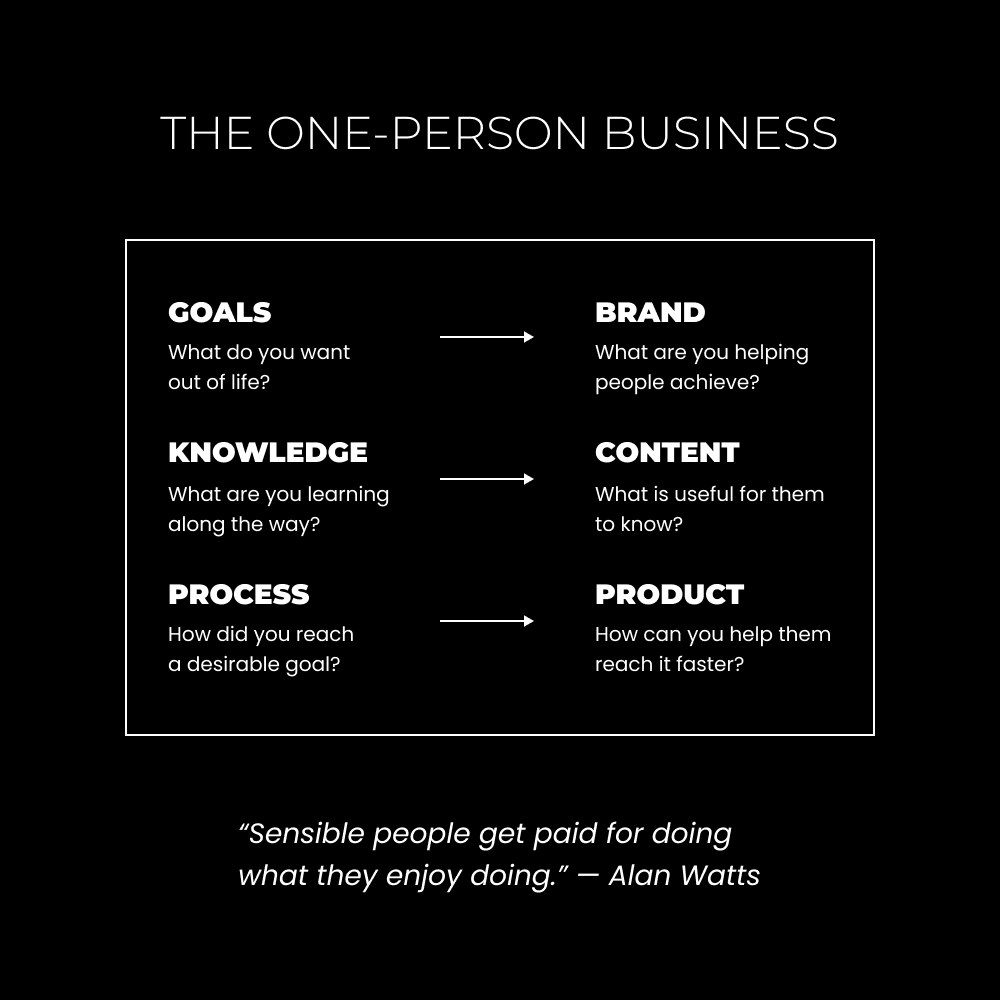
  • You pursue your own goals (brand).

  • You teach what you learn (content).

  • You help others achieve their goals faster (products).

For those with a wide range of interests, I clearly recommend the second path, as it is more profound.

First, when you take this path, you are also walking the first path. Because building a brand, content, and products will force you to hone all relevant tradeable skills; so even if you fail, you still possess "payable" abilities. You are building your own business; if you do well enough in any part of it, you can also help others in some aspect.

Second, it flips the traditional model upside down.

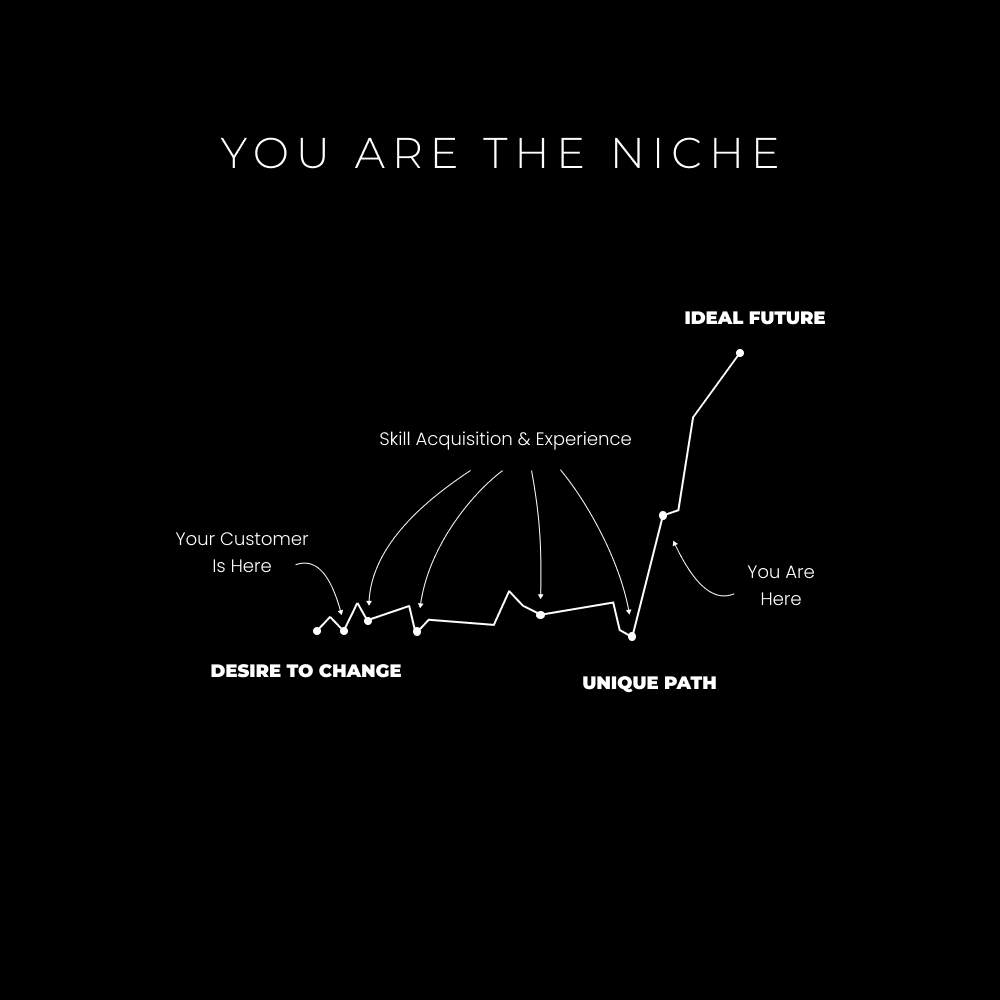
You no longer "fabricate a customer persona" to niche down and only serve that one person; you turn yourself into the customer persona.

This makes everything much smoother.

You pursue and develop your life goals → you have validated that what you will provide is indeed useful → you help "past versions of yourself" achieve the same goals faster.

Don’t be a YouTube creator.

Don’t be a "personal brand."

Don’t be an influencer.

Be yourself. But please place yourself in a position where your work can be discovered, noticed, and supported. Now and for the foreseeable future, that place is the internet.

Jordan Peterson (or similar figures) is not a "content creator," even though it may seem that way on the surface.

He tours, writes books, uses social media as a base, and leverages all available tools to spread his life’s work. He doesn’t worry about the latest "content idea trends." His mind surpasses those short-sighted growth strategies. The quality of his thoughts sets him apart and changes people’s lives (regardless of your views on Peterson’s ideas).

Based on this, I want to offer a different perspective on "brand, content, product." This way, you can treat it as a vehicle to carry your lifelong career.

V — Brand is an Environment

Stop thinking of "brand" as just a profile picture and social media bio.

A brand is an environment where people come to undergo transformation.

A brand is a small world you invite others into.

A brand is not something that is "shown" to readers the first time they visit your homepage.

A brand is a collection of ideas that form in the reader's mind after following you for 3-6 months.

You will present your worldview, story, and life philosophy at every touchpoint: banners, profile pictures, bios, links in bios, landing page design, pinned content, posts, threads, newsletters, videos, etc.

In other words, your brand probably looks like this:

Brand diagram

Your brand is your story.

You might want to take a day to write it down: where you come from, where the "lows" of your life are, what you have experienced, what skills you have gained, and how these things have helped you the most.

When you think of ideas, content, or products, you should filter them through your story. This doesn’t mean you have to talk about yourself all the time, but it means: everything you say should align to keep your brand consistent.

The difficult part is: you have to realize that your story is worth telling—even if you think it’s boring, or you haven’t seriously reflected on your growth.

The point is:

Your bio and profile picture don’t matter. There are indeed some people whose bios consist of just one word, and their profile pictures are just a single color.

My advice:

  • List 5-10 people you respect online.

  • Look at their profile pictures, bios, and content.

  • Remember the commonalities among them.

  • Start deducing how you should build your own brand, and incorporate your own little changes.

To be honest, I wouldn’t overthink it or even worry about it. Your brand will naturally take shape as you start writing content. We could even say: brand is content, so we need to get content right.

This article might help you: How to Build Your Own Content Ecosystem.

VI — Content is a Novel Perspective

The internet is a fire hose of information.

AI will only add more noise.

This means: trust and signal are more important than ever.

In my view, your content should serve as a "guiding lighthouse": curate the best ideas into one place. Your brand is the collection of all the ideas you care about, gathered under your own words, on one account, on the internet.

If you plan to do podcasts or public speaking, pay attention: the best speakers always have 5-10 of their strongest arguments or ideas in mind. They constantly repeat these ideas and build influence with them. If you don’t have those 5-10 ideas, you won’t be able to penetrate as you could. Writing a lot of content is the way to discover these ideas.

As your content increases in "idea density" over time and effort, it will form a brand worth paying attention to, even worth paying for.

Incorporating ideas into your brand's curation goal should fall at the intersection of both:

  • Performance — This idea has the potential to "perform well." It measures how much others will care.

  • Excitement — This idea gives you the thrill of wanting to write it down. It measures how much you care yourself.

Art and business.

Metrics and performance shouldn’t dictate everything, but they do mean something.

Step 1) Build an "Idea Museum"

Most creators you admire have a secret: they curate their notes, ideas, and sources of inspiration with extreme rigor.

In other words, they have what marketers often call a "swipe file."

You can use Eden (if you have access), Apple Notes, Notion, or any tool you prefer, but I want to make this very clear:

You need a place to jot down ideas the moment they appear.

This is a key habit.

Whenever you encounter an idea that is "useful now" or "will be useful soon," write it down. You don’t need content pillars or 2-3 fixed topics. The ideas you curate just need to be important to you. Just that means: they are relevant to a specific audience—that is you. Of course, if you want, you can also create a "content map": the-content-map-how-to-never-run.

I don’t care what structure you use. It can be a neatly organized document or a chaotic, ever-expanding note. Habit is more important than format.

You can assess whether a post has the potential to resonate by glancing at likes, views, or overall engagement. If an idea falls flat or is clearly worse than other content, it likely won’t perform well for you either.

You can evaluate excitement by observing a feeling: when you think, "If I don’t write this down, I’m wasting something precious," it often means it’s worth capturing.

Step 2) Curate Around "Idea Density"

How do you start filling your idea museum?

You need 3-5 sources of information with high "idea density."

By "idea density," I mean high signal ideas.

It’s hard to explain how to find high-signal content because it’s very subjective. It depends on your stage of development (what is useful to you), your audience's stage of development (what is useful to them), and your ability to translate "your understanding" into "something they can use."

The most basic advice might be the most valuable thing in the world to someone; but to you, it might just seem like common sense.

Over time, you will calibrate your own signal-to-noise ratio by observing which ideas resonate with your audience and which do not.

The most "idea-dense" sources of information:

  • Old or obscure books — I have 5 books that I repeatedly read because the ideas in them are so good. Eternal principles reside there, untainted by trends.

  • Curated blogs, accounts, or books — Blogs like Farnam Street curate the essence of modern thinkers; accounts like Navalism curate Naval's best insights; books like "The Maxwell Daily Reader" break down one of Maxwell's best insights into 365 days, giving you one each day. These contents do a lot of the "filtering work" for you, allowing you to pick the best from the best.

  • High-quality social media accounts — I have a list of about 5 accounts that consistently publish great ideas. If I’m ever unsure of what to write, I’ll scroll through their pages, find a piece of content I have thoughts on, and write about it.

Finding these sources will take months of exploration. But maintaining a high-density idea museum will lead you to one outcome: you start producing high-density content.

Your idea museum will become the external manifestation of the kind of mind you are trying to build.

That is the ultimate goal.

The aim is to have a content library: so good that people can’t help but open your emails, check your post notifications, share your ideas with friends, and frequently think of your thoughts.

You will become a kind of "idea curator": curating ideas that people wouldn’t even think to ask AI about, curating ideas that people would never stumble upon through casual browsing.

This will make your success less dependent on algorithms.

Step 3) Write 1000 Expressions of One Idea

Becoming a good writer or speaker is not just about "the idea itself," but about "how you express that idea."

Ideas carry a lot of weight, but structure makes them attractive, unique, and impactful.

Let me give you an example.

Suppose you use this post structure:

I’ve observed a pattern among happy people: they are extremely dedicated to keeping their minds clear.

The idea here is: happy people keep their minds clear.

The structure is divided into two parts: a "hook" presented as an observation, and a specific delivery of that observation.

It seems simple, but the difference in idea structure can make a world of difference.

Now, if I express the same idea using a "list" structure:

Happy people are clear-minded people:

  • They make time for rest

  • They focus on a single goal

  • They ruthlessly eliminate distractions

In other words, happy people are extremely dedicated to keeping their minds clear.

Same idea. Different structure. Different effect.

If you’re willing, you can practice "writing the same idea" using every post structure you encounter.

Here’s how to practice:

Step 1: Deconstruct the Structure of 3 Ideas.

Choose 3 posts from your idea museum that resonate with you. Then try to break down each part and write down why it is effective.

If you don’t have experience in content psychology, that’s okay. You will learn through practice.

Now is a great time to let AI help. You can try this prompt for each post:

Please provide a comprehensive analysis of this social media post: the overall core idea, sentence structure, and word choice. Analyze why people engage with it, why it is effective, what psychological strategies are used, and how I can replicate this style step by step for my own ideas.

Then paste the post content below the prompt.

If I had to choose a model, I would recommend Claude over ChatGPT or Gemini.

Any idea you encounter along the way, as long as you want to incorporate it into your writing style, you can continue to analyze using this method. It also applies to videos, not just text posts.

Step 2: Rewrite 3 Ideas with Different Structures.

Go back to your idea museum, select an idea you didn’t use in "Step 1." Then try to rewrite it using the 3 post structures you just deconstructed.

This is how you expand your range of expression.

This is how you stop staring at a blank screen.

This is how you turn one idea into a week’s worth of content production.

Why do this?

Because by now, you have mastered all the secrets of "creating standout content" and "coming up with good ideas."

Really, that’s the secret. Everything else is just a product of practice.

VII — Systems are the New Product

Alright, this piece is already long, so I’ll speed up from here.

And I already have a complete guide on "how to create your first product": mega-guide-how-to-create-your-first…… so I don’t want to repeat too much here.

At this point in time, we are in a "systems economy."

People don’t want a "solution."

They want your solution.

There are many writing products on the market. So what makes my 2 Hour Writer (2HW) different? Or Eden—the software I’m building; to some "very smart people who have definitely built products successfully in the YouTube comments," it "could easily be replaced by Google Drive or Dropbox."

What makes them different is that they are systems I built through personal results.

2HW doesn’t teach a bunch of academic writing nonsense—those things won’t help you achieve our shared vision: to live a creative and meaningful life.

I had a few problems:

  • I struggled to consistently generate content ideas.

  • I didn’t want to waste a lot of time creating content separately for different platforms.

So, I started experimenting with my own system.

The goal of the system was clear: to write all the content I needed in under 2 hours a day. This way, my audience growth would be "automatically handled"; I could focus my energy on creating better products and enjoying life.

I began testing various "how to get more content ideas" strategies.

I established a swipe file, a process for generating ideas, and templates I could use when I still couldn’t think of anything.

I clearly scheduled the content I needed to write each week: 3 posts a day; 1 thread a week; 1 newsletter a week.

In the process, I realized I could publish my writing simultaneously across all social platforms (this is public, you can see it). I also realized: threads could become carousels, newsletters could become YouTube videos.

If this system wasn’t working smoothly, I would try something new the following week.

Then I realized: I could directly copy and paste the newsletter into my blog, embed the YT video in that blog post, promote my products in that blog post, and turn that blog post into a source of more content ideas.

Then, I could place the link to that blog post under my content every day.

This would lead to more newsletter subscriptions, YouTube subscriptions, and product sales.

I realized: if everything I did was centered around the newsletter, then whether it was audience growth or product promotion, I only needed to focus on that one thing.

This is how you stand out in a world flooded with "copy-paste products."

Yes, it takes time and experience.

But the end result is well worth it.

This letter ends here.

Thank you for reading.

——Dan

First of all, if you’ve read this far, I like you. You’re willing to read long articles.

If you want to support this letter, consider joining the paid tier. The content I provide includes: a complete course on "how to start a one-person company," prompts for "resetting your life," and writing strategies I use when I run out of inspiration.

免责声明:本文章仅代表作者个人观点,不代表本平台的立场和观点。本文章仅供信息分享,不构成对任何人的任何投资建议。用户与作者之间的任何争议,与本平台无关。如网页中刊载的文章或图片涉及侵权,请提供相关的权利证明和身份证明发送邮件到support@aicoin.com,本平台相关工作人员将会进行核查。

Share To
APP

X

Telegram

Facebook

Reddit

CopyLink