January 12 (Monday)
● The market officially enters the "Super Week," where market sentiment will be tested under the dual pressure of macro data and micro performance.
● Event: The G7 finance ministers' meeting is held in Washington, D.C. The core topics of the meeting are expected to revolve around the security of critical mineral supply chains, particularly concerning rare earths, with the geopolitical impact on resource dynamics once again becoming a focal point.
● Event: The U.S. Supreme Court has announced a delay in the key ruling regarding the tariffs imposed during former President Trump's administration under the International Emergency Economic Powers Act. The new ruling date is set for January 14 (Wednesday), and the outcome of this ruling will affect the future boundaries of U.S. executive authority in trade policy, drawing significant market attention.
● Event: Several Federal Reserve officials plan to give speeches. Before the quiet period leading up to the Fed's interest rate meeting at the end of January, comments from various officials, including FOMC permanent voting member and New York Fed President John Williams, will provide more clues for the market to speculate on the monetary policy path. Among these, officials' assessments of the inflation outlook and their statements regarding the pace of interest rate cuts will be the core focus.
● Earnings Report: The U.S. earnings season kicks off today with several regional banks, allowing investors to get an initial glimpse of the impact of the high-interest-rate environment on the U.S. banking sector, particularly the risk exposure in areas like commercial real estate.
January 13 (Tuesday)
● The first key data day of the week arrives, with the core focus concentrated on both sides of the Atlantic.
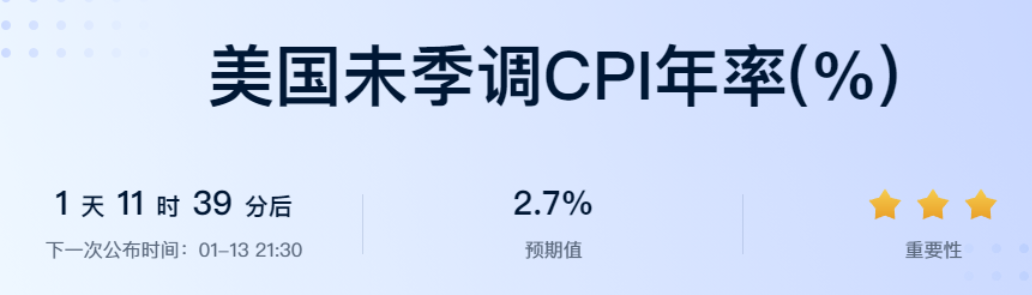
● Data: The U.S. Department of Labor will release the Consumer Price Index (CPI) for December. This is the most anticipated economic data of the week and even the month. Market institutions generally predict a significant rebound in the month-on-month core CPI for December, expected to be in the range of 0.36%-0.38%, far exceeding the average levels of October and November. Analysts generally point out that this rebound is mainly related to the seasonal adjustment model distortion caused by the short government shutdown in the fourth quarter of last year, representing "technical" noise. How the market interprets this data—whether focusing on the short-term rebound or "discounting" it and paying attention to the trend slowdown—will directly trigger significant fluctuations in U.S. Treasury yields and the U.S. dollar index, affecting global asset pricing.
● Data: The U.S. Energy Information Administration (EIA) will release its monthly Short-Term Energy Outlook report, providing the latest forecasts for the price outlook of energy products such as crude oil and natural gas.
● Macroeconomic Dynamics: A new round of U.S. government funding bills enters a critical phase. To avoid another government shutdown after January 30, the House of Representatives has passed a "mini omnibus" funding bill package, which will be submitted to the Senate for review this week. The progress and final outcome of this review will determine the actual risk of a government shutdown at the end of the month, having a substantial impact on market sentiment and economic operations.
January 14 (Wednesday)
● An event-driven day, with judicial rulings and central bank reports making their appearance.
● Event: The U.S. Supreme Court is expected to announce its ruling on the Trump tariff case. This ruling will clarify the legal boundaries of the U.S. President's authority to impose tariffs broadly under the guise of "national security" without explicit congressional authorization, having far-reaching implications for the future direction of U.S. trade policy.
● Data/Report: The Federal Reserve will release its national economic conditions survey report, known as the "Beige Book." This report summarizes the assessments of economic conditions in the 12 regional Federal Reserve districts, covering various aspects such as employment, prices, consumption, and manufacturing. Investors will look for regional evidence regarding economic resilience, the cooling of the job market, and inflationary pressures to confirm or adjust their judgments on the economic outlook.
● Data: The U.S. will release the Producer Price Index (PPI) for November and retail sales data. The PPI data, as an indicator of upstream inflation, helps assess the trend of cost pressure transmission and provides a basis for calculating the PCE price index to be released at the end of the month. Retail sales data (the "terrifying data") is a key window for observing the resilience of U.S. consumer spending, especially in the post-holiday season.
January 15 (Thursday)
● The earnings season reaches its first peak, with the "backbone" of the tech industry speaking out.
● Earnings Report: The U.S. banking sector's earnings season reaches its climax. Major systemically important banks such as JPMorgan Chase, Bank of America, Citigroup, and Wells Fargo will release their performance results.
Investors will closely monitor: trends in net interest margin changes, provisions for credit losses (especially in commercial real estate and credit card loans), signs of recovery in investment banking, and management's outlook on the economic future. The earnings reports of large banks serve as a direct window for assessing the health of the U.S. financial system and the momentum of the real economy under a high-interest-rate environment.
January 16 to 18 (Friday and Weekend)
● Macroeconomic Dynamics: Canadian Prime Minister's visit to China continues until January 17. Trade and international security are expected to be discussion topics, and the outcomes may have marginal impacts on bilateral relations between China and Canada and specific commodity trade.
● Market: As major data and significant earnings reports are released, the market will comprehensively price this information and begin to position itself for the next phase—widespread corporate earnings reports and the Federal Reserve's interest rate meeting at the end of the month. Volatility may remain elevated.
This week is a typical "Super Week" interwoven with macro and micro factors.
The policy expectation game triggered by the U.S. December CPI data, along with the "opening red" performance of the earnings season represented by TSMC and Wall Street's major banks, constitutes the two core driving forces of the short-term market.
At the same time, the U.S. Supreme Court's ruling on tariff powers, the risk of a U.S. government shutdown, and geopolitical and economic governance events such as the G7 finance ministers' meeting will add additional complexity and uncertainty to the market. Investors need to strive to discern the true fundamental trends of the economy and enterprises amidst the noisy data and event noise.
Join our community to discuss and grow stronger together!
Official Telegram community: https://t.me/aicoincn
AiCoin Chinese Twitter: https://x.com/AiCoinzh
OKX benefits group: https://aicoin.com/link/chat?cid=l61eM4owQ
Binance benefits group: https://aicoin.com/link/chat?cid=ynr7d1P6Z
免责声明:本文章仅代表作者个人观点,不代表本平台的立场和观点。本文章仅供信息分享,不构成对任何人的任何投资建议。用户与作者之间的任何争议,与本平台无关。如网页中刊载的文章或图片涉及侵权,请提供相关的权利证明和身份证明发送邮件到support@aicoin.com,本平台相关工作人员将会进行核查。


