While much of the crypto world celebrated Christmas, a viral X post of bitcoin “crashing” to $24,000 sent social media into a frenzy. However, a closer look at the data reveals that the market did not actually collapse; rather, a perfect storm of low liquidity and aggressive yield-chasing caused a localized “wick” on a single trading pair.
The panic began when bitcoin appeared to drop 72% in a matter of seconds. According to exchange data, the volatility was confined entirely to the BTC/USD1 pair on Binance. During the same three-second window, the primary BTC/ USDT pair—which handles the vast majority of bitcoin’s trading volume—remained stable above $86,400. By Dec. 26, the cryptocurrency was on the rise and closing in on $89,000.
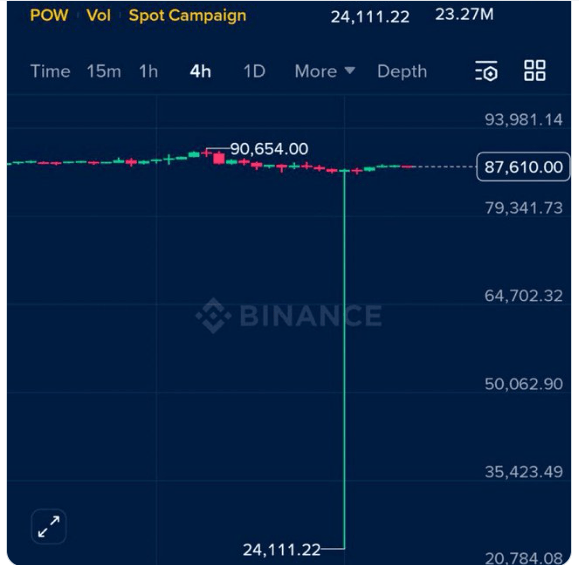
Although the plunge was short-lived, it caught the attention of critics like Jacob King, who shared a screenshot on X showing the steep drop. The post went viral, garnering over a million views and sparking panic among some investors. However, market analyst Shanaka Anslem Perera pointed out that the crash was limited to one specific order book and had almost zero impact on the rest of the market.
“The ‘crash’ existed on exactly one order book,” Perera said. “It wasn’t a bitcoin crash; it was a liquidity vacuum.”
According to Perera, the roots of the flash crash trace back to a Binance promotion launched just 24 hours earlier. The exchange offered a 20% annual percentage yield on deposits of USD1, the stablecoin issued by World Liberty Financial.
This high yield triggered a predictable chain of events. First, traders aggressively swapped USDT for USD1 to capture the 20% interest, which in turn drained the sell-side liquidity from the BTC/USD1 pair. When a single large market sell order hit the now-empty order book, the price plummeted to the nearest available bid at $24,111 before arbitrage bots instantly corrected the price.
Read more: WLFI Partners With AB To Deploy The USD1 Stablecoin On AB Chain
Perera noted that a nearly identical event occurred on Dec. 10, when the same BTC/USD1 pair wicked from $96,000 to $76,000.
Meanwhile, the market analyst asserted that the rise of USD1—which recently crossed a $3 billion market cap—highlights a growing risk in the stablecoin sector. He warned that new and promotional trading pairs often function more like “landmines” than reliable trading venues.
As long as promotional yield campaigns continue to create sudden shifts in liquidity, these “wicks” are likely to happen again, Perera said. For the informed trader, it is a lesson in “alpha”; for the casual observer, it is a reminder that a screenshot rarely tells the whole story.
- Did Bitcoin really crash to $24K? No—the drop only appeared on Binance’s BTC/USD1 pair.
- Why did the flash crash happen? A 20% APY promo drained liquidity from the BTC/USD1 order book.
- Was the wider market affected? No— BTC/ USDT, the main trading pair, stayed stable above $86K.
- What’s the bigger risk here? Promotional stablecoin pairs can act like “landmines” for traders worldwide.
免责声明:本文章仅代表作者个人观点,不代表本平台的立场和观点。本文章仅供信息分享,不构成对任何人的任何投资建议。用户与作者之间的任何争议,与本平台无关。如网页中刊载的文章或图片涉及侵权,请提供相关的权利证明和身份证明发送邮件到support@aicoin.com,本平台相关工作人员将会进行核查。


