NIGHT, with a daily trading volume of nearly 10 billion and an FDV ranking in the top 50, surprisingly comes from the "outdated" Cardano?

CN
16 hours ago

Original Title: "A Token with a Daily Trading Volume of Nearly $10 Billion, Surprisingly from Cardano?"

Original Author: Eric, Foresight News

Recently, a token called NIGHT, which launched on Bitget, Binance, OKX, and Bybit at the beginning of the month, has seen a total trading volume exceeding $9 billion in 24 hours, approaching $10 billion. Bybit even surpassed Binance in 24-hour spot trading volume thanks to NIGHT.

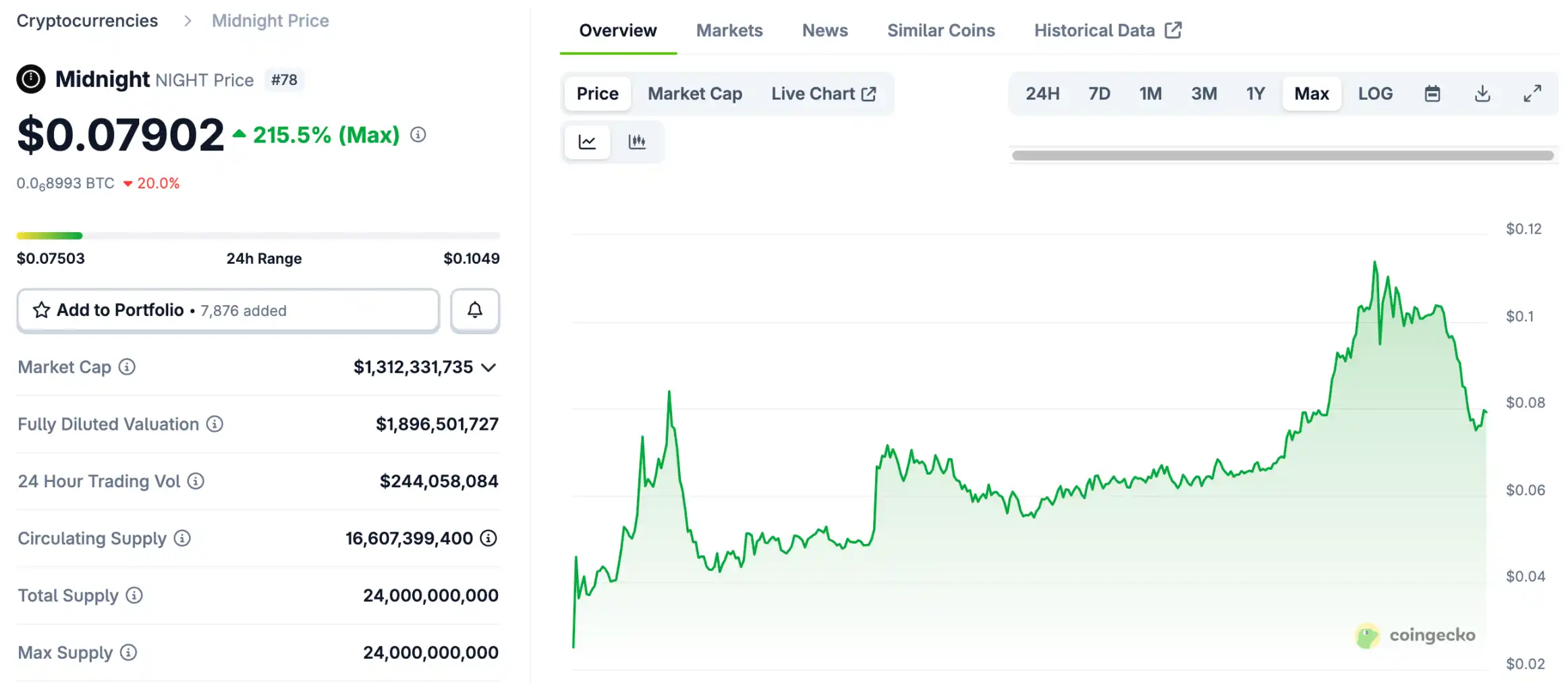
NIGHT was officially launched on December 9, and according to CoinGecko data, the token's price rose from around $0.025 to nearly $0.0114 in less than two weeks, an increase of over 3 times, with its FDV once exceeding $2.5 billion, placing it among the top 50 by market capitalization. As of the time of writing, the price of NIGHT has retreated to around $0.08.

It is not surprising for a token to perform well when launched on several major trading platforms, but interestingly, NIGHT is the token of Midnight, a privacy sidechain of Cardano. The explosive potential of a project labeled with both "Cardano" and "Privacy" has indeed caught most people off guard.

Where is Midnight's "Value"?

Midnight is a sidechain developed by Input Output Global (IOG, the parent company of Cardano) that focuses on "programmable data protection" as its core selling point. It has created a ready-to-use TypeScript API for zero-knowledge proofs (ZKP), allowing Web2 developers to implement "selective disclosure" on-chain without needing to learn cryptography. The entire network is built on Cardano as the consensus base, with Halo2 as the ZK backend, adopting a dual-token model (NIGHT+DUST). The goal is to first realize "data available but not visible," which is most important to enterprises, and then gradually expand to scenarios like DeFi, RWA, and on-chain compliant identities.

Overall, there is nothing particularly special; the privacy technology uses ZKP but does not natively protect privacy. Instead, it makes privacy features optional to meet actual needs.

IOG first publicly announced the development plan for Midnight in November 2022, but it wasn't until nearly two years later, in October 2024, that the testnet was launched. This is indeed IOG's style; it took nearly 5 years from the announcement of Cardano's introduction of smart contracts to their actual implementation, with smart contract functionality only available in September 2021, by which time the bull market had already cooled down.

In May of this year, Midnight established a foundation, with Fahmi Syed, former CFO of the Polkadot development team Parity, serving as chairman, indicating that the TGE has taken its first step. Just two days after the foundation's announcement, Cardano founder Charles Hoskinson revealed a plan to airdrop tokens to 37 million addresses across 8 major blockchains, stating that the airdrop would only target retail investors, with no VC participation in the project.

Perhaps what truly ignited market sentiment was Midnight's "massive token distribution." In addition to the airdrop, Midnight also collaborated with Binance, OKX, and Bybit to distribute nearly 3 billion NIGHT tokens. This large-scale distribution is quite different from the recently popular ICO model, generating a positive market response.

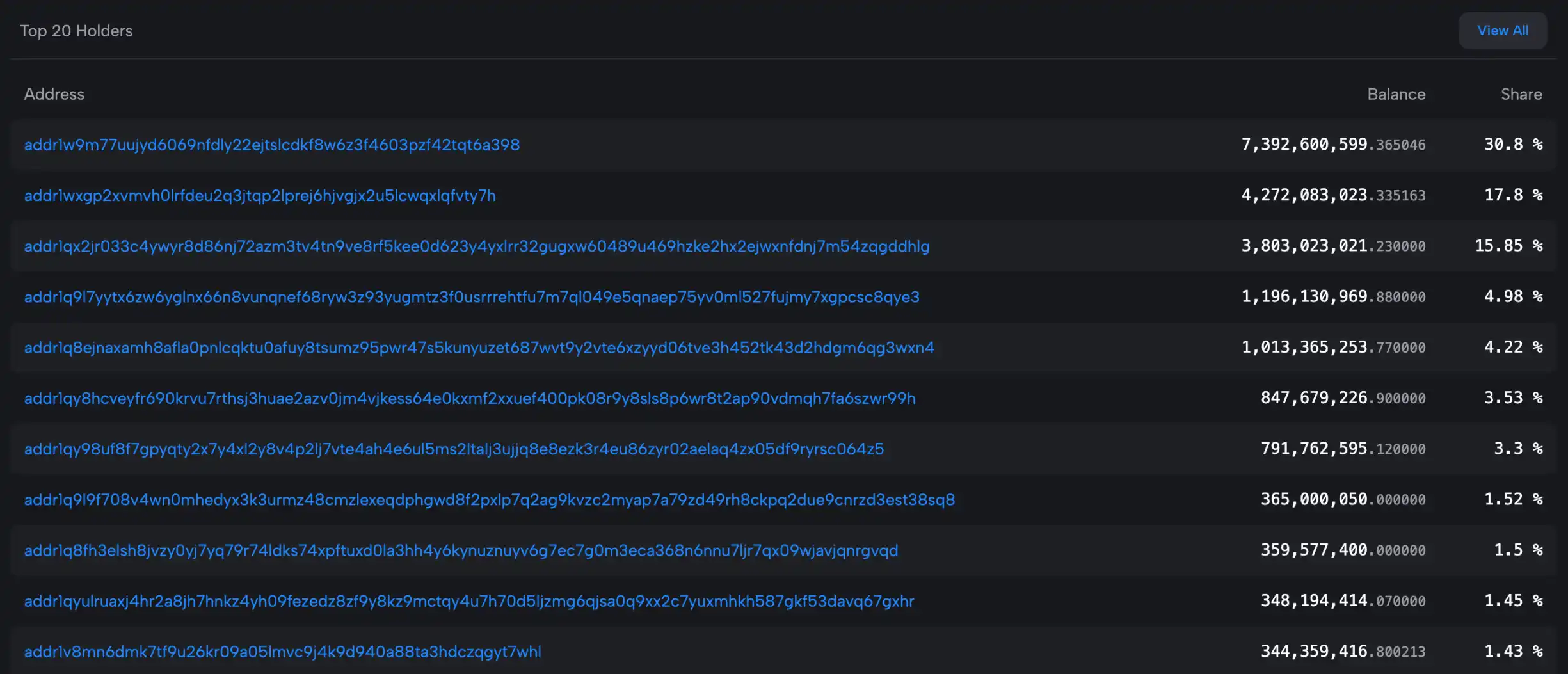
From the blockchain explorer, the top few addresses holding NIGHT, aside from the top three that likely belong to IOG or the Midnight foundation, show a relatively dispersed holding among the remaining addresses. According to data provided by the official website, I estimate that the tokens distributed through NIGHT's airdrop and activities in collaboration with trading platforms account for nearly 1/3 of the total supply (24 billion tokens), which can indeed be considered a significant distribution.

Midnight's token is not just NIGHT, but employs a "NIGHT+DUST" dual-token model. This rare design is not due to any "creative idea," but rather ensures compliance with regulatory requirements. NIGHT can be used for network governance, incentives, and generating another token, DUST. NIGHT itself is unrelated to privacy and supports on-chain auditing.

DUST, generated by holding NIGHT, is used to pay transaction fees, similar to Gas. Additionally, DUST will also be used to pay for privacy fees; if one wants to add optional privacy features to on-chain transactions, they need to pay DUST as a fee. DUST will be automatically distributed to NIGHT holders' accounts with each block and will "decay" over time to prevent malicious hoarding and network attacks.

Thus, Midnight's "equity" NIGHT does not participate in the payment of on-chain transaction fees but exists solely as a governance token and generates the actual on-chain fuel, DUST. DUST itself, as a "renewable resource," is generated by NIGHT and will continuously decrease over time, which, from a regulatory policy perspective, will be viewed as a resource rather than an asset, meeting regulatory requirements in various regions.

Cardano Will Invest Heavily in On-Chain Ecosystem Next Year

According to Cardano's roadmap, next year will be a year of fully promoting on-chain activity.

First and foremost, Cardano will undergo a network upgrade to increase throughput to 1,000 to 10,000 TPS through parallel block processing and a layered structure, achieving vertical scalability while maintaining security and decentralization. Following that will be the mainnet launch of Midnight, which Cardano believes will bring more DeFi activity and TVL through its optional privacy features. Additionally, the Cardano treasury will allocate funds to support the native issuance of major stablecoins like USDT and USDC on Cardano.

Lastly, and perhaps most importantly, Cardano plans to focus on interoperability, but not in a simple cross-chain manner; rather, it aims to allow users from other chains to interact directly with DApps on Cardano by consuming the Gas tokens of the source chain.

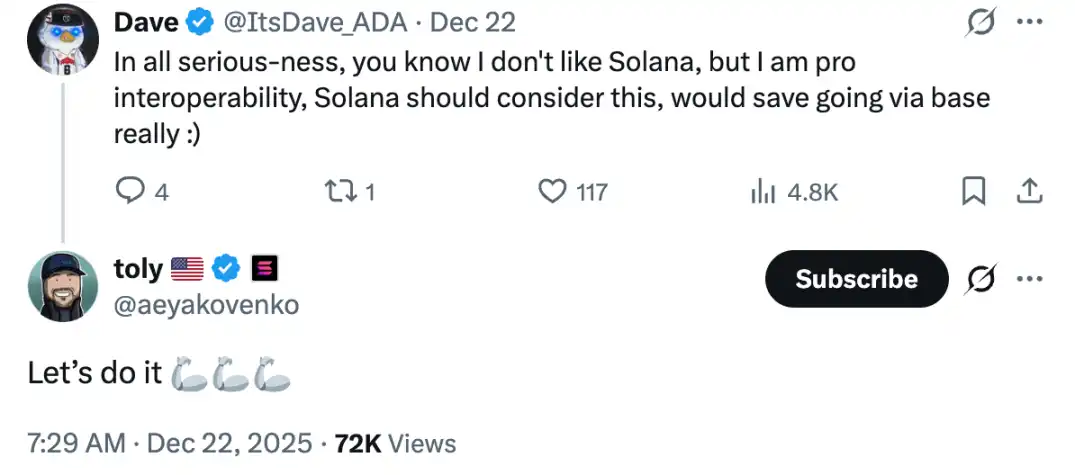
Last week, Cardano achieved atomic transactions between BTC and ADA through Fluid, not via cross-chain bridges, wrapped tokens, or centralized custody, but directly through script-to-script transactions, which is partly due to Cardano's own UTXO ledger model. Two days ago, interactions between Cardano's stake pool operators and Solana co-founders on X also confirmed this development direction.

Accompanying the strategic and product plans is the financial investment. The Cardano Foundation plans to increase its marketing budget by 12% and make appearances at events like TOKEN2049 and Consensus. The Venture Hub will also invest 2 million ADA to support startups and ecosystem projects. Furthermore, the Cardano Foundation plans to inject tens of millions of ADA into on-chain DeFi to enhance liquidity and attract institutional participation.

It seems that driving the price of NIGHT up may just be an appetizer for Cardano's series of plans. By 2026, it might be worth paying attention to this project, which launched its mainnet in 2017 and has almost been forgotten by the mainstream Web3 market.

Original Link

免责声明:本文章仅代表作者个人观点,不代表本平台的立场和观点。本文章仅供信息分享,不构成对任何人的任何投资建议。用户与作者之间的任何争议,与本平台无关。如网页中刊载的文章或图片涉及侵权,请提供相关的权利证明和身份证明发送邮件到support@aicoin.com,本平台相关工作人员将会进行核查。

Share To
APP

X

Telegram

Facebook

Reddit

CopyLink