Over 80% of new coins' TGE is at its peak; the root cause and remedy for the false prosperity of Web3 are here.

CN
1 hour ago

Original Author: Solus Group, Crypto Researcher

Original Translation by: CryptoLeo (@LeoAndCrypto)

Editor’s Note: Recently, analyst Ash stated in a popular post that among over 100 new tokens with TGE in 2025, 84.7% of the tokens had an FDV lower than their FDV at TGE. The median FDV of these tokens dropped by 71% compared to their issuance (the median market cap dropped by 67%). Only 15% of the tokens saw an increase in FDV compared to their TGE. Overall, most new tokens issued in 2025 peaked at their TGE price.

Following these data findings, I came across a more interesting article (from Solus Group) that also started from the project token TGE, analyzing the trends of 113 tokens post-TGE in 2025 and their financing situations, community activity, and the correlation with exchange listings. The research found that high financing, active communities, and exchange listings—criteria often used to evaluate project quality—had little impact on the price trends of project tokens. In the past, we often filtered good projects based on these conditions, but this project evaluation model has clearly “failed” in 2025. One particularly thought-provoking set of data is:

  • Projects with trading prices below IDO prices had an average revenue of $1.36 million.
  • Projects with trading prices above IDO issuance prices had an average revenue of $790,000.

However, these projects all received venture capital support, indicating to some extent that the market values speculation over actual performance, values stories over data, and values promises over the product itself. Web3 can no longer pretend that “everything is fine” and cannot continue to label bot traffic as “growth.” Of course, the conclusions drawn in this article are purely statistical and may not apply to all projects. Good projects and large financing can still represent the development direction of the crypto industry. Odaily Planet Daily compiles it as follows:

$2 million in financing, top venture capital participation, 500,000 community followers, listed on major exchanges, a spectacular launch day, and a lively atmosphere on Discord, with celebrations all over social media.

In a previous article, we revealed the true situation of a 0.96x ROI: by 2025, on average, each token actually died on the first day. We proved that the system is no longer effective. Now, we have analyzed 113 token issuance cases since 2025, providing solid data to support this—while most founders are reluctant to face these data.

The findings are shocking: large financing is futile, massive communities are irrelevant, and every variable you optimize is statistically worthless.

But beneath the surface lies something even more distorted, which continues to trouble many founders:

Currently, the revenue situation of projects is a bearish signal; the trading price of profitable project tokens is lower than that of unprofitable project tokens. This dynamic is a matter of life and death. If we continue to punish the profitable and reward the speculators, the entire industry will not survive.

Odaily Planet Daily Note: Previously, Solus Group disclosed relevant data indicating that the average investment return rate for new project tokens from TGE in 2025 was 0.96, meaning their product release was in a loss state from day one.

Entrepreneurial Data Trap: The Financing Paradox, High Financing Does Not Equal Token Advantage

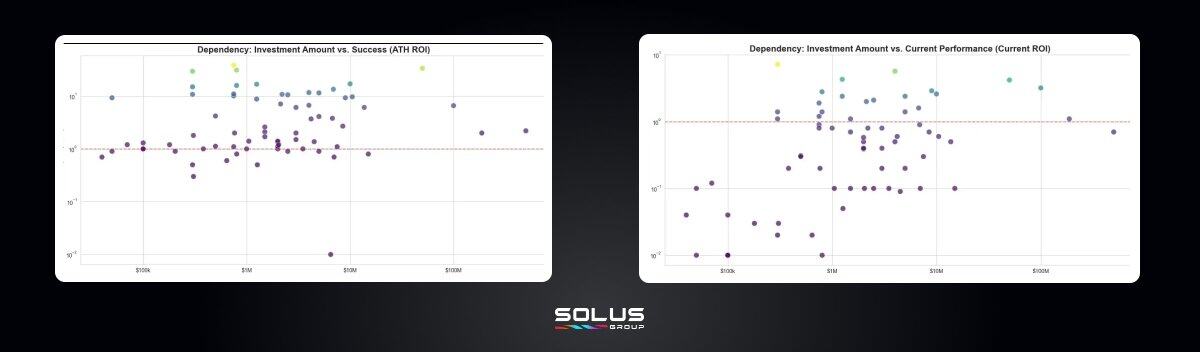
The correlation between financing and token performance: 0.04, which can be considered zero statistically.

Projects that raised $10 million perform exactly the same as those that raised $1 million. The above chart proves this—regardless of the amount of financing, the distribution of tokens within the ROI range is random. The best-performing projects include: Myshell, B² Network, Bubblemaps, Mind Network, Particle Network, Creator.Bid (valued at 10x to 30x at ATH) raised between $300,000 and $3 million. Meanwhile, projects like Boundless and Analog, which raised over $10 million, had valuation multiples of only about 1x.

Currently, token performance is even worse; regardless of the scale of financing, most token investment returns are below 1x. For example, tokens with financing between $5 million and $100 million have ROIs of 0.1x to 0.7x (e.g., Fleek, Pipe Network, Sahara AI), which are the same as those with little financing.

The fact is: large financing accelerates the death of project tokens.

Projects with the least funding ($300,000 to $5 million) have a higher ROI for every dollar raised; they execute faster, have lower switching costs, and are not drowned in quarterly venture capital token unlock schedules, where a large number of unlocked tokens can damage project revenues.

If you pursue $10 million in financing to “compete,” you are preparing for failure.

The Fan Myth: Large Project Communities Are Just “Paper Tigers”

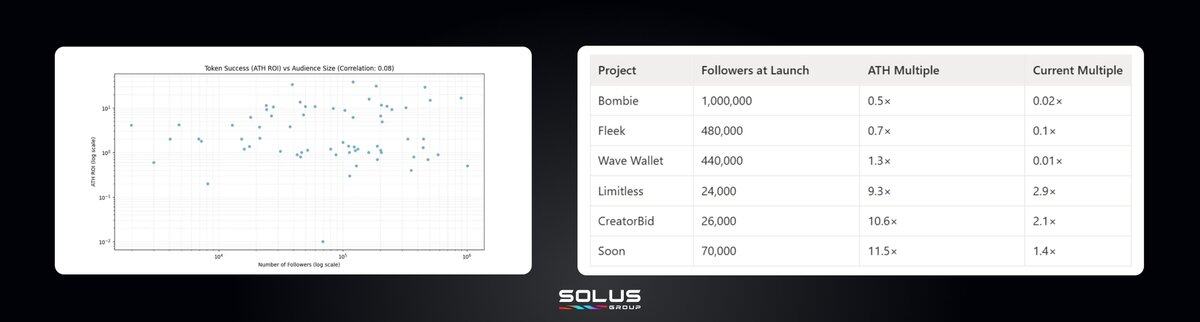
Social media with 500,000 followers and 50,000 followers show completely identical statistical results.

Correlation coefficient: 0.08 (token ATH) and -0.06 (current token situation)

Data shows that the size of the audience’s followers has no predictive value for token performance; projects with large follower bases perform inconsistently—some surge, some plummet, and projects with smaller audiences are the same, with no trends, no patterns, and no correlation.

Your Discord group is not a community; it is a speculative audience waiting to leave.

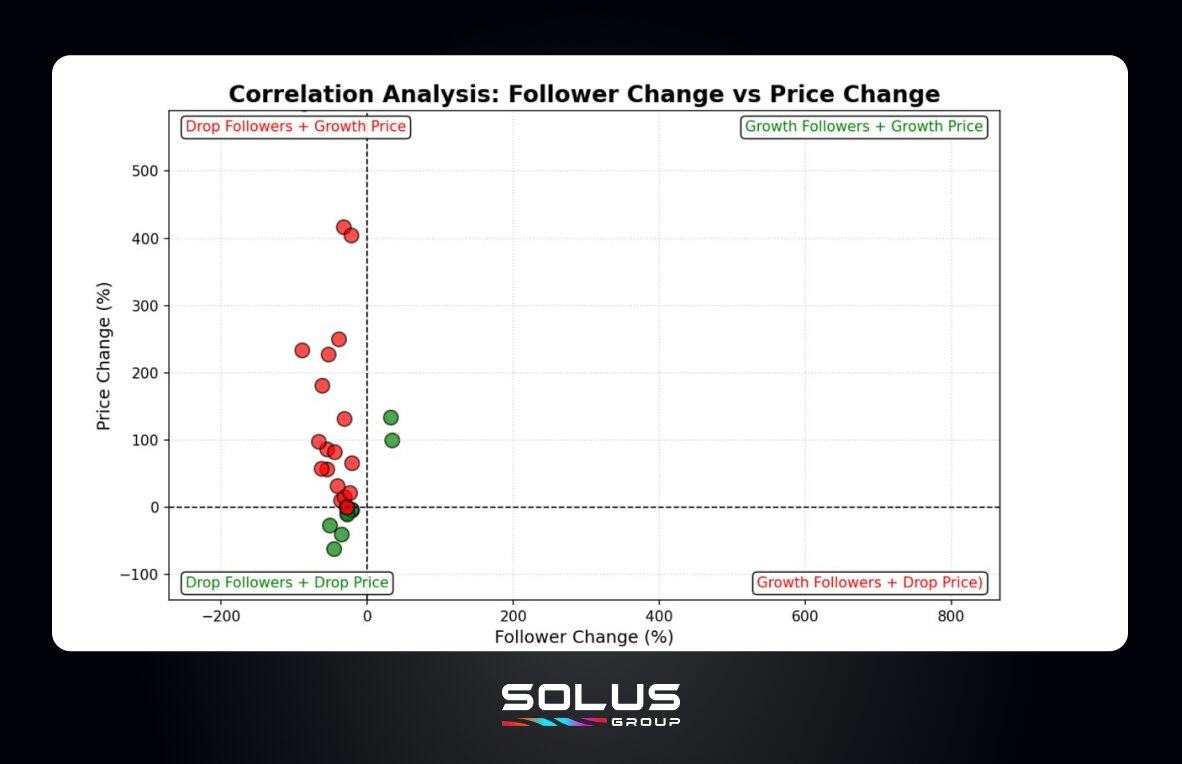
The reality is: price determines community development, not the community driving price.

When prices plummet, followers disappear. The chart proves this— the lower left quadrant (decreasing followers + price drop) is very dense. When prices soar, followers sometimes increase, but it is not stable.

This means:

Your “active community” has never truly cared about the product—they care about the token price trends. Once the token performs disappointingly, they will disappear; community growth is a lagging indicator, not a leading indicator.

This is not just theory, but a viewpoint publicly expressed by @belizardd (researcher and trader/KOL):

Most people come here purely for speculation, not for the product itself. We find that very few protocols perform well after TGE, and they are mainly those with lower initial token FDV, lower fundraising amounts, and generous airdrops. To be honest, I wouldn’t blindly follow and invest in anything right now. The risk/reward isn’t worth it; I’m just waiting for the market to improve.

Speculators know the game has failed. They are taking a wait-and-see approach. Meanwhile, founders continue to pour 60% of their budget into Discord bots, Twitter giveaways, and KOL promotions—burning money on statistically irrelevant metrics.

The real question is: “If the token drops 50% tomorrow, how many people will stay?”

The answer: almost none.

Token Price Trap, Beware of Overpricing/Underpricing

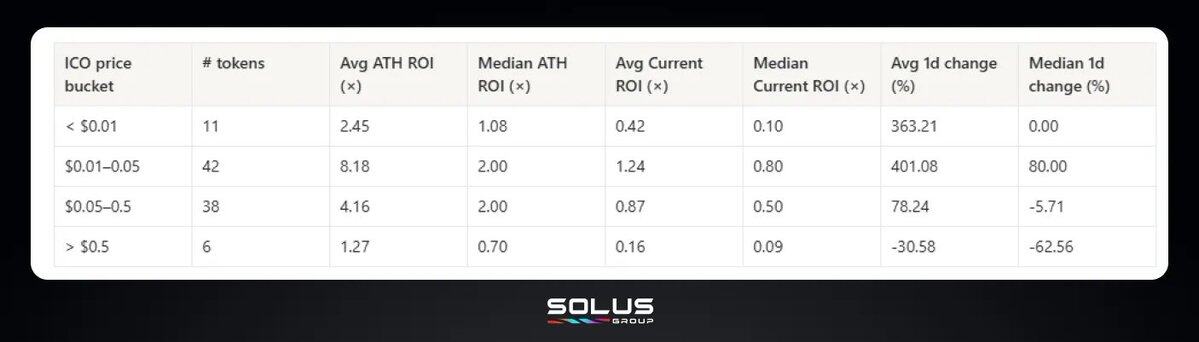
Median investment return rate calculated by token listing price:

Below $0.01: 0.1x (90% loss)

$0.01 to $0.05: 0.8x (survival zone)

$0.05 to $0.50: 0.5x (50% loss)

Above $0.50: 0.09x (91% loss)

To explain again:

A launch price below $0.01 does not make your token “easier to access”; it only makes you a low-priced coin that attracts profit-driven capital, which rises quickly and falls just as fast.

A price above $0.50 does not make your token a “premium token”; it only makes it appear overpriced, and a high token price will stifle the retail market, and whales will not buy in.

The price range of $0.01 to $0.05 is the only viable pricing range; this price is high enough to indicate the legitimacy of the project and low enough to leave room for growth. Within this price range, only 42 out of 97 projects had a median token performance that was positive.

If your token economic model sets your valuation at $0.003 or $1.20, then stop rebuilding the model; the data indicates that the project has already failed.

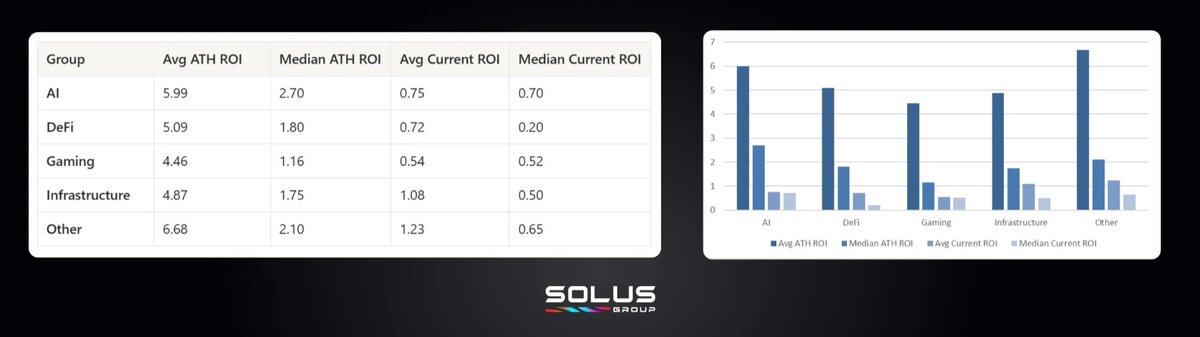
Industry Status: Stop Building Like It’s 2021

Losers: Gaming

Average ATH ROI: 4.46x (lowest)

Current median investment return rate: 0.52x

GameFi tokens are like lottery tickets; play once, and they are forever forgotten.

Trap: DeFi

Average ATH ROI: 5.09x (looks good)

Current median investment return rate: 0.2x (catastrophic)

DeFi's early price surges followed by sharp declines are greater than in any other sector, with the gap between speculation and reality being extremely harsh.

Winners: AI

Average ATH ROI: 5.99x (highest increase)

Current median investment return rate: 0.70x (best retention rate)

AI token prices have surged and remained stable. This trend is persistent, and funds are flowing in as a result.

If you are developing GameFi, your execution needs to be ten times better than average to achieve mediocre results. If you are in the DeFi space, be prepared for rapid rises and sharp declines. If you are in the AI sector, the market will give you opportunities, but only if you can deliver results. The requirements in the infrastructure sector are even more stringent: compared to standard decentralized applications (like AI agents), you will consume more time and resources, yet your current median ROI is slightly lower than the declining GameFi sector.

Data does not care about the projects you are interested in.

IDO/IEO Data Overview: Good Platforms Cannot Save Projects

You spend months building connections just to secure a spot on Binance Launchpad or a primary IDO allocation, thinking that being filtered through a platform means you are protected. The data shows otherwise.

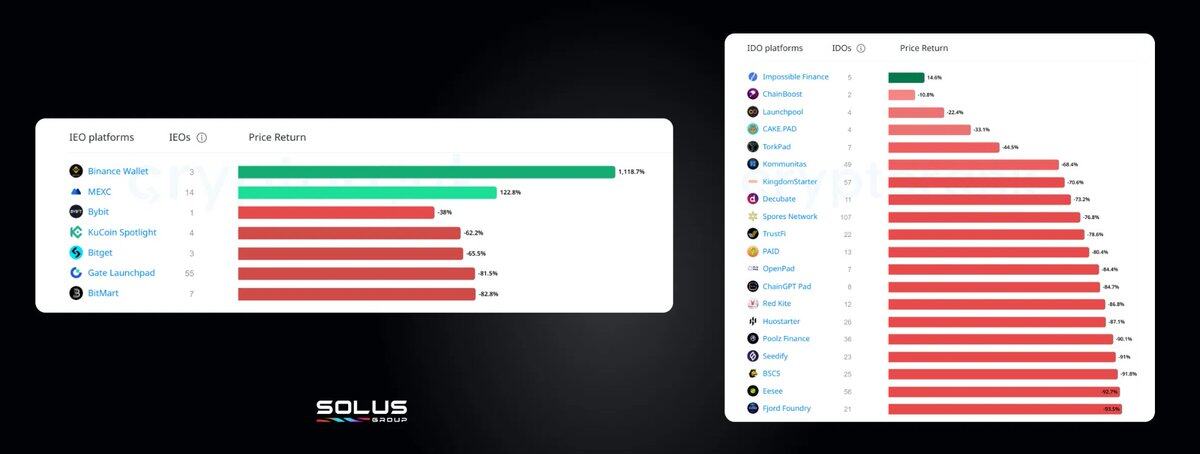
IDO Platforms: Almost all projects are in a loss state

Only one project among the five IDO platforms had a return rate of +14.6%, and that’s it. All other projects had return rates between -70% and -93%.

The so-called “premium Launchpad” does not provide protection for buyers; it merely offers them a way to lose money.

IEO Platforms: The Ultimate Manifestation of Survival Bias

Binance Wallet shows a yield of 11 times. It seems incredible, but it only had three issuances, and the sample size is too small. MEXC shows a yield of +122.8% over 14 issuances—larger sample size, but still an outlier. All other projects? Poor performance. Bybit IEO tokens have a loss rate of 38%, with other projects suffering even more.

This proves that:

Choosing a platform is like a lottery with a better brand effect. The victories of a few outlier data points distort the average, while a large number of tokens drop after issuance; the “curation service” fees you pay—whether through connections, listing fees, or token allocations—do not reliably protect token ROI.

Platforms cannot save garbage tokens, nor can they help good tokens.

Reflecting on 2025, Looking Ahead to 2026

The project developments based on 2025 have failed at every level.

Zero Level: Foundation

Issue: “Speculative token economics.” Recklessly dumping tokens into a liquidity-starved market without an organic revenue model to absorb shocks.

First Level: Financing

Issue: “Modify on PDF first, then deal with it.”

Second Level: Marketing

Issue: KOL model, paid shills’ users disappear once payments stop.

Third Level: Liquidity

Issue: Assuming liquidity will increase with speculation, but in reality, institutional investors will wait for evidence.

Fourth Level: User Retention

Issue: Zero retention infrastructure. The “project community” consists of 10,000 Telegram users who will abandon you within 90 days.

In 2026, we should no longer play the old game. There is a deeper issue behind all this; infrastructure is indeed important, but even with perfect infrastructure, timing determines everything. As Ivan Paskar (Growth Director at Altius Labs) said:

Tokens cannot fix broken things—they amplify reality. Right timing = momentum increases. Wrong timing = years of effort vanish in an instant. Most teams do not fail in token design; they fail because they misjudge the stage they are in and the macro environment. Timing is not a detail; it determines everything.

What Projects Should Do in 2026

Survival is not about following the old script; it’s about building a new one.

  1. Thoughtful Design

Target amount between $300,000 and $5 million; the projects with the highest ROI per dollar invested are here. More funding = more problems.

  1. Survival Cost

Issuance price between $0.01 and $0.05. Other prices struggle to survive. If your token economics do not fit this range, then there is a problem.

  1. Product First, Token Second

If you cannot explain in one sentence why your token exists, then it does not exist. Revenue should precede speculation.

  1. Ignore Vanity Metrics

Follower count is a distraction; wallet activity, retention rate, and revenue per user are the key metrics.

  1. Industry Realism

Understand the failure rate in your industry before writing code. GameFi requires double the execution efficiency to break even. AI has a tailwind—if you can deliver results.

  1. Integrate or Perish

The era of mergers and acquisitions is coming. If you cannot expand independently, seek an acquirer. Acquisition is not failure; it is a wise move.

These six principles are crucial. But the fact is: the standard script is outdated, and there is no longer a one-size-fits-all model.

免责声明:本文章仅代表作者个人观点,不代表本平台的立场和观点。本文章仅供信息分享,不构成对任何人的任何投资建议。用户与作者之间的任何争议,与本平台无关。如网页中刊载的文章或图片涉及侵权,请提供相关的权利证明和身份证明发送邮件到support@aicoin.com,本平台相关工作人员将会进行核查。

Share To
APP

X

Telegram

Facebook

Reddit

CopyLink