EU Issues $105B Loan to Ukraine, Leaves Russian Assets Untouched

CN
2 hours ago

Europe has agreed to support Ukraine without taking control of the Russian assets, a course of action that would have been troubling for the world’s economic system, according to economic analysts.

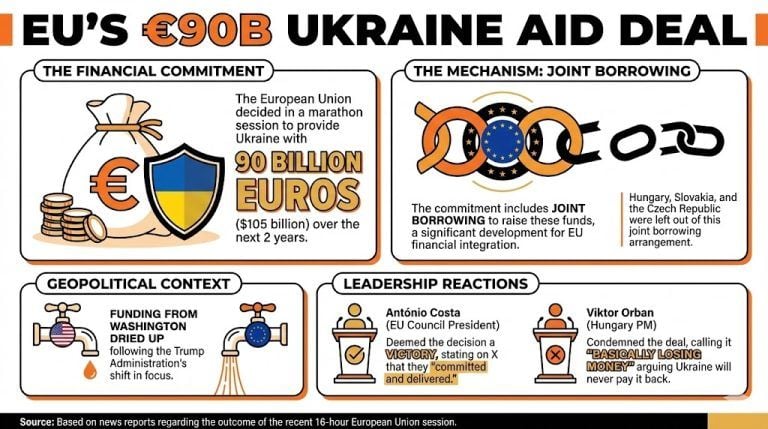
In a marathon 16-hour session, the European Union decided to provide Ukraine with 90 billion euros ($105 billion) during the next 2 years to support its defense in the ongoing conflict against Russia. The commitment includes joint borrowing for these funds, leaving out Hungary, Slovakia, and the Czech Republic.

The decision was deemed a victory by European Council President António Costa, who stated on X that they committed and delivered. Nonetheless, the European Union was forced to intervene as funding from Washington dried up after the Trump Administration began focusing on ending the conflict through alternative means.

Viktor Orban, Hungary’s Prime Minister, condemned the deal, explaining that it was a bad move. “It looks like a loan, but the Ukrainians will never be able to pay it back. It is basically losing money,” he stressed.

Read more: Analysts Warn: EU Reparations Loan Could Upend Global Economic Landscape

While it was finally dropped, the European Union had presented a plan to leverage frozen Russian assets, valued at over 210 billion euros, to fund such a loan. The proposal faced strong opposition, mainly from Belgium, home to Euroclear, the clearinghouse that holds most of these assets.

Belgium resisted this outcome, as it would leave it vulnerable to legal actions from the Russian government, facing potential liabilities. Ultimately, Belgium refused to commit to such a deal.

President Putin referred to the plan as “robbery” in his year-end presser. “Theft is not an appropriate term. Theft is the covert taking of property. What they are trying to do here is out in the open — this is robbery,” he stressed.

While the risks of taking over Russian assets have been averted for now, these remain frozen until further notice and can still be leveraged in future negotiations. So, the risk for destabilization of the financial system, as experts have pointed out before, remains.

  • What financial commitment has the European Union made to Ukraine?
    The EU has agreed to provide 90 billion euros ($105 billion) over the next two years to support Ukraine in its defense against Russia.
  • Which countries are excluded from the EU’s joint borrowing plan?
    Hungary, Slovakia, and the Czech Republic are excluded from participating in the joint borrowing arrangement for Ukraine’s support.
  • Why was there opposition to using frozen Russian assets for funding?
    Belgium opposed using frozen Russian assets, valued at over 210 billion euros, fearing potential legal liabilities from the Russian government.
  • What are the potential implications of the EU’s decision on global finance?
    While the risk of taking control of Russian assets is currently avoided, experts warn that the ongoing freeze could still destabilize the financial system in future negotiations.

免责声明:本文章仅代表作者个人观点,不代表本平台的立场和观点。本文章仅供信息分享,不构成对任何人的任何投资建议。用户与作者之间的任何争议,与本平台无关。如网页中刊载的文章或图片涉及侵权,请提供相关的权利证明和身份证明发送邮件到support@aicoin.com,本平台相关工作人员将会进行核查。

Share To
APP

X

Telegram

Facebook

Reddit

CopyLink