Original Title: "Dialogue with 00s Fintech Entrepreneur Christian: Desiring Iteration Speed and Honesty, Financial Perspective is More Important than Choice, 'Young People Should Have a Sense of Awe'"
Original Author: Kaori, Dongcha Beating
How has your 2025 been? As the founder of Infini, 00s Christian candidly expressed a desire for it to pass quickly. For a Fintech startup that has only been established for a year, whether it has experienced a trust crisis due to a theft or the necessity of transforming by dismantling old answers, these are not mere setbacks that can be lightly brushed aside.
Rewind three years to 2022, Christian was still a typical crypto Degen, obsessed with NFTs, later diving into DeFi and memes, with emotions fluctuating alongside market trends, relying on intuition and gut feelings for judgment. It was an era where daring to jump in was enough; narratives outpaced risk control, and growth masked many details. But when he truly began to take action—from products, asset management to payment links—the feedback from the industry changed. The harsh reality that a single incident could wipe out trust made Christian realize that the most expensive thing in finance is not efficiency, but trust.
The financial enlightenment of Christian's generation has almost been fed by products: from QR code payments to password-free deductions, from one-click installment plans to tap-to-pay, the golden age of Fintech has lowered financial barriers and made smoothness the default. However, when they began to start their own businesses, the industry had changed its climate. Many entrepreneurs from the previous generation grew large on dividends and then filled in the gaps, while this generation often learns as they go.
Thus, this dialogue discusses not just the path of a product or a company, but a portrait of entrepreneurs that is more relevant to the present: in an era where fees are getting thinner, channels are becoming more selective, and compliance increasingly resembles a time cost, what truly pushes the business forward is a long-term deliverable experience.
Finance is not just a game for the "old-timers"; new markets need to retain the ambitions of young people while learning to become tougher at the most fragile points. 2025 will undoubtedly be remembered by Christian for a long time, as it marks the year when Infini and he truly entered the core of the financial business, where not only speed matters, but also the ability to endure slowness and pain.
Beating Highlights:
· Greater opportunities may not only lie in B2B cross-border settlements but in scenarios closer to where transactions occur. How to make it easier for the new generation of entrepreneurs to collect payments and manage funds, and how to target the global market from the outset of business, is the value that stablecoins are about to deliver.
· What is truly hard to replicate is a company's core. How you treat customers, how you serve them, especially whether you genuinely value their assets and are willing to respond 24/7 when they have issues. Nowadays, many product features are not that different; faster iterations, more meticulously crafted user experiences, and timely responses and patience are what truly matter.
· Good entrepreneurs must have the courage to let go. Even if the business is doing well at the moment, if it cannot lead us to our goals within the expected timeframe, the team should seek a direction that is more worthy of investment.
· Rather than just providing a seemingly better asset management product, it is more important to help users truly understand risks. Do not place trust in any single asset or institution; at the very least, maintain independent judgment.
· What truly makes a product and team stand out often lies in the details: every detail of the product, every piece of copy, every design element, and the implementation behind each function will ultimately determine what the product becomes.
· The more layers and politics a startup has, the more it will drag down efficiency and delivery. Everyone makes mistakes, including myself, and I am willing to admit it. But more importantly, we must dare to speak up when we see problems; do not remain silent out of concern, as it ultimately affects the entire team's goals.
The following is the full content of the interview:
"Young People Should Have a Sense of Awe"
Dongcha: You previously said you had a smooth journey, but when your crisis hit in the form of $50 million, what was your first reaction?
Christian: My first reaction was definitely shock; my mind went blank, wondering how something like this could happen to me. Not long ago, I had seen similar incidents and we had paid special attention to them, but I never expected it would happen to us next.
But soon I realized there were only two possible outcomes: either solve the problem and push through with the team, or fail to handle it, which for most people would essentially mean game over.
As everyone has seen, we managed to pull through, and even after March and April, growth became smoother. That was my most genuine reaction at the time; I didn’t think too much, just felt it was what I should do.
Dongcha: After going through this, what is the biggest change in your mindset that you didn’t have before?
Christian: I think the biggest gain is "awe." Many young people do not understand awe, especially when things are going smoothly, making it easier to become complacent. Cases like SBF essentially stem from a lack of respect and awe for the industry, the market, and the users.
After this incident, I became more certain of two points. First, I am not omnipotent and will definitely make mistakes. The goal of risk control is not to never make mistakes but to minimize losses when errors occur, preventing a single mistake from becoming a fatal blow.
Second, many problems ultimately come down to people. Whether intentionally or unintentionally, someone has not done their job well. So after the incident, we invested a lot of energy in rebuilding and strengthening our hiring, screening standards, and team mechanisms.
I am actually very grateful for this experience; if it hadn’t happened, the state and capability of Infini’s team might not be as good as they are now. It forced me to continuously iterate and align standards, and made me realize that people whose values and rhythms do not match find it hard to walk together in the long term. Initially, I was certainly very frustrated, but now I feel more of a continuous gratitude. Things will ultimately be resolved; the key is how you resolve them and whether your reputation and trust can be maintained in the long run.
Dongcha: "The general public does not necessarily need financial products, but rather a financial perspective." Why do you have such an insight?
Christian: This year we experienced black swan events in the industry; whether in crypto or traditional finance, there are no products that will never have issues. The so-called better people are just those who understand risk control better and are more responsible, able to do things in a more long-term manner.
But if someone puts all their wealth at stake due to trust, even if the probability of an incident is only one in ten thousand, once it happens, it is unbearable for them.
So I increasingly feel that helping everyone establish a correct financial perspective is more important. Rather than just providing a seemingly better asset management product, it is better to help users truly understand risks and not place trust in any single asset or institution; at the very least, maintain independent judgment.
It is precisely because of these reflections that we are adjusting our direction, moving from initially only doing asset management to now wanting to focus on payments and collections first. I increasingly believe that the two must ultimately be combined; you must first solve "how to make money, how to collect money" before discussing accumulating capital and managing and preserving it. This is my biggest realization of the year.
Fearless of First-Mover Advantage, Infini's Underlying Ambition
Dongcha: Infini made a significant pivot, retreating from the to C business and shifting focus. How did you make this judgment? Where did the determination to change come from?
Christian: During the time we were doing ToC, our team was relatively young and lacked relevant experience, and we stumbled into many pitfalls. Some pitfalls you wouldn’t know unless you personally experienced them, and no one would proactively tell you. For many, this lack of transparency is actually key to their making money and arbitraging. But I really dislike this system; I have always believed that the payment industry should be more transparent. Additionally, we were not yet in a very ready state overall, making it particularly difficult to operate.
At the same time, the business model was not clear enough. For example, we were hardly making money from the U card business because we wanted to minimize costs to allow more people to use it at a lower threshold, rather than just serving large clients.
But as the user base grew, problems arose. These users might not bring you revenue, yet you have to invest a lot of time and energy to handle various situations. During that time, the team was basically pushed along by problems; everyone was tired and unhappy. Development was often firefighting, customer service had to work late to respond, and there were huge volumes of complaints, many of which we couldn’t resolve because the entire chain was too long and had too many links; any segment having issues made it hard to manage.

Because of this, we wanted to focus on blockchain-based solutions, where the underlying links are more certain and have fewer supply chain issues. As long as we do our part well, we can deliver more stable products and experiences.
Secondly, we realized that no matter how well we did on this path, it fundamentally did not create new value. It was more like regulatory arbitrage; it did provide convenience for some people who found it inconvenient to use traditional bank cards, but the underlying network did not change, and costs and efficiencies were not fundamentally improved. In fact, because the links were more complex, optimization costs were higher, ultimately passing the burden onto consumers.
Rather than continuing to grow in a field with limited differentiation that ultimately can only compete on price, I believe good entrepreneurs must have the courage to let go. Even if the business is doing well at the moment, if it cannot lead us to our goals within the expected timeframe, the team should seek a direction that is more worthy of investment. In contrast, I believe the path we are currently on is indeed worth long-term investment, and there are still many infrastructures and standards that need to be filled.
Dongcha: Infini has now expanded into the acquiring business, which is a direction that places great emphasis on channels and operations. How did you find your first batch of customers? What needs did you address?
Christian: Acquiring is certainly our core segment, but we will not stop at just acquiring. Our positioning is more like a financial OS, aiming to provide experiences and functions close to bank-level quality.
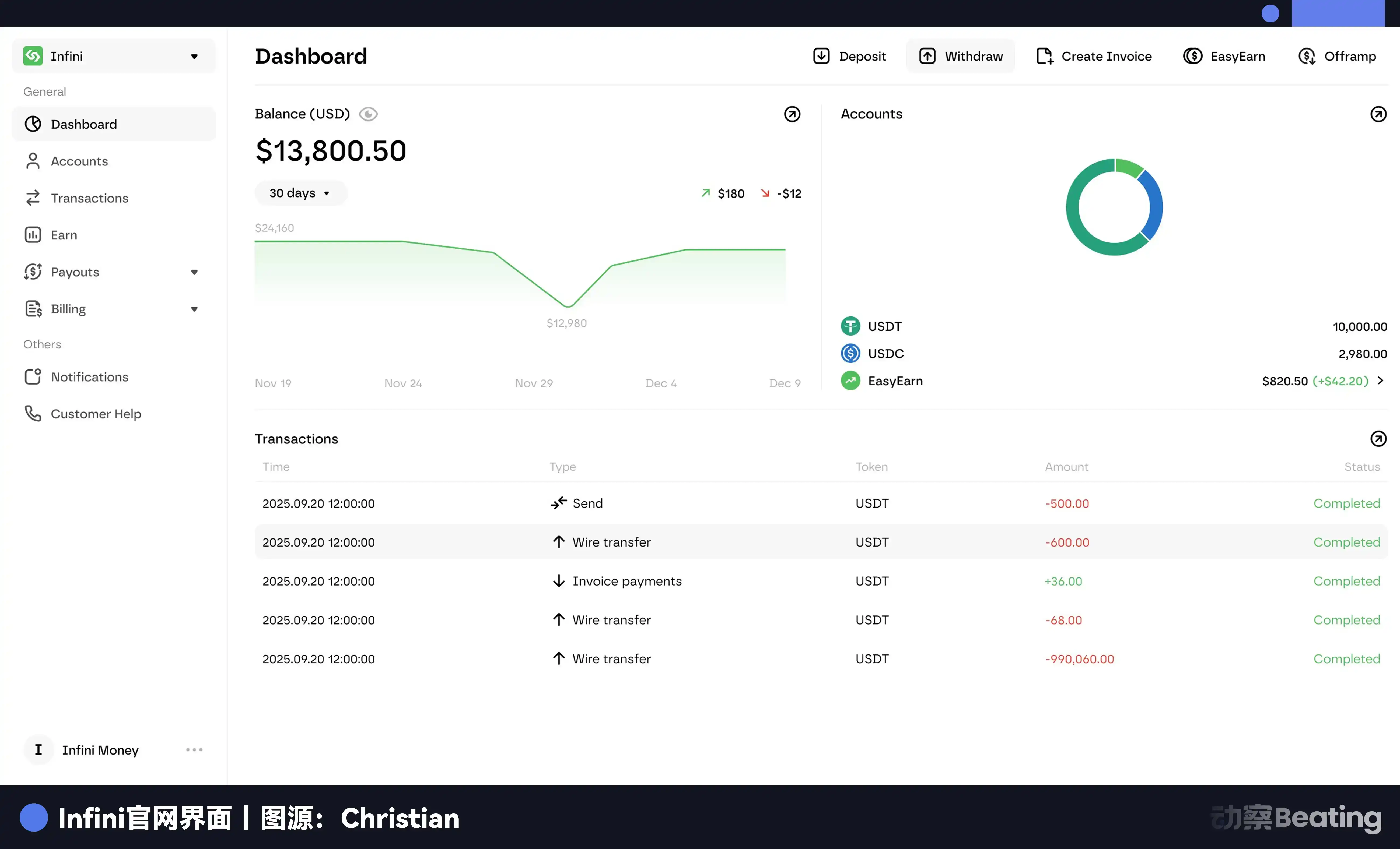
Specifically regarding acquiring, there are roughly two types of problems to solve. The first is to provide lighter payment accounts for overseas entrepreneurs and small teams. My judgment is that in the future, many people will create products and start collecting payments without necessarily needing a bank account first.
Especially in the AI era, the time from development to launch has been significantly compressed by various tools; you cannot still follow the traditional pace and go through bank processes. In the past, it might take a month to set up an account and connect, but with Infini, an account can be opened in ten minutes, and if all goes well, the connection can be completed in a day, allowing for payment collection to begin.
This is very practical for independent developers, super individuals, and small entrepreneurial teams. Among our current fewer than 20 seed merchants, the proportion of AI application developers is quite high, and there are indeed "one-person companies" using it; their most pressing need is to get payment collection up and running.
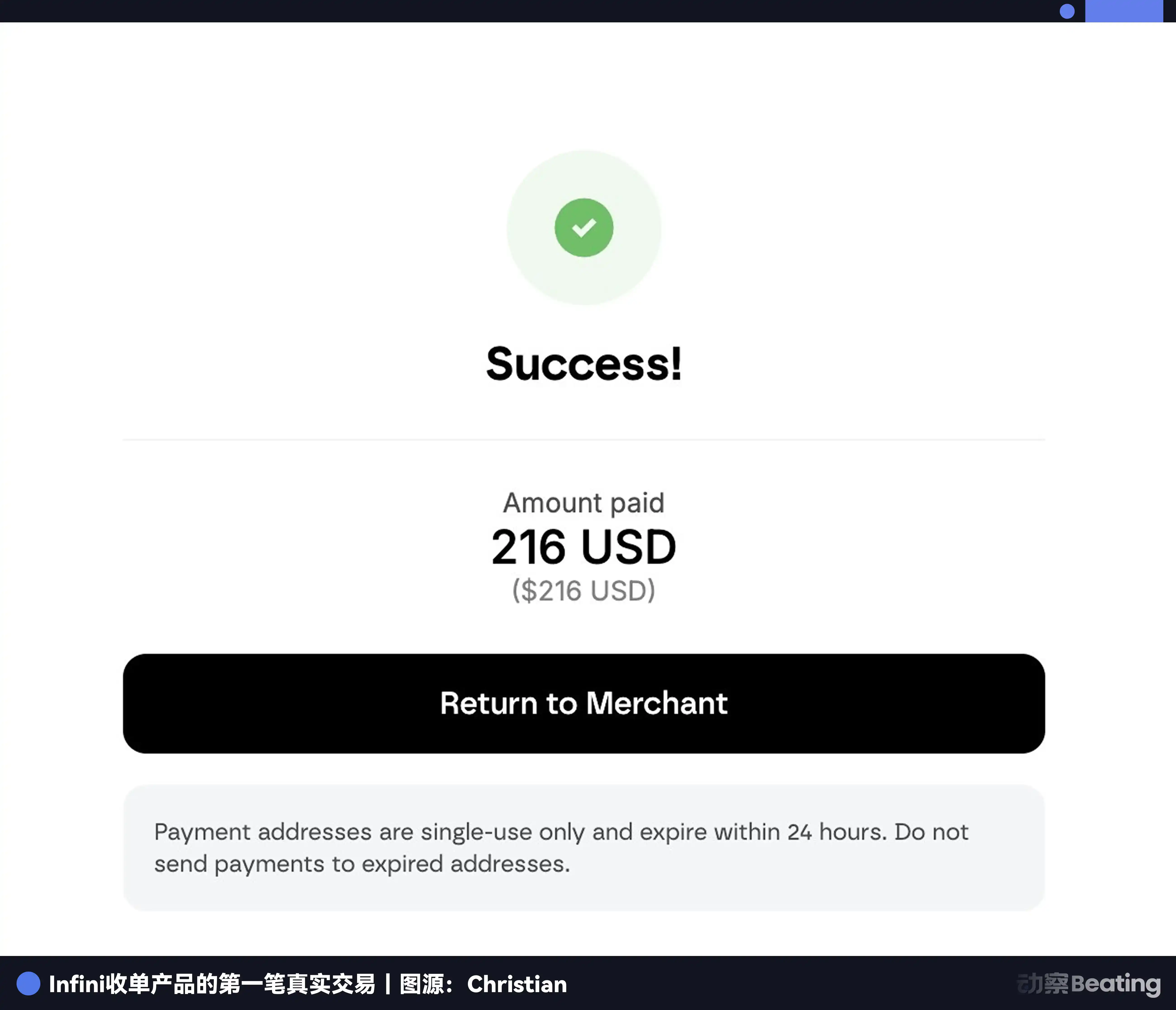
The second type is to enable merchants to connect to stablecoin payments earlier. Today, the vast majority of companies still rely on fiat currency systems for settlements, but I believe that in the future, the proportion of stablecoins in wallets will increase, especially in regions like Latin America.
When we were doing the U card, we observed that many users actually just wanted to pay for Netflix, Starlink, or shop on Amazon. So why do they have to first convert stablecoins into a card before spending? There is inevitably wear and tear in the process; if they could pay directly with stablecoins, the chain would be shorter and the experience better.
For merchants, having an additional method to accept stablecoin payments essentially means an additional source of income. It's like adding another wallet channel in traditional payments; the customer base covered can often increase slightly.
We have also seen some cases where stablecoin acceptance brings in new users, rather than just making the experience smoother for existing users. The scale is still small, but the earlier we integrate, as merchants grow and user habits improve, the share of this channel will also rise.
Dongcha: Mature Fintech companies like Revolut have accumulated over ten years, already possessing scale, data, and strong compliance capabilities. Even if they are not the first to implement new features, they can quickly replicate and distribute them to tens of millions of users. In contrast, Crypto Native enterprises often find themselves constrained by financing, licensing, and compliance. How do you compete against this first-mover advantage? In the Financial OS route you mentioned, what is Infini's core moat?
Christian: I think it can be viewed from two angles. First, the Fintech industry itself does not have strong network effects, unlike social products where the winner takes all. Many small Fintech companies can thrive because the core of customer choice is often trust.
Every era has its giants, and there are always challengers. However, today, this trend has been reinforced. Some large domestic companies can indeed quickly launch product features that attract attention and then use multiples or hundreds of times the resources to compete. This situation exists, and the probability is increasing. But I actually don’t focus on preventing copying. Ideas are inherently not valuable; features and interfaces can be replicated.
What is truly hard to replicate is a company's core: how you treat customers, how you serve them, especially whether you genuinely value their assets and are willing to respond 24/7 when they have issues. Nowadays, many product features are not that different; faster iterations, more meticulously crafted user experiences, and timely responses and patience are what truly matter.
The True Mission of Financial Products is Equality
Dongcha: Many opinions suggest that the innovations of the past twenty years have mostly remained at the distribution level, optimizing experiences while the underlying logic of capital flow remains traditional, leading to homogenization, thin profits, and competitive involution. As a new generation of Fintech entrepreneurs, what do you most want to improve?
Christian: I agree with this assessment. Looking at the timeline, many of the financial technology products we are familiar with were actually born in the last fifteen years or so. The first generation of successful unicorns indeed made a lot of innovations, but most of their innovations were still completed under the traditional banking and payment paradigms, essentially creating better products and experiences on old systems.
Within this traditional paradigm, there has been a long-standing issue that is difficult to truly resolve: the barrier to entry. Many financial technology products require users to first have a traditional bank account to use them. No matter how much innovation you do on top, you ultimately have to synchronize a lot of information and details back to the underlying bank; as long as you rely on bank licenses and systems, you cannot avoid these restrictions. The second issue is the cost of transfer networks, especially for cross-border transactions, where fees are high, small transfers are hard to establish, timeliness is unstable, and the mutual recognition and anti-money laundering processes between different countries are complex.
Dongcha: Where is your value capture in this chain?
Christian: For B2B companies, one of the biggest values in the future is enabling businesses to access and use financial services without relying on traditional bank accounts as a foundation. For independent developers, small teams, or small startups, this will bring a significant change in onboarding efficiency.
Our advantage as a new type of entrepreneur lies in the fact that, from an infrastructure and technology perspective, we can do a more global business today, especially covering emerging markets faster, allowing users to register and use services more freely and smoothly. Of course, in the long run, everyone will still move towards a more complete compliance and licensing layout, but the starting paths are different.
In terms of products, we are trying to build a new payment network based on stablecoins as much as possible. Traditional players are also moving in a similar direction, but most still revolve around card organizations like Visa and Mastercard for settlements. My judgment is that greater opportunities may not only lie in B2B cross-border settlements but in scenarios closer to where transactions occur. How to make it easier for the new generation of entrepreneurs to collect payments and manage funds, and how to target the global market from the outset of business, is the value that stablecoins are about to deliver.
Dongcha: The previous generation of Fintech entrepreneurs also tried "specialization" early on, targeting students, gig workers, and teenagers, but ultimately had to evolve into large, comprehensive super apps.
Christian: I think this is not just a Fintech logic but a path that all applications will eventually take. True growth often comes from a precise entry into a very small group's pain points. First, thoroughly address this pain point, then expand outward along the demand, discovering similar issues in adjacent groups, and continuously design and iterate, gradually pushing the boundaries.
Of course, as a company reaches a certain stage, there will be differentiation. Some founders are more satisfied with perfecting a very niche area; since they have solved this problem well enough, they are willing to hold their ground and deepen and specialize their services. Others may think further, hoping to serve more people and recognize more needs, while also pursuing larger scales, profits, and paths to capitalization from a business perspective.
Dongcha: If you had to describe your ideal Fintech product in one sentence, how would you describe it?
Christian: The product I envision, and what we hope to create in the future, is a form of equality: providing the capabilities of banks and financial services in a more indiscriminate and fair manner to everyone in need—especially to every aspiring entrepreneur. In my view, the true mission of financial products lies here.
Management Philosophy of the New Generation of Entrepreneurs
Dongcha: Some say that being older gives an advantage in finance. What do you think of this statement?
Christian: I think the phenomenon of "Fintech preferring older, more experienced founders" is more common in Asia, but there are also many very young and excellent entrepreneurs in Europe and the U.S.
The differences behind this are primarily environmental and ecological choices. I have asked many investors, and they indeed prefer to invest in slightly older, more experienced individuals, especially in Fintech, which is a highly regulated and risk-controlled industry. Many pitfalls are learned through time and experience, which gives them an advantage from this perspective.
However, I do not believe that age itself is a determining factor. We do not use absolute age to judge capability when hiring; being older does not mean lacking innovation, and being young does not mean one will necessarily do poorly. The key still lies in two things: whether you have encountered pitfalls and your understanding of risk and bottom-line control.
Since everyone will encounter pitfalls, another variable is the speed of growth and iteration. Young people may need to pay some tuition; I have paid quite a bit myself, but if they can progress quickly during the process and truly clarify compliance and risk control, they can also do very well.
Dongcha: You mentioned that there was a time you pretended to be an entrepreneur. Where was the pretense?
Christian: It’s a state of mind, especially for some older founders who have management backgrounds in large companies. After starting their own businesses, they easily continue their old habits, thinking that as long as they handle a few management tasks—finding money, recruiting people to build a team, and setting direction—they are fine. These are certainly responsibilities that a CEO must take on, as no one else can do them for you.
If you think that doing these three things well will naturally lead things to go as planned, I believe that is a false premise and one of the reasons many people stumble. What truly makes a product and team stand out often lies in the details: every detail of the product, every piece of copy, every design element, and the implementation behind each function will ultimately determine what the product becomes.
Team management is the same. It’s not that the team is not doing well, but if the founder can personally prototype and establish standards from the beginning, the execution of the team will be much smoother, and it will be easier to achieve consistent high quality overall.
Dongcha: During this time, you must have many insights into organizational management in the entrepreneurial process.
Christian: Besides what I mentioned earlier about not pretending to be an entrepreneur, it’s also important to lead by example. You need to be on the front lines with the team, at least willing to understand the issues. If you don’t understand, have no interest, and lack curiosity to figure things out, it’s hard for colleagues to truly treat it as something they need to take full responsibility for. You certainly cannot be proficient in everything, but your attitude is very important—showing everyone that you are continuously thinking and improving. Many times, morale is built this way.
Then, it is essential to find the right people. The most fatal mistake in hiring the wrong person is not their lack of ability, but that they will slow down the organization’s iteration speed. Some people are great but are just better suited for large companies; when they come to a startup, they may not fit in, struggle to adapt to the pace, and fail to deliver as expected. One of the most important qualities of a startup is the courage to make choices, letting unsuitable people go early while continuously seeking more suitable ones.
To assess whether a startup team is strong, it depends on whether the overall average quality is high enough. Ideally, everyone should be able to stand alone, maintaining high standards in delivery. In the future, with the enhancement of AI tools, team sizes will likely become more streamlined; it is unlikely that we will see expansions of hundreds or thousands of people again. But the smaller the team, the more each person's level must be aligned, because if anyone's attitude or ability falls behind, it could slow down the entire team's speed. Therefore, in addition to product development, continuously evaluating, timely adjusting, and constantly strengthening the team is itself very important.
Dongcha: How do you select what you consider suitable entrepreneurial partners?
Christian: I focus on three things that are more important than experience, background, or education. The first is iteration speed and curiosity, which is to say, learning ability. This is not necessarily related to age, especially since we are in a new field with almost no mature paradigms and no products to copy; learning and thinking ability is paramount. Additionally, if a person is not using AI or other productivity tools in their current workflow, I feel they lack the awareness to maximize efficiency.
The second is long-termism—whether they can work with the team to carry things forward. Many people in the crypto space are more accustomed to short-term monetization, which is reasonable, but we do not see ourselves as a purely Web3/Crypto company; we are more like a long-term internet product and platform.
We do not plan to issue tokens and pursue short-term monetization; often, we need to sacrifice short-term cash flow for long-term value. In this process, decision-making is frequent, and tolerance for error is low. If someone is only focused on making quick money, they naturally may not be suitable for us.
The third is absolute honesty. The more layers and politics a startup has, the more it will drag down efficiency and delivery. Everyone makes mistakes, including myself, and I am willing to admit it. But more importantly, we must dare to speak up when we see problems; do not remain silent out of concern, as it ultimately affects the entire team's goals.
Dongcha: Who do you admire most in your entrepreneurial journey?
Christian: The founder of Revolut, which is a company I greatly admire. They have absolute execution power and an extreme demand for team standards.
From the product perspective, what Revolut did in its early days wasn't groundbreaking innovation; features like card issuance and foreign exchange are actually the most fundamental aspects of traditional banks. What I truly admire is their drive and speed of advancement.
The common perception is that European companies are slow and inefficient, but Revolut has proven that Europe can also have the speed and intensity of domestic internet companies. Their strength lies in their ability to replicate basic functions of a product in a very short time, then continuously optimize it and ultimately outperform you. This capability is very strong, and I hope we can cultivate it as well.
But it's not just about speed; the premise is that every function must genuinely solve user problems and be done better than others. Revolut's iteration speed is, on one hand, due to fast development and implementation, and on the other hand, more importantly, they can very accurately capture user needs, ensuring that when a product is released, there are users ready to use it. I really appreciate this.
The second aspect is the founder's attitude towards team management. He has a famous saying: "get shit done," and I even use this phrase as a signature for our internal collaboration tools. It does not glorify the 996 work culture, nor does it rely on rules and regulations to pressure people; rather, it emphasizes mutual selection when building a team: those who come in must have a sense of responsibility. How is responsibility manifested? First is curiosity, and second is the desire to do things well and strive for excellence.
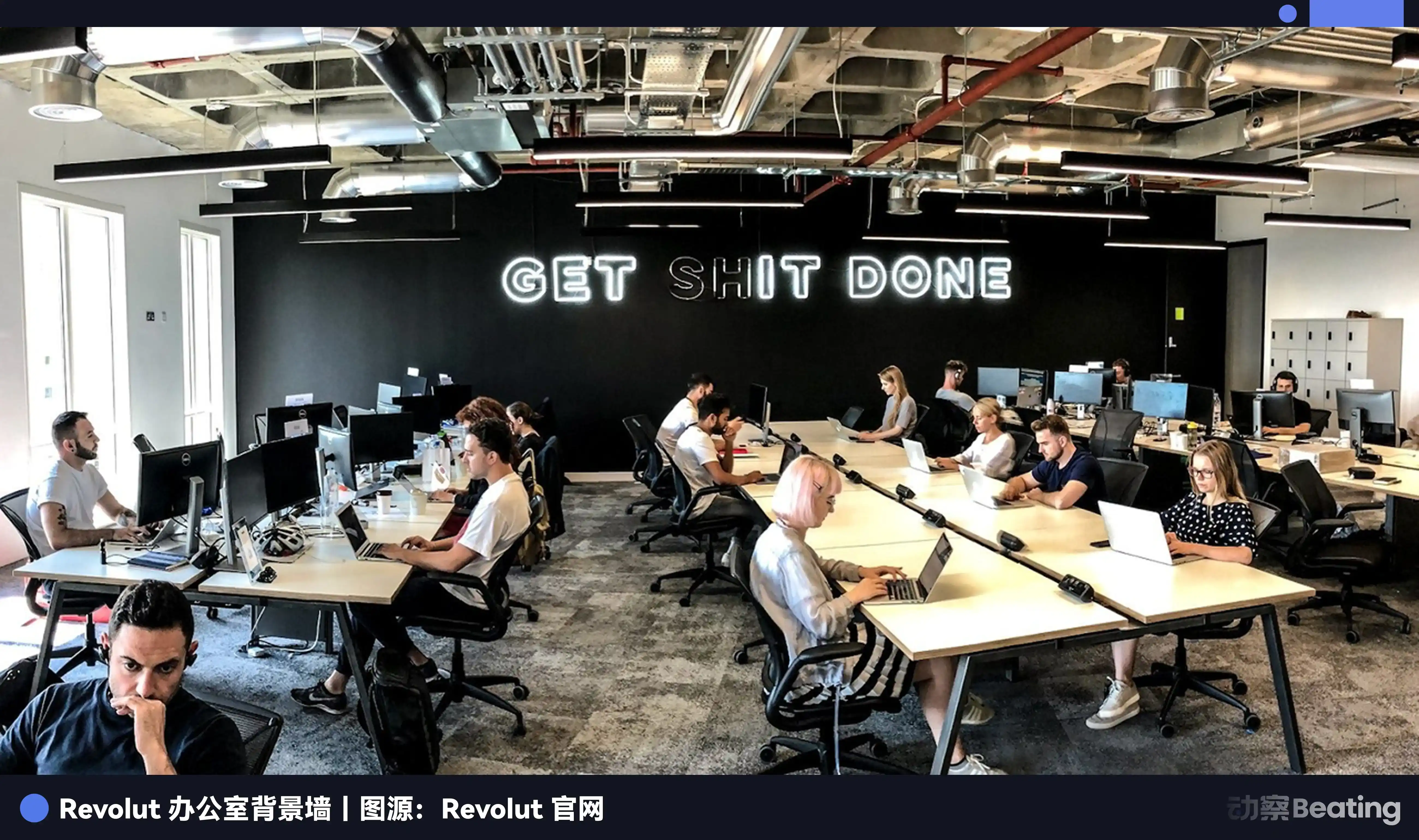
Behind this is actually a very rigorous management philosophy. He has very high demands on the team, and those who do not meet the standards will be let go. This almost ruthless standard, in turn, makes the overall combat effectiveness of the team very strong, the quality very high, and the progress very fast. This is what I aspire to, and I hope to align with it as much as possible. Of course, in the end, everyone will find their own unique management style.
Dongcha: What book has inspired you the most or that you liked the most this year?
Christian: After reading "Lychee of Chang'an," I realized I didn't know much about the Tang Dynasty, so I consecutively read three related books. As I read, I felt quite deeply that the most exciting parts of history often revolve around Li Shimin, and his experiences provide me with strong inspiration. The essence of conquering in ancient times is quite similar to entrepreneurship today; fundamentally, it requires someone to lead and bring a group of people together to accomplish something.
I particularly admire Li Shimin's broad-mindedness and vision, which is almost universally recognized among emperors. He was able to gather, trust, and even reuse former enemies and strong rivals after victory. Entrepreneurs should also have this kind of broad-mindedness because the best people are often unruly and hard to persuade. If you can get this group of people to willingly work with you, that is a rare and crucial ability.
Additionally, he seized power through a military coup, even turning against his own father. Perhaps because I study philosophy, I ponder what kind of circumstances would lead a person to make such choices that are viewed as treasonous within traditional moral frameworks. For me, this matter is not simply about good or bad, or a judgment of merits and faults. It provides a perspective that perhaps there are people who exist in a different moral state. Ultimately, how each person chooses in different situations is thought-provoking and worth contemplating over the long term.
Dongcha: 2025 may be a bit challenging for you; what would you write in your year-end summary?
Christian: I sincerely hope 2025 passes quickly (laughs). It's not that this year has been all about challenges, but it has indeed been quite difficult. However, looking back, I feel quite lucky to have experienced so much at this age; this has also been my fastest year of growth.
My year-end summary really revolves around one thing: what areas could I have done better if I could do them over again? What lessons should I learn? Of course, more often, I am thinking about what to do next. Another fortunate aspect is that during this process, I discovered that many people around me have been there, with colleagues, friends, and family accompanying me through this difficult time.
At the same time, this year has made me more clearly see who are the people that can help you solve problems during tough times. I will be more willing to trust them and feel that they are worth working with long-term and continuing to move forward together.
免责声明:本文章仅代表作者个人观点,不代表本平台的立场和观点。本文章仅供信息分享,不构成对任何人的任何投资建议。用户与作者之间的任何争议,与本平台无关。如网页中刊载的文章或图片涉及侵权,请提供相关的权利证明和身份证明发送邮件到support@aicoin.com,本平台相关工作人员将会进行核查。


