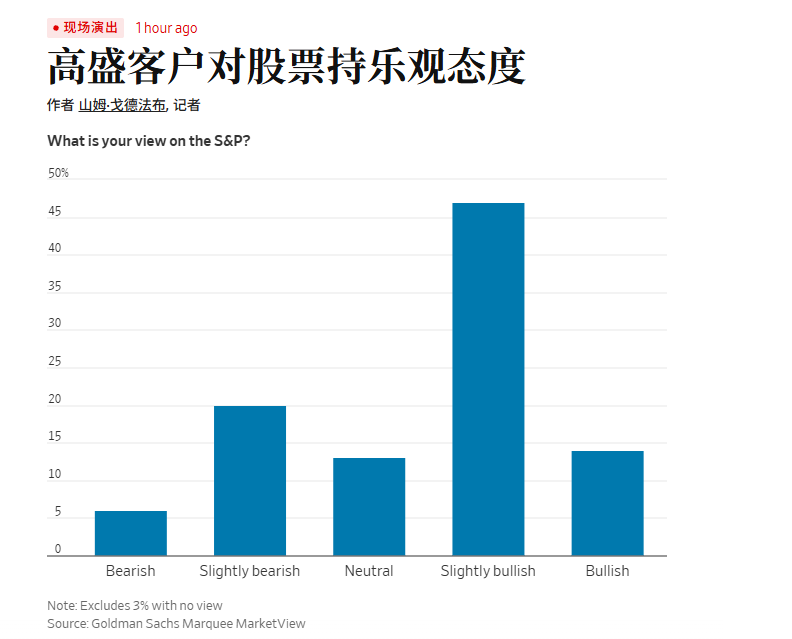
Goldman Sachs' Survey on 2026 from Some Investors and My Personal Interpretation
According to a recent client survey by Goldman Sachs, investors are generally optimistic about the stock market as they approach 2026. 47% of respondents expressed a slightly positive outlook on the S&P 500 index, while 14% were completely optimistic.
This optimistic sentiment also extends to the U.S. economy. 85% of respondents expect real GDP growth to reach between 1.5% and 3.5% next year. Sentiment towards corporate bonds is more cautious, as most expect credit spreads to widen.
Respondents generally anticipate a decline in Treasury yields and hold mixed views on investments in artificial intelligence.
My Interpretation:
On the positive side, 61% of respondents believe that the S&P 500 will at least show an upward trend in 2026, which essentially denies the possibility of a recession that investors might expect in 2026. However, it is evident that nearly half of the respondents do not foresee a significant increase in 2026, likely considering that the Federal Reserve's monetary policy will not fully shift to easing.
There are also 25% of respondents who are completely bearish, which is a considerable number. When combined with nearly 15% of respondents who believe in maintaining a neutral stance, it can be said that almost 40% of users are not very optimistic about the market in 2026. This indicates an important point: the market consensus suggests that 2026 may not be a "new bull market," but rather a year that "avoids recession."
In simpler terms, the core judgment of most institutions is that the U.S. economy is unlikely to experience a deep recession in 2026. However, in the context of the tail end of a high-interest-rate cycle and limited fiscal and monetary policy space, the upward potential for the index may be limited.
This is why the mainstream bullish attitude is concentrated on "Slightly bullish" rather than "Bullish." It is important to note that Goldman Sachs' survey targets its own clients, not a complete retail investor survey, and can even be said to represent the views of some institutions. Institutions are willing to take a long position but are not willing to commit to aggressive positions.
Overall, this survey reflects that 2026 may not be exceptionally good, but institutions have gradually ruled out the worst-case scenarios for 2026. If we consider the mid-term elections in 2026, it is possible that there could be a market rally towards the end of 2026.
This also means that the main contradiction in the market going forward is likely not whether the economy will face problems, but rather whether the Federal Reserve's monetary policy will bring about better liquidity. If the environment remains constrained in terms of liquidity, how high can risk assets provide returns?
To put it more simply, the market essentially denies the possibility of a recession in 2026, but it also does not expect a new cycle of strong growth.
If we relate this to Bitcoin, it means that under the premise of liquidity not significantly improving, $BTC is more likely to maintain a high-range fluctuation, occasionally driven by risk appetite or changes in liquidity, but to sustain a breakthrough and establish new highs, a clearer shift in monetary policy will still be needed as support.
Bitget VIP, lower fees, better benefits

免责声明:本文章仅代表作者个人观点,不代表本平台的立场和观点。本文章仅供信息分享,不构成对任何人的任何投资建议。用户与作者之间的任何争议,与本平台无关。如网页中刊载的文章或图片涉及侵权,请提供相关的权利证明和身份证明发送邮件到support@aicoin.com,本平台相关工作人员将会进行核查。