After making a profit of 580,000 USD, I once again heavily invested 1,000,000 USD to short ETH.

CN
11 hours ago

"Shorting ETH is a simple and effective strategy."

Compiled & Edited by: Deep Tide TechFlow

Podcast Source: Taiki Maeda

Original Title: Why I’m Shorting $1M of ETH (Again)

Broadcast Date: December 18, 2025

Key Summary

Taiki returns to the market, shorting $1 million worth of ETH. In this video, Taiki reviews the bearish arguments regarding ETH from the past few months and explains why he decided to re-enter the short market.

Highlights

  • We should welcome bear markets because they present opportunities to make money; true wealth is accumulated when buying at lows.

  • When Tom Lee invests heavily in ETH, you can choose to sell your assets; and when they might stop buying, you can start shorting.

  • Whenever ETH's price rises, OGs tend to sell off, making ETH more of a primary exit liquidity tool rather than an asset suitable for long-term holding.

  • I believe the actual fair value of ETH could be between $1,200 and $2,200.

  • The cryptocurrency market currently lacks new marginal buyers, the bubble has burst, and the market is in a phase of instability after the excitement.

  • Some investors do not really want to hold ETH long-term; they just hope to make quick profits.

  • The crypto market currently exhibits a PvP (player versus player) competitive state, lacking clear advantages.

  • Tom Lee's operational strategy is not only to drive up ETH's price but also to maximize personal and corporate interests.

  • Once funds run out or market demand weakens, ETH's price could drop rapidly.

  • Tom Lee aims to increase ETH's market share to 4% or 5% within six months.

  • January 15, 2026, is not only the date for the Bitmine board to decide on bonuses but also the deadline for MSTR potentially facing delisting. If MSTR is delisted, it will trigger billions of dollars in capital outflow, creating significant selling pressure on the market.

  • I once fancied that ETH's price would rise to $10,000 and held on, only to see it drop from $4,000 to $900.

  • My analysis of the market is more based on the fundamentals of numbers and capital flows rather than simply drawing charts or lines to predict price trends.

  • Almost no one is actually using ETH.

  • The maturity of the cryptocurrency market lies in understanding: technically, it may be excellent, but that does not mean it is a good investment.

  • The current market phase can be summarized as: DATs have driven up prices, and people are gradually realizing that this frenzy may have gone too far, and the actual value of ETH could be much lower. This is exactly the direction of my current bet.

  • Shorting ETH is a simple and effective strategy.

Shorting $1 Million Worth of ETH

  • Over the past two months, I have made over $500,000 by shorting ETH and altcoins at market highs. In this video, I will explain why I decided to short $1 million worth of ETH again, as I believe ETH's price will decline further.

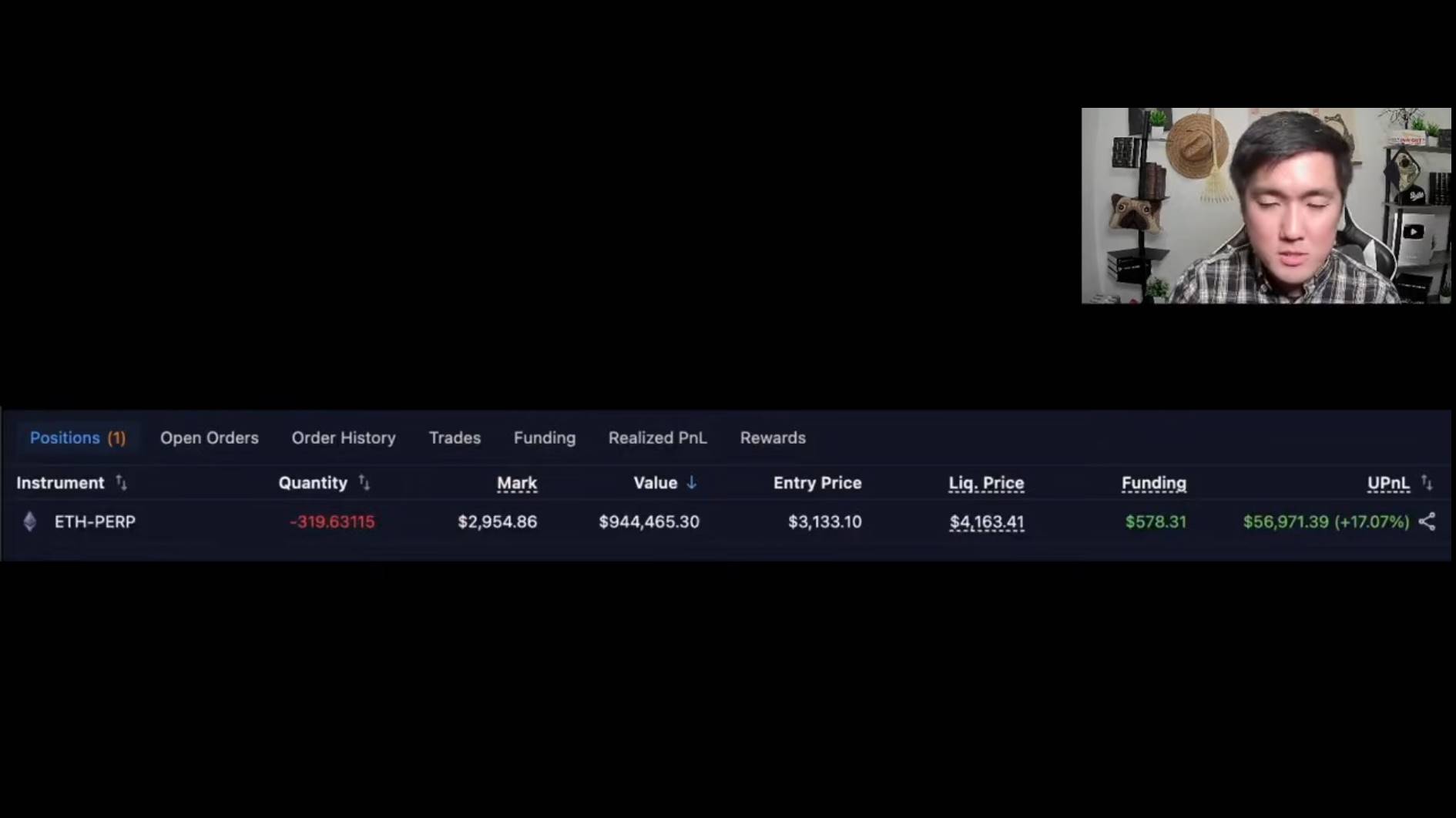
  • I have maintained a very pessimistic view of the market over the past two months. I expressed my views by shorting ETH and altcoins and have returned to trading. About ten days ago, I re-established my ETH short position. A few weeks ago, when ETH's price dropped to around $2,650, I had closed my position, but after a price rebound, I shorted again.

  • Since I posted that tweet, I have increased my position. Currently, my average entry price is $3,133, with a total value of about $1 million, and an unrealized profit and loss of about $56,000.

Reviewing the Bearish Arguments for ETH

  • Now let's review my summary of the bearish arguments for ETH. The first part of my shorting ETH is based on the understanding that MSTR and Michael Saylor have run out of funds, making the likelihood of a rise in the fourth quarter very low, especially after the liquidation event on October 10. Therefore, shorting ETH above $4,000 is reasonable; it's a fairly simple trade.

    • MSTR's net asset value (MNAV) has been continuously shrinking, reminiscent of the previous cycle near the market top. If Saylor cannot buy, we lose one of the largest marginal buyers of Bitcoin, which is not a good thing. The question I pose to the audience is: What happens to ETH and altcoins if the promised fourth-quarter rise fails to materialize? Everything would drop, right? That is exactly what happened.

    • October 10 was a good catalyst. Once altcoins drop, you should anticipate that the fundamentals of ETH, Solana, and all these information coins will worsen. This is because the purpose of deploying funds on-chain is to generate returns, and those returns come from altcoins, so DeFi TVL is expected to decrease. In a sense, the drop in altcoins acts as a leading indicator of on-chain adoption, as people withdraw funds after major liquidation events.

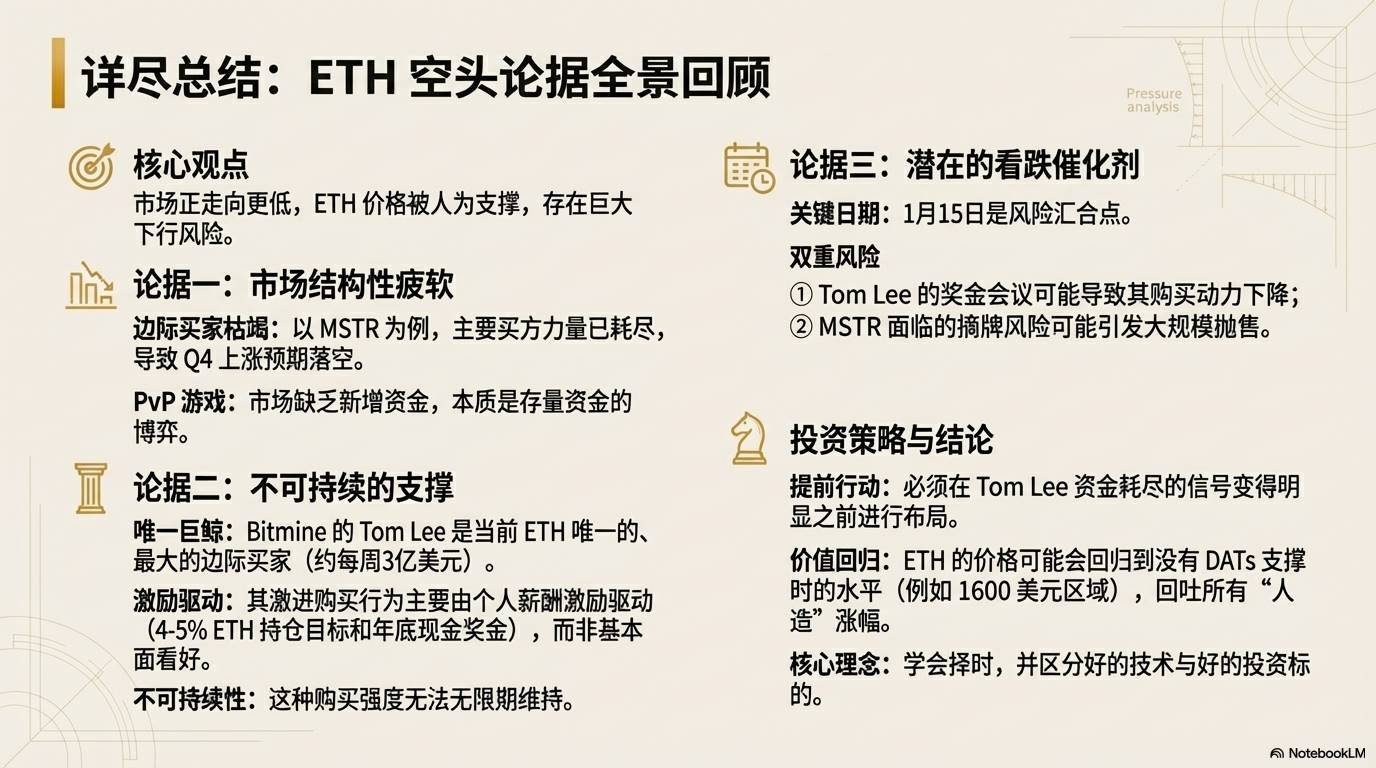
  • Now I believe we are in the second part, which is somewhat similar to the first part. Tom Lee has been one of the reasons I short ETH because I believe he has pushed the price above its fair value. Therefore, it makes sense to short the price back down. But I still believe he is propping up ETH, which provides an interesting opportunity. Because I think once he runs out of funds or starts to run out of money, ETH will truly return to fair value.

    • I do believe ETH will drop lower, but Tom Lee is preventing it from continuing to fall; however, at some point, he will run out of funds. The issue with DATs is that I don't like them; no one enters the crypto space to study DATs. But in my view, they control the market and the marginal capital flows of cryptocurrencies, so we must study them.

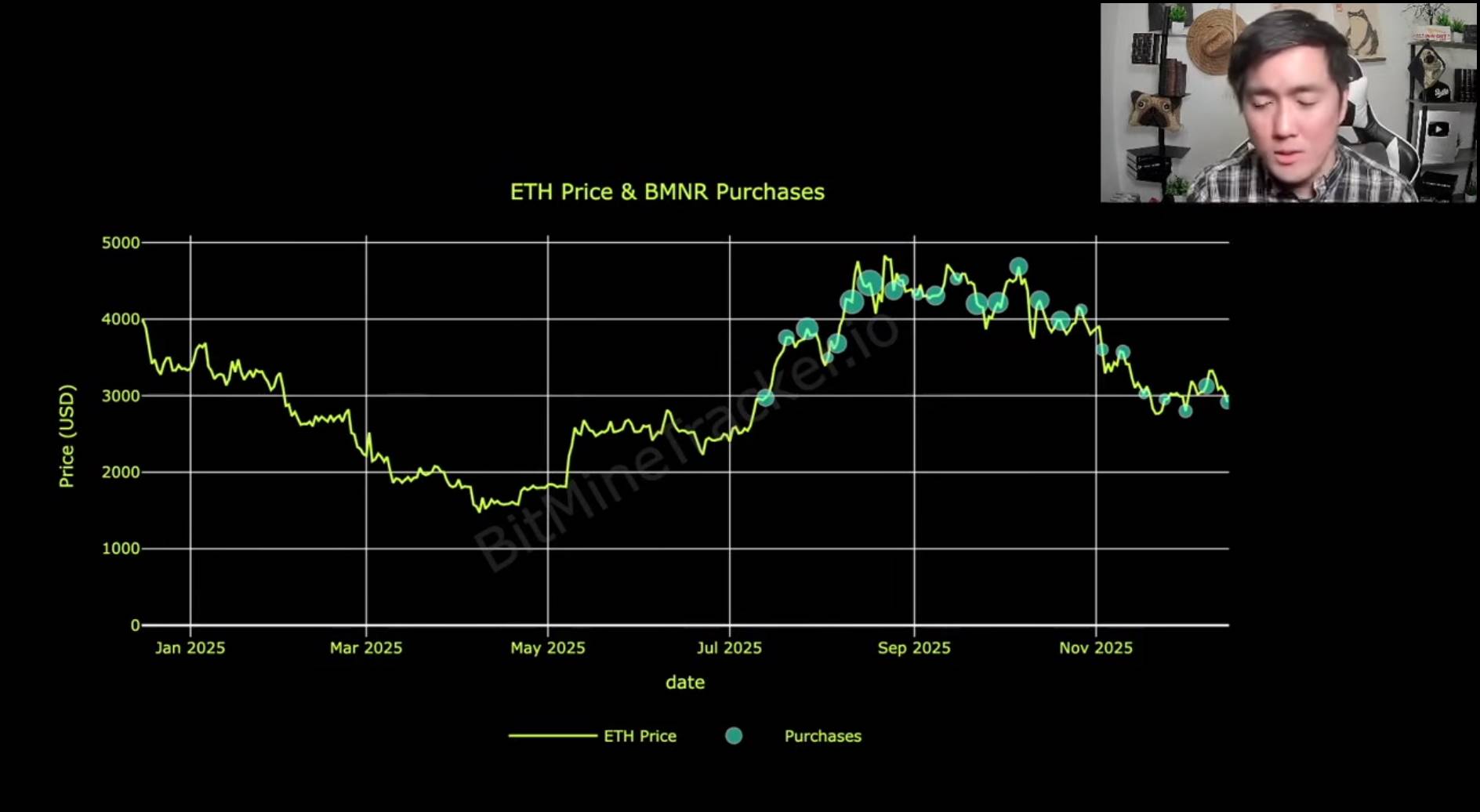
    • I believe Tom Lee has inflated ETH's price significantly, and now the amount he is buying has been decreasing over time. I think ETH will converge to its fair value. I don't know what the fair value is, but it could be much lower. You can see that Tom Lee's activity has involved buying a lot above $4,000, but if you understand how DATs operate, when cryptocurrencies rise, people flood into these assets because the market is reflexive. So these DATs buy heavily during the rise, and once the market continues to decline for a long time, they can no longer keep buying.

  • Saylor has accumulated over 3% of Bitcoin in the past five years, which has driven Bitcoin's price from about $10,000 to $85,000. In contrast, Tom Lee has concentrated on buying over 3% of ETH in just five months, but during this period, ETH's price has only risen slightly from $2,500 to $2,900. Whenever ETH's price rises, OGs tend to sell off, making ETH more of a primary exit liquidity tool rather than an asset suitable for long-term holding, which is a point I have been emphasizing over the past few months.

Tom Lee's Influence on ETH

  • In the crypto market, holding a contrarian view often pays off, as you can validate your judgment through capital trading. If your prediction is correct, the market rewards you with more capital, which you can reallocate to other areas.

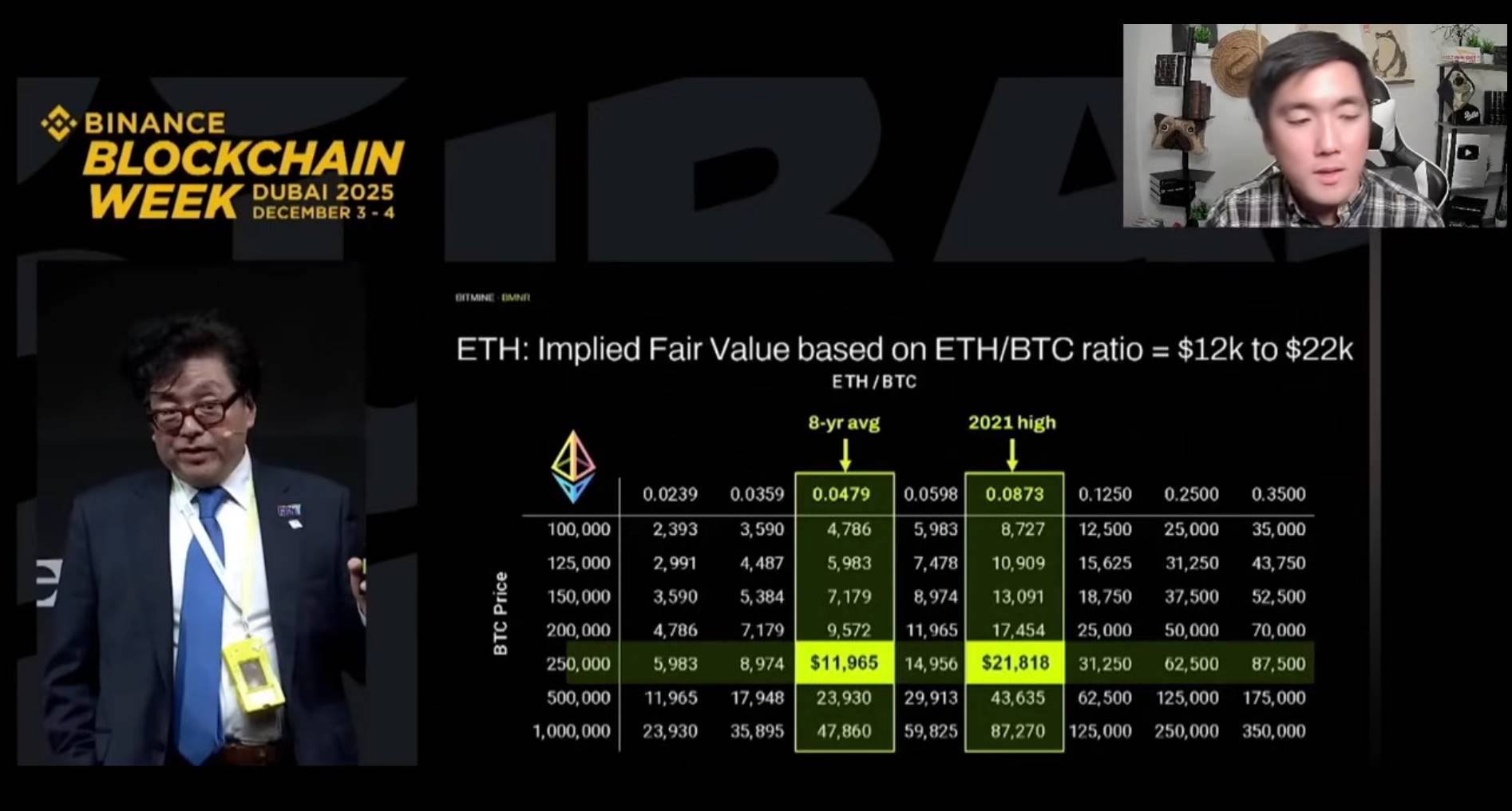
  • Recently, Tom Lee has been investing about $300 million weekly to buy ETH, which is particularly remarkable in the current market environment. He publicly stated at the Binance Blockchain Week that ETH's price has bottomed out and that he is increasing his purchases. His exact words were: “We believe ETH has bottomed out, so we are buying more.” To accurately time their purchases, they have also hired Tom Demar—a highly paid but capable consultant. Tom Lee predicts that ETH's price could rise to around $22,000 and has provided a fair value range of $12,000 to $22,000. However, I personally believe this prediction may be flawed, and the actual fair value could be $1,200 to $2,200.

  • In recent weeks, Tom Lee's public statements indicate that they are significantly increasing their holdings of ETH, which has led to ETH outperforming other altcoins lacking marginal buyers, such as Solana. From the charts, ETH's price trend is clearly stronger. However, from a market game theory perspective, I believe the cryptocurrency market currently lacks new marginal buyers. Most potential buyers have already entered the market, and the market is in a phase of instability after the excitement, with the bubble having burst, and we are trying to figure out what level these assets might drop to.

  • If Tom Lee continues to purchase $200 to $300 million worth of ETH weekly in the short term, the market may be influenced by him. In this case, whenever ETH's price drops, short-term traders may choose to buy, anticipating that Tom Lee's funds will push the price up, and then sell for a profit. For short-term traders, Tom Lee's buying behavior undoubtedly provides liquidity support. From a psychological perspective, I call this the “perceived Tom Lee safety effect.” Knowing he is buying makes people more willing to hold ETH in the short term rather than Bitcoin or Solana. If you are waiting to trade on a market rebound, holding ETH may be a more reasonable choice.

  • Although I am currently shorting ETH, I still believe that in the short term, ETH is more suitable to hold than other assets, simply because of Tom Lee's continued buying behavior. However, we need to be aware that once Tom Lee's funds run out, ETH's price could experience a significant drop. This phenomenon is similar to when Saylor announced the purchase of $1 billion worth of Bitcoin, and Bitcoin's price actually plummeted. The market understands that he cannot continue buying indefinitely, so each purchase diminishes future purchasing power.

  • Additionally, there is a Chinese whale named Garrett Bullish, who is said to manage funds for others. Before the market crash on October 10, he was shorting, but then he purchased over $500 million worth of ETH on the on-chain Hyperliquid platform, currently facing a loss of about $40 million. I believe his investment logic may be partially influenced by Tom Lee. However, this behavior seems more like a way to make “quick money,” as these investors do not genuinely want to hold ETH long-term; they just hope to profit quickly.

  • The crypto market currently exhibits a PvP (player versus player) competitive state, lacking clear advantages. Although there is still capital flowing in the market, the overall trend is that funds are gradually flowing out of the ecosystem. This may also be the reason we have seen price fluctuations recently. As market participants, it is crucial to understand Tom Lee's purchasing capacity, the scale of his purchases, and when he might stop buying. Personally, I believe his funds may run out soon, which is why I have recently increased my short positions.

Tom Lee's ETH Operational Strategy

  • Let's analyze Bitmine's current financial situation. A month ago, they held about 3.5 to 3.6 million ETH and $600 million in cash. According to the latest announcement yesterday, their ETH holdings have increased to nearly 4 million, and cash reserves have grown to about $1 billion. Clearly, Tom Lee's operations are very bold and efficient. He is continuously expanding his holdings by purchasing ETH while also raising more cash.

  • Tom Lee's strategy includes leveraging media publicity to attract investor attention to Bitmine and Ethereum. He draws people to buy Bitmine's stock by showcasing the company's assets and market potential. Subsequently, he issues more shares and uses part of the funds to purchase ETH. It is reported that he recently sold about $500 million worth of stock to Bitmine shareholders, with approximately $300 million used to buy ETH. This method maintains Bitmine's market demand and trading volume, allowing him to continue fundraising.

  • However, this strategy also carries risks. Although Tom Lee's brand effect and market reputation may attract investors, the trend of Bitmine's stock price does not look optimistic. Personally, I believe that this model is difficult to sustain long-term and may ultimately cease due to depleted funds. After all, fundraising is not an infinite possibility, and the market will not remain irrational forever.

  • As a well-known figure in the market, Tom Lee has been a bull in cryptocurrency for the past decade, and most of the time, his predictions have been accurate. His business model is also very successful, such as selling newsletter services. However, why does he take the reputational risk of pushing ETH's price to new heights? I believe the answer lies in the incentive mechanism. As Charlie Munger said: “Show me the incentive, and I will show you the outcome.” If we analyze Bitmine's incentive structure, we can better understand his behavior.

  • According to the Schedule 14A document submitted by Bitmine to the SEC, Tom Lee's compensation is closely tied to the company's performance. His performance bonuses are linked to Bitcoin revenue, ETH holding ratio, Bitcoin price, and company market capitalization. Additionally, the board can vote each year to decide whether to grant him a cash bonus of $5 million to $15 million. More importantly, the equity incentive mechanism stipulates that if Bitmine's ETH holdings reach 4%, Tom Lee will receive 500,000 shares, estimated to be worth about $15 million to $20 million at current stock prices; when holdings reach 5%, he will receive 1 million shares, doubling the reward.

  • It is worth noting that Bitmine's revenue primarily comes from asset management fees. For example, if Tom Lee purchases $10 billion worth of ETH and pays a 2% management fee, the company's revenue will reach $200 million. This model, while simple, is very effective.

  • Tom Lee's operational strategy is not only to drive up ETH's price but also to maximize personal and corporate interests. However, the sustainability of this strategy is worth noting; once funds run out or market demand weakens, ETH's price could drop rapidly. As market participants, it is crucial to understand the scale of his funds, purchasing plans, and when he might stop buying.

Negative Factors on January 15, 2026

  • Tom Lee's goal is to increase ETH's market share to 4% or 5% within six months, which is a very bold and noteworthy move. His incentive mechanism motivates him to continue investing in ETH before the end of the year, as there are potential cash reward mechanisms each year. He hopes to showcase excellent performance at the board meeting on January 15, such as: “I bought this much ETH, give me a $15 million bonus.” This reward mechanism explains why he would accelerate his purchases of ETH before the end of the year.

  • Once Tom Lee achieves the target of 4% or 5% market share, his motivation to buy may weaken as the marginal benefits of the incentive mechanism decrease. Of course, he may still need to continue buying to maintain ETH's price, but the motivation to push the price up will decline. It is evident that he has a stronger incentive to drive up prices before the end of the year.

  • Tom Lee's strategy has indeed benefited ETH holders significantly. He has pushed ETH's price from $2,500 to $4,900 through bold capital investments and continues to buy. However, this strategy also carries risks. If ETH's price experiences a significant drop in the future, retail investors may feel disappointed, especially those who bought Bitmine stock due to Tom Lee's statements.

  • It is worth noting that January 15, 2026, is not only the date for the Bitmine board to decide on bonuses but also the deadline for MSTR potentially facing delisting. If MSTR is delisted, it will trigger billions of dollars in capital outflow, creating significant selling pressure on the market. The leadership of MSTR is clearly concerned about this, as they even set up a page on their official website calling for investors to support them in avoiding delisting. If a delisting event occurs, it could lead to market panic, as MNAV may fall below 1. Although Saylor has stated that if MNAV falls below 1, he may sell Bitcoin to repurchase stock, the market may stress test this.

  • Tom Lee's incentive mechanism before January 15 gives him the motivation to continue buying ETH. However, if MSTR is delisted and Tom Lee has exhausted his funds for purchasing ETH, the market could face a collapse. While this scenario is extreme, it is worth paying attention to. Studying incentive mechanisms can help us better understand the behavioral logic of market participants.

The Situation May Get Worse

  • I believe that in cryptocurrency trading, we should always ask ourselves two questions: Who are the marginal buyers? Who are the marginal sellers? A few months ago, I raised this question as well. At that time, the market generally believed that the fourth quarter would see a rise and that there would be an "altcoin season." But I continued to ask: If everyone is ready for the rise, then who will be the marginal buyers? Clearly, they could not answer this question. Thus, I realized that these people are actually the marginal sellers. Because if the market does not rise as expected, they will turn to sell, which provides an excellent opportunity for shorting.

  • Recently, I have to admit a fact: The current cryptocurrency market does not have real "structural buyers." While this may change in the future, for now, the market resembles a PvP (player versus player) game. Digital Asset Treasury companies (DATs) support the market to some extent, but their funds are ultimately limited. If you agree with this view, then the market trends of the past few months become relatively easy to understand. For example, when Tom Lee invested heavily in ETH, you could choose to sell your assets; and when they might stop buying, you could start to short.

  • Taking Tom Lee as an example, he may make large-scale purchases in December, but by the New Year, he may slow down his buying while reserving some cash to protect his stocks, as he will eventually need to build a cash reserve. The current market situation is somewhat similar, with funds primarily flowing into ETH, keeping its price supported at a high level. Once Tom Lee slows down his purchases, the market's long positions may quickly unwind. As I mentioned earlier, ETH's price could have been lower, but Tom Lee's actions temporarily prevented this. Once he exits the market, ETH's price may drop rapidly.

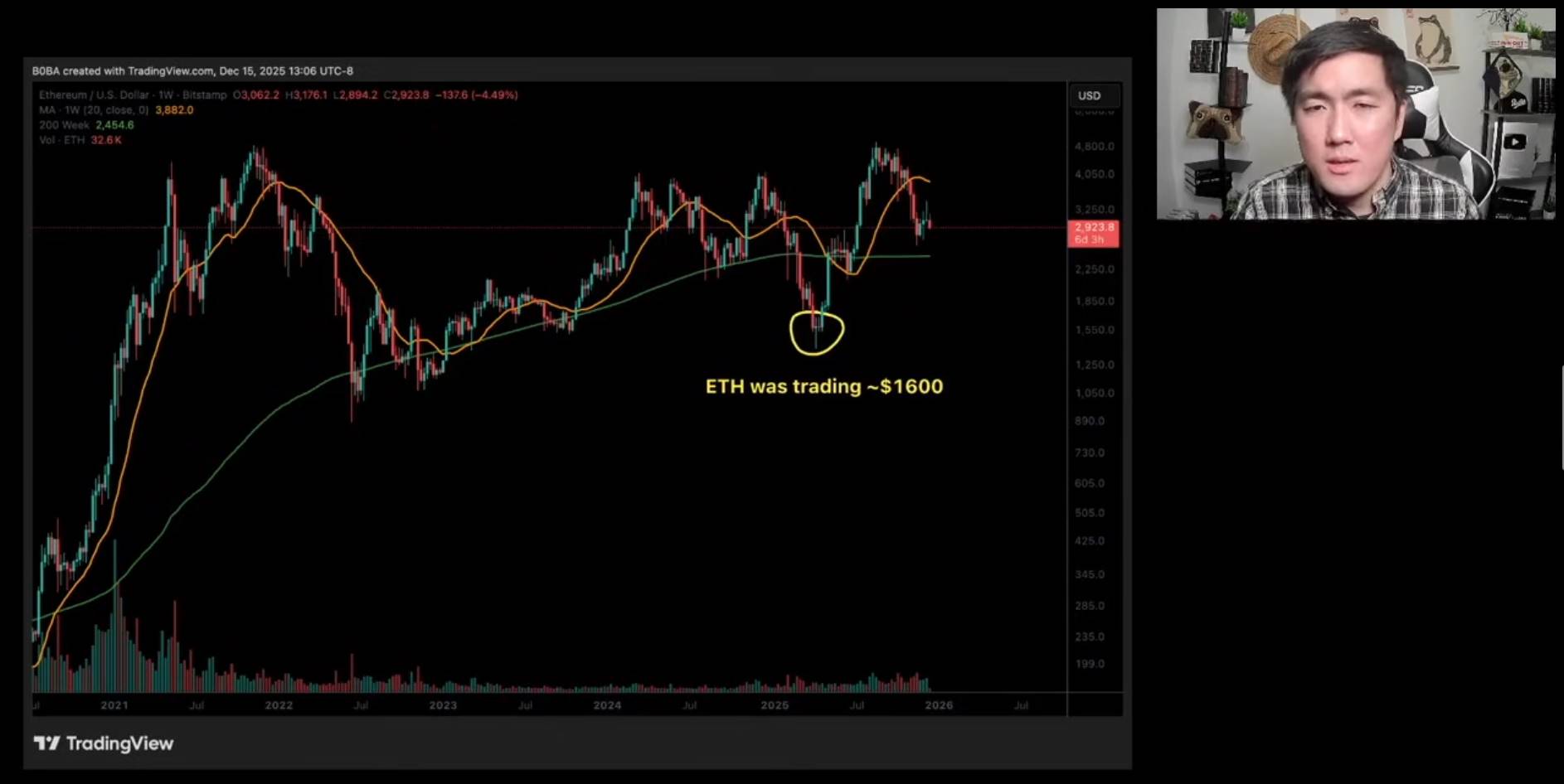
  • Tom Lee's Bitmine was announced when ETH was priced at $2,500. I believe this increase may ultimately be fully retraced. The last time Bitcoin traded at $85,000, ETH was around $1,600. While this can be seen as a price anomaly due to tariffs and other factors, the fact is that at similar Bitcoin price levels, ETH's price was previously lower. I believe that ETH's price is still around $2,900 mainly due to the continued purchases by DATs. These funds do provide support, but they will eventually run out. If you are just waiting for the funds to run out before shorting, it may be too late. You need to judge the market trend in advance because by the time the funds run out, ETH's price may have already dropped significantly.

  • Although my view may sound pessimistic, if you are familiar with my trading style, you will know that I usually lean towards being bullish. I have made mistakes in the past by always reinvesting all profits back into the market. Whenever there was a clear risk in the market, I would choose to take profits. Shorting is a strategy I have only recently adopted; I generally still prefer going long. If you think about it carefully, we should welcome a* bear market*, as it presents opportunities to make money. Many people only think about profiting during the "altcoin season" in the fourth quarter, but real wealth is accumulated by buying at the lows. For instance, anyone who bought Bitcoin when it was around $20,000 and now sees it at $85,000 has made a fourfold return.

  • I hope everyone understands that the market can always get worse. Moreover, unless you sell, you cannot truly realize profits. You need cash reserves and to decisively sell when the market is quiet. I am not saying you must sell now; I am just sharing my trading thoughts. During the last market cycle's bear market, ETH fell for 11 consecutive weeks. At that time, I thought the market would rebound after the sixth week, but that did not happen, and it fell for another five weeks. So the market can always get worse.

  • I want to remind everyone not to be satisfied with simply holding cryptocurrencies, as they can drop rapidly in a short time. Even in the recent market, no one anticipated it would fall so quickly, but it did happen. You cannot profit in the cryptocurrency market unless you sell. Of course, you can choose to hoard Bitcoin or ETH for the long term. Personally, I do not think ETH is a good investment, but if your investment horizon is long enough, say 20 years, and you completely disregard short-term fluctuations, it might be acceptable. However, most people do not have the conditions to become wealthy Bitcoin or ETH whales; we at least need to trade to capture the market tops and bottoms, or else we can only bear the risk of asset depreciation.

Taiki vs ETH Supporters

  • Recently, I received some attacks from extreme ETH supporters, which is somewhat understandable. For these individuals, their identity seems to revolve entirely around their early purchases of ETH, while I candidly pointed out on YouTube that ETH's price might fall further, providing data and facts to support my view. However, I respect ETH supporters like Ryan Burkeman, as he genuinely believes in ETH's value. Of course, sometimes I correct some of his mathematical errors.

  • I want to clarify that I am not a blind worshipper of ETH. In fact, if you look at my on-chain trading records, I use the ETH ecosystem (like ETH L2s) more frequently than most extreme ETH supporters. Whether on Twitter or YouTube, I might be one of the most active on-chain participants, frequently using the blockchain and even participating in mining.

  • Many people's attitudes towards ETH are not critical enough. They may simply buy ETH and expect the price to rise, but I make these videos not to attack ETH, as I think ETH is a great technological product, but we must learn to distinguish between "assets" and "technological products," as they are two different things. While the superiority of technology may influence asset prices, it does not mean that ETH's price will rise indefinitely. We need to think critically about what factors are driving ETH's price changes.

  • The bear market of 2022 caused me significant losses. Although I sold near the market top, I kept buying lower lows because I firmly believed that ETH's price would eventually rise higher. Four or five years ago, I was a delusional ETH bull. I believed DeFi would change the world, that ETH was the future of finance, and even thought ETH would surpass Bitcoin as a better currency. But now, I find that there are far fewer people holding these views. I once deluded myself into thinking ETH's price would rise to $10,000 and held on, only to see it drop from $4,000 to $900; that experience was very harsh.

  • On my channel, I have been striving to share my trading strategies. I do not always get my trades right, but at least I try to be honest and genuine. My analysis of the market is more based on the fundamentals of numbers and capital flows rather than simply drawing charts or lines to predict price movements. For example, ETH's rise is due to Tom Lee's large-scale purchases, while ETH's decline may be due to capital exhaustion. If Tom Lee is still buying, I would choose to short his purchases and position myself in advance to respond to market changes after his funds run out.

Good Technology, Bad Asset?

  • Perhaps my view is wrong, but I am using my own funds to verify it, and all my trades can be validated through on-chain data. Looking at the current situation, almost no one is truly using ETH. Of course, the ETH mainnet is expanding, on-chain transaction costs are becoming lower, and user activity may shift to L2 (Layer 2), but based on these data alone, you cannot simply conclude that "the world is adopting ETH." At least from my perspective, such an interpretation does not hold.

  • ETH's market capitalization is currently about $350 billion, and this valuation resembles a castle in the air, such as "If global financial activities migrate to ETH, then ETH's market cap will continue to rise." But does this logic really hold? No matter how excellent the technology is, it does not necessarily drive asset prices up. Some have been tagging me, saying, "JPMorgan is issuing stablecoins on-chain, and ETH's market cap will rise to $10 trillion." But I believe that the maturity of the cryptocurrency market lies in understanding: technology may be excellent, even net positive for certain businesses and regions, but that does not mean they are good investments.

  • For example, Robinhood is using the Arbitrum Orbit stack to build its own blockchain. Perhaps this decision is beneficial for Robinhood's equity, but it may not be beneficial for Arbitrum's token. So, is it possible that companies using blockchain technology can all profit while the underlying infrastructure does not see significant gains? It might benefit a little, but not too much. This situation is also difficult to accept, but it is at least worth considering.

Conclusion

  • Once Tom Lee stops buying or exits the market, the situation may get worse. As I mentioned earlier, the last time Bitcoin was at similar levels, ETH's price was much lower. I believe the current market overvaluation is mainly driven by Digital Asset Treasury companies (DATs), and these long positions need time to unwind. At the same time, market participants also need time to realize that this price may not be reasonable.

  • The current market phase can be summarized as: DATs have driven up prices, while people are gradually realizing that this frenzy may have gone too far, and ETH's actual value may be much lower. This is precisely the direction of my current bet. Of course, I am not a doomsayer but a long-term supporter of cryptocurrency. My loyal audience knows that I am currently just cash-priced. I believe the way to accumulate more cash is by shorting ETH, participating in airdrop mining, and staying calm. I recently participated in a trading competition, and to pass the time, I chose to short Solana and ETH, ultimately winning the competition and earning $50,000.

  • I believe that shorting ETH is a simple and effective strategy. Although sometimes ETH's price may rise due to random factors like Tom Lee, once their buying volume peaks and the market's reliance on them gradually weakens, ETH's price will start to decline slowly. Unfortunately, I believe the current market is in such a phase.

免责声明:本文章仅代表作者个人观点,不代表本平台的立场和观点。本文章仅供信息分享,不构成对任何人的任何投资建议。用户与作者之间的任何争议,与本平台无关。如网页中刊载的文章或图片涉及侵权,请提供相关的权利证明和身份证明发送邮件到support@aicoin.com,本平台相关工作人员将会进行核查。

Share To
APP

X

Telegram

Facebook

Reddit

CopyLink