Written by: Glendon, Techub News
The prediction market is developing rapidly, accelerating towards mainstream financial markets, and has become a hot "huge opportunity" at present.
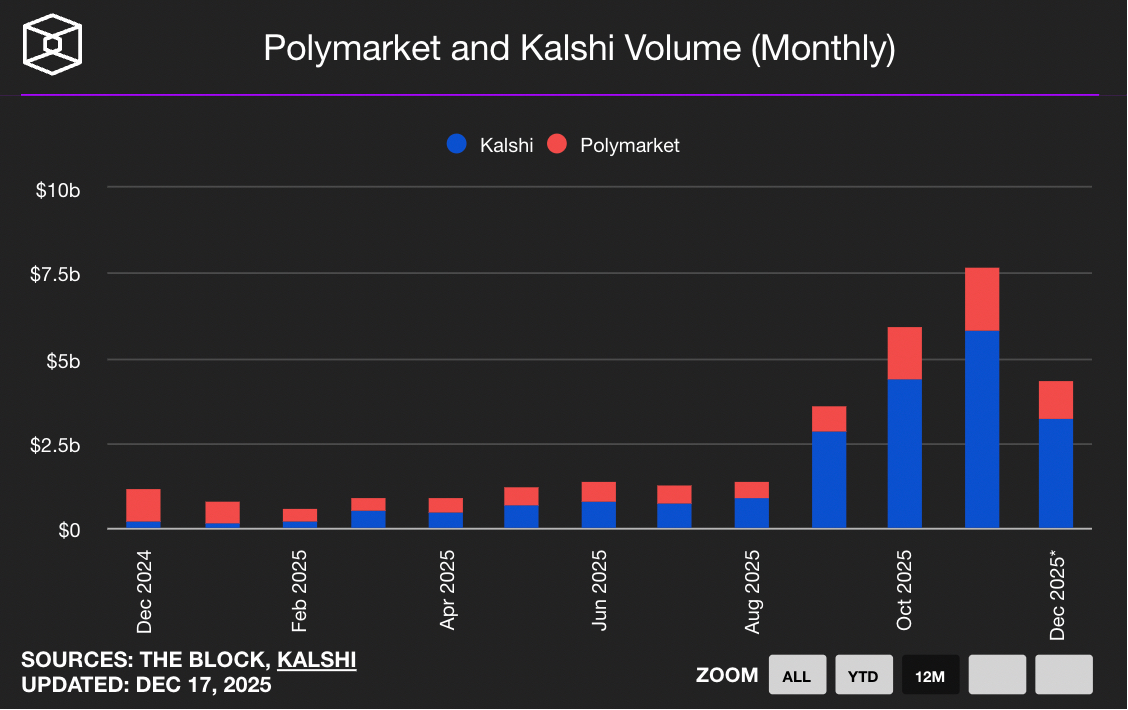
According to data from The Block, Kalshi's trading volume reached $5.8 billion in November, a 32% increase from October, setting a new historical high; Polymarket's trading volume in November also climbed to $3.74 billion, setting a new historical high with a month-on-month increase of 23.8%.

Today, the prediction market Probable officially launched on the BNB Chain. This platform is co-incubated by PancakeSwap and YZi Labs, supporting users to predict events related to cryptocurrencies, global events, sports events, etc., without any transaction fees. Meanwhile, Coinbase is also actively laying out its plans, stating at the System Update launch that it will significantly expand the range of trading assets on its platform, mainly including stock trading, prediction markets, and other new services to solidify its market position as a "universal exchange."
It can be seen that the prediction market "duopoly" of Kalshi and Polymarket is leading explosive growth in the industry, while the crypto-native prediction market Probable and trading platforms like Coinbase are striving to catch up. Even though the current market conditions are relatively sluggish, this field still presents a thriving scene. However, behind the excitement, what is the current development status of the prediction market?
Kalshi: Firmly on the "Throne," Aiming at On-Chain Prediction Markets
At this stage, Kalshi firmly occupies the dominant position in the prediction market and is working hard to consolidate its market position.
As the first prediction market platform in the U.S. regulated by the Commodity Futures Trading Commission (CFTC), Kalshi is not a crypto-native application. However, Kalshi is actively seeking change, having brought thousands of prediction markets on-chain through Solana to promote the open monetization of its global liquidity pool. At the same time, Kalshi has launched a developer grant program totaling over $2 million to encourage emerging applications to integrate on-chain functionalities. This move targets the $3 trillion crypto asset market, with a clear goal of attracting high-frequency trading crypto users and further expanding its user base. This seems to indicate that Kalshi is preparing for a direct confrontation with Polymarket in the on-chain finance sector.
In terms of financing, Kalshi completed a $1 billion Series E funding round led by Paradigm earlier this month, with participation from a16z, Sequoia Capital, ARK Invest, and others, bringing its latest valuation to $11 billion. To secure a more advantageous position in market competition, on December 12, Kalshi, along with Crypto.com, Robinhood, Coinbase, and Underdog, established the Coalition for Prediction Markets (CPM) to strengthen its compliance moat. This coalition aims to maintain a safe, transparent, and federally regulated access environment for prediction markets. Notably, this coalition excludes its competitor Polymarket, and the intention behind this is evident.
In addition to financial platforms like Robinhood and Coinbase, Kalshi has also partnered with news channels such as CNN and CNBC, integrating its real-time probability data into relevant programs for media use.

As of the time of writing, data from The Block shows that Kalshi's trading volume this month has reached $3.22 billion, with weekly trading volumes exceeding $1 billion. Currently, the platform has established over 3,500 trading markets and will continue to expand its product variety, seek more media partnerships, and integrate more brokerages.
Polymarket: Returning to the U.S. Market, Fully Seizing Market Share
Polymarket received approval from the Commodity Futures Trading Commission (CFTC) for a revised designated order last month, allowing it to enter the U.S. market through intermediary channels. Currently, Polymarket's focus remains on launching trading in the U.S. market. Earlier this month, Polymarket began gradually opening its new mobile application to users on the waiting list, with the initial features focusing on sports predictions, and plans to expand functionalities to various markets in the future.
During this period, Polymarket is also actively expanding its partnership channels. On December 5, Polymarket officially launched the MetaMask mobile application, introducing a prediction market supported by Polymarket. On December 9, Polymarket CEO Shayne Coplan revealed in an interview with AXIOS that Polymarket is currently operating at a loss. In this situation, capturing as much market share as possible has become Polymarket's top priority.

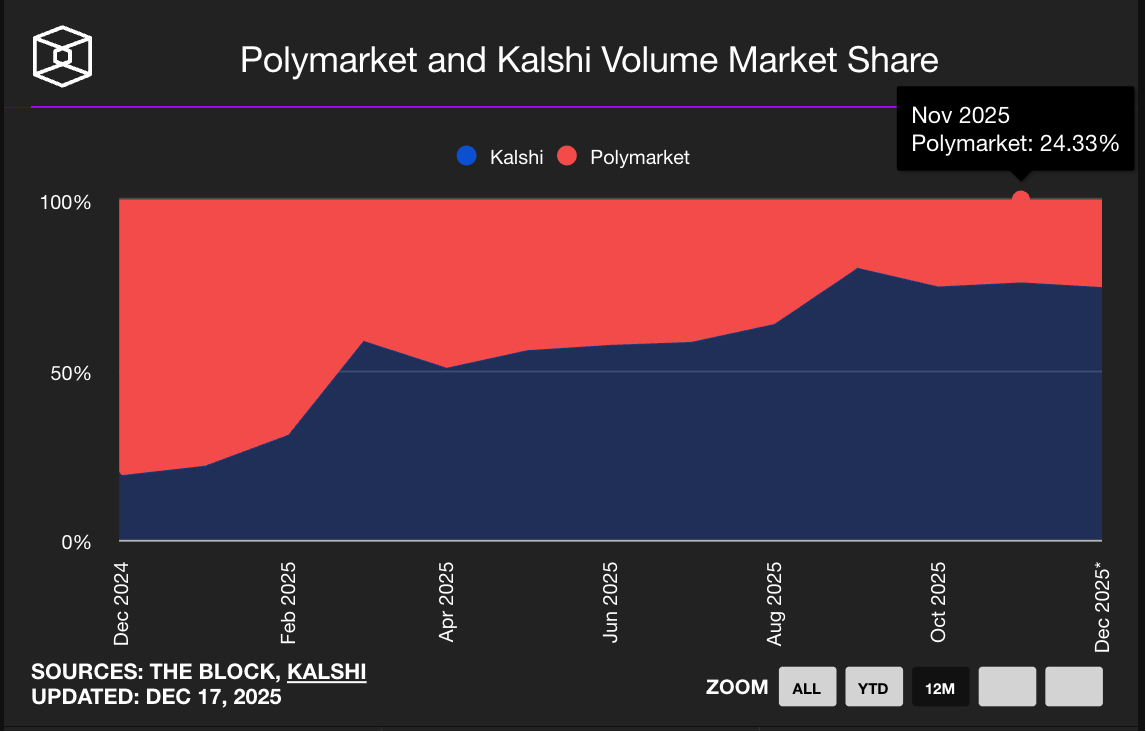
From market data, Polymarket is currently facing significant competitive pressure. As of the time of writing, Polymarket's market share compared to Kalshi is only 24.33%, while these two platforms account for nearly 95% of the entire prediction market. Specifically, Polymarket's trading volume this month is approximately $1.11 billion, with the number of monthly active users currently around 334,700. However, with the official opening of the U.S. market, Polymarket will welcome new development opportunities, and its competition with Kalshi is about to begin.
Opinion Accelerates Rise, BNB Chain Becomes an Important Innovation Ground
From an industry ecosystem perspective, BNB Chain has become an important innovation ground. Currently, several prediction markets are operating on BNB Chain. Among them, the BNB Chain ecosystem prediction market Opinion has emerged as a shining new star.
Opinion officially launched on October 23 and has shown remarkable growth momentum since its debut, becoming the fastest-growing prediction market. Within a month of its public launch, its trading volume exceeded $5 billion, and within 50 days of launch, the cumulative nominal trading volume surpassed $6.4 billion, with daily trading volumes exceeding $200 million multiple times. Its advantage lies in standardizing macroeconomic indicators such as inflation, interest rates, and employment into tradable assets, making it a representative case of a macro-oriented prediction market.
At the beginning of this month, the Opinion team revealed an important piece of news during an event: it has recently secured tens of millions of dollars in funding support, which will be used to advance the construction of the prediction market ecosystem based on BNB Chain, user growth plans, and infrastructure development. To further promote ecosystem development, Opinion announced a $1 million incentive program on December 10, launching a Builders Program for global developers.
Currently, Opinion has supported mobile trading, allowing users to log in and trade through Binance Wallet and other methods.

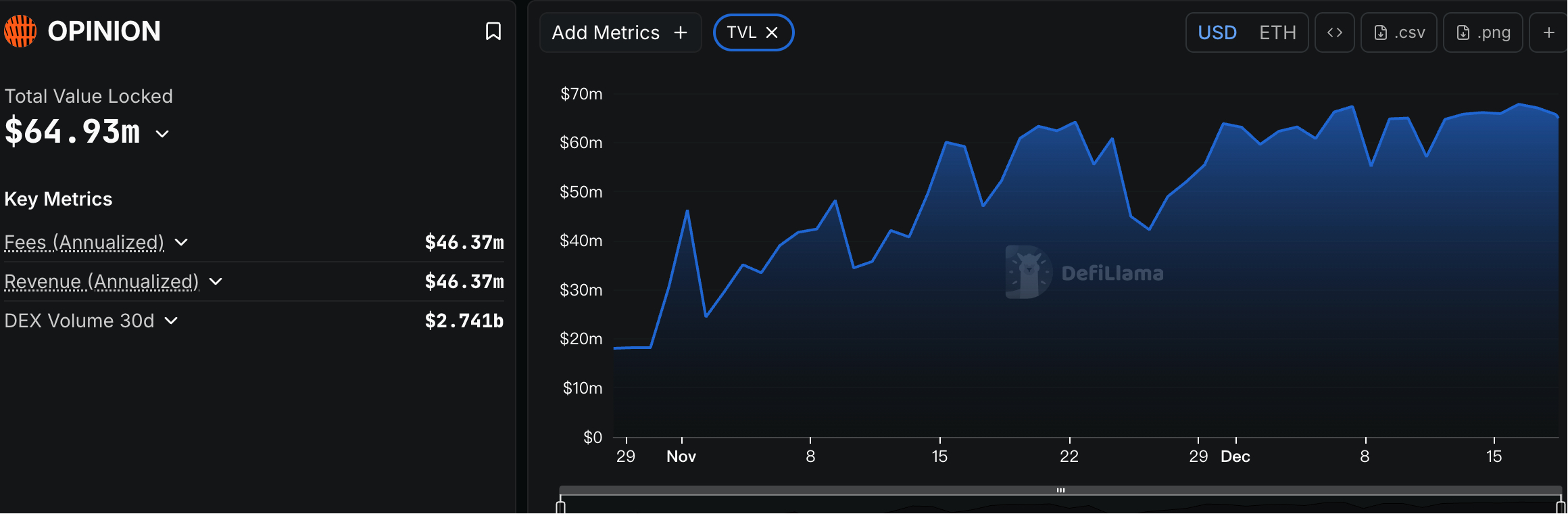
From the holding data, Opinion's performance is also noteworthy. According to DefiLlama data, the total holding volume of the prediction market Opinion once exceeded $72 million, setting a historical high, ranking second among on-chain prediction markets, only behind Polymarket (approximately $286 million). As of now, the platform's total holding volume has slightly decreased to about $64.93 million.
It is worth noting that Binance has shown a very optimistic attitude towards the prediction market sector and is making significant bets. In addition to the previously mentioned prediction market Probable co-incubated by PancakeSwap and YZi Labs launching on BNB Chain, not long ago, BNB Chain also launched another highly anticipated prediction market platform, Predict. This platform was founded by former Binance employees and incubated and invested by YZiLabs, with its uniqueness lying in supporting interest on funds. The platform allows users' funds to generate returns while participating in predictions, preventing funds from being idle.
Moreover, Trust Wallet, a self-custody cryptocurrency wallet under Binance founder Changpeng Zhao, has also launched a prediction market, which first integrates the Web3 prediction market protocol Myriad and plans to soon expand to major platforms like Kalshi and Polymarket. From this series of actions, it is not difficult to see Binance's high level of attention to the prediction market and its determination to comprehensively layout in this sector.
Other Prediction Markets: Blossoming in Multiple Areas, Each Making Progress
In addition to the aforementioned leading prediction market platforms, other prediction markets also have some noteworthy new developments:
The Base ecosystem prediction market Limitless has completed its third $50,000 LMTS token buyback this month, repurchasing a total of $150,000 from the secondary market over the past three weeks, with a total holding volume of approximately $670,000;
Myriad has integrated the cryptocurrency wallet Trust Wallet, with its total holding volume rising to $960,000;
The Solana ecosystem prediction market worm.wtf, which launched in mid-October, has recently completed a $4.5 million Pre-Seed round of financing;
The leveraged prediction market Space has completed a $3 million seed round and strategic financing, planning to build the first 10x leveraged prediction market on the Solana blockchain, and has opened the public sale of SPACE tokens early this morning.
As various crypto prediction market projects develop, more and more crypto trading platforms are discovering the potential of prediction markets, gradually launching related prediction market products or features, further enriching the market ecosystem.
The cryptocurrency exchange Gemini (stock code GEMI) has received approval from the U.S. Commodity Futures Trading Commission (CFTC) this month to enter the prediction market space. Subsequently, it quickly launched its prediction market product, Gemini Predictions, which is now fully operational in all 50 states of the U.S. This product allows users to trade based on the outcomes of real-world events, offering near-instant execution and complete transparency.

The cryptocurrency wallet Phantom has partnered with Kalshi to launch prediction market features, allowing users to trade binary event contracts using Solana tokens within the wallet, covering popular events in sports, politics, crypto, and culture. Its prediction market is now open to eligible users.
Additionally, Coinbase is also actively preparing to launch an internal prediction market supported by Kalshi's technology, expected to be released next week. It is important to note that this is not an exclusive partnership, but once the product is launched, Kalshi will be the only operator collaborating with Coinbase in the prediction market space.
Notably, traditional fintech institutions are increasingly entering this field, intensifying competition. Following the moves of Robinhood, Google, and the Chicago Mercantile Exchange, sports giant Fanatics has launched its prediction market platform, Fanatics Markets, this month, initially available in 10 U.S. states. Fanatics has partnered with Crypto.com to provide compliant trading infrastructure, and with its strong resources and capabilities, it plans to expand its business into categories such as crypto prices, IPOs, technological advancements, and movie outcomes by 2026. Fanatics has clearly stated its goal to compete with Polymarket and Kalshi for market share.
Summary
From the current competitive landscape, the U.S. market has formed a "duopoly" monopoly situation with Kalshi and Polymarket, where new entrants face extremely high compliance and liquidity barriers, making it challenging to carve out a share in this market. However, from a broader perspective, the entire prediction market industry is still in its early development stage, containing enormous potential. Currently, more users are focusing on traditional areas like sports events, overlooking broader economic scenarios. Analysts from Citizens Financial Group Inc. point out that the industry's annual revenue is currently about $2 billion, and by 2030, the revenue of prediction market companies could grow to five times its current level, surpassing $10 billion. This suggests that the industry may be at a critical point of explosive growth, with limitless possibilities ahead.
In the next five years, the prediction market is expected to undergo a transformation from a "niche speculative tool" to a "mainstream decision-making infrastructure." The deep involvement of institutional investors will drive continuous improvements in market efficiency, while AI-driven dynamic pricing models may fundamentally change traditional prediction mechanisms, bringing about a new revolution in the market. For industry participants, seizing the dual opportunities of "compliance" and "scenario-based" strategies may become a core strategy to secure a place in this emerging market worth hundreds of billions.
免责声明:本文章仅代表作者个人观点,不代表本平台的立场和观点。本文章仅供信息分享,不构成对任何人的任何投资建议。用户与作者之间的任何争议,与本平台无关。如网页中刊载的文章或图片涉及侵权,请提供相关的权利证明和身份证明发送邮件到support@aicoin.com,本平台相关工作人员将会进行核查。