Author: Web3 Compliance Officer
On December 17, 2025, with the sound of a gong at the Hong Kong Stock Exchange, HashKey Group officially completed its transformation from a compliant exchange to a publicly listed company. After two years of deep industry engagement and policy adaptation, HashKey's listing not only contributes to the construction of Hong Kong as a "crypto center" but also brings significant upheaval and profound reflection to the domestic crypto community, which is under strict regulatory scrutiny.
I. Breaking the Ice: The Leap from "Offshore Identity" to "Mainstream Asset"
For a long time, practitioners in the domestic crypto space have been burdened with "identity anxiety." Since 2021, the mainland's severe crackdown on virtual currency businesses has left many web3 talents and funds in a state of limbo. As one of the more influential virtual currency exchanges in Hong Kong, HashKey's listing has at least two major impacts:
First, the "Anchor Point" of Compliant Assets: HashKey's listing marks a shift in the perception of crypto platforms in the Chinese-speaking regions from being seen as "makeshift" or "gray areas." It establishes a clear compliance value anchor in the Hong Kong stock market for the first time.
Second, the Restructuring of Valuation Logic: In the past, domestic investors often focused on "odds" and "traffic" when evaluating crypto projects; now, with the public disclosure of HashKey's financial reports, the market will begin to learn how to assess the value of Web3 enterprises through the lens of traditional finance (such as P/E ratios, daily trading volume, and assets under custody (AUC), etc.).
II. Policy Boundaries: Hong Kong as a "Testing Ground" and the Mainland's "Firewall"
HashKey's listing does not signify a shift in mainland policies but rather further clarifies the framework of "strict risk control domestically, orderly exploration abroad."
(1) Strict "Internal Port Isolation"
According to the current regulatory framework for virtual currencies in Hong Kong and the mainland, even with its listing, HashKey's core trading operations still strictly enforce KYC restrictions, preventing mainland residents from directly participating in secondary market crypto trading on its platform. This "firewall" ensures financial stability in the mainland (a closed ecosystem) while allowing HashKey to become an "offshore financial hub" specifically for attracting overseas funds and domestic institutions going abroad.
(2) Northbound Reference for RWA (Real World Assets)
A core motivation for HashKey's listing is its layout in the RWA (Real World Assets) sector. By tokenizing high-quality debt and supply chain financial assets from the mainland in Hong Kong and listing them, HashKey effectively opens a path for "technology moving south and capital flowing west." This provides a new financing approach for high-quality domestic projects struggling to go abroad. Although on December 5, the China Internet Finance Association, the China Banking Association, the China Securities Association, the China Securities Investment Fund Association, the China Futures Association, the China Listed Companies Association, and the China Payment and Clearing Association (hereinafter referred to as the "Seven Associations") jointly issued a risk warning regarding illegal activities related to virtual currencies, which seemed to sentence RWA to "death," we believe this actually presents an opportunity for RWA to be reborn — the Seven Associations emphasize that RWA activities cannot be conducted domestically, which gives Hong Kong a favorable opportunity to engage in RWA business.

III. Three Substantial Impacts on the Domestic Crypto Ecosystem
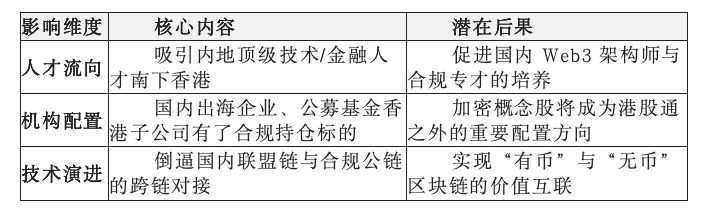
We analyze the impact of HashKey's listing on the domestic crypto ecosystem from three perspectives:

(1) The "Regularization" of Capital Flows
In the past, domestic capital often participated in the crypto market through high-risk channels like C2C, facing significant pressures regarding fund safety and anti-money laundering. After HashKey's listing, its stock becomes a "mapped asset." Domestic capital can indirectly share in the growth dividends of the crypto industry through compliant channels like QDII, significantly reducing legal risks.
(2) The "Application Transformation" of the Developer Ecosystem
HashKey's success proves that under a compliant framework, the core of Web3 is no longer merely "speculating on coins," but rather enhancing underlying infrastructure and financial efficiency. This will guide domestic developers to shift from "pure protocol layers" to more practical "middleware" and "RegTech" development.
IV. Challenges and Gamesmanship: The "Goldfish Bowl" Effect Post-Listing
However, listing is not the end but the beginning of facing more stringent scrutiny. For HashKey, it must confront the following challenges:
First, the Double-Edged Sword of Transparency: As a publicly listed company, HashKey must disclose its asset reserves, profitability, and regulatory compliance details. While this enhances trust, it may also expose its vulnerabilities during extreme market fluctuations.
Second, The Battle for Liquidity: In the face of the first-mover advantage of U.S. stock Coinbase, whether HashKey can leverage its deep roots in Asia to attract incremental funds from Southeast Asia and the Middle East is key to maintaining its stock price.
Third, The Ongoing Evolution of Regulation: The Hong Kong Securities and Futures Commission (SFC) has very high requirements for licenses. How to maintain high-pressure compliance without sacrificing user experience is a long-term game that HashKey must face.
V. Conclusion: A New Journey for the Chinese-Speaking Crypto Community
The sound of the gong for HashKey at the Hong Kong Stock Exchange marks the complete end of the "barbaric growth" era. For the domestic crypto community, it provides a perfect model of a "middle ground": leveraging Hong Kong's legal system to deeply participate in the global digital asset pricing power competition without crossing the mainland's policy red lines.
In the future, we may see more outstanding domestic Web3 enterprises returning to the mainstream spotlight through "listing in Hong Kong." HashKey is not the first, and it certainly will not be the last.
免责声明:本文章仅代表作者个人观点,不代表本平台的立场和观点。本文章仅供信息分享,不构成对任何人的任何投资建议。用户与作者之间的任何争议,与本平台无关。如网页中刊载的文章或图片涉及侵权,请提供相关的权利证明和身份证明发送邮件到support@aicoin.com,本平台相关工作人员将会进行核查。