Author: JW, Techub News
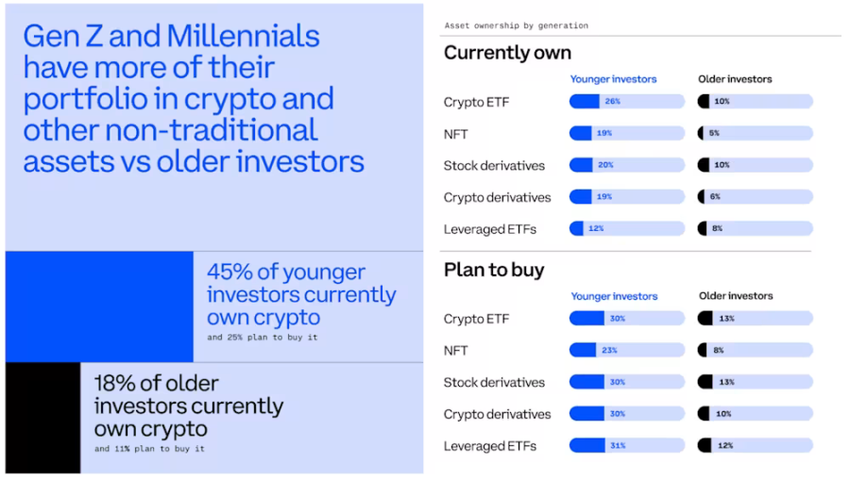
Today, I want to discuss Coinbase's latest “Cryptocurrency Industry Report”. On the surface, it talks about the crypto market, but if we look at this report more broadly, it actually discusses a recurring theme: every generation encounters its own "path to wealth" and era of dividends.

In the United States, for the past few decades, there has been almost a fixed route: study hard, find a stable job, buy a house, invest in some stocks, and then let time work its magic. This path was once effective, which is why the previous generation walked it with confidence and certainty.
But for today's young people, this route has lost its persuasiveness.
It's not because they are not hardworking or because they are greedier, but because the times have changed. Housing prices are rising, tuition and loans are becoming more burdensome, and wages are increasing slowly. Many young people work while knowing that even if they follow the traditional path, it is difficult to replicate the life trajectory of their parents' generation.
This feeling is not unique to young people in the United States; it is also familiar to many in China: "In the early days of reform and opening up, opportunities lay in starting a business; in the 1990s, those who were a bit bolder relied on permits and information gaps; after 2000, buying a house became the safest choice; later on, wealth management, funds, and stock trading became 'financial activities that ordinary people could participate in.' You will find that every generation encounters the same confusion: the path that worked for the previous generation suddenly becomes impassable for them. It’s not that the method is wrong, but when a path is written into textbooks, it often no longer belongs to ordinary people.
Against this backdrop, more and more young people are beginning to rethink: if the traditional path no longer suits them, are there other options?
As a result, they are becoming more proactive in investing. They are not just handing their money over to others to manage, nor are they strictly following the "standard answers," but rather they are looking, trying, and judging for themselves. They still buy stocks, but they no longer place all their hopes on them; instead, they are willing to allocate a portion of their money to try new things, such as cryptocurrencies.
Many people instinctively associate cryptocurrencies with "gambling" or "speculation." However, for many young people, it feels more like a new opportunity. A financial world where they can participate without waiting for others' approval or meeting too many thresholds. They can enter and exit at any time, without being restricted by time and geography, and they don’t need to have a large amount of capital upfront.
Importantly, young people do not feel that the existing financial system is on their side, so they are more willing to explore possibilities outside the system. They want to see new opportunities sooner rather than waiting for everyone to recognize them before passively following along. If we look at this in a historical context, it is not new at all. In every economic environment change in China, there has always been a group of people who first tried new things: some were the earliest to start businesses, some were the first to buy houses, and some were the first to begin wealth management. At the time, it seemed "radical," but in hindsight, it often signaled the loosening of old rules.
For today's young people, cryptocurrencies may not necessarily be the endpoint; they are more like a fork in the road. Some will delve deeper, some will only skim the surface, and some may eventually walk away. But at least, it gives them a chance to re-engage and re-choose.
You will notice that this generation has several obvious characteristics when it comes to investing: they operate more frequently, are more willing to bear volatility, and are more accustomed to diversifying their money across different places. They do not believe in "one choice for a lifetime," but rather accept continuous adjustments and trial and error. For many young people, cryptocurrencies may not be the answer itself, but at least they signal that when the old paths are blocked, it’s time to explore and take risks on new paths.
免责声明:本文章仅代表作者个人观点,不代表本平台的立场和观点。本文章仅供信息分享,不构成对任何人的任何投资建议。用户与作者之间的任何争议,与本平台无关。如网页中刊载的文章或图片涉及侵权,请提供相关的权利证明和身份证明发送邮件到support@aicoin.com,本平台相关工作人员将会进行核查。