Reject "security claims," wallet security is entering a verifiable era.

CN
3 hours ago

Original source: OKX

In 2025, Web3 will enter a new phase of "larger scale and higher frequency of use," and wallets will accelerate their evolution from "coin storage tools" to on-chain entry points and transaction operating systems. Market research firm Fortune Business Insights estimates that the crypto wallet market will reach approximately $12.2 billion by 2025 and may grow to $98.57 billion by 2034.

The expansion on the user side is also evident: a16z crypto estimates in the "State of Crypto 2025" that there are about 40 to 70 million active crypto users, while the number of crypto asset holders who "hold coins but may not be active on-chain" is around 716 million; a report from Crypto.com Research also indicates that the number of global crypto holders will increase from 681 million to 708 million in the first half of 2025.

On the other hand, the rise in scale and penetration rate is accompanied by an amplification of security risks. It is no longer just about "whether there are vulnerabilities in the contracts," but whether risks can be intercepted in advance at critical user points, such as clicking links, connecting wallets, signing authorizations, and transferring funds.

The "attack surface" in the on-chain world often extends beyond contract vulnerabilities and is more commonly found in low-barrier phishing, fake domains, impersonating customer service, and authorization fraud, which are all "pre-transaction risks." For example, Chainalysis defines "crypto drainers" (wallet emptying tools/phishing authorization tools) as tools that do not steal account passwords but instead lure users into connecting their wallets and approving malicious transaction authorizations, thereby directly transferring assets. Public data also shows that losses related to "wallet emptying tools" approached $500 million in 2024.

Therefore, enhancing the security of Web3 wallets will no longer focus solely on whether contracts have vulnerabilities but will need to further address how to intercept risks in advance at critical user behavior points, i.e., "pre-transaction security."

In this industry context, "security" is increasingly difficult to address with a single slogan; rather, it resembles a set of governance capabilities that need to be continuously proven: whether it can be verified, whether it can be traced, and whether it can be disclosed in a timely manner are becoming important criteria for users when choosing a wallet.

From "Security Claims" to "Understandable Security Capability Lists"

For a long time, when wallet projects talked about security, common phrases included "we have conducted audits," "we have a white paper," and "we take risk control seriously." However, with the industrialization of scams and phishing, such "security claims" are losing their persuasiveness. The moment users actually encounter issues often occurs during brief interactions such as clicking links, connecting wallets, and signing authorizations. The "crypto drainers" described by Chainalysis exemplify this typical path: attackers disguise themselves as legitimate pages, guiding users to complete authorizations, after which assets are immediately transferred away; their research even mentions cases of faking Magic Eden pages to conduct malicious transactions targeting Ordinals users.

Public data is also driving the industry narrative towards "understandability." Security Week cites statistics from Scam Sniffer, stating that losses caused by wallet emptying tools in 2024 approached $500 million, with over 332,000 victims—these events do not require attackers to breach complex systems but rather rely on users being unable to "understand the risks" during interactions. On the other hand, Chainalysis also estimates in its 2025 disclosure that on-chain scam revenues in 2024 will be at least $9.9 billion and may be revised upward as more addresses are identified. When risks primarily stem from "gaps in user readability," wallet providers must move security from backend engineering to frontend expression.

As a result, an increasing number of wallets in the industry are beginning to "productize" security capabilities: no longer just telling users "we are secure," but breaking down protective actions into a list that users can understand—what tokens will be marked as high risk, which transactions will trigger alerts, which addresses or DApps will be blocked, and why they are blocked. The essence of this change is to rewrite security from "qualification narratives" to "interaction narratives": allowing users to obtain actionable information before signing, rather than looking at an audit PDF afterward.

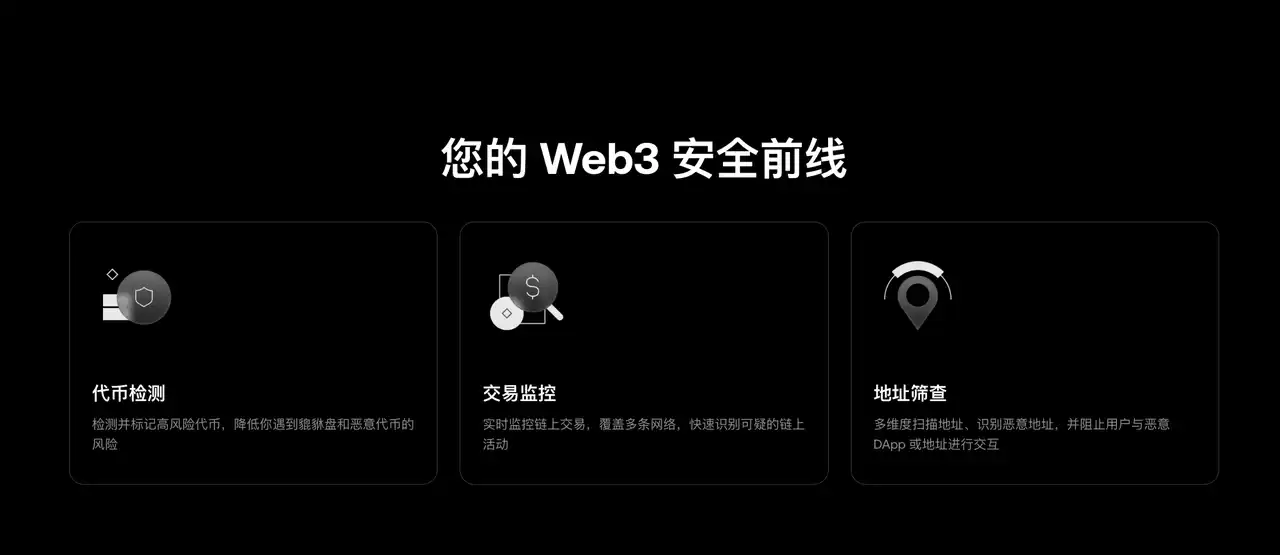
In this trend, the newly launched and upgraded security center page of the OKX wallet provides a typical example of "list-based expression." The page clearly outlines the security capabilities aimed at users as three "frontline defenses": Token risk detection, Transaction monitoring, and Address screening, each explained in a single sentence, such as "marking high-risk tokens to reduce exposure to honeypots and malicious parties," "real-time cross-chain monitoring to identify suspicious on-chain activities," and "intercepting interactions with malicious DApps and addresses." The benefit of this writing style is that even if users do not understand security terminology, they can quickly relate it to the actions they are currently taking—whether they should click, sign, or transfer.

Direct link: OKX Wallet Security Landing Page Audit Report

More importantly, "understandable" does not mean "self-explanatory." On the same page, the OKX wallet also provides an entry to "View audit reports," linking the "capability list" with "third-party verification." The audit report collection page in its help center further clarifies the scope of the audit, the number of issues found, and the status of fixes, allowing users to transition from "understanding capabilities" to "verifying evidence" when needed.

This shift from "security claims to understandable lists" has core value not in making security sound more grandiose, but in making it more executable: as scams increasingly rely on inducement and disguise, whether wallets can provide risk alerts at interaction points and clearly explain "where the danger is, why it is dangerous, and what you should do" is becoming part of security capabilities and increasingly determines whether users will fall into traps at critical moments.

Audit Information "Publicly Accessible": Transforming Third-Party Endorsements from "Having Links" to "Verifiable Evidence Chains"

In the wallet industry, there has long been a practical issue with audits: many projects indeed "conducted audits," but the information is scattered across announcements, PDFs, and social media shares, making it difficult for ordinary users to quickly understand "who audited, what was audited, whether it was fixed, and when it was updated." The more noticeable action taken by the OKX wallet this time is to centralize publicly available third-party audit reports into a unified entry and directly indicate on the page "published on November 11, 2022, updated on November 17, 2025," allowing users to quickly determine that this is not a one-time display but a continuously maintained information disclosure window.

From the publicly available entries on this collection page, the disclosure scope does not stop at the traditional audit subject of "smart contracts." For example, the entry from CertiK dated May 23, 2024, clearly covers key code paths for mobile and frontend: including iOS/Android components, frontend ReactJS UI components, and JS controllers interacting with keyrings, as well as multiple wallet SDK modules, while also providing the audit methods and conclusions.

On the same page, the entry from SlowMist is more aligned with the "new paradigm" of wallet evolution over the past two years—AA smart contract accounts, MPC keyless wallets, and Ordinals transaction modules are all listed as publicly auditable subjects; additionally, there is a separate entry for "private key security module" audit information, directly stating that "private keys or mnemonic phrases are only stored on the user's device and will not be sent to external servers," addressing users' core concerns about key security with clearer boundary descriptions.

The value of this "centralized display" lies not only in more comprehensive information but also in binding "new capabilities" with "verifiability" at the same entry: as the wallet industry increasingly moves towards complex architectures like AA and MPC, what users need most is not a statement of "we are secure," but quickly verifiable evidence—whether the audit scope covers key modules, what the methods are, whether risks have been closed-loop repaired, and whether information is continuously updated.

At the same time, according to the OKX wallet, after this upgrade, new audit reports and related information can be updated directly through configuration without the need for version releases. If this mechanism can operate stably over the long term, it effectively shortens the path to "externally verifiable" information, rather than just saving development and release costs.

For users, this means that when audits are added or fixes are completed, the public entry can more quickly reflect the "latest status," reducing uncertainty during critical risk windows where they "can only rely on forwarded screenshots/old links for judgment"; for third-party observers and researchers, it becomes easier to form a traceable timeline: which modules were audited when, what level of issues were found, when fixes were confirmed and publicly updated, thus truly transforming "third-party endorsements" into a continuously verifiable evidence chain rather than a one-time display of a PDF.

This article is from a submission and does not represent the views of BlockBeats.

免责声明:本文章仅代表作者个人观点,不代表本平台的立场和观点。本文章仅供信息分享,不构成对任何人的任何投资建议。用户与作者之间的任何争议,与本平台无关。如网页中刊载的文章或图片涉及侵权,请提供相关的权利证明和身份证明发送邮件到support@aicoin.com,本平台相关工作人员将会进行核查。

Share To
APP

X

Telegram

Facebook

Reddit

CopyLink