Preface: How Can We Manage Assets Besides Mnemonic Phrases?
For a long time, mnemonic phrases have been not only the only key to unlocking the Web3 door but also the biggest psychological burden for many users. We must carefully write down, verify, and store them because, in the traditional account model, losing the mnemonic phrase (private key) means permanently losing ownership of the assets.
While this strict rule establishes the cornerstone of decentralized security, it also creates a barrier to the widespread adoption of blockchain technology. So, is there a technology that can retain the core advantages of decentralization while making account management and recovery as easy as Web2 applications?
The answer is Account Abstraction (AA).
This technology is redefining the way digital assets are managed. imToken Web is a next-generation wallet product built on AA technology, attempting to tell users: a safer experience does not require you to be half a cryptographer. This article will explain the core logic of AA in simple terms and how it will change your digital life.
The "Impossible Triangle" of Traditional Accounts
To understand the value of AA, we first need to look at the commonly used account model—Externally Owned Accounts (EOA), which are the accounts you generate in wallets like the imToken App.
The design of EOA is very fundamental and rigid, with the core logic being "the private key is everything." Your private key is mathematically strongly bound to your account address. This architecture brings an irreconcilable contradiction: to ensure security (offline, cold storage), we often have to sacrifice convenience; and once we pursue convenience, we easily face the risk of private key leakage. More cruelly, this type of account has no "password recovery" option, resulting in a very low tolerance for error.
Additionally, EOA accounts have many interaction limitations, such as needing to use native tokens like ETH to pay for gas fees. For new users holding USDT but lacking ETH, this often becomes the first hurdle.
With the maturity of Layer2 networks significantly reducing on-chain costs, along with the finalization of the ERC-4337 standard and the implementation of the EIP-7702 protocol, AA technology has finally welcomed the opportunity for widespread adoption. It aims to break the aforementioned deadlock and liberate account control from the underlying cryptographic rules.
Basic Concept: From "Key" to "Smart Steward"
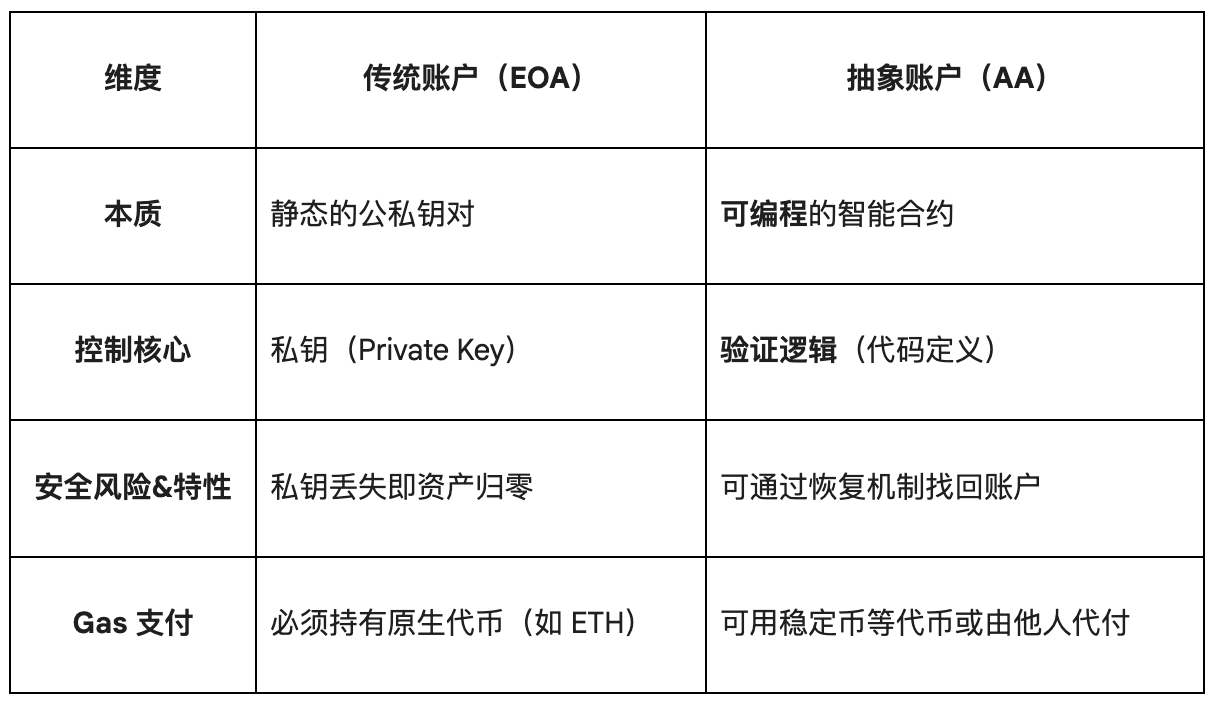
If we were to define AA (Account Abstraction) in one sentence, it would be: transforming accounts from "keys" into "smart stewards."
In the traditional EOA world, the rules are written at the blockchain protocol layer; once the private key signature matches, the transaction is executed. In the world of AA, the account itself is a smart contract deployed on the chain.
This means that the rules of the account are no longer fixed but are programmable. You can write various logics into the account, such as: "transfer only when conditions A and B are met," "transfer a maximum of 1000 U per day," "if I lose my key, allow my guardian to help me reset," and so on.
This shift achieves a decoupling of "ownership" and "signing authority." You still own the account, but the way you control the account becomes flexible and varied, no longer constrained by a single private key.
How Does AA Change Your User Experience?
We can look at its advantages from four dimensions: Verification (how to log in), Execution (how to trade), Fees (how to pay), and Evolution (how to grow).
1. Verification Logic: Say Goodbye to Mnemonic Phrases, Embrace Safer "Seamless" Login
The most intuitive change of AA is that it supports more advanced verification methods, freeing users from dependence on mnemonic phrases.
Hardware-Level Security Experience
In AA accounts (like imToken Web), you can use a Passkey to manage assets. This is a technology based on the WebAuthn standard, which utilizes the secure chip in your phone (iPhone/Android) or computer to generate and store keys.
In daily use, you only need to complete transaction signing through FaceID or fingerprint. This is not only more convenient than writing down mnemonic phrases but also more secure—because the private key is always stored in the hardware chip and never touches the internet. More importantly, passkeys have a natural anti-phishing feature. They strongly bind the key to the website domain, so even if a hacker forges a website, they cannot trick you into generating a valid signature.
Account Recoverability
In the AA model, losing a device no longer equals "digital death." Since the account is essentially a contract, we can preset logic to change the "lock core." For example, you can set your EOA wallet, social account, or friends and family as "guardians." When you cannot access the account, you can initiate a recovery request, and after confirmation from the guardian, you can reset control and recover your assets.
2. Execution Logic: From Complicated Commands to "Intent" Driven
Traditional on-chain interactions are often cumbersome. For instance, when buying coins on-chain, you usually need to first initiate an "Approve" transaction, wait for it to be on-chain; then initiate a "Swap" transaction and wait again. This not only wastes gas but also creates a fragmented experience.
AA supports Atomic Batching. Simply put, it can package multiple actions like "Approve" and "Swap" into one data packet. For users, you only need to click "Swap" once, and the backend will automatically handle all steps. These steps will either all succeed or all fail on-chain, avoiding the awkward situation of "approved but not swapped."
The extension of this capability is that the future of Web3 will move towards Intent-Centric. Users only need to express the intent "I want to swap A for B," without worrying about the underlying paths and complex steps. The AA account, combined with the backend solver network, will automatically find the optimal path and execute it for you.
3. Fee Logic: Breaking the Payment Barrier of Native Tokens
For new users, the most confusing aspect is: "I have 1000 U in assets, but I can't transfer a penny because my account has no ETH."
AA introduces a role called Paymaster (payment contract), which completely changes the logic of fee payment. It allows the application side to deploy a set of exchange rate calculation or subsidy logic on-chain:
- Token Paying Gas: You can directly use the tokens in your account (like USDC) to pay gas fees. The Paymaster will automatically exchange and pay ETH to the Bundler (like miners) in the background according to the exchange rate. This makes the payment experience in Web3 as natural as using a credit card, no longer limited to having to hold native tokens.
- Gasless: In certain scenarios (like new user registration, participating in events), project parties can even fully subsidize gas fees, so users are completely unaware of the existence of gas during interactions.
4. Evolution Logic: A Wallet That Grows with Demand
Traditional wallets often have fixed functions, while AA accounts, based on smart contracts, endow them with powerful modular capabilities. You can think of it as a steward that can continuously learn new skills and evolve based on your needs.
- Differentiated Services: A beginner may only need the simplest transfer and payment functions, with a clean interface that is easy to use.
- Function Expansion: As experience accumulates, when you need to participate in complex interactions or manage large assets, you can "configure" new modules for the account, such as adding multi-signature protection or setting daily spending limits.
This modular design makes AA accounts no longer a static tool but a smart platform that can flexibly combine to meet users' needs from beginner to advanced throughout their lifecycle.
The Future of EOA: Can Old Accounts Upgrade?
The innovative experiences mentioned above are primarily built on the ERC-4337 standard. It is currently the most mature AA path, but it usually requires users to create a brand new AA account.
You might ask: "I don't want to give up my old address that I've used for many years, nor do I want the hassle of migrating assets, what should I do?"
The EIP-7702 proposal provides the answer—it allows existing EOA accounts to achieve on-the-spot upgrades.
The core mechanism of EIP-7702 is code delegation. Traditional EOAs can only passively execute instructions signed by the private key, while EIP-7702 allows you to use a special signature to "mount" a piece of smart contract code during a transaction.
This means you still hold the original private key and address, but at the moment of the transaction, your account "transforms" into a programmable smart contract. This design cleverly breaks the limitation of EOA being non-programmable, allowing you to directly invoke various AA logics mentioned earlier without changing addresses, seamlessly accessing a more advanced interaction experience while maintaining asset sovereignty.
Conclusion: Making Wallets "Invisible"
The best form of technology is often one that users do not perceive the existence of.
In the EOA era, users are forced to understand obscure cryptographic concepts like private keys, Nonce, and Gas Price, just as if every internet user had to understand the TCP/IP protocol. The ultimate mission of AA technology is to make wallets "invisible" yet powerful.
Through passkeys, we no longer need to face unfamiliar mnemonic phrases; through Paymaster, we are no longer constrained by the barrier of gas fees; through modular design, wallets can grow with us. AA is not just a technological upgrade; it is the necessary path for Web3 to transition from a geek community to the general public.
免责声明:本文章仅代表作者个人观点,不代表本平台的立场和观点。本文章仅供信息分享,不构成对任何人的任何投资建议。用户与作者之间的任何争议,与本平台无关。如网页中刊载的文章或图片涉及侵权,请提供相关的权利证明和身份证明发送邮件到support@aicoin.com,本平台相关工作人员将会进行核查。


