Author: May P, Janus R
Source: CoinFound
Takeaway
- USDT Rating Downgrade and Controversy: The proportion of non-pegged assets (such as BTC and gold) in USDT reserves has reached about 24%, coupled with insufficient governance and transparency, leading to its perception as a heightened risk within traditional financial frameworks, resulting in a rating downgrade. The downgrade of USDT's rating has sparked controversy.
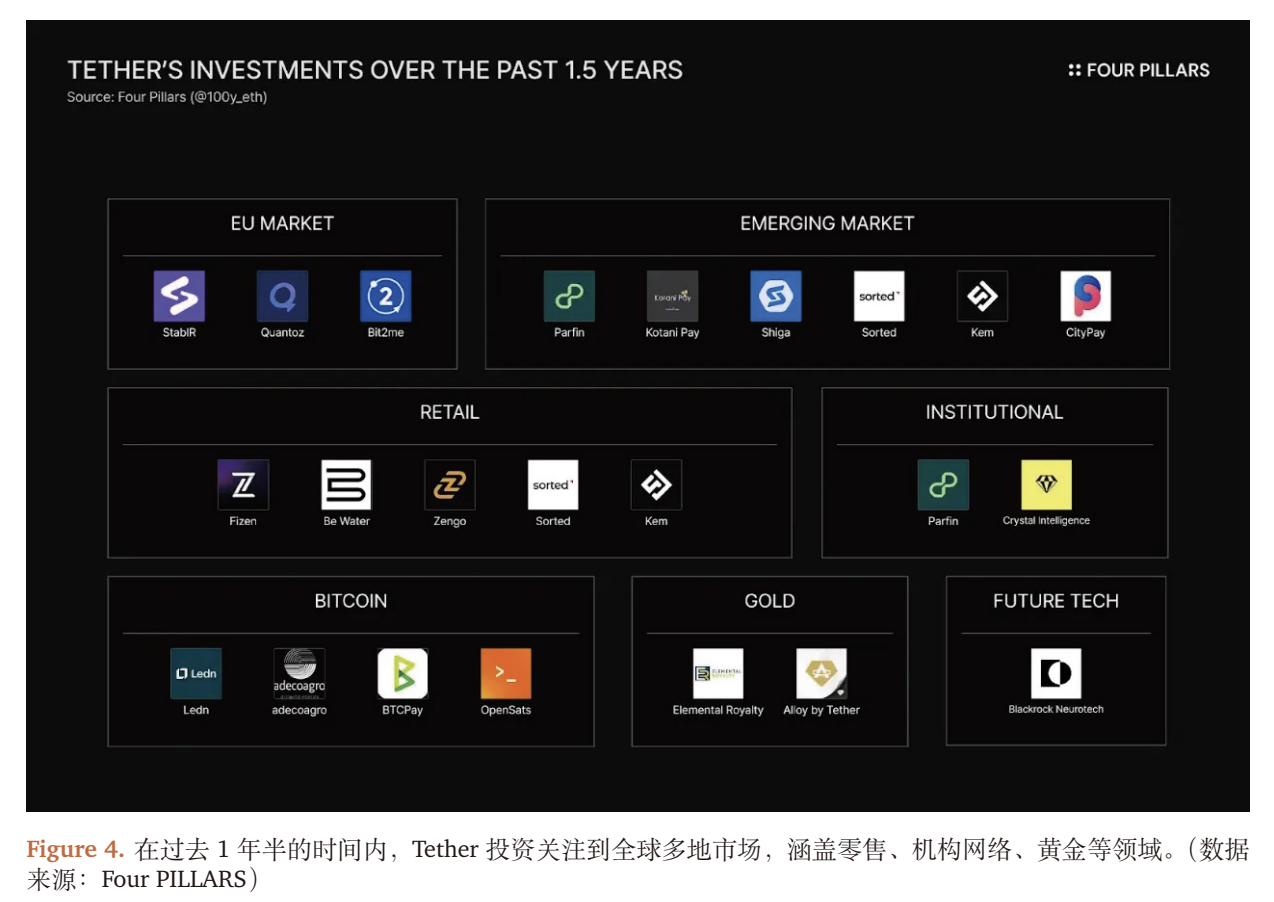
- Tether Significantly Increases Gold and Bitcoin Proportions: In response to inflation hedging, asset diversification, reducing single exposure to the dollar, and enhancing returns, Tether has continuously increased the proportion of gold and Bitcoin reserves in recent years.
- The Nature of the Discrepancy Between S&P and Tether: Traditional financial risk perception prioritizes "redemption capability," focusing on "the ability to liquidate reserves under extreme runs"; whereas Tether emphasizes "market liquidity first" and long-term value preservation and risk resistance (especially against inflation risk). The dimensions of risk assessment between the two are fundamentally different.
- Strategic Intent of Tether's Reserve Transformation: Tether's reserve model is shifting from a "1:1" cash equivalent reserve to a mixed model of "hard assets (gold) + digital assets (BTC) + low-risk assets (U.S. Treasuries)." Essentially, this is a transformation from a "stablecoin issuer" to a "global liquidity provider + digital asset reserve institution," driven by factors including inflation hedging demand, pro-cyclical yield enhancement (e.g., the anticipated BTC/gold bull market in 2025), and de-dollarization strategies. In fact, Tether is becoming more like a "shadow central bank" rather than just a simple stablecoin issuer.
- Limitations of the Current Rating System: S&P's "stability rating" covers "redemption risk," failing to address investors' demands for Tether's "asset appreciation capability" and "cyclical resilience." The market may require more multidimensional risk rating information in the future, and perhaps a dual-framework model of "stability rating (regulatory + redemption) + investment risk rating (returns + cycles)" to bridge the risk perceptions of traditional and crypto finance.
- Short-term Risks and Long-term Trends of USDT: The anchoring stability of USDT is still supported by on-chain liquidity. However, in the short term, the 24% high-volatility assets (BTC/gold/loans) in reserves may expose risks during the 2026 interest rate cut cycle and potential crypto bear market (in 2025, Tether's balance sheet may show huge unrealized gains from holding gold and Bitcoin reserves, but the situation may change in 2026). In the long term, the trend of "central bank-like" stablecoins (anti-inflation assets + global networks + energy) will drive the industry towards "transparency + standardization."
1. Event Review: The Controversy and Essence of S&P's Downgrade of USDT
1.1 Event Timeline and Core Contradictions
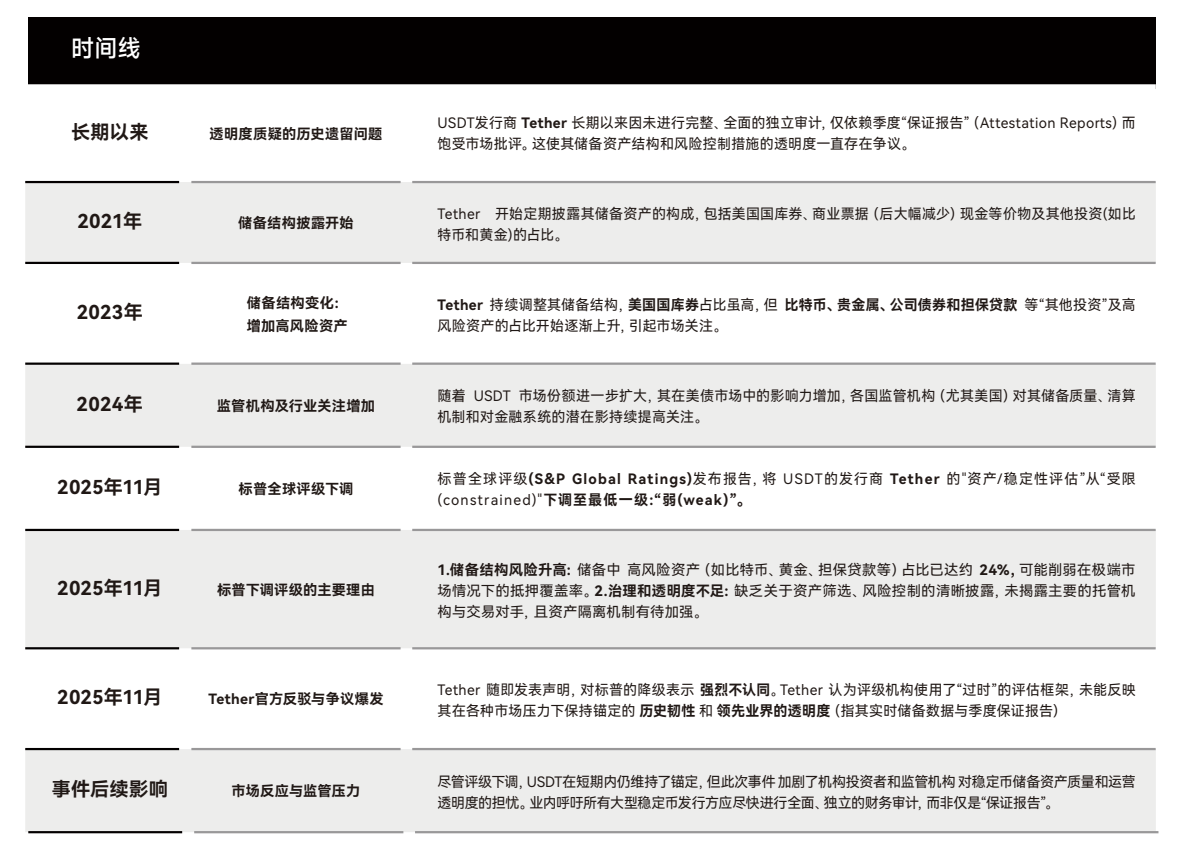
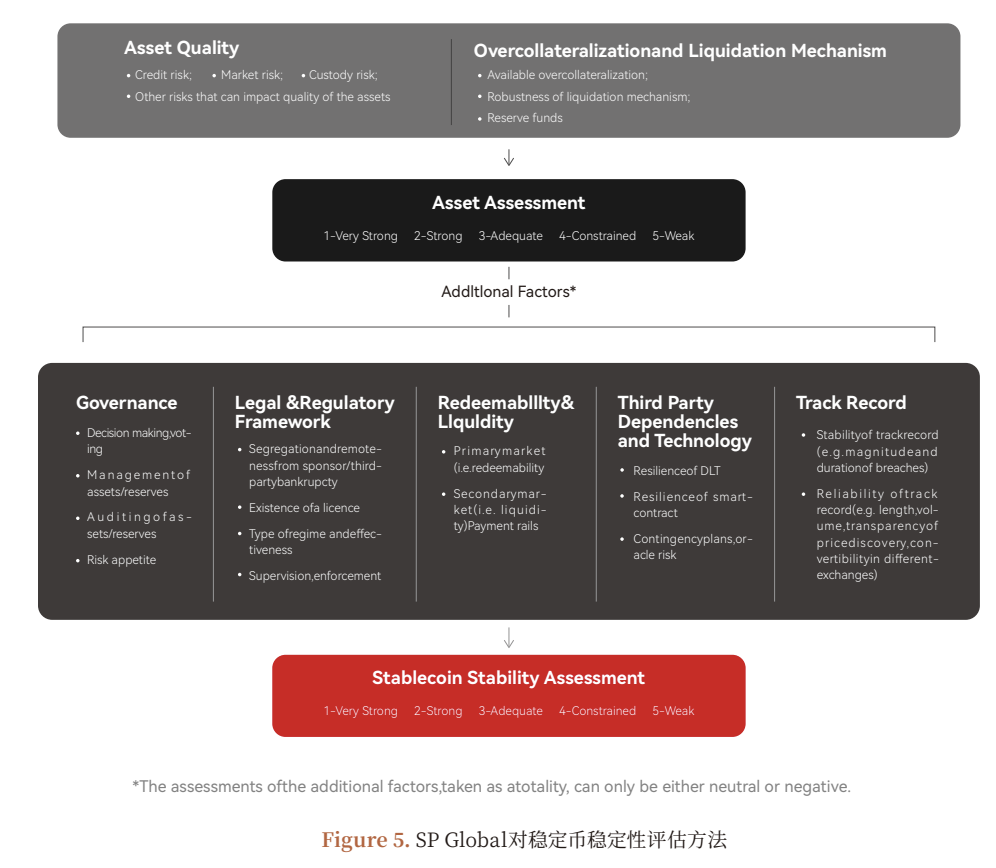
In November 2025, S&P Global downgraded USDT's "asset/stability assessment" from "constrained" to "weak," with two core reasons:
- Reserve Structure Risk: The proportion of high-volatility assets (BTC, gold, loans, etc.) in Tether's reserves has reached 24% (up from only 12% in 2023), and such assets cannot be quickly liquidated in a "panic run" scenario;
- Insufficient Governance Transparency: Key custodian information and details of on-chain collateral isolation mechanisms have not been disclosed, and only "quarterly assurance reports" are provided instead of complete independent audits.
Tether's counterattack focuses on "actual market performance" and questions the rating methods from the traditional financial system:
- Historical Resilience: USDT maintained its peg during eight extreme events, including the FTX collapse in 2022, the Silicon Valley Bank crisis in 2023, and tightening crypto regulations in 2024;
- Leading Transparency: Since 2021, Tether has provided "real-time reserve data" (on-chain addresses can be checked), with quarterly assurance reports covering over 95% of assets, outperforming some traditional money market funds.

(Figure 1: Review of the USDT Rating Downgrade Event)
1.2 The Essence of the Discrepancy: A Collision of Two Risk Measurement Systems
In November 2025, S&P Global Ratings downgraded USDT's stability assessment to the lowest level of "weak." Tether immediately publicly countered, accusing S&P of "using an outdated framework" and ignoring the multiple extreme stress tests USDT has undergone over the past decade. This debate is not just a rating controversy but a direct clash of two financial civilizations.
- S&P represents: "Regulation - Capital Adequacy - Redemption Capability"
- Tether represents: "Market Liquidity - Global Trading Demand - On-chain Instant Settlement"
- The ways in which these two measure risk are fundamentally different, making consensus impossible. The argument between S&P and Tether appears to be a "stability rating" spat, but in essence, it reflects two entirely different understandings of risk.
- S&P and Tether come from different backgrounds: one from 100 years of traditional finance, the other from 10 years of on-chain high-frequency markets. S&P uses the logic of "central banks - banks - money market funds"; Tether relies on the logic of "on-chain liquidity - perpetual leverage - insurance funds - automatic liquidation."
The logic represented by Tether is currently not adoptable by traditional financial markets.
1.3 What S&P Sees: The Redemption Logic of Traditional Finance
In the cognitive framework of traditional finance, all "1:1 redeemable instruments" (money market funds, commercial banks, stablecoins) must meet two hard conditions:
Reserve assets must be highly secure and immediately liquidatable: S&P points out in its report that the proportion of BTC, gold, and loan-type assets in Tether's reserves has exceeded 20%, and these assets are volatile with long liquidation cycles, potentially unable to be quickly sold at face value in a "panic run" scenario.
Governance structure must be transparent, and custodial arrangements must be penetrable: S&P believes that Tether's custodian information, on-chain collateral isolation, and risk disclosures are still insufficient.
In other words, in S&P's world: the key risk of a "stablecoin" lies in whether it can withstand the moment when everyone comes to redeem it. This is the redemption stability of the traditional system.
1.4 What Tether Insists: The Liquidity Logic of the Crypto World
If the stability of TradFi comes from "whether reserves are sufficient, fast enough, and safe enough," then Tether's stability comes from "whether I can maintain massive liquidity on-chain, whether the risks of the perpetual market can be absorbed, and whether the secondary market can maintain price anchoring." In other words:
- TradFi measures stability by redemption capability, while Crypto measures stability by market liquidity + liquidation stability.
- Tether's decade-long record (including multiple panic situations) indeed shows that USDT's de-pegging is often not due to "insufficient reserves," but rather because of "temporary imbalances in secondary market liquidity," which are quickly rectified each time.
Why does Tether strongly counter? Because it adheres to a different "market logic." Tether's response emphasizes three points:
USDT has maintained a 1:1 peg under all extreme emotions: This includes multiple exchange collapses, rapid interest rate hikes by the Federal Reserve, regulatory tightening, and bank run events. From Tether's perspective, "I am not theoretically stable; I have actually operated for ten years without de-pegging. The true rating of a stablecoin is given by the market every day, not by models."
Real-time reserve data + quarterly assurance reports are sufficiently transparent: Tether believes it has outperformed some traditional shadow banks or MMFs. However, S&P does not recognize the form of "real-time web disclosure," as S&P's methodology considers "unaudited transparency to be credible transparency."
BTC/gold are "anti-inflation assets + strategic reserves," not high-risk exposures: The significant rise in BTC and gold in 2025 has led Tether to achieve substantial unrealized gains (over $10 billion). This has effectively formed a "hard assets + U.S. Treasuries + loans + digital assets" hybrid central bank-like model. Tether's worldview is "I am like a central bank reserve of a country; my structure is not the traditional dollar system but a new global asset basket." But S&P's worldview is "you are not a central bank; you are just a token issuer promising 1:1 redemption."
1.5 Why is There a Complete Conflict in Understanding "Risk" Between Both Parties?
It reveals a key fact: the crypto market and TradFi have completely different logics of risk-bearing.
- Arthur Hayes published an article on perpetual contracts on November 27, which is a typical example of how traditional finance and crypto finance cannot currently merge. In traditional finance (TradFi), the risk of forward contracts comes from "unlimited liability." In TradFi, if liquidation is not timely, positions are liquidated, and investors lose to negative numbers, they need to continue to add money (Margin Call), even using all personal assets to repay debts. Therefore, TradFi must require reserves of "extremely high-quality assets"; any volatility is unacceptable.
- However, in crypto finance (Crypto), risk is borne by "insurance funds + automatic liquidation + ADL." This is because, in crypto perpetual contracts, losses do not carry unlimited liability for traders. In the crypto finance system, liquidation surpluses replenish insurance funds, liquidation fees are injected into insurance funds, ADL (automatic deleveraging) provides a safety net, and exchanges use their own funds to supplement. The end result is that crypto users can only lose their margin but will not incur debt. Therefore, the crypto market can accept high-volatility assets more readily because there is a market structure to back it up.
This is the essence of the disagreement between S&P and Tether: S&P measures the risk of TradFi, which is "if everyone comes to redeem, can you pay out?" Tether addresses the risk of Crypto, which is "in a 7 x 24 high-volatility market, can I ensure trading, liquidity, and global high-frequency usage?" The two are not measuring risk on the same dimension.
2. Tether's Reserve Transformation: The Strategic Logic from "Stablecoin" to "Shadow Central Bank"
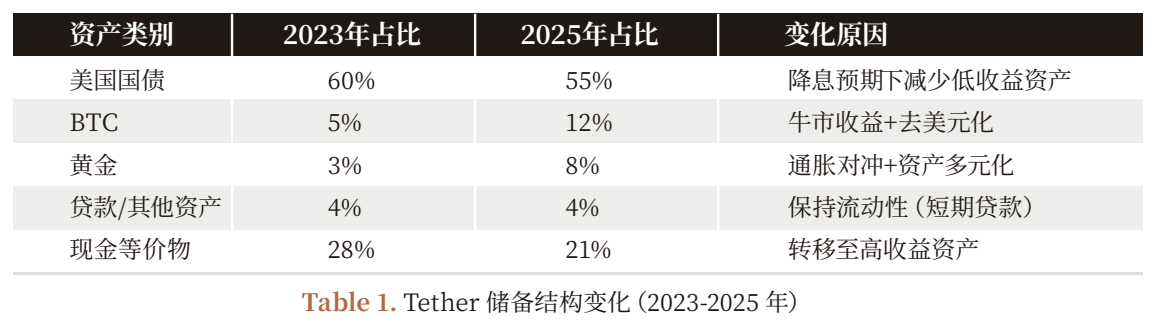
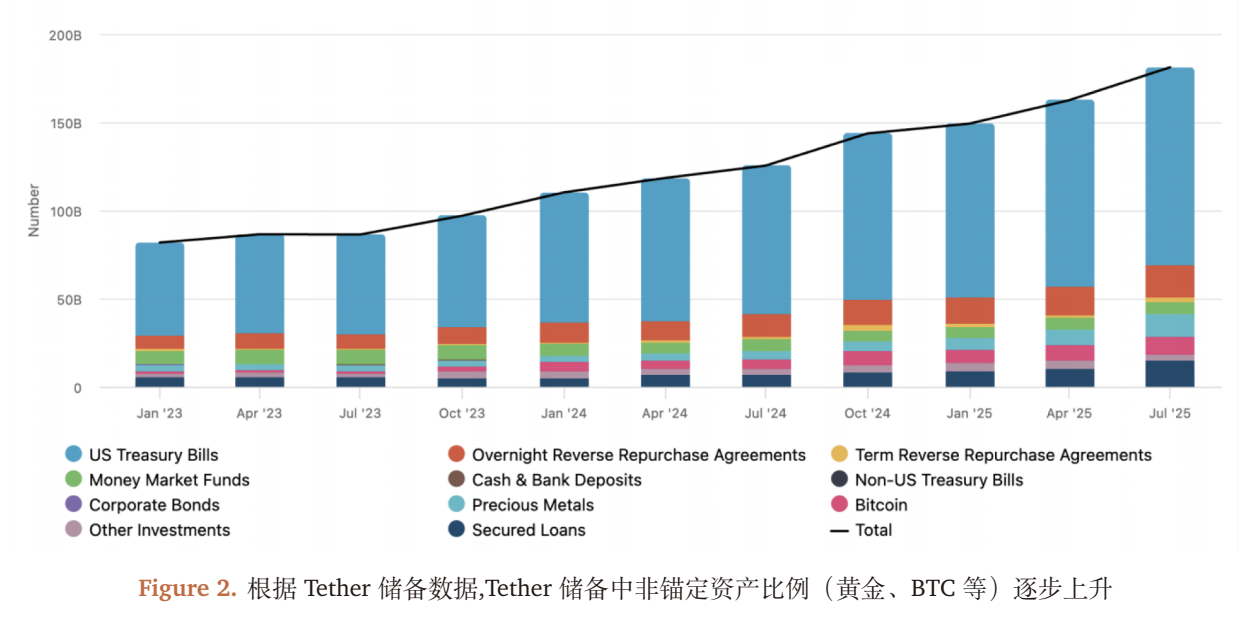
2.1 Time Series Changes in Reserve Structure (2023-2025)


2.2 Why Increase the Proportion of BTC and Gold? Balancing Pro-Cyclical Returns and Long-Term Strategy
Tether's reserve structure transformation (2023-2025) is not random but is based on a "return - risk - strategy" triple consideration:
Inflation Hedging Demand: The Federal Reserve's interest rate hikes from 2022 to 2024 have led to a decline in the purchasing power of the dollar (U.S. CPI rose from 2% to 8%), making gold (a traditional inflation hedge) and BTC (digital gold) core assets for hedging against inflation;
Pro-Cyclical Yield Enhancement: In 2025, the price of BTC rose from $40,000 to $65,000 (an increase of 62.5%), and gold rose from $1,900/ounce to $2,500/ounce (an increase of 31.6%). Tether's unrealized gains accounted for 70% of its net profit ($10 billion) in the first nine months of 2025 (with U.S. Treasury interest contributing only $3 billion);
De-Dollarization Strategy: The proportion of Tether's dollar reserves decreased from 75% in 2023 to 55% in 2025, by increasing the proportions of gold and BTC to reduce exposure to a single dollar asset (in response to the U.S. debt ceiling crisis and the global de-dollarization trend).
2.3 The "Sweetness and Hidden Dangers" of Profit Structure: Risks Under Pro-Cyclical Conditions
Tether's performance in 2025 (net profit exceeding $10 billion in the first nine months) appears impressive, but its profit structure is highly dependent on the "bull market cycle":
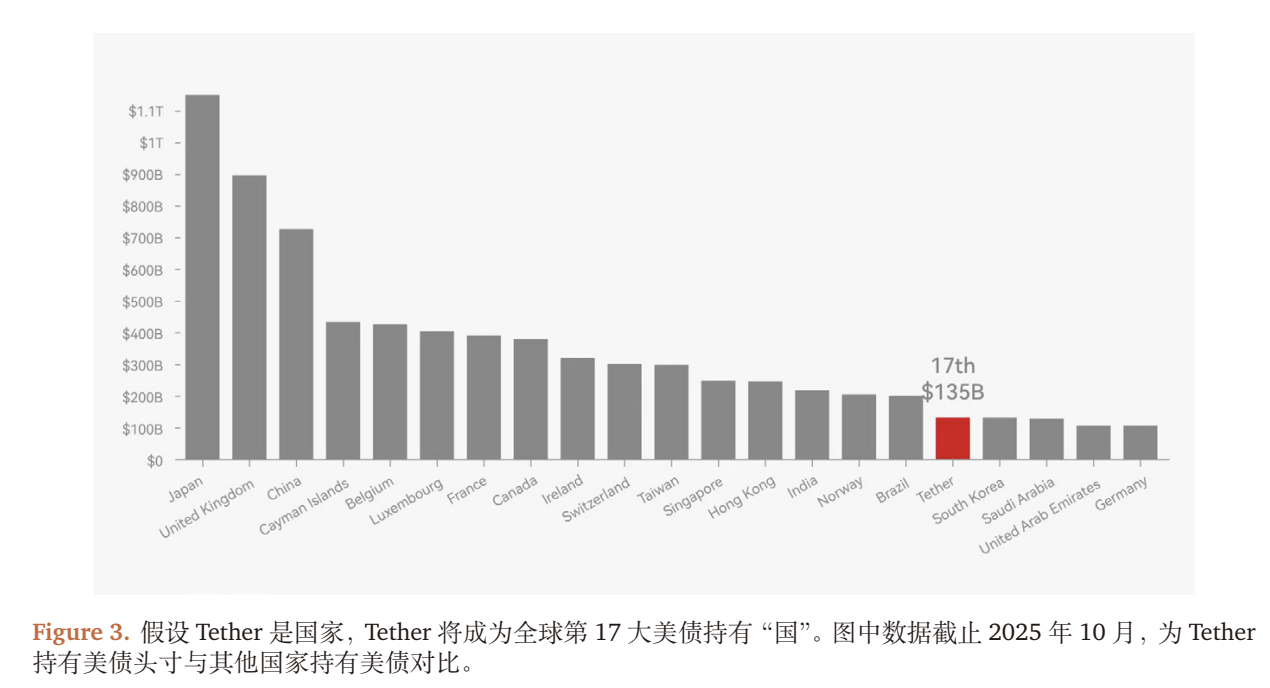
- Stable Income: Interest income from approximately $135 billion in U.S. Treasuries (with a 1-year yield of about 2.2% in 2025) contributes about $3 billion;
- Floating Income: Unrealized gains from BTC (about 100,000 coins) and gold (about 10 million ounces) contribute about $7 billion (corresponding to BTC rising by $25,000/coin and gold rising by $600/ounce).
Risk Transmission Mechanism:
- If the Federal Reserve cuts interest rates by 25 basis points in 2026 (market consensus), Tether's interest income from Treasuries will decrease by $325 million/year ($135 billion * 0.25%);
- If the price of BTC drops by 20% (returning to $52,000) and gold drops by 10% (returning to $2,250/ounce), Tether's unrealized gains will shrink by about $2.5 billion (BTC depreciation of $250 million + gold depreciation of $2.25 billion);
- If the crypto market enters a bear market (as in 2022), the issuance of stablecoins will contract (in 2022, USDT issuance fell from $80 billion to $60 billion), and Tether's Treasury holdings will decrease, further compressing interest income.
2.4 The Ultimate Goal of Strategic Transformation: From "Stablecoin" to "Shadow Central Bank"
By tracking Tether's on-chain addresses and business layout, we find that it has surpassed the positioning of a "stablecoin issuer" and is building a "shadow central bank" system of "anti-inflation asset reserves + global stablecoin issuance + on-chain distribution network + energy":
- Anti-Inflation Asset Reserves: BTC and gold account for 24%, corresponding to "central bank foreign exchange reserves";
- Global Stablecoin Issuance: USDT accounts for 70% of the total stablecoin trading volume in on-chain transactions across 150 countries, corresponding to "central bank fiat currency issuance";
- On-Chain Distribution Network: Collaborating with over 200 exchanges/DeFi protocols such as Binance and Uniswap to achieve global instant transfers of USDT;
- Energy Layout: Investing $1 billion in Bitcoin mining farms (with a hash rate accounting for 5% of the global total in 2025) to hedge against energy costs of BTC mining.


2.5 Market Performance: The Anchoring Stability and Liquidity of USDT
- Anchoring Deviation: From 2023 to 2025, the average price deviation of USDT (the price difference with the dollar) is only 0.02%, far lower than USDC (0.05%) and DAI (0.1%);
- On-Chain Liquidity: The liquidity pool of USDT on Uniswap V3 reached $5 billion (only $1 billion in 2023), with market makers' bid-ask spreads stabilizing within 0.01%;
- Institutional Holdings: The proportion of USDT held by institutions increased from 15% in 2023 to 30% in 2025, indicating that institutions view USDT as "a combination tool with liquidity and asset appreciation (rather than just a stablecoin)."
3. Future Outlook: The Evolution Direction of Stablecoin Rating Systems
3.1 Limitations of the Current Rating System: Only Covers Redemption Risk
S&P's stability rating addresses the question of whether stablecoins can be redeemed, but it cannot respond to the core needs of institutional investors:
- Quality of Returns: Is Tether's profit sustainable? (e.g., decline in returns after Treasury rate cuts)
- Exposure Risk: Is the proportion of BTC and gold too high? (e.g., the impact of a 20% drop in BTC on reserves)
- Operational Risk: Is Tether's governance transparent? (e.g., the safety of custodial assets)

3.2 Beyond the Current Rating System
In the future, the crypto market may require a more comprehensive rating system that not only focuses on redemption and stability. The potential rating design may include:
Stability Rating (Upgrade of Existing Framework)
- Core Indicators: "Safety coefficient" of reserve assets (proportion of cash equivalents), "liquidity coefficient" (liquidation cycle of high-volatility assets), "transparency coefficient" (coverage of independent audits, disclosure of custodial information);
- Goal: To answer the question of "Can stablecoins maintain redemption during extreme runs?"
Investment Risk Rating (New Framework)
Core Indicators:
- Quality of Returns: Proportion of stable income (Treasury interest) (>=50% as "low risk");
- Exposure Management: Proportion of high-volatility assets (=10% as "low risk");
- Operational Risk: Profit growth rate of the issuer (>=10% as "stable"), regulatory compliance (e.g., U.S. MSB license, EU MiCA certification);
- Goal: To answer the question of "Can the issuer of stablecoins sustain operations, and can its reserve assets appreciate?"
3.3 Industry Trends: From "Controversy" to "Standards"
The controversy between S&P and Tether is essentially about the "rule output" of traditional finance to the crypto market. We judge that:
- Short-term: Regulation will drive the "mandatory transparency requirements" for stablecoins (e.g., the U.S. Stablecoin Act requires 100% cash equivalent reserves, and the EU MiCA requires complete audits);
- Medium-term: The rating system will develop, and ratings will not be limited to the "regulatory-capital adequacy-redemption capability" framework. Institutional investors will stabilize stablecoins based on "stability ratings + investment risk ratings" in different scenarios;
- Long-term: Stablecoins may further differentiate into "pure stable tools" (e.g., USDC, 100% cash equivalents) and "stable tools with appreciation" (e.g., USDT, mixed reserves) to meet the needs of different investors.
Risk Warning
Price Volatility Risk of Reserve Assets: A decline in BTC and gold prices will lead to a depreciation of Tether's reserves, affecting redemption confidence;
Regulatory Policy Risk: If the U.S. and EU require stablecoins to hold 100% cash equivalents, Tether will need to sell BTC and gold, leading to a significant decline in profits;
Market Liquidity Risk: In extreme market conditions (e.g., the 2022 FTX collapse), depletion of on-chain liquidity may lead to USDT de-pegging;
Operational Management Risk: Insufficient governance transparency of Tether may trigger internal operational risks (e.g., custodial assets being stolen).
Download Link for the Research Report "USDT Rating Controversy": https://app.coinfound.org/research/1
Website: https://dataseek.coinfound.org/
X: https://x.com/CoinfoundGroup
Analyst Statement: This report is based on publicly available information and reasonable assumptions and does not constitute investment advice. The analyst does not hold positions in Tether or USDT.
Copyright Statement: This report is copyrighted by Coinfound.
About CoinFound
CoinFound is a data technology company focused on TradFi Crypto for institutional and professional investors, providing RWA asset data terminals, RWA asset ratings, Web3 risk relationship maps, AI analysis tools, and customized data services. From data integration and risk identification to decision support, it helps institutions obtain key intelligence at lower costs and higher efficiency, transforming it into actionable insights to build a global RWA underlying infrastructure.
免责声明:本文章仅代表作者个人观点,不代表本平台的立场和观点。本文章仅供信息分享,不构成对任何人的任何投资建议。用户与作者之间的任何争议,与本平台无关。如网页中刊载的文章或图片涉及侵权,请提供相关的权利证明和身份证明发送邮件到support@aicoin.com,本平台相关工作人员将会进行核查。