Gate Research Institute: BTCFi's diffusion drives Starknet's upward momentum, high-performance L1 and on-chain finance narrative heating up.

CN
18 hours ago

On-chain Data Summary

Overview of On-chain Activities and Fund Flows

To accurately assess the real usage of the blockchain ecosystem, this section will delve into several key on-chain activity indicators, including daily transaction volume, Gas fees, active addresses, and net flow of cross-chain bridging, covering multiple dimensions such as user behavior, network usage intensity, and asset liquidity. Compared to merely observing fund inflows and outflows, these on-chain native data can more comprehensively reflect the fundamental changes in the public chain ecosystem, helping to determine whether the capital flow is accompanied by actual usage demand and user growth, thereby identifying networks with sustainable development potential.

Transaction Volume Analysis: Solana Remains Strong, Mainstream Public Chains Maintain Steady Activity

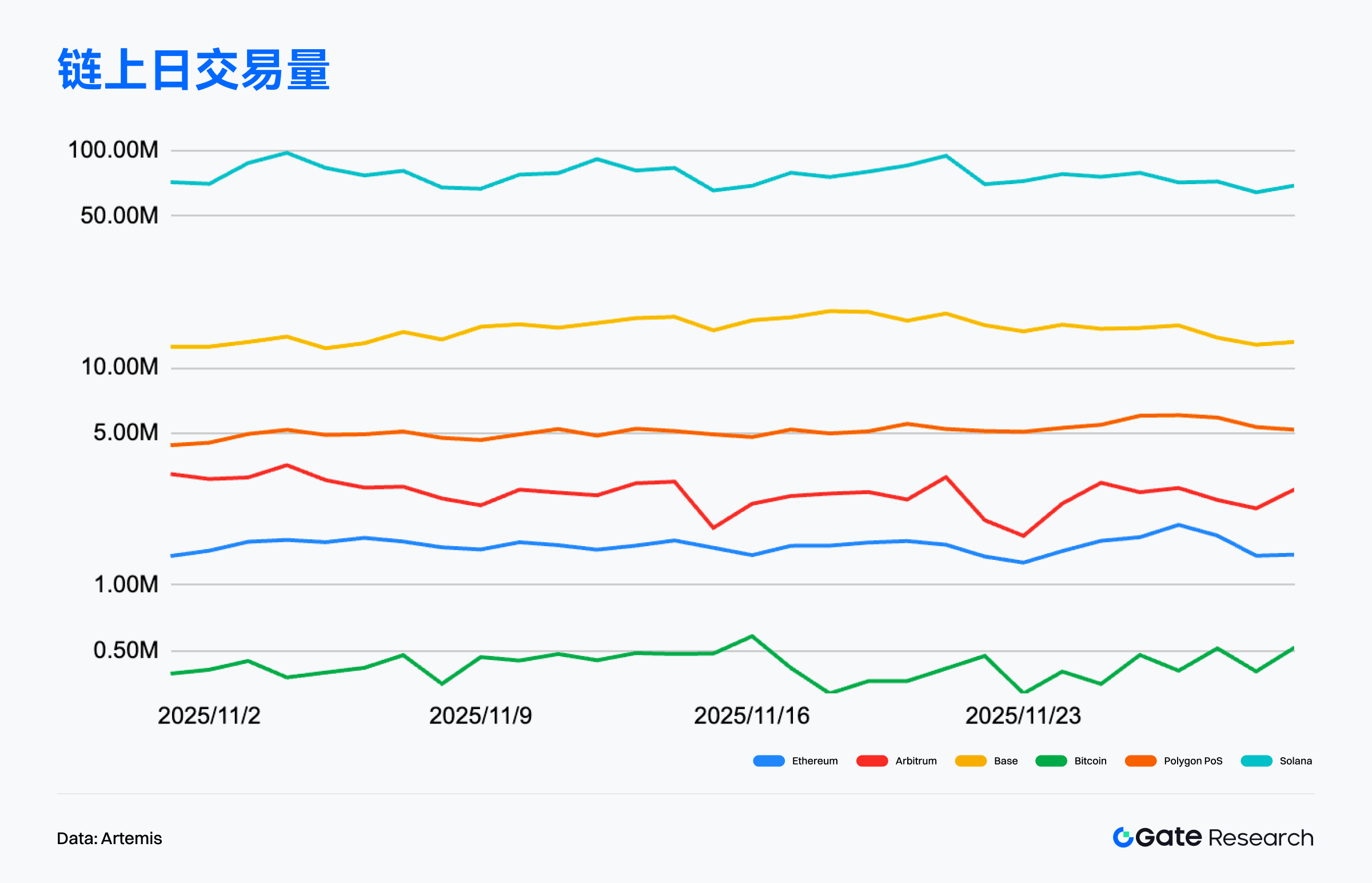
According to Artemis data, in November, the on-chain transaction activities of several mainstream public chains maintained a moderate upward trend, showing a structural pattern dominated by high-performance public chains and a gradual recovery of Layer 2. From a trend perspective, Solana maintained a significant lead throughout the month, with daily transaction volumes mostly falling within the range of 70 million to 100 million, and it experienced multiple spikes in the middle and at the end of the month, indicating that its high-frequency interactive applications continue to support ecosystem activity, even during market fluctuations, with usage intensity remaining stable.【1】

Base showed a gentle upward trend overall, with transaction volumes gradually increasing from about 10 million in September to the range of 12 to 14 million in November, reflecting a relatively stable monthly structure that indicates its social and lightweight application ecosystem continues to generate robust interaction demand. In contrast, Arbitrum's on-chain transaction volume exhibited a typical sideways fluctuation structure over three months: it fluctuated repeatedly within the range of 2.5 to 4.5 million but did not show a sustained upward trend. From a mid-term structural perspective, Arbitrum did not exhibit the "continuous warming" or "significant recovery in transactions" commonly described in market narratives, but rather maintained a weak sideways fluctuation, with ecosystem activity remaining stable but not expanding.

Overall, the transaction volume structure over the past three months shows the following characteristics: Solana remains solid at a high level, demonstrating a strong trend that ignores market fluctuations. Base shows a slight upward mid-term trend, with ongoing ecosystem diffusion effects. This may indicate that the layering of on-chain activities remains clear, with high-performance chains driving overall traffic, and only Base showing structural improvement among Layer 2, while Arbitrum is currently closer to a "stable but not expanding" state, suggesting that the market should avoid overinterpreting its short-term fluctuations as a trend recovery.

Active Address Analysis: Solana Leads Strongly, Arbitrum Maintains Low Fluctuation

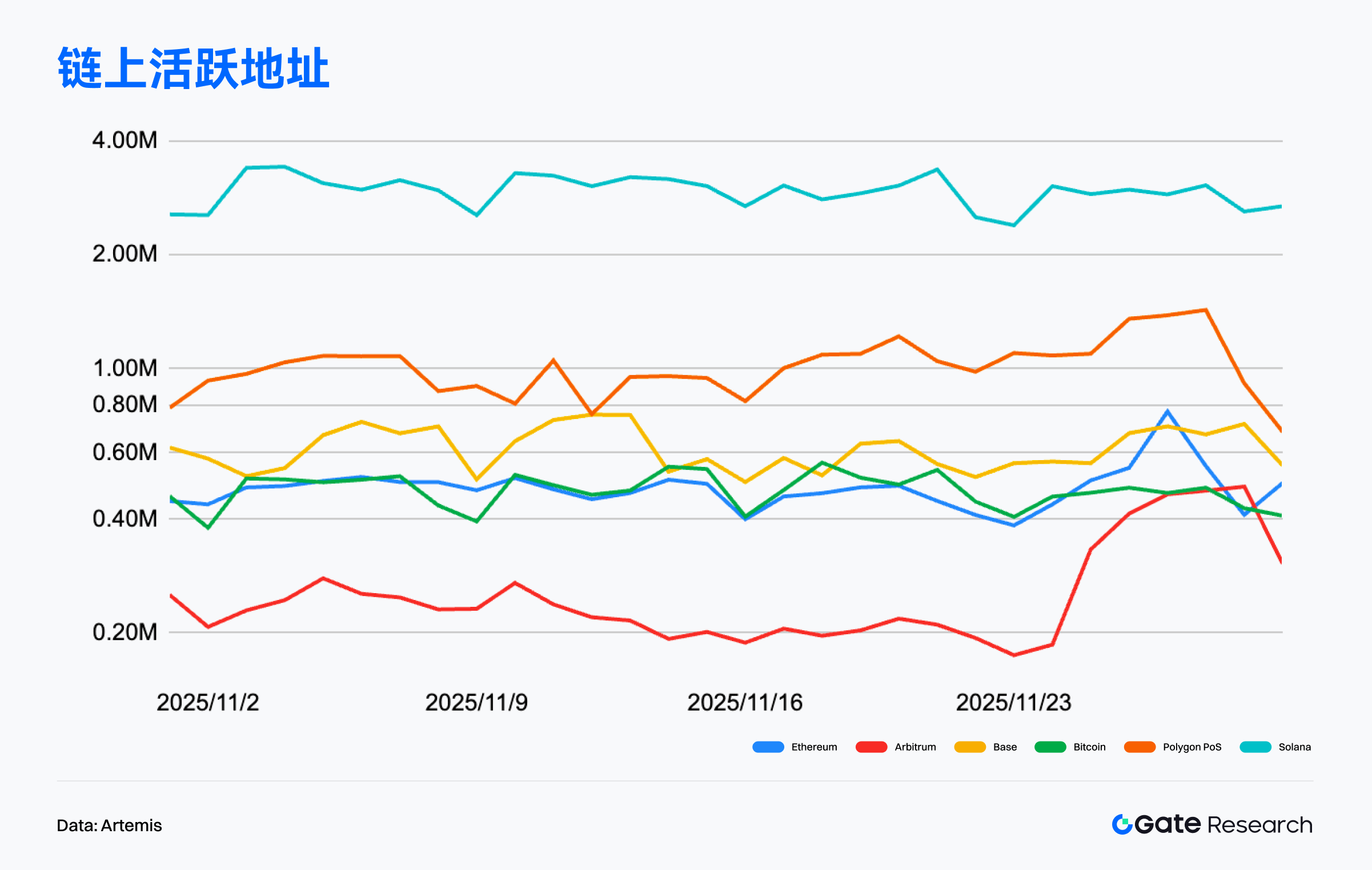
According to Artemis data, in November, the overall active addresses across multiple chains maintained a stable pattern, but the structural differences between different public chains became more pronounced. Solana significantly leads with an average of 2.5 to 3.5 million active addresses per day, showing periodic fluctuations but overall maintaining high-level operation, reflecting the stickiness and high-frequency interaction characteristics of its application ecosystem.【2】

Polygon PoS performed steadily in November, with active addresses mostly falling within the range of 800,000 to 1.2 million, and at the end of the month, it briefly surpassed 1.3 million, making it one of the most active main chains aside from Solana. Base followed closely, with daily active addresses around 550,000 to 750,000, showing a stable structure that reflects its social and lightweight application ecosystem's continued attractiveness. Arbitrum, on the other hand, exhibited more pronounced low-level fluctuations, with active addresses gradually declining from about 250,000-300,000 at the beginning of the month to a low point of 180,000-200,000 in the middle of the month. Although there was a rebound at the end of the month, it remained in a low-level fluctuation range overall. Compared to other chains, Arbitrum's user interaction heat in November was relatively weak, indicating that some activities may have temporarily shifted to ecosystems like Base and Polygon.

Overall, the on-chain activity in November displayed a clearly layered structural pattern, with Solana firmly occupying the absolute leading position in high-frequency interaction scenarios, far exceeding other public chains; Polygon PoS remained stable above Base, indicating that its ecosystem still has a robust and continuously expanding user base. The main chains Ethereum and Bitcoin maintained stable operations, with no significant expansion or contraction in activity, continuing to play a core role in value settlement and system stability. In contrast, Arbitrum's activity significantly declined this month, remaining in a cyclical low-level fluctuation, indicating a phase of cooling in the heat of some Layer 2 ecosystems. Overall, high-performance chains continue to dominate high-frequency interactions, mid-tier chains expand steadily, while some Layer 2s enter a correction phase, making the layering trend of the multi-chain ecosystem clearer.

On-chain Fee Revenue Analysis: Ethereum and Solana Remain at the Top, Base Experiences Increased Volatility

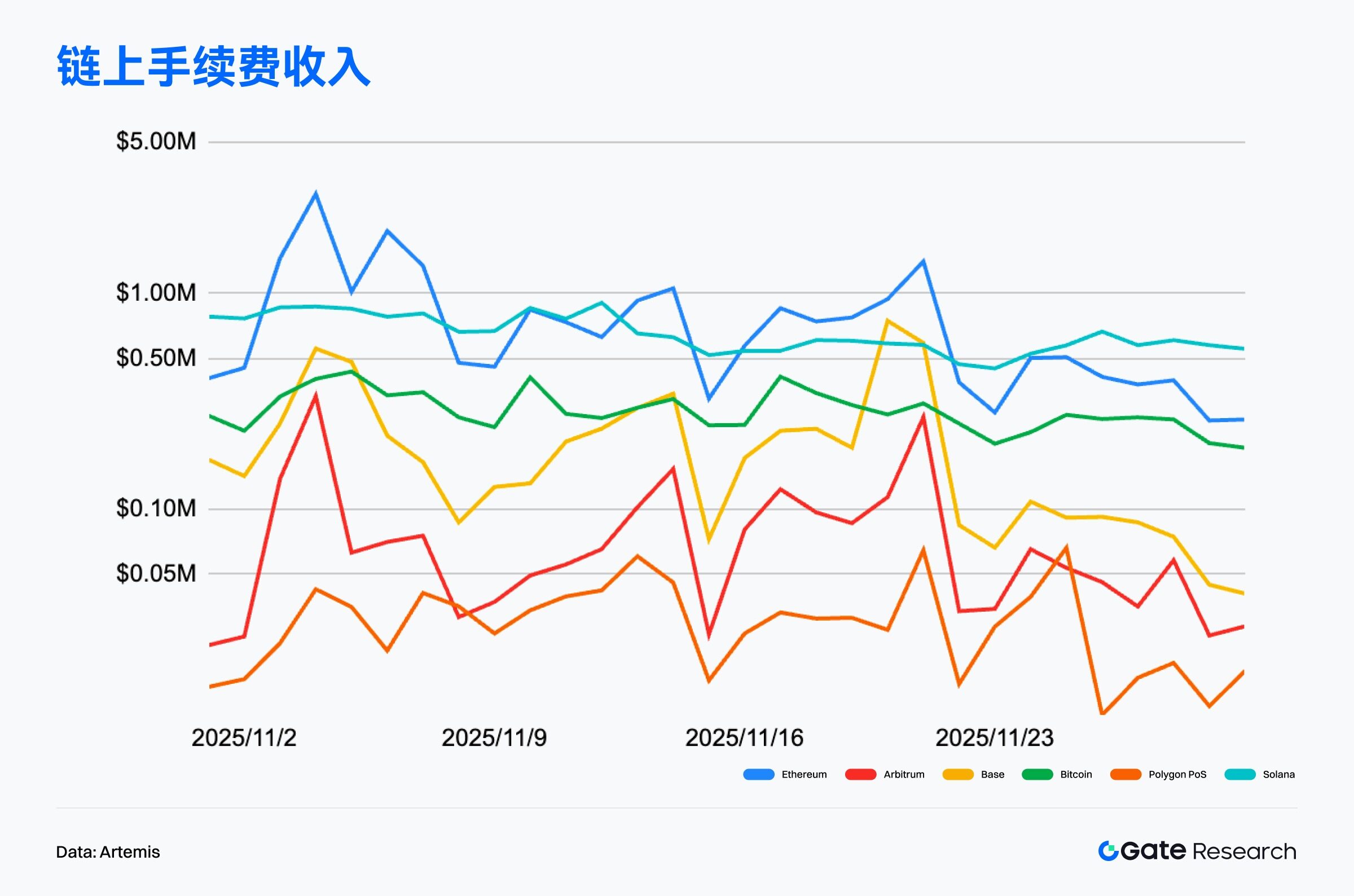
According to Artemis data, in November, the fee revenue of mainstream public chains exhibited a structural pattern of "high-value chains leading steadily, mid-tier chains experiencing weakened volatility." Ethereum's revenue throughout the month was significantly higher than that of other chains, with daily fees mostly falling within the range of $500,000 to $1.5 million, and it experienced notable peaks at the beginning, middle, and end of the month, making it the core chain that best reflects changes in market activity. Its fee structure remains dominated by DeFi liquidations, high-value transfers, and contract calls, solidifying its position as the economic center of the mainnet.【3】

Solana continues to hold the second tier, with fee revenue mostly concentrated in the range of $800,000 to $1 million, showing relatively limited overall volatility. Even with changes in market sentiment, its high-frequency trading, DEX activities, and application interactions continue to contribute stable revenue. Compared to the first two, Base exhibited more significant volatility in November, with daily fee revenue rising from below $100,000 to short-term peaks of $400,000 to $600,000 multiple times, and at the end of the month, it even reached a peak of over $700,000, indicating that certain protocols or trading activities within its ecosystem may periodically amplify on-chain fees.

Overall, the fee revenue structure in November displayed a clear layering, with Ethereum and Solana leading steadily, Base experiencing periodic spikes amidst volatility, while Polygon and Arbitrum remained hovering at low levels. Overall fee revenue did not show sustained expansion, indicating that the on-chain economy relies more on specific event-driven factors rather than structural growth in a low-volatility market.

Public Chain Fund Flow Divergence: Arbitrum Continues to Lead, Starknet and BTCFi Narratives Rise

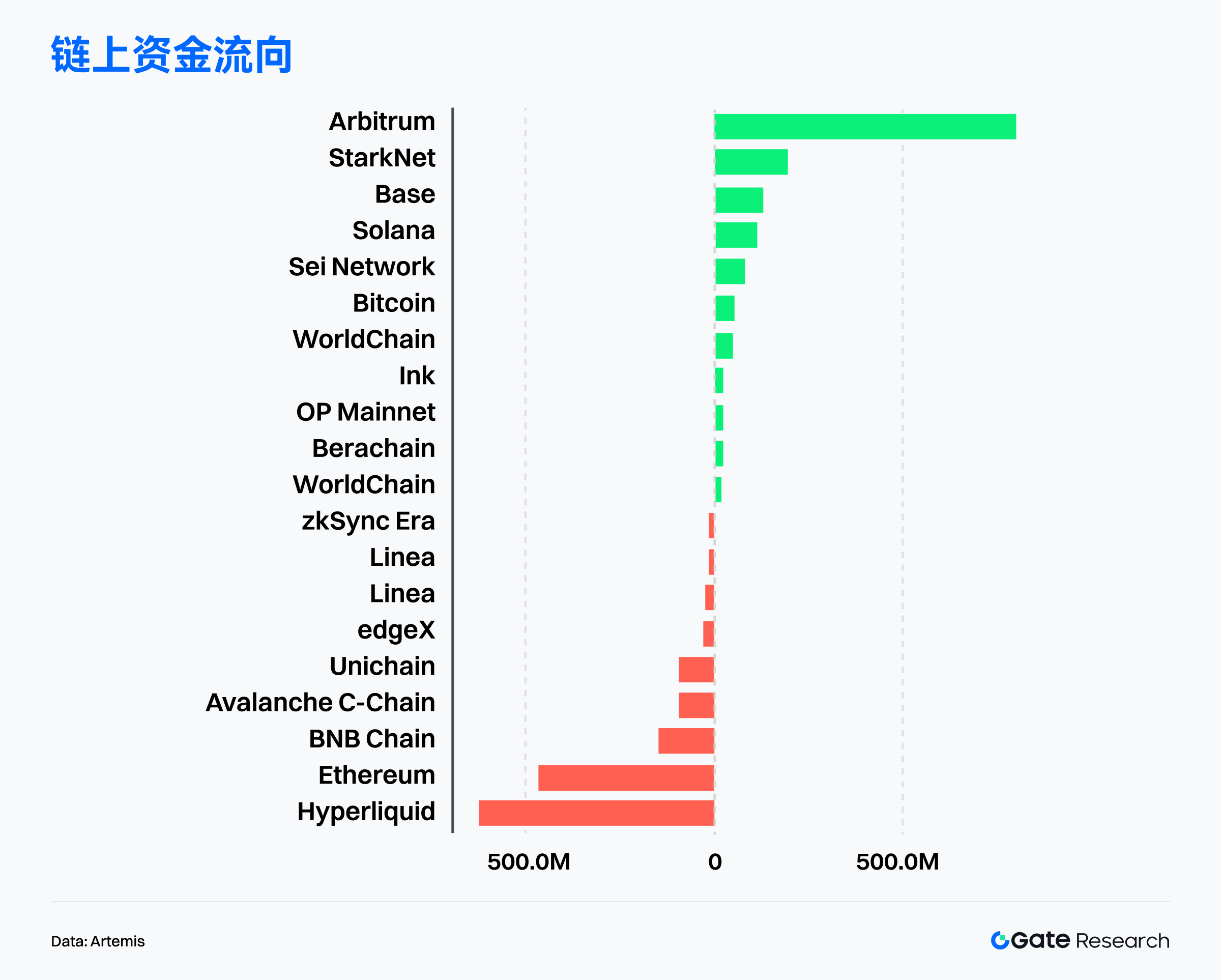
According to Artemis data, in the past month, on-chain fund flows exhibited significant divergence, with high-growth Layer 2s and emerging public chains continuing to gain incremental inflows, while some overvalued main chains experienced substantial outflows. Among them, Arbitrum maintained the top position with a net inflow far exceeding other public chains, reflecting its comprehensive advantages in incentive continuity, institutional layout, and financial infrastructure expansion; ecosystems like Starknet, Base, Solana, and SEI also recorded positive inflows, indicating that market funds prefer projects with expansion momentum and narrative extensibility.【4】

Arbitrum's fund attraction comes from multiple acceleration lines: Robinhood has positioned it as the core issuance layer for regulated security tokenization, with on-chain tokenized asset scale approaching tens of millions of dollars, forming a real trading cycle; institutional-grade infrastructure such as Deblock, BlockControl, and Hermes has densely deployed, elevating its positioning from a "DeFi chain" to a "cross-chain liquidity and asset settlement hub"; the supply of USDC and USDT has both increased, with cross-chain bridge ETH inventory reaching new highs, continuously enhancing on-chain fund carrying capacity.

Starknet has also performed outstandingly under the BTCFi narrative drive: BTC staking scale has rapidly accumulated, with multiple BTC asset pathways established, accelerating its approach to the "Bitcoin yield layer"; the STRK staking system and validator structure have matured, with over 1 billion STRK participating in staking, stabilizing network security and economic models; the DeFi ecosystem and consumer-grade applications are growing in parallel, pushing user scale beyond one million, relying on account abstraction application scenarios.

In contrast, previously high-heat ecosystems like Hyperliquid, Ethereum mainnet, BNB Chain, and Avalanche generally experienced significant net outflows, indicating that funds are withdrawing from overvalued ecosystems and shifting towards public chain sectors with higher growth elasticity and stronger narratives. Overall, the market has entered a phase of "structural rotation + risk repricing," with funds concentrating on on-chain ecosystems where narratives are established, user growth is robust, and there is room for expansion.

Bitcoin Key Indicator Analysis

In November, the cryptocurrency market accelerated its decline under excessive leverage accumulation, falling 17.5% throughout the month, marking the largest single-month pullback of the year, with risk assets under overall pressure. Against the backdrop of weakening economic data and a dovish stance from the Federal Reserve, the probability of interest rate cuts in December has risen to over 80%. Although BTC and ETH recovered to $90,000 and $3,000 respectively last week, trading volumes have significantly shrunk, indicating limited rebound momentum; institutional funds remain cautious, with weak inflows into Bitcoin spot ETFs, and structural demand remains in a low ebb.

In this context, on-chain data presents more structural signals, with BTC still operating above multiple core cost lines, and overall risk indicators maintaining a neutral to strong bias, indicating that the main trend has not been broken, but the dense area of chips above still constitutes short-term resistance; at the same time, the realized loss indicator has significantly rebounded, suggesting that the market is undergoing a phase of emotional clearing intertwined with high-level selling pressure, with short-term capital's willingness to absorb still being cautious; in a longer-term dimension, the profit margins of long-term holders continue to decline and show signs of net reduction, reflecting that some early chips are entering the realization phase, with the market structure shifting from inertia-driven upward trends to trend turnover and cyclical cooling.

BTC Breaks Below Short-term and Active Investor Cost Lines, Risk Indicators Shift to Neutral to Weak Bias

According to Glassnode data, BTC's latest price has fallen below the short-term holder cost (STH Realized Price) and the active investor mean, indicating that short-term funds have begun to enter a floating loss zone, with market sentiment shifting from neutral to strong to neutral to weak. The short-term support band formed by the yellow and red cost lines from below has been effectively broken, meaning that short-term buying momentum is weakening, and the market has entered a pressure-dominated structural phase.【6】

At the same time, although the BTC price remains above the Realized Price and the True Market Mean, the divergence between the two is converging, reflecting that market momentum is transitioning from an upward phase into a digestion and turnover cycle. If the price continues to operate below the active investor mean, the risk appetite of short-term funds may continue to contract, bringing the market closer to the average or realized price region.

The multi-cycle ATH cost lines remain above the current price, indicating that the long-term structural framework has not been damaged, and BTC is still within the broader framework of a bull market. However, in the context of the short-term cost line being breached, the market is more likely to evolve into a high-level fluctuation and chip redistribution phase. If BTC can regain its position above the short-term holder cost, it will help restore a strong short-term structure; conversely, if it continues to hover below the cost line, the correction pressure will further increase. Overall, the risk indicator combination shows that BTC has shifted from a neutral to strong bias to a neutral to weak rebalancing phase, under short-term pressure but with the mid-term trend still intact.

BTC Realized Losses Rise, Market Enters a Phase of Emotional Clearing and High-Level Pressure Intertwining

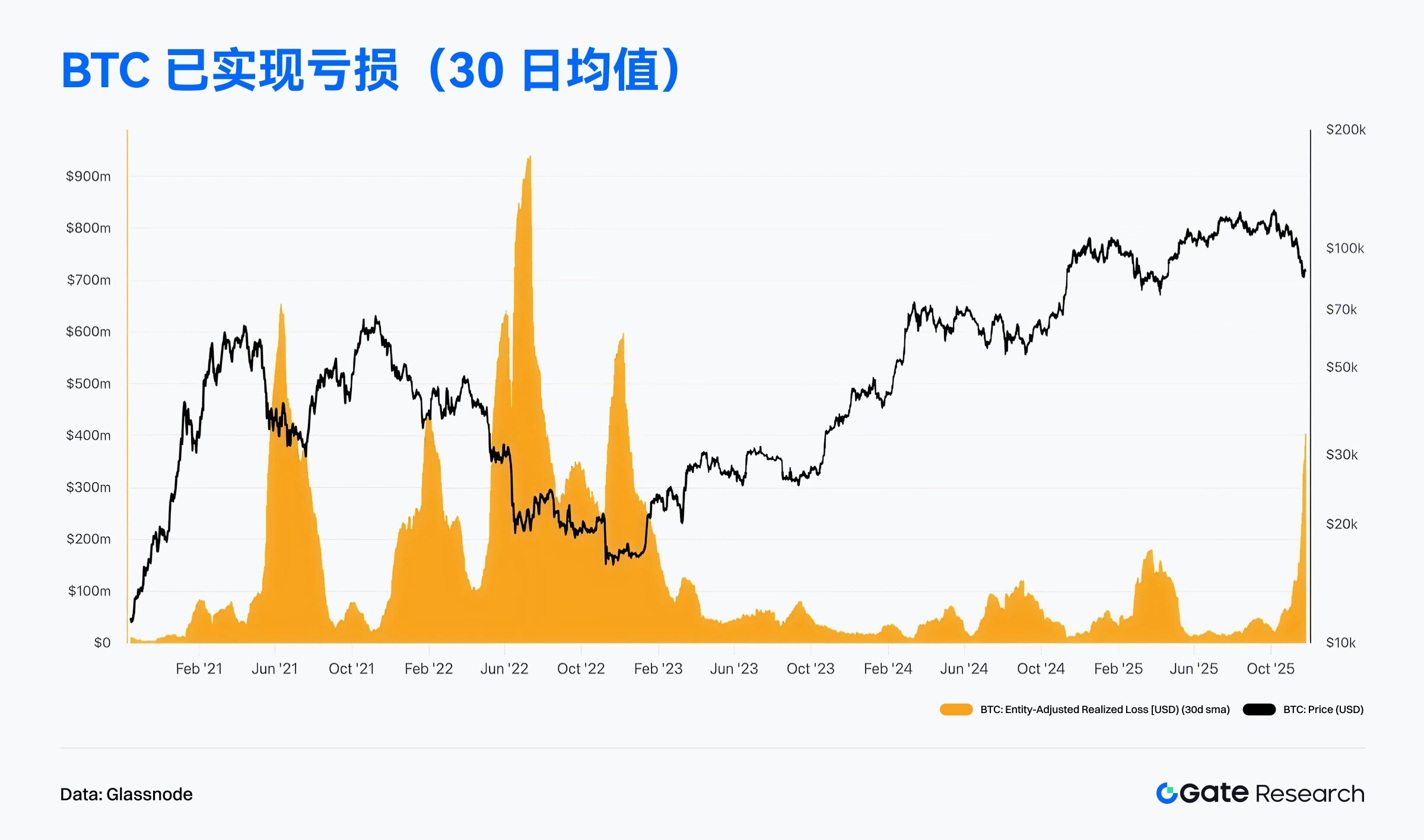
According to Glassnode data, the realized losses from entity adjustments (30-day average) significantly expanded during November, showing a steep structure rising rapidly from a low level, reflecting concentrated and sustained selling losses during the recent price downturn phase. This trend shares similarities with historically high volatility periods: each time large-scale loss releases occurred, they typically corresponded with passive stop-losses from short-term holders, liquidation pressures after leverage increases, and emotional sell-offs. Although the current loss scale has not reached the extreme peaks of 2021 and 2022, it is significantly higher than the normal levels of 2023-2024, indicating that the market has entered a short-term adjustment cycle, with speculative positions undergoing an active or passive deleveraging process.【7】

Although the expansion of losses represents short-term pressure, from a cyclical structural perspective, the release of losses in the high-level range essentially belongs to a correction of bullish sentiment, which can be seen as a "risk absorption" phase during price pullbacks. Compared to historical trends, if realized losses show a rapid decline in the following 1-3 weeks, it usually indicates that the market has completed a short-term turnover, and prices are expected to return to the trend structure; conversely, if the loss indicators continue to maintain high levels accompanied by increased trading volume, caution is warranted regarding a chain reaction of selling pressure, pushing BTC to further test deeper support areas. Overall, the expansion of losses in November indicates that the market's short-term volatility has increased, but it has not damaged the mid-term bullish pattern; rather, it appears to be a necessary correction within the upward cycle, preparing for the continuation of the next phase of the trend.

BTC Long-Term Holder Profitability Declines, Market Enters a Trend Turnover and Cycle Cooling Phase

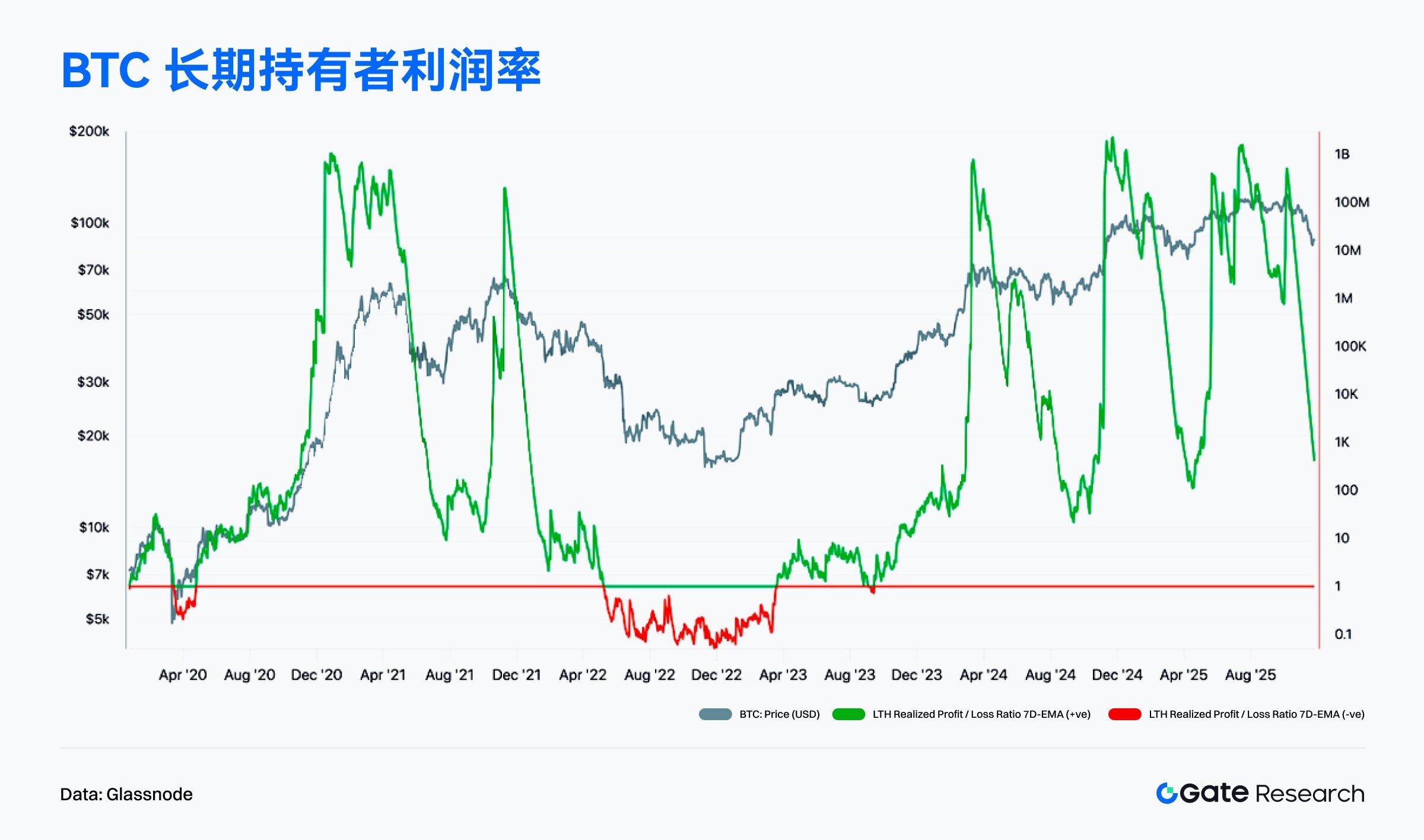
According to Glassnode data, the Long-Term Holder Realized Profit/Loss Ratio (LTH Realized Profit/Loss Ratio) showed a significant downward reversal during November, with the indicator dropping sharply from high levels, reflecting a narrowing profit space for long-term funds, as some holders began to realize profits during price weakness. Historically, a rapid decline in this indicator is usually accompanied by a cooling of sentiment after a cycle peak, representing that the profits of early investors are being eroded by market volatility. Against the backdrop of prices still fluctuating at high levels, the profitability of LTH is weakening, indicating that the continuity of a strong trend is beginning to be tested, and the market is entering a mid-term correction phase characterized by "trend turnover + profit contraction."【8】

Although the LTH profit ratio has clearly declined, it can be seen from the chart that it has not fallen into the typical bear market loss zone (red area), indicating that long-term funds have not experienced large-scale panic selling or loss pressure. The current profit ratio remains above a critical threshold, representing that the market's long-term profit structure is still at a healthy level, albeit with a slowing marginal increase. If the ratio stabilizes and rises again, it usually indicates that long-term funds have completed a phase of clearing, laying the foundation for the next round of trends; however, if it continues to decline and falls into the loss zone, caution is warranted regarding the market entering a deeper cyclical correction. Overall, the LTH data for November leans more towards trend cooling and healthy turnover rather than a complete reversal.

Popular Projects and Token Dynamics

On-chain data indicates that funds and users are gradually concentrating on ecosystems with interactive foundations and application depth, while projects with topicality and technological innovation capabilities are becoming new focal points for capital pursuit. The following sections will focus on recently outstanding popular projects and tokens, analyzing the logic and potential impacts behind them.

Overview of Popular Project Data

Monad

Monad is a recently highly regarded high-performance Layer 1 public chain project, centered on the "single-threaded efficient EVM" as its core technological path, aiming to significantly enhance execution efficiency and network throughput while being fully compatible with Ethereum. On November 24, Monad officially launched its mainnet and released its native token MON, while initiating a large-scale airdrop plan covering 225,000 on-chain active users, benefiting users of lending protocols such as Aave, Euler, and Morpho, as well as users of decentralized exchanges like Hyperliquid and Uniswap, and participants from community and meme platforms like Pump.fun and Virtuals, forming a broad distribution pattern across different sectors and ecosystems. On the day of the mainnet launch, over 140,000 new active addresses were created, on-chain transaction volume exceeded 2.66 million, and the average TPS reached 32.75 within 24 hours, reflecting the high activity and stable carrying capacity of the new L1 during its launch phase.【9】

In terms of price performance, MON exhibited a typical "sell-the-news effect" after its launch. Influenced by concentrated profit-taking from the airdrop, ICO share releases, and high-frequency speculative forces, the token briefly surged to $0.048 at the opening before quickly retreating to around $0.022, resulting in a short-term price drop. With the simultaneous integration of OpenSea, Pyth oracle, and multiple wallet tools, over 300 ecological applications became available, and on-chain tested TPS exceeded 5,000, with the first day's on-chain transaction volume skyrocketing to $400 million within half a day, becoming a typical high-volatility case in the new public chain issuance cycle.

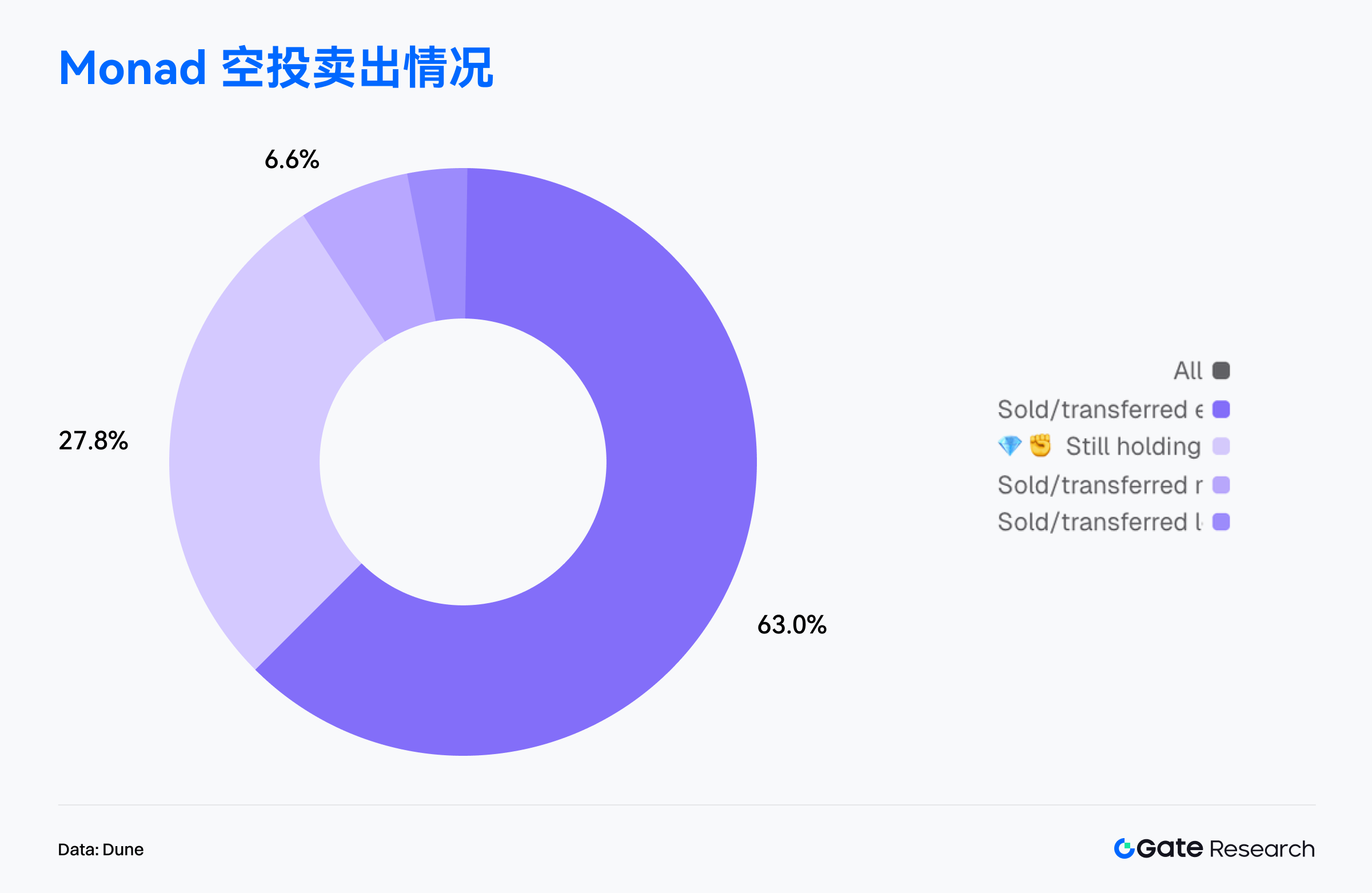
From the perspective of on-chain wallet behavior, the pressure from airdrop realizations was clearly dominant in the early stages. Data shows that among the 76,021 addresses that completed their claims, 63% had sold or transferred all their airdrop tokens, becoming the main source of market selling pressure; 27.8% of users chose to continue holding their full positions, reflecting a relatively strong long-term expectation; and another 6.6% of addresses sold more than half, with only a very small portion retaining a minimal position. Overall, the proportion of true long-term holders is less than 30%, and this highly concentrated profit-taking behavior is one of the core driving forces behind the severe price fluctuations of MON after its launch.【10】

In terms of ecological incentives, multiple projects have simultaneously launched MON staking and yield activities to enhance liquidity and user stickiness. FastLane Labs introduced shMON minting staking, with over 122 million MON participating in staking; Magma offers gMON liquid staking with an annual yield of about 15%. At the same time, gaming and application ecosystems have also launched initiatives, such as Lumiterra introducing a 1 million MON seasonal prize pool and Kuru DEX launching a 25% platform fee rebate plan, driving continuous increases in user activity within the ecosystem.

Overall, Monad's market performance aligns with the typical launch curve of a new L1: technological innovation and high expectations boost initial enthusiasm, while airdrops and early liquidity releases lead to short-term price pressure; on-chain activity, ecological incentives, and staking demand provide support for mid-term network development. Future growth in TVL, developer migration, and ecosystem expansion will be key indicators for assessing MON's mid-term price performance and long-term competitiveness of the network, marking the official commencement of a new round of competition among high-performance public chains.

Overview of Popular Token Data

$TEL

Telcoin is a multinational fintech project established in 2017, focusing on integrating blockchain technology, telecommunications networks, and digital banking services to provide low-cost, instant, and inclusive cross-border remittance and digital asset services for global mobile users. The project is managed by the Swiss non-profit organization Telcoin Association, operating the EVM-compatible Telcoin Network, and is jointly maintained by global mobile operators through a PoS mechanism. Its ecosystem includes the multi-signature digital banking application Telcoin Wallet and the ongoing compliant digital bank Telcoin Bank, aiming to build a global infrastructure for "mobile users to access on-chain finance."

According to CoinGecko data, $TEL has increased by 88.9% in the past 30 days. This month's strong performance is closely related to the rising narratives of "compliant finance," "on-chain dollars," and "stablecoin regulation," leading to a noticeable return of funds from speculative sectors to projects with solid fundamentals.【11】

In terms of project progress, Telcoin announced that its digital banking business and compliant stablecoin eUSD have entered the formal deployment stage, positioning itself as a combination structure of "bank-grade stablecoin + direct access to on-chain finance." eUSD will be issued and minted on-chain by regulated banking entities, becoming one of the first on-chain stablecoins directly issued by traditional financial institutions. This development gives Telcoin a complete on-chain financial closed loop with digital banking capabilities, stablecoin issuance rights, and open DeFi access, changing the project's business model and long-term positioning, prompting the market to significantly reassess its value.

On the community and media front, with key developments announced, discussions about Telcoin on X, Telegram, and Reddit have significantly increased. Crypto media generally view it as a "demonstration case of the integration of banks and on-chain finance," incorporating it into macro narratives such as "new stablecoin competition," "traditional financial institutions going on-chain," and "mobile crypto banking." Community sentiment is consistently optimistic, forming a positive cycle of "narrative enhancement → increased attention → increased liquidity," further strengthening the upward trend of short-term capital inflows.

Overall, the rise of $TEL this month belongs to a typical structure of "fundamental breakthrough + compliance narrative strengthening + market sentiment resonance." The advancement of digital banking services and the eUSD stablecoin has become a decisive positive factor, elevating Telcoin from a cross-border payment project to a comprehensive infrastructure of "bank-grade stablecoin + on-chain financial interface layer." If the related products are successfully implemented and the compliance financial narrative continues to maintain its momentum, $TEL still has the potential for mid-term trend continuation after experiencing a rapid rise.

Summary

In November 2025, Solana maintained its position as the leader in overall chain activity and trading volume due to high-frequency applications and strong user stickiness, demonstrating resilience in usage that can withstand market fluctuations. Ethereum continued to serve as the core main chain for value settlement, maintaining an absolute lead in fee income, with on-chain economic activities primarily consisting of high-value interactions. Base and Polygon PoS steadily expanded in the mid-range, showing sustained growth momentum in social applications and consumer-level interactions. In contrast, while Arbitrum's trading volume and active addresses remained in a low-level fluctuation, the flow of funds indicates its advantages in asset tokenization, infrastructure improvement, and institutional layout, making it a key beneficiary of this round of capital preference. Meanwhile, emerging public chains like Starknet rapidly accumulated momentum under the BTCFi narrative, showing significant user growth and capital attraction.

Overall, the on-chain ecosystem is transitioning from mere capital flow to a new phase driven by genuine usage demand, application growth paths, and narrative diffusion. High-performance public chains continue to dominate interaction traffic, value-oriented main chains solidify their foundational roles, while mid-sized and emerging ecosystems with application increments and narrative space are becoming the focus of capital repricing, with the on-chain growth structure steadily advancing towards diversification and stratification.

In terms of Bitcoin, as the price fell below the short-term holder cost and the active investor mean, high-level chips began to enter a more obvious redistribution phase, indicating that the short-term structure has shifted from strong to under pressure. The lower Realized Price and market mean still constitute medium to long-term support, keeping the overall bull market framework intact; however, the short-term breach of the cost line means that some funds have entered the floating loss zone, with loss releases accelerating turnover, leading the market into a weak "repricing—rebalancing" transition phase. Currently, the long and short forces are re-competing in a critical range, and the subsequent trend will depend on whether they can effectively digest the selling pressure above and re-establish incremental demand after sentiment converges.

At the project level, the newly launched high-performance public chain Monad has demonstrated strong interaction and high growth potential during its mainnet launch phase, although airdrop realizations have put short-term price pressure on it; Telcoin, on the other hand, has successfully transitioned from a cross-border payment project to a representative of on-chain financial infrastructure due to the advancement of digital banking and compliant stablecoins, with narrative and fundamentals resonating to drive significant revaluation. The overall trend indicates that the market is shifting from pure speculation to focusing on genuine usage and sustainable ecological growth.

References:

  1. Artemis, https://app.artemisanalytics.com/chains

  2. Artemis, https://app.artemisanalytics.com/chains

  3. Artemis, https://app.artemisanalytics.com/chains

  4. Artemis, https://app.artemisanalytics.com/flows

  5. DefiLlama, https://defillama.com/chain/arbitrum

  6. Glassnode, https://studio.glassnode.com/charts/da73676e-78a6-4880-5ca2-a227ee301230?s=1579395107&zoom=

  7. Glassnode, https://studio.glassnode.com/charts/indicators.RealizedLossAccountBased?a=BTC&chartStyle=column&mAvg=30&s=1602806400&u=1764115200&zoom=

  8. Glassnode, https://studio.glassnode.com/charts/btc-lth-realized-plratio?s=1577318400&u=1764115200&zoom=

  9. Dune, https://dune.com/hashed_official/monad-overview

  10. Dune, https://dune.com/counterparty_research/monad

  11. CoinGecko, https://www.coingecko.com/coins/telcoin

Gate Research Institute is a comprehensive blockchain and cryptocurrency research platform that provides readers with in-depth content, including technical analysis, hot insights, market reviews, industry research, trend forecasts, and macroeconomic policy analysis.

Disclaimer

Investing in the cryptocurrency market involves high risks. Users are advised to conduct independent research and fully understand the nature of the assets and products they purchase before making any investment decisions. Gate is not responsible for any losses or damages resulting from such investment decisions.

免责声明:本文章仅代表作者个人观点,不代表本平台的立场和观点。本文章仅供信息分享,不构成对任何人的任何投资建议。用户与作者之间的任何争议,与本平台无关。如网页中刊载的文章或图片涉及侵权,请提供相关的权利证明和身份证明发送邮件到support@aicoin.com,本平台相关工作人员将会进行核查。

Share To
APP

X

Telegram

Facebook

Reddit

CopyLink