Written by: Ryan Weeks, Kok Leong Chan, Netty Idayu Ismail, Bloomberg
Translated by: Chopper, Foresight News
In Malaysia's hotspots for illegal cryptocurrency mining, investigations are being conducted from the air. Drones hover over rows of shops and abandoned houses, searching for abnormal heat sources, which are typical thermal signals from illegal mining machines in operation. On the ground, police use sensors to check for unusual electricity usage. Sometimes, the investigation methods are more primitive: residents report strange bird calls, and when the police arrive, they discover that someone is deliberately playing natural sound effects to cover up the roar of machines behind tightly closed doors.
These tools together weave a mobile surveillance network, fully encircling illegal Bitcoin mining.
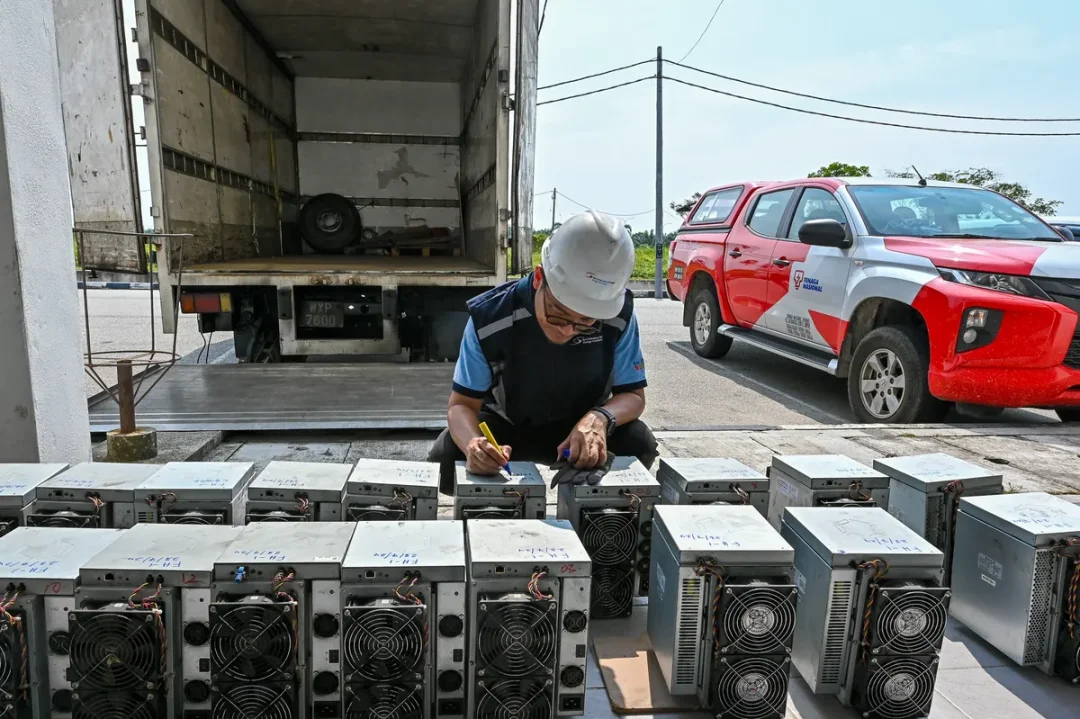
In July 2024, an official inspects mining machines after a Bitcoin mining raid.
The mining companies under investigation act very cautiously: they frequently shift their operations between vacant storefronts and abandoned houses, installing insulation to cover the thermal radiation from the machines; they equip entrances and exits with CCTV, heavy security facilities, and barriers made of broken glass to prevent uninvited guests from entering.
This is the cat-and-mouse game between Malaysian authorities and Bitcoin miners. Over the past five years, Malaysia has cracked down on approximately 14,000 illegal mining sites. According to the Ministry of Energy, during the same period, the state-owned energy company Tenaga Nasional (TNB) suffered losses of up to $1.1 billion due to electricity theft, and this trend is worsening. In early October of this year, Bitcoin prices reached an all-time high, and by that time, authorities had registered about 3,000 cases of electricity theft related to mining.
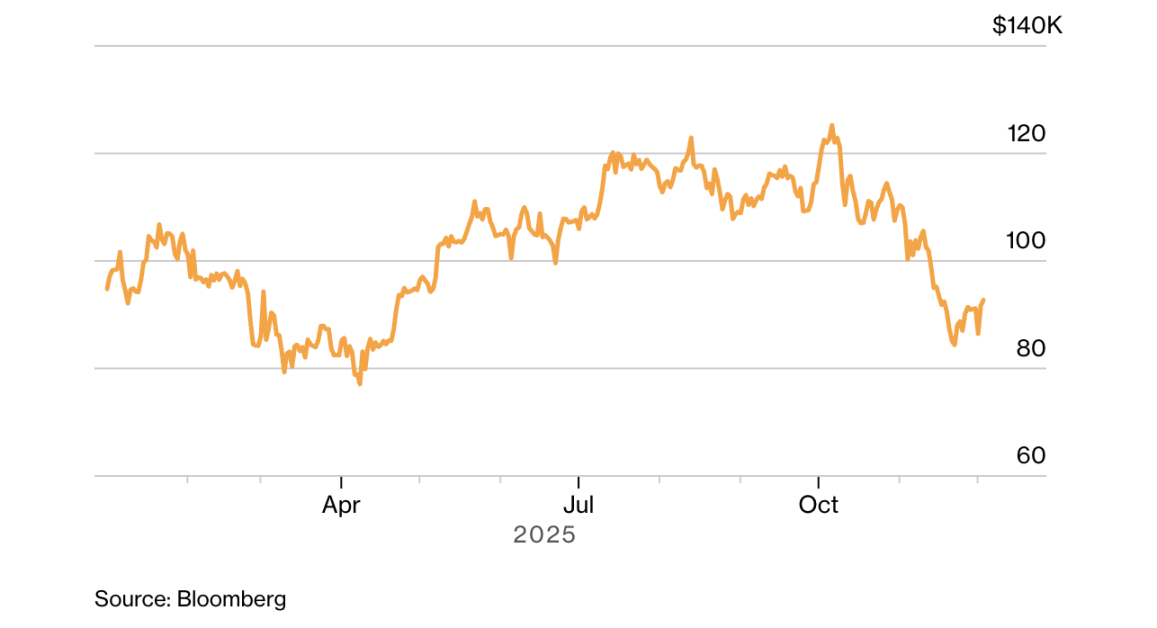
Bitcoin reached a record price of $126,251 in October 2025, after which cryptocurrency prices fell sharply.
Now, Malaysia is ramping up its crackdown efforts. On November 19, the government established a special interdepartmental committee, including members from the Ministry of Finance, Bank Negara Malaysia, and the National Energy Group, to coordinate a targeted crackdown on illegal mining operators.
"The risks of allowing such behavior go unchecked extend beyond electricity theft," said Akmal Nasrullah Mohd Nasir, Deputy Minister of Energy Transition and Water, who also serves as the committee chair. "These activities could even damage our power facilities and pose a severe challenge to the grid system."
Bitcoin mining is essentially a competition of computational power: rows of specialized equipment can perform trillions of calculations per second in hopes of successfully verifying transactions and earning Bitcoin rewards.
Bitcoin mining is a big business. The global electricity consumption for Bitcoin mining has surpassed the total electricity consumption of countries like South Africa or Thailand. According to a report from the Cambridge Centre for Alternative Finance, over 75% of Bitcoin mining activities are currently concentrated in the United States. Malaysia's share in this industry is relatively unclear: in January 2022, its global hash rate share was 2.5%, but the latest survey from Cambridge University has not released updated data.
What is clear is that miners in Malaysia are adept at transforming various special venues for mining operations.
Overlooking the Strait of Malacca, the ElementX shopping mall, a massive complex that saw a decline in foot traffic during the COVID-19 pandemic, has struggled to recover since. Today, most areas of the mall still resemble a construction site, with bare concrete floors and exposed wiring. In early 2022, this mall welcomed a special tenant: Bitcoin miners. It wasn't until early 2025, when a TikTok video exposing its mining operations went viral, that the mining machines were cleared out.
Hundreds of miles away in East Malaysia's Sarawak state, similar hidden mining sites exist. Bloomberg News previously reported that a company named Bityou set up a mining site in an old logging camp. The company did not respond to requests for comment on this matter.
In Malaysia, as long as operators legally obtain electricity and pay taxes, Bitcoin mining is considered a legal activity.
However, Akmal disagrees. At the first meeting of the special committee on November 25, members discussed "whether to recommend a complete ban on Bitcoin mining."
"Even if mining operations are compliant, the extreme volatility of the market remains a significant issue," he pointed out. "I believe that currently, no mining company can be considered a 'legally successful operation.'"
He further stated that the large number of illegal Bitcoin mining sites and the operational patterns of the individuals behind them indicate the presence of organized crime.
"These activities are clearly controlled by criminal groups," Akmal said, "and the mobility of frequently moving mining machines between different locations shows that their methods have formed a fixed pattern."
免责声明:本文章仅代表作者个人观点,不代表本平台的立场和观点。本文章仅供信息分享,不构成对任何人的任何投资建议。用户与作者之间的任何争议,与本平台无关。如网页中刊载的文章或图片涉及侵权,请提供相关的权利证明和身份证明发送邮件到support@aicoin.com,本平台相关工作人员将会进行核查。


